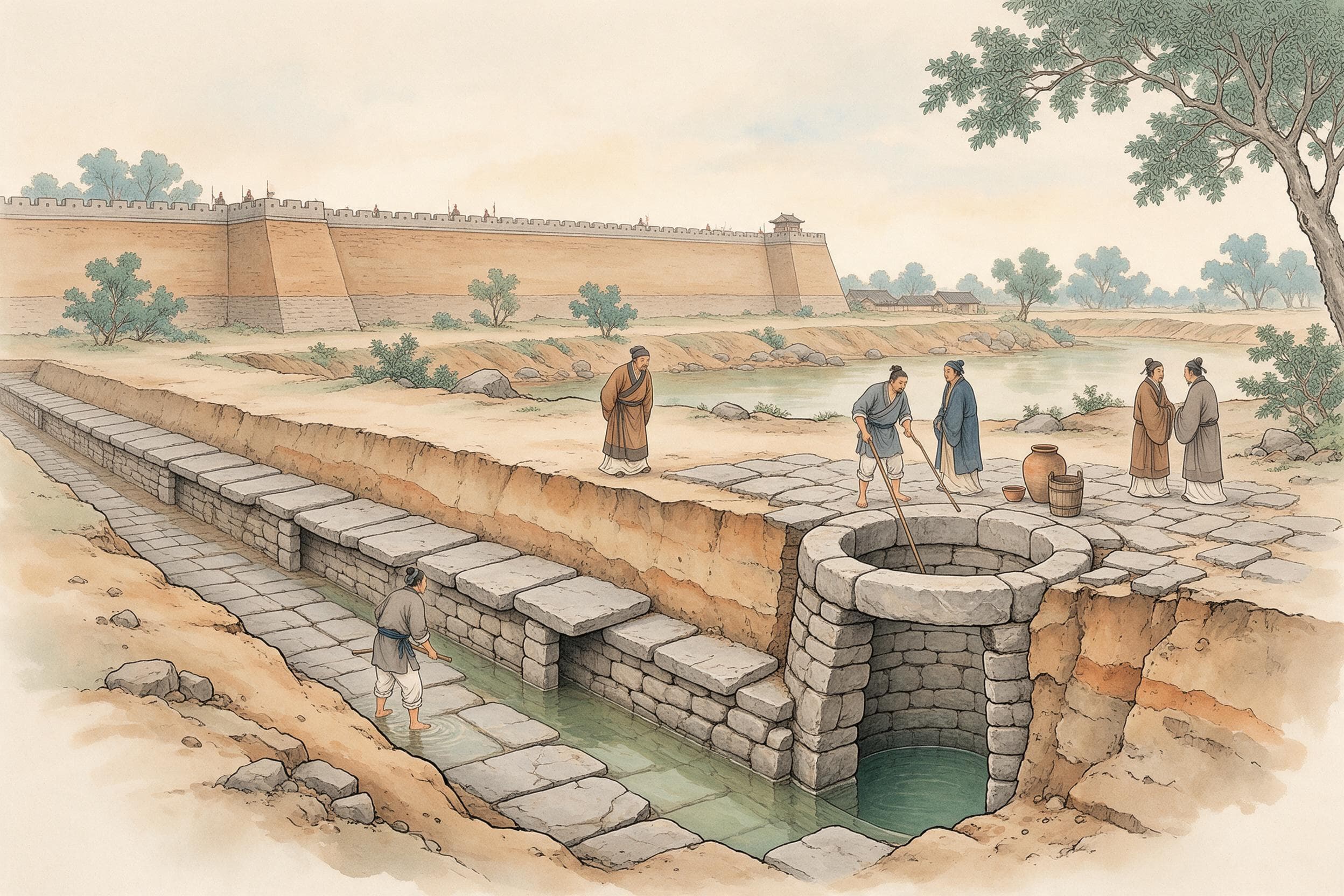
In the sixth month of 1466 the ditches from the east and west Gongsheng gates to the Great Ming gate were cleared — 215 zhang each — and the ditch from the East An gate to the corner of the south wall, 225 zhang. That is nearly all the detail there is: lengths, no width, no depth, no cross-section, no account of what the dredgers found. The number is small and the wording plain. Four lines of it survive, quoted from the Ming Veritable Records by a Qing compilation.
Two ditches, measured
The gate is older than the ditch by thirty years. The east and west Chang'an gates opened onto the street of the Five Commissions and the ministries; the market people of the capital called the gate 'Kong Sheng gate', a popular corruption, but its real name was Gongsheng. In the sixth month of 1436 the court 'made the Gongsheng gate south of the Chang'an side gates'. The gate came first; the ditch that ran from it came thirty years later.
The word in the record is 'each': 'the ditches from the east and west Gongsheng gates to the Great Ming gate, 215 zhang each.' It may mean two separate ditches of 215 zhang, one east and one west; it may be a single total. The translation keeps the word and does not add the figures. Nor is there a route: the entries give gate names at each end, not a map, and this article does not draw one.
Where the water came from
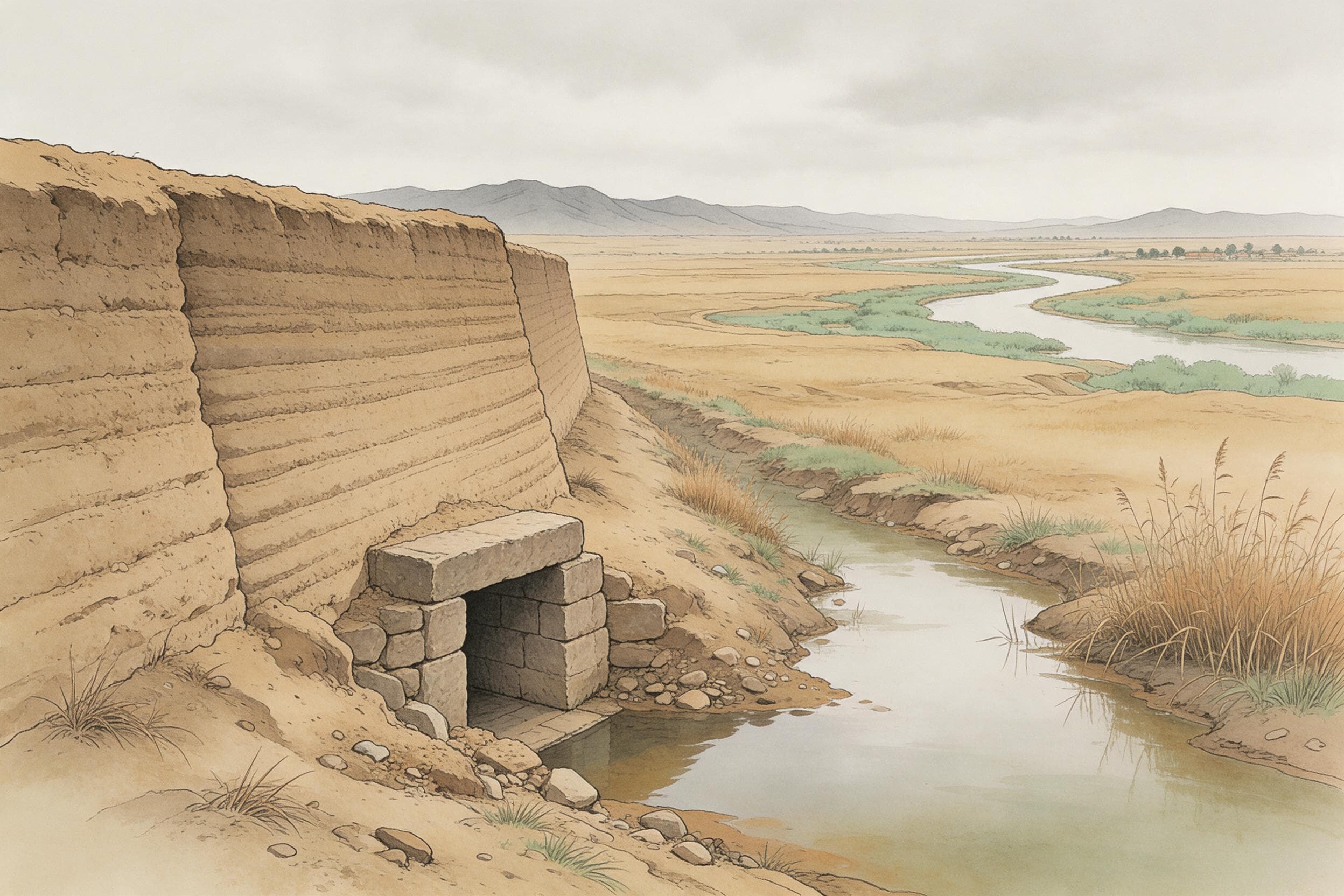
The water that filled these ditches came from far outside the city. The moat's source, in the early-Qing account of Ming Beijing, is the Shenxian spring at Baifu village in Changping prefecture; it joins the Yu river and the Yimu and Mayan springs to form the Qili pool, flows east and circles the capital under the name Jade River, and from the Datong bridge runs to Gaoli village in Tongzhou, where it enters the Bai river and joins the Lu. Its length is given as more than 160 li. The channel was cut by Guo Shoujing under the Yuan and named the Tonghui river; the Ming used it. 'Jade River' names the stretch that circles the capital, not the whole canal.
A second branch is described separately: the Western Hills spring comes through the water gate, past the Yue bridge (known as the Silver Ingot bridge), into the Western Garden, around the palace precincts, out at the Jade River bridge, and so into the city moat and the canal at the Datong bridge. There are three Jade River bridges, the account says: one across Chang'an East street, one across Wende lane, one near the city wall.
Bridges, sluices, moat
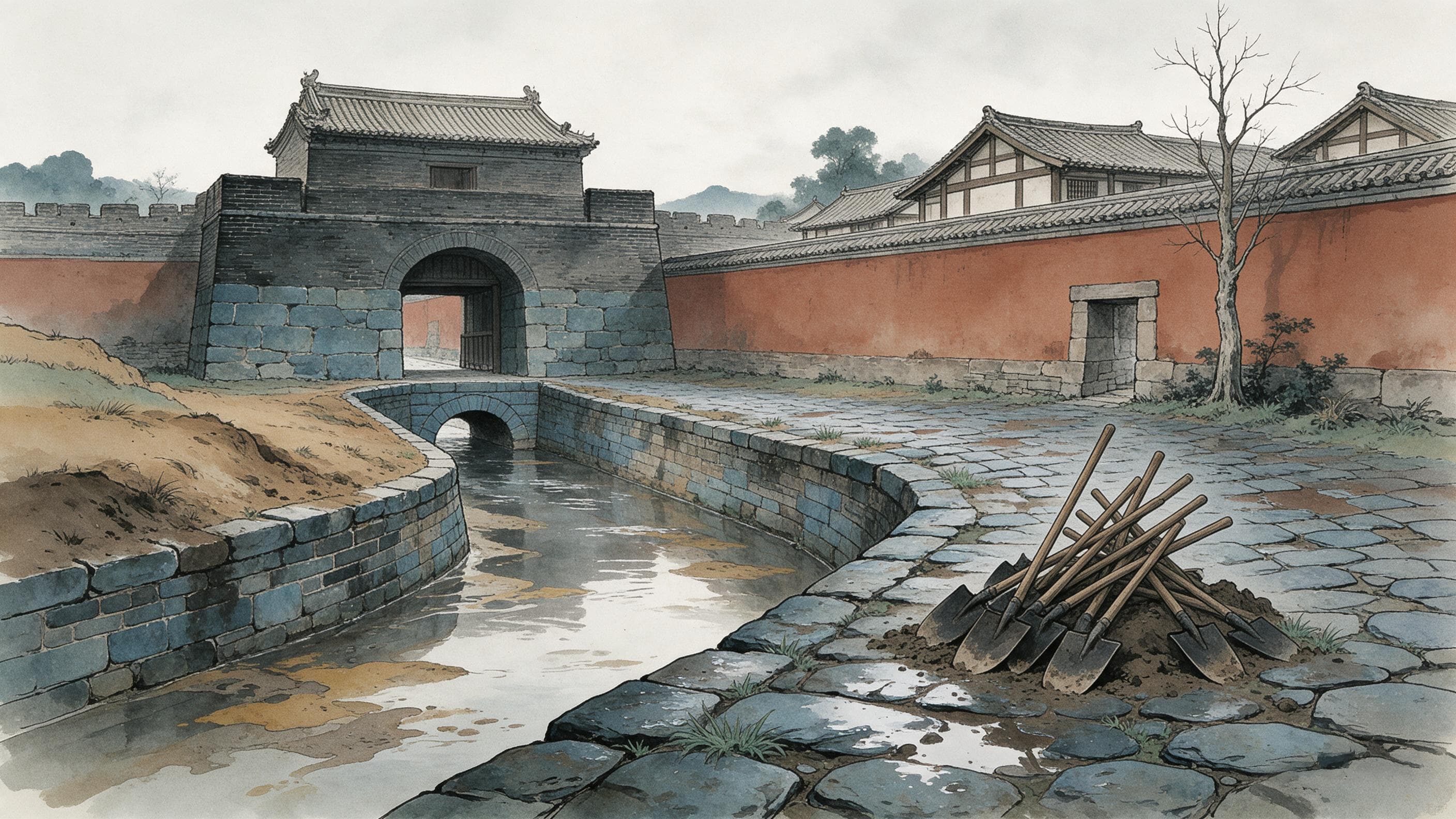
In 1439 the court deepened the moat and faced all four sides with brick and stone; the wooden bridges at the nine gates were removed and replaced in stone, and 'between every two bridges there was a water sluice'. The moat ran from the north-west corner around the city eastward, 'past nine bridges and nine sluices', to the Datong bridge at the south-east corner. Nine bridges and nine sluices is the count for this moat line only, not for every drain in the city. That ring, not a grid of drains, is what the early-Qing account describes. That is the closest the sources come to a drainage system: not pipes under the streets but a ring of water with gates on it.
The official history keeps only three entries for the capital, and they are repairs, not a treatise. In 1439 it set a spillway outside Zhengyang gate and dredged the city ditches; in 1441 it repaired the Jade River bridge and embankment at Jiangmi lane and dredged the south-west city river; in 1523 it repaired the channels at Desheng gate east and Chaoyang gate north. None of the three gives a length, a labour count or a cost. Two of the three are bridge-and-embankment work, one is spillway-and-ditch work. The chapter is titled 'provincial waterworks'; it is not a survey of the capital's drains, and it should not be read as one.
One rain, one argument
In the sixth month of 1440 rain exposed the weakness. The lecturer Liu Qiu reported that the river west of Xuanwu street had broken its banks and spread, met the river east of the street, and that the two had flooded the houses; he asked for embankments to contain them and for a spillway to be made outside the city, west of the Xuan bridge, to let the city's water out. The memorial survives in an early-Qing compilation, dated to that month. Most of what the sources record is remedial like this, not routine maintenance.
The answer came from Huangfu Zhonghe: west of Xuanwu gate there was an old cool-water river, and on the south bank of the city river east of it an old ditch; both could be cleared to take the flood, and 'it is not advantageous to make new ones'. The throne agreed with him. So the decision was to clear old channels rather than cut a new spillway — and the record does not say whether the clearing was done.
The last great cut
The last great work was cut for grain, not for drainage. In the second month of 1639 an inner eunuch, Cao Huachun, proposed a canal outside the city to move tribute grain; from the nineteenth of the third month to the sixth month of 1641 the work cut 3,862 zhang from Guangqu gate to the north bank of the transport river at the Datong bridge, 270 zhang of moon channel outside Dongzhi gate, and 3,151 zhang from Douhu camp to the great stone bridge. The accounts give 2,032,000 soldier-labourers and 20,900 hired men; 13,500 zhang remained unfinished. The vice-minister of war, Wu Shen, memorialised against it as costly, useless and damaging to the earth's veins.
One more account survives, of a moat dredge rather than a canal. Wei Dazhong's memorial counts 1,500,819 labourers, 1,289 craftsmen, 33,012 soldier-labourers reckoned by days worked, 61,628.9148 taels of silver from the water office, 1,733.13 taels from the grain office, and 3,301.2 shi of rice, beginning at the east convenience gate. The memorial is undated; its reference to the fall of Shenyang and Liaoyang places it in the early Tianqi years, and that is a guess from internal evidence. The canal of 1639 and the moat dredge are two works, two decades apart, and they are kept apart here. No width, no depth, no cross-section appears in any of these accounts. No figure is given for the depth of silt, or for the men who fell ill. What they describe throughout is a city of rivers, moats, ditches, bridges and sluices — never a network of pipes under the streets, and never a system that worked as a whole.
Sources & further reading
- 《明史》卷八十八·河渠六·直省水利 (Ming shi, juan 88, 'Waterways 6: Provincial Waterworks') — Official history, but a chapter on provincial waterworks, not a treatise on the capital's drains; Beijing appears in three entries only: 1439 a spillway outside Zhengyang Gate and dredging of the city ditches; 1441 the Jade River bridge and embankment at Jiangmi Lane plus dredging of the south-west city river; 1523 repair of the channels at Desheng Gate east and Chaoyang Gate north. No lengths, labour counts or costs.
- 《日下旧闻考》卷三十九·皇城一(清乾隆官修,四库全书本)(Rixia jiuwen kao, juan 39, Siku edition) — Siku edition, not collated against a critical edition. Quoting the Ming Xianzong Veritable Records: in the sixth month of 1466 the ditches from the east and west Gongsheng gates to the Great Ming gate were cleared, 215 zhang each, and the ditch from the East An gate to the corner of the south wall, 225 zhang. Also quoting the Shuyuan Zaji and the Yingzong Veritable Records on the Gongsheng gate (market name 'Kong Sheng', real name Gongsheng), first built south of the Chang'an side gates in 1436.
- 孙承泽《天府广记》卷四(清初人记明代北京)(Sun Chengze, Tianfu guangji, juan 4, early Qing on Ming Beijing) — Early-Qing account of Ming Beijing: the Jade River rises at the Shenxian spring in Baifu village, Changping, gathers the Yimu and Mayan springs into the Qili pool, circles the capital and runs more than 160 li to the Bai River at Gaoli village; a second branch brings the Western Hills spring through the water gate, past the Yue bridge into the Western Garden and around the palace precincts to the three Jade River bridges; in 1439 the moat was deepened and faced with brick, wooden bridges replaced in stone with a sluice between each pair, nine bridges and nine sluices around the circuit; in 1440 Liu Qiu reported flooding and Huangfu Zhonghe advised clearing old channels rather than cutting a new spillway.
- 孙承泽《春明梦余录》卷三(四库全书本,未与点校本复核)(Sun Chengze, Chunming mengyu lu, juan 3, Siku edition) — Siku edition: the 1639-41 canal outside the city (3,862 zhang from Guangqu Gate to the transport river at the Datong bridge, 270 zhang of moon channel outside Dongzhi Gate, 3,151 zhang from Douhu camp to the great stone bridge; 2,032,000 soldier-labourers and 20,900 hired men; 13,500 zhang unfinished; Wu Shen's memorial against it), and Wei Dazhong's dredging memorial (1,500,819 labourers, 1,289 craftsmen, 33,012 soldier-labourers by days, 61,628.9148 taels from the water office, 1,733.13 taels from the grain office, 3,301.2 shi of rice); the memorial is undated and is placed in the early Tianqi years only by its reference to the fall of Shenyang and Liaoyang.