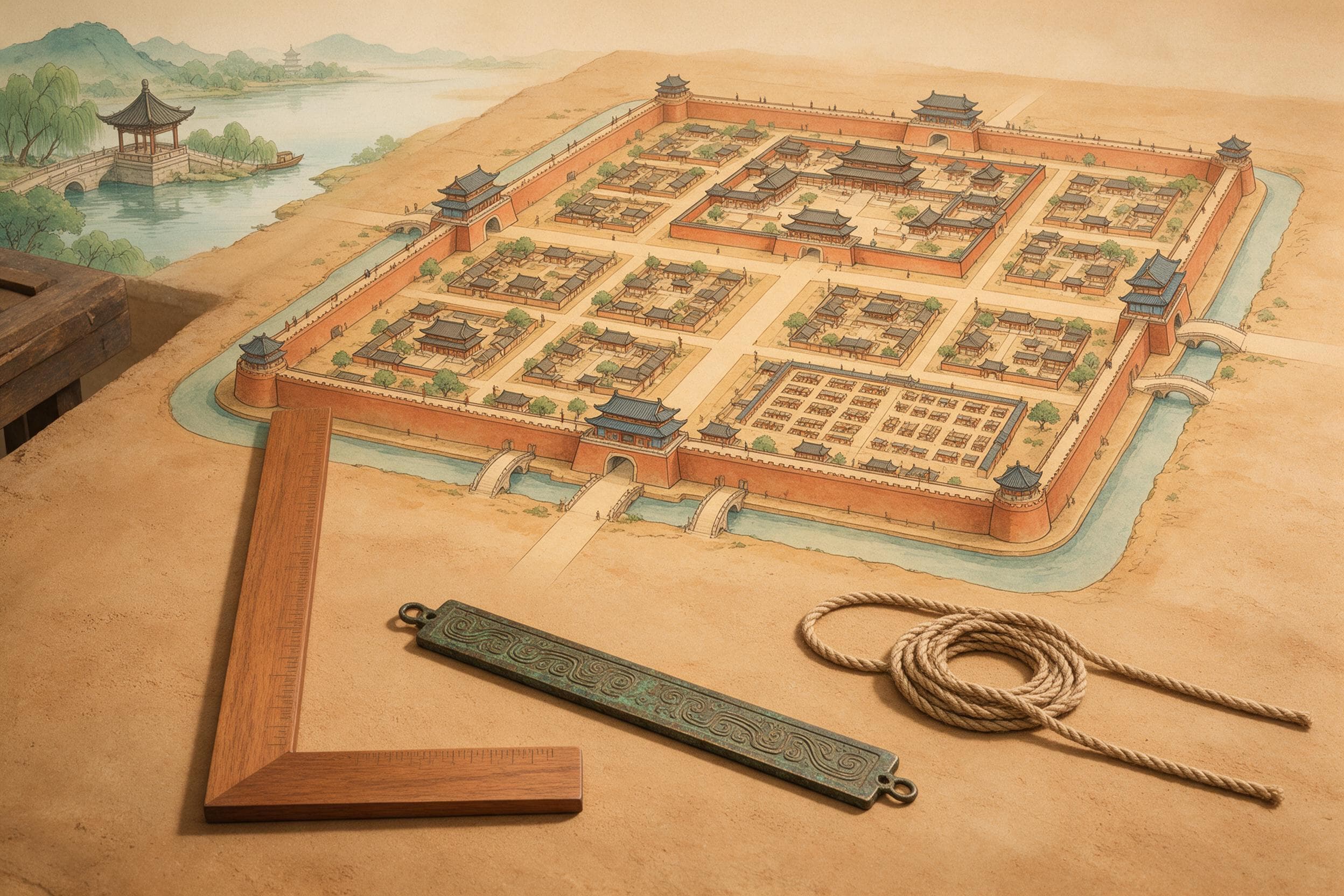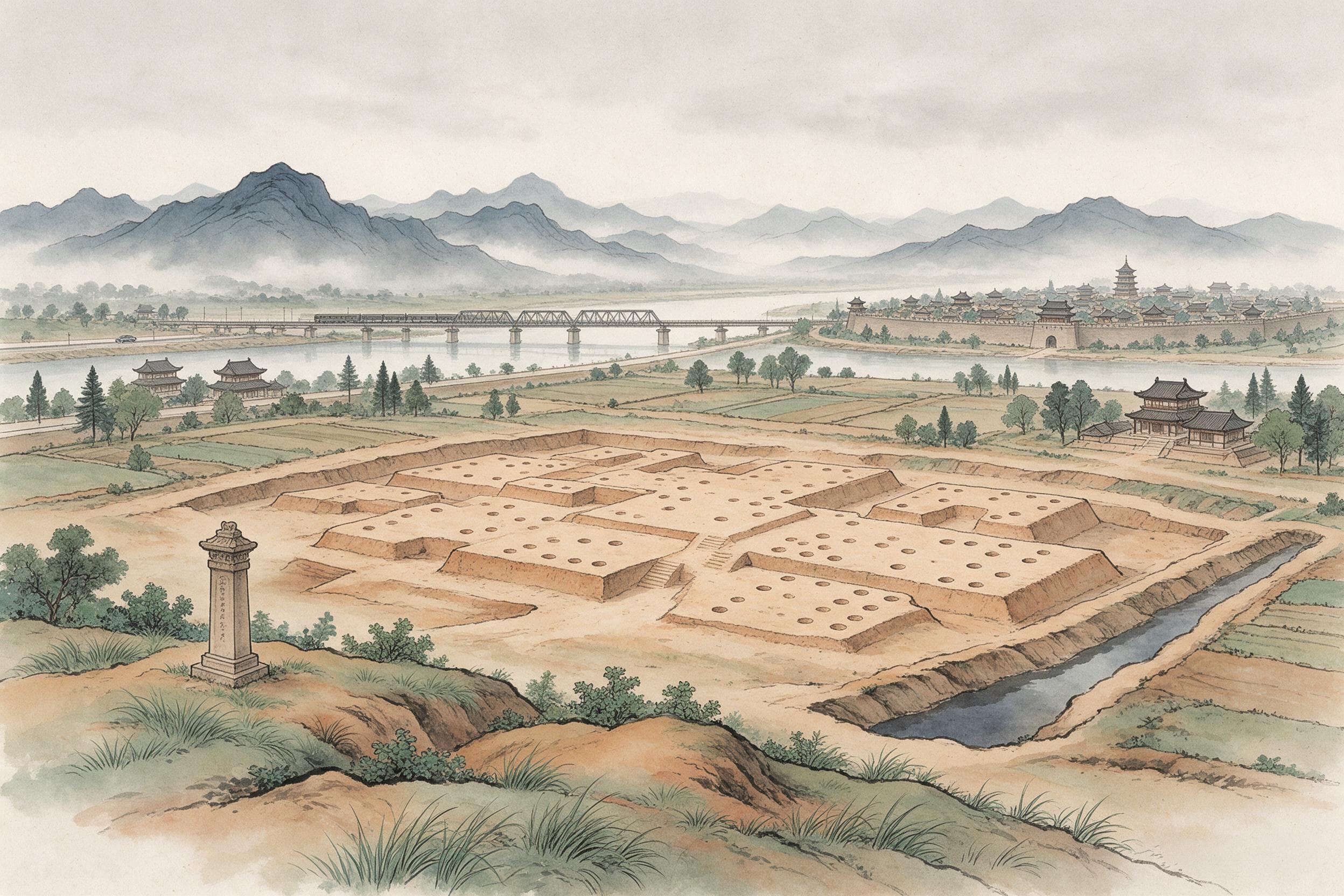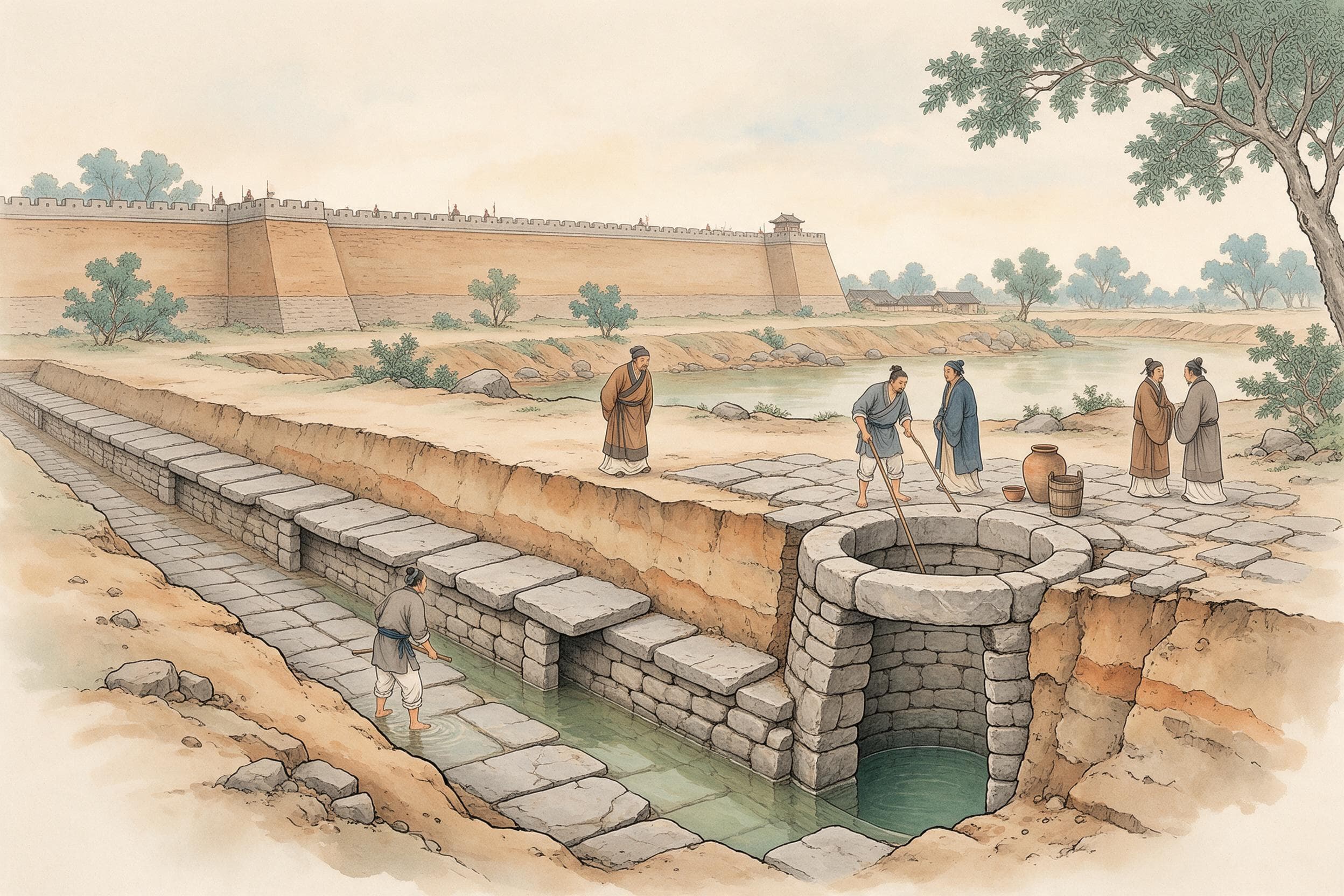
Beneath the floor of the palace quarter at Zhengzhou, the water ran in a covered stone channel. Excavators cleared a reservoir there about 100 metres east-west and 20 metres north-south, its floor paved with flat slabs to keep it from leaking; off its south side ran a stone-built conduit about 40 metres long, and four wells opened down onto that conduit. How deep the wells were, how wide their mouths, how their curbs were built — the report says nothing. What it gives is the arrangement: a basin, a channel, wells above the channel, all joined. That arrangement is what this piece is about, not how advanced it was.
Pool, channel, wells
A research survey quoting the excavation briefs records the same group from the other side. The conduit's surviving length is 'over 30 metres'; it lay in a trench 11 metres wide at the top, 3 metres at the bottom and about 4 metres deep; the stone-lined channel itself is nearly square, about 1.5 metres wide and 1.5 high; and every 8 metres a shaft came down to meet it. The lid was stone slabs, with more than 3 metres of rammed earth over them. The accounts differ on length — about 40 metres against over 30 — and neither is an average to be corrected; they differ on wells too, the report counting four and the survey one every 8 metres. A count and a spacing are different kinds of number, so both are kept.
What the material does not contain is as clear as what it does. No well depth, no well mouth, no curb; no figure for how much the reservoir held. Ceramic drain pipe turns up in the same city: a cylinder from Luodamiao surviving 23 centimetres, 13.5 across and 0.6 to 0.8 thick, but it is drain hardware, not this conduit, and gets one sentence. Researchers read the pool, the channel and the wells together as one supply works, on the strength of how they sit relative to one another. That is an inference from layout, and is written as one.
Eight hundred metres of stone at Yanshi
East at Yanshi the conduit is longer and better recorded. One stone-lined channel runs more than 800 metres: it passes under the great city's west gate, turns twice at right angles to enter the palace city, meets a large reservoir there, turns again, leaves by the east gate and runs into the moat at both ends. From the measured levels a researcher infers that the west branch fed water in and the east branch drained it out. The argument rests on heights, not on any text, and is given here as an inference.
The western channel was opened for 54 metres inside the palace city, about 1.6 metres wide. The builders dug a trench about 3 metres wide and 1 metre deep, levelled its bed with red-brown earth, set posts, laid flat stones and built up the stone walls. Across those 54 metres the slabs are level to within less than 10 centimetres — measured with a level, not judged by eye. Later the channel was narrowed by thickening its walls, leaving a clear width of about 50 centimetres. Where it passed the second-period palace wall, it was built in two storeys, the upper 20 to 30 centimetres high, the lower about 30: water went through, and no one walked through after it.
The east channel, a gradient, and two small details
The eastern channel is the smaller of the two: about 32 metres exposed inside the palace city, and after rebuilding a trench 2.5 to 3 metres wide at the top, 1.5 to 1.7 at the bottom and about 1.2 deep, with the channel itself 0.35 to 0.38 metres wide and 0.5 to 0.6 high. It is also the only place in this material where a gradient is given: 'one calculation puts the fall of the east channel at six per thousand.' The figure cannot be stretched into a rule for Shang conduits, and it is not the excavators' own measurement; the text says somebody worked it out.
Two details sit off the main line. On the inner face of the city wall at Yanshi, on the slope of the rammed-earth bank, a road was found with a ditch between it and the wall, the ditch bottom lined with a hard layer of silt; the excavators take it as the road's drain. And under the road surface of a gate passage, a stone-walled drain lay covered with wooden boards, its floor slabs overlapping, higher inside and lower outside, like scales. Small things, but the same habit as the level floor: the water was given a line to follow.
Where the water ends
At Yanshi the great city's northern moat lies 12 metres from the wall, about 20 metres wide at the mouth and 6 deep, steeper on the outer bank than the inner, with 2 metres of Shang silt in the bottom. At Zhengzhou the moat outside the outer city's south wall is 10 metres from the wall: 24 metres wide at the mouth, 12 at the floor, 7 metres below present ground. Outside the west wall it is 23 to 25 metres wide and '7 metres deep without reaching the bottom'. The 2023 report, describing the same outer city, calls the moat 'over 40 metres wide'. Both numbers stand; the material never says whether they measured different stretches.
Inside the palace quarter at Zhengzhou there is also a large ditch at the north-west corner: over 80 metres of it known, 6.5 metres wide at the top and 2.5 to 3.5 at the bottom, which some scholars take as a protective ditch on the palace's north side. In the moat outside the south wall the Shang silt is 0.6 to 4.3 metres thick — deposit is the record of water standing or running there. A moat that keeps people out and a moat that takes water away are one trench with two jobs; how much of each, the material does not say.
What the 2023 season added
The newer work closes the circuit. Several Shang channels have been exposed over about 540 metres in all, wide at the top and narrow at the bottom, the widest about 12 metres, the deepest about 4. That is an exposed length, not the length of the city's whole water net. One channel was made by working a natural stream, two were dug by hand. In the Tanwan channel a stone wall 13 metres long and 1.7 high was found, built only along the south side and floor, which the report reads as a barrier raised against water scouring down from the north. And on the outer rampart a passage was found that led water into the city, with channels joined to it; the water left through the east gate.
So the system reads in one direction. Water enters through a passage in the outer rampart, is held in a reservoir, passes under the palace floor in a stone conduit with wells above it, is carried out by a second conduit, and the moats receive it. What can be said is measured and local: 54 metres level to within 10 centimetres, a shaft every 8 metres, a fall of six per thousand in one calculation. What cannot be said is local too: no well depths, no well mouths, no curbs, no water volumes, no labour, no cost, no total length of the network. The material is a survey quoting briefs plus one season's archaeological reporting; neither is the excavation report — which is why nothing here needs the word 'first'.
Sources & further reading
- 张兴照〈商代邑聚输排水综考〉,中国社会科学院历史研究所网站,2016(研究综述,转引各家发掘简报) — Research survey, not an excavation report: it quotes the excavation briefs. Yanshi: a stone-lined conduit over 800 m long running from the west gate through the palace city to the east gate and the moat; the west channel's palace section 54 m long and 1.6 m wide, with less than 10 cm of level error over 54 m, narrowed to about 50 cm after rebuilding, and doubled into two stacked levels where it passed the palace wall; the east channel 32 m long, 0.35-0.38 m wide and 0.5-0.6 m high after rebuilding, its gradient given as 6 per thousand by one calculation. Zhengzhou: the palace water works had a channel trench 11 m wide at the top, 3 m at the bottom and about 4 m deep, a stone-lined conduit about 1.5 by 1.5 m, and shafts every 8 m connecting down to it. Also the moat sections, the ditch inside the wall, the drain under the gate road, and the large ditch at the palace quarter's north-west corner.
- 河南日报〈郑州商城遗址供排水系统「拼图」日趋完善〉2023-09-15(河南省文化和旅游手机报转载;考古报道,非发掘报告) — Archaeological reporting, not a brief: the inner city wall is 6,960 m in circuit and up to about 9 m high with 11 possible gate gaps; the outer moat is over 40 m wide; newly found Shang channels exposed for about 540 m, up to 12 m wide and 4 m deep; a 13 m by 1.7 m stone wall in the Tanwan channel; the palace reservoir about 100 by 20 m with a stone-lined channel about 40 m long and four wells connected to it; water entered through a passage in the outer wall and left through the east gate.