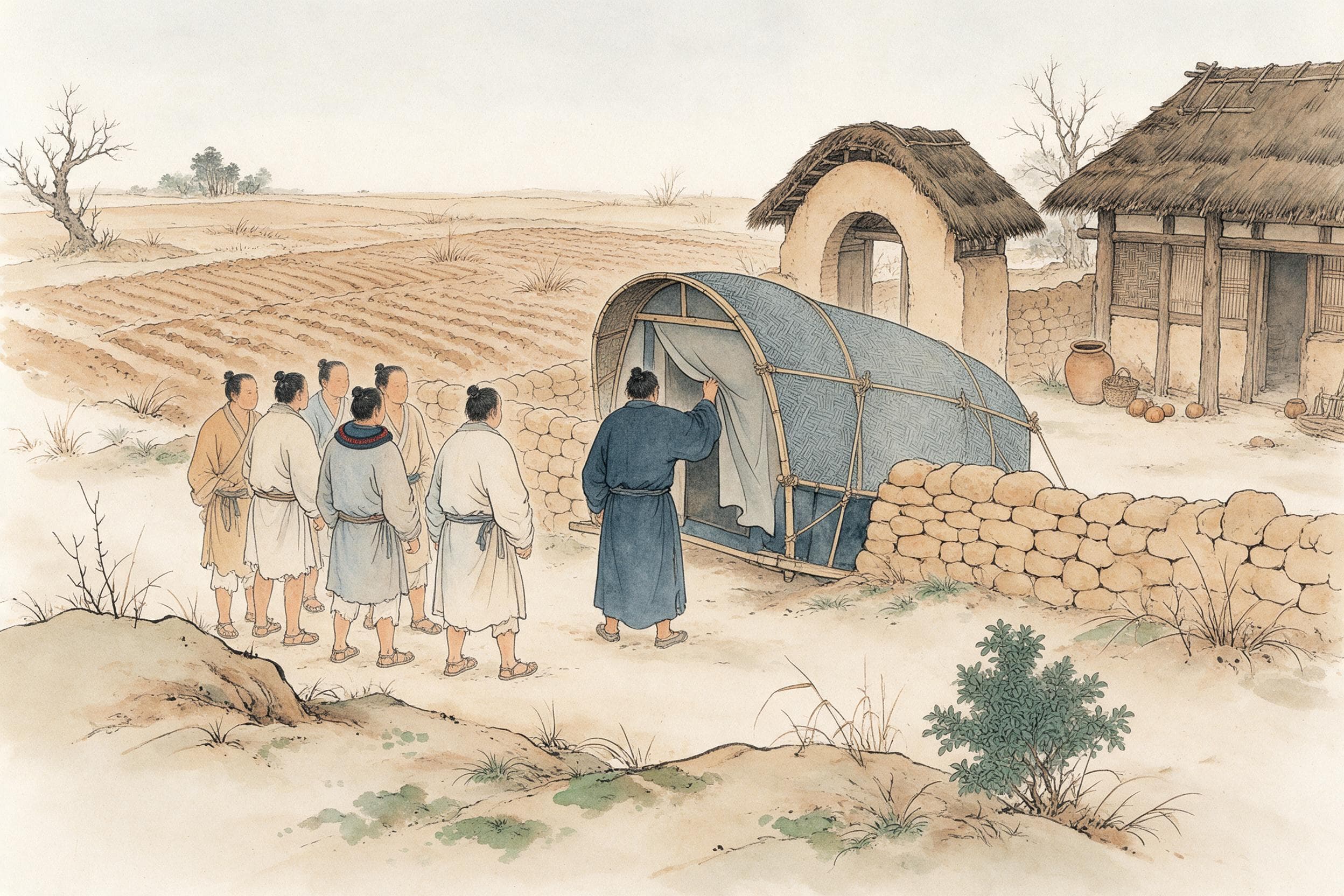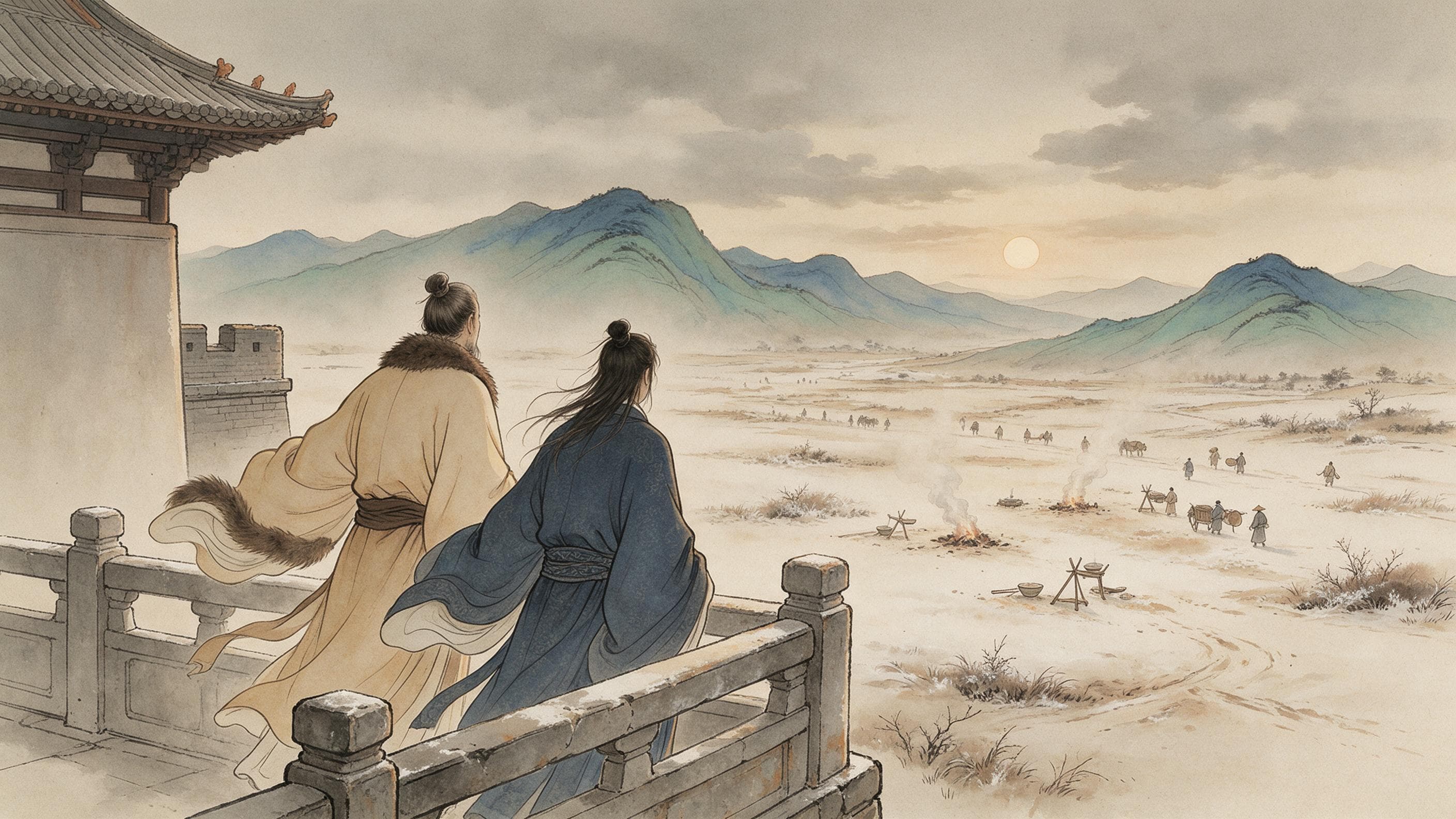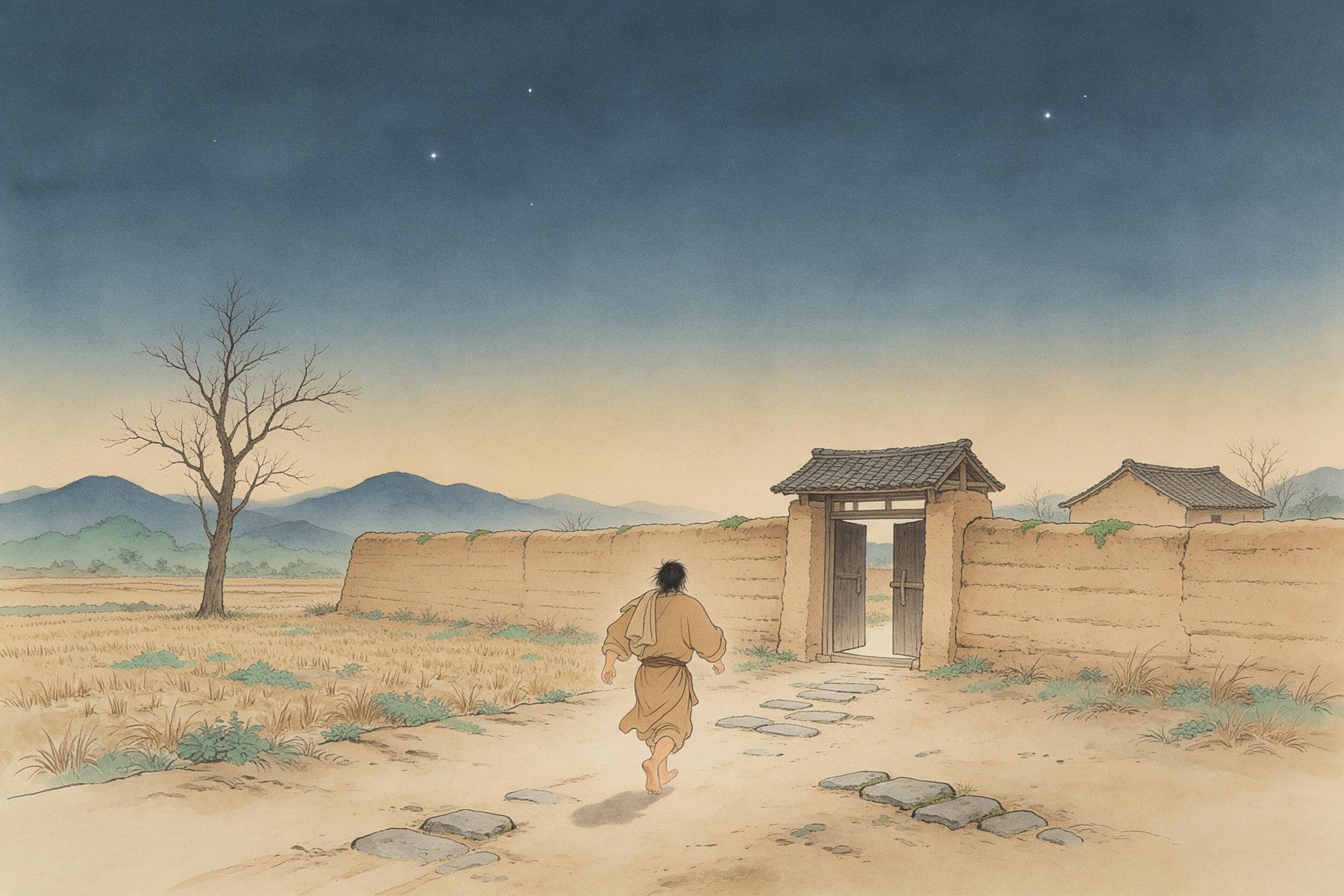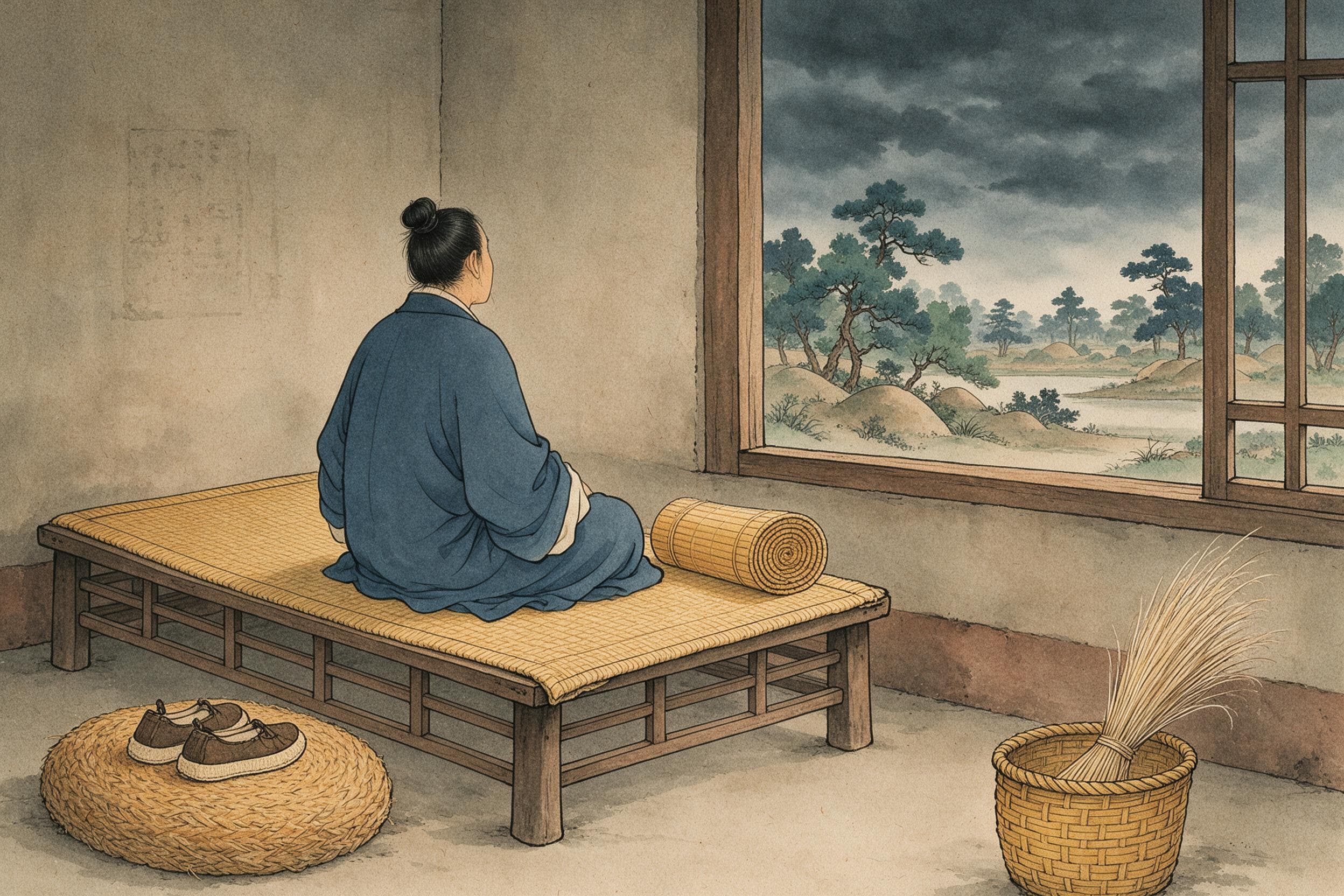
A piece of gold lies in the vegetable plot. 管揮鋤與瓦石不異,華捉而擲去之 — Guan Ning's hoe goes through it like a stone; Hua Xin picks it up and throws it away. Later a canopied carriage passes: 寧讀如故,歆廢書出看 — Guan reads on, Hua puts down his book to look. 寧割席分坐曰:「子非吾友也。」 — Guan cuts the sitting mat in two: You are no friend of mine. It is the eleventh of forty-seven entries in 德行, Virtue, the first chapter of the Shishuo Xinyu. The other book is the Jinshu, and its chapter 孝友, Filial Friendship, holds fourteen biographies. One is a selection of forty-seven scenes; the other, fourteen lives. One records who saw, the other who approved.
One: forty-seven entries, two hundred years
The page is headed 上巻上·德行第一, between a preface and the chapter 言語: the 第一 makes it the first chapter of the upper roll, not a ranking. Forty-seven entries, a scene or two each, no dates. Entries 1 to 13 are late-Han men — Chen Fan, Xun Jubo, Hua Xin, Guan Ning; from the fourteenth it is Wei and Jin. The entries are unevenly shared: Hua Xin four, Wang Rong five. The notes change sources with the period, late-Han worthies' lives first, then the Jin yangqiu, the Zhongxing shu and Jin family records: one chapter put together across two hundred years. The notes are not neutral either: each one produces the authority the entry needs.
Hua Xin's four show how it is edited. The tenth praises him: 華歆遇子弟甚整,雖閒室之内,嚴若朝典 — as strict with his juniors in a private room as at court. The eleventh is the cut mat. The twelfth is 王朗毎以識度推華歆, Wang Lang deferring to his judgement. In the thirteenth, fleeing by boat, Hua refuses a stranger who asks to join them (歆輒難之); Wang Lang says 幸尚寬,何爲不可; when the pursuers come and Wang would put the man off, Hua says 本所以疑,正爲此耳。既已納其自託,寧可以急相棄邪 and keeps him. Then 世以此定華王之優劣 — the world settled their worth by this. Praise and cut mat side by side, and the editor deletes neither. Nothing in the chapter tells the reader which of the four to believe; the two verdicts stand in the same chapter, four entries apart, with no comment between them.
Two: entries that are not virtue at all
Xie Yi, magistrate of Shan, 有一老翁犯法,謝以醇酒罰之,乃至過醉,而猶未已 — punished an old offender with strong wine until he was far gone. Xie An, seven or eight, on his brother's knee, said 阿兄,老翁可念,何可作此, and the man was released. Asked why she never saw him teach the children (那得初不見君教兒), Xie An answered 我常自教兒, I teach them all the time. Entries like these are in the chapter: it is a selection, not a book of models.
Filial prodigies are kept in two layers. Of Wang Xiang the text gives only the plum tree — a storm comes and 祥抱樹而泣, he holds the tree and weeps — and his mother coming at him in the dark, when 因跪前請死。母於是感悟,愛之如己子. The ice is in the note, Liu Xiaobiao's in the received text, quoting the Jin yangqiu: 解衣將剖冰求之,會有處冰小解,魚出 — he was undressing to break the ice when it gave way and a fish came out.
Three: fourteen lives and a chain of approval
The Jinshu chapter has a preface, fourteen men, and a verdict. The preface divides filial conduct into 事親之道也, 追遠之情也, 立身之行也; the title comes from 因彼孝慈而生友悌,理在兼綜,義歸一揆; the aim is 采其遺絢,足厲澆風,故著《孝友篇》以續前史云耳. Its precedents are prodigies: 郭巨致錫金之慶, 陽雍標蒔玉之祉, 烏馴丹羽,巢叔和之室,鹿呈白毳,擾功文之廬. Fourteen men, one piece each, each with a native place and an official career. The three are not stages of one argument. 事親 is what one does while the parents live; 追遠 is what is owed after they are dead; 立身 is what a man does with himself, and the preface puts all three under one word. The prodigies that follow — gold, jade, tame crows, white deer — are offered as precedent, not proof, and the fourteen lives are expected to match them.
Xu Zi's piece runs the whole chain. After his parents died 柴毀骨立,杖而能起; 躬自負土,不受鄉人之助; when helpers insisted, 晝助不逆,夜便除之 — by day he let them, by night he carried it back. He planted pines 亙五六里. A deer damaged the saplings: 鹿獨不念我乎 — does the deer alone not think of me? — and next day the deer lay dead under them; he buried it, and 猛獸即於孜前自撲而死. He remarried only 積二十餘年. Then the certification: 邑人號其居為孝順里, the governor memorialises, 詔旌表門閭。蠲復子孫, and 圖孜像於堂,朝夕拜焉 — his portrait hung in the hall and was bowed to morning and evening.
Four: the same motif, placed twice
The fish that answers grief sits in different places. Wang Xiang's ice is in the Shishuo's note; the Jinshu tells of Wang Yan in its text. His stepmother wanted live fish in winter; beaten till he bled, he 尋汾叩淩而哭, and a fish 長五尺,踴出水上 leapt out. The same motif, once a note and once a text: the two books disagree about what belongs to the text. Wang Yan also has 夏則扇枕席,冬則以身溫被.
Grave and grief the Jinshu always accounts for. Wang Pou 未嘗西向而坐。示不臣朝廷也, never sat facing west; 三徵七辟皆不就; 廬于墓側, and 攀柏悲號,涕淚著樹,樹為之枯 — he clung to the cypress and wailed, the tears fell on the tree and it withered. At thunder he went to the grave: 裒在此, I am here. Reading 哀哀父母 he 三復流涕, and his students 並廢《蓼莪》之篇. Yu Gun stayed in a plague tending his dying brother 親自扶持,晝夜不眠, 十有餘旬, more than a hundred days; for an orphaned niece he 刈荊苕為箕帚, cut switchgrass for a broom, saying 灑掃庭內,婦之道也 and 匪器之為美,欲溫恭朝夕,雖休勿休也; drunk once, he 乃于父墓前自杖三十. That a book of anecdotes keeps the prodigy in a note while a dynastic history puts it in the text is the whole difference between them, and neither page comments on it.
Five: who saw, who approved
未嘗西向而坐 is a refusal of the throne's direction, not of the throne's grief: he is mourning a father the court killed. The broom and the thirty strokes are the same man on two scales, one public and one not. In the Shishuo the verdicts hang on other people: 時人以爲純孝之報也, the people of the time said, when Chen Yi, who saved the burnt rice for his mother, survived a rout on it; 世以此定華王之優劣, the world settled Hua and Wang. In the Jinshu the record is approval — neighbours, governors, edicts, portraits. They meet in the chapter's last entry: two brothers weeping for their mother, 路人爲之落涙, passers-by wept; Han Kangbo's mother heard and told her son 汝若爲選官,當好料理此人; he became minister of personnel, and 大呉不免哀制,小呉遂大貴達 — the elder never escaped the mourning rules, the younger rose very high. The weeping was heard, and an office was remembered. 大呉不免哀制,小呉遂大貴達 is also the chapter's own ending, and it names the machinery: grief, overheard by someone with a son in the ministry, becomes an appointment.
- Two genres: the Shishuo is a Liu-Song anecdote collection, the Jinshu a Tang dynastic history, neither contemporary; the same motif sits in a note in one and in the text of the other, not stitched into one life.
- 德行 and 孝友 are labels made by an editor and by historians, not self-descriptions; 德行第一 means the first chapter of the upper roll, not a ranking.
- The cut mat is quoted as written, Hua Xin as the negative; the chapter also keeps his praise and its own 世以此定 sentence, side by side and unreconciled.
- Text and note are separate layers: the ice-breaking is in Liu Xiaobiao's note, the text has only the plum tree and the kneeling.
- Numbers as written: forty-seven entries, fourteen lives, four for Hua Xin, five for Wang Rong, twenty-odd years, five or six li, more than a hundred days, thirty strokes — nothing added up or converted.
- No talk of Wei-Jin style or of filial piety rising and falling, no modern moral comparison; model officials, worthy women, 任誕 and 容止 are other articles.
One chapter of forty-seven lets a man be two things; one chapter of fourteen leaves each a native place, a career and a sentence of approval. The first records who saw — 時人, 世, passers-by, a neighbour's mother; the second, who approved — neighbours, a governor, an edict, a portrait. Neither page says why these forty-seven, or why these fourteen. Both pages are silent about selection: no criterion for the forty-seven, no rule for the fourteen.
Related reading:Model Officials: How a Historian Turns a Man into a Good Magistrate · Worthy Women: A Few Women, A Few Sentences · Renden: A Chapter of Men Who Broke the Rites
Sources & further reading
- 《世说新语》卷上上·德行第一(南朝宋刘义庆编,随文注通行本为梁刘孝标作;维基文库本,白文+随文注,页面标 textquality 100%,未与中华书局点校本复核) — Forty-seven entries behind one label, the first chapter of the upper roll, between 序 and 言語; the name is the editor's. Entries 1–13 are late-Han men, 14 onward Wei-Jin, and the notes change sources with the period. Hua Xin has four: 華歆遇子弟甚整,雖閒室之内,嚴若朝典; the cut mat (管揮鋤與瓦石不異,華捉而擲去之 / 寧讀如故,歆廢書出看 / 寧割席分坐曰:「子非吾友也。」); 王朗毎以識度推華歆; the boat (本所以疑,正爲此耳。既已納其自託,寧可以急相棄邪), ending 世以此定華王之優劣. Also used: 謝以醇酒罰之 / 阿兄,老翁可念,何可作此; 那得初不見君教兒 / 我常自教兒; 祥抱樹而泣; 因跪前請死。母於是感悟,愛之如己子; 時人以爲純孝之報也; 路人爲之落涙; 汝若爲選官,當好料理此人; 大呉不免哀制,小呉遂大貴達. The ice is not in the text but in the note quoting the Jin yangqiu: 解衣將剖冰求之,會有處冰小解,魚出. The page writes 呉 for 吳 and uses 毎, 爲, 眞; quotations follow the page.
- 《晋书》卷八十八·列传第五十八·孝友传(唐房玄龄等撰;维基文库本,白文无注,页面标 textquality 50%,未与中华书局点校本复核) — A dynastic category biography: preface, fourteen men, 史臣曰 and 贊曰. The preface divides filial conduct into 事親之道也, 追遠之情也, 立身之行也; the title from 因彼孝慈而生友悌,理在兼綜,義歸一揆; the purpose 采其遺絢,足厲澆風,故著《孝友篇》以續前史云耳; precedents 郭巨致錫金之慶, 陽雍標蒔玉之祉, 烏馴丹羽,巢叔和之室,鹿呈白毳,擾功文之廬. Xu Zi: 柴毀骨立,杖而能起; 躬自負土,不受鄉人之助; 晝助不逆,夜便除之; 列植松柏亙五六里; 鹿獨不念我乎; 猛獸即於孜前自撲而死; 積二十餘年孜乃更娶妻; 邑人號其居為孝順里; 詔旌表門閭。蠲復子孫; 圖孜像於堂,朝夕拜焉. Wang Pou: 未嘗西向而坐,示不臣朝廷也; 三徵七辟皆不就; 廬于墓側; 攀柏悲號,涕淚著樹,樹為之枯; 母沒,每雷,輒到墓曰:「裒在此。」; 三復流涕; 並廢《蓼莪》之篇. Yu Gun: 親自扶持,晝夜不眠; 十有餘旬; 刈荊苕為箕帚; 灑掃庭內,婦之道也; 匪器之為美,欲溫恭朝夕,雖休勿休也; 乃于父墓前自杖三十. Wang Yan: 尋汾叩淩而哭; 長五尺,踴出水上; 夏則扇枕席,冬則以身溫被. The page writes 為 not 爲 in places; quotations follow the page.