The Book of Han's treatise on arts and letters begins by explaining how the books got there: after Confucius 'the subtle words were cut off', the schools of the Warring States 'fell into confusion', Qin 'burned and destroyed the writings', the Han 'gathered up the records and opened the road for presenting books', and under Emperor Wu 'established the policy of storing books and set up officers to copy them'; by Emperor Cheng, 'because the books had rather scattered, he sent the messenger Chen Nong to seek surviving books throughout the world' (使謁者陳農求遺書於天下). Only then the editing. The textual layer first: this treatise is Ban Gu's digest made 'from the Seven Epitomes, cutting down what is essential', so it is itself an abridgement — 'now I have cut down what is essential, to furnish the record' (今刪其要,以備篇籍) — and the Seven Epitomes as a work is lost.
Four Editors, Four Kinds of Book
The division of labour, as printed: 'An edict ordered Liu Xiang, grand master of light, to edit the classics, traditions, masters and poetry; Ren Hong, colonel of foot, the military books; Yin Xian, grand astrologer, the numbers; and the attending physician Li Zhuguo, the medical arts' (詔光祿大夫劉向校經傳諸子詩賦,步兵校尉任宏校兵書,太史令尹咸校數術,侍醫李柱國校方技). Four men, four lots of books: classics and traditions with the masters and poetry, military works, numbers, medicine. The division is by subject, one man to a whole field.
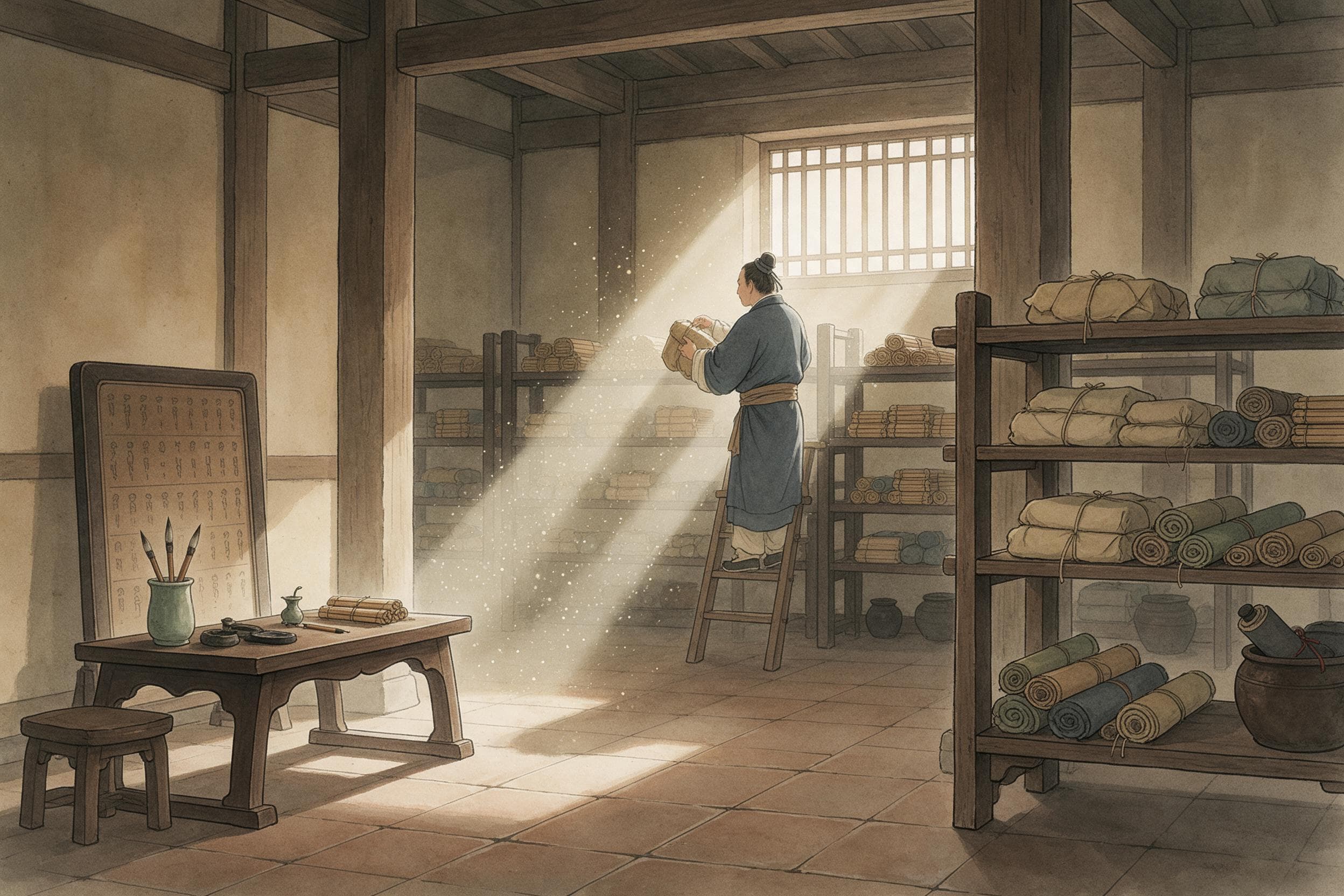
Each man's method is given in one sentence: 'for each book finished, Xiang would list its chapters, summarise its purport, record it and present it' (每一書已,向輒條其篇目,撮其指意,錄而奏之). Three actions: catalogue, summary, memorial. After Liu Xiang died, 'Emperor Ai again ordered his son Liu Xin, attendant and chariot-commander, to finish his father's work', and Liu Xin 'collected all the books and presented his Seven Epitomes' (總群書而奏其七略). Which hall the editing was done in, how many clerks, which copies were collated — the page does not say, and no institutional establishment is invented here.
The Seven Epitomes: One General Summary and Six Divisions
The seven are listed: 'thus there is the Ji lüe, the Liu yi lüe, the Zhu zi lüe, the Shi fu lüe, the Bing shu lüe, the Shu shu lüe and the Fang ji lüe' (故有輯略,有六藝略,有諸子略,有詩賦略,有兵書略,有術數略,有方技略). The point to hold: the first, Ji lüe, is generally taken not as a class of books but as a general summary, so that the real classes are the six that follow. Seven epitomes are therefore not seven classes; the article follows the reading of one summary plus six divisions, which is the usual one, since the page lists the names only. The page does not give the Seven Epitomes' text, nor define each division.
The Six Divisions and Their Total
Each division closes with a subtotal, and all six are printed: the classics 'altogether 103 schools, 3,123 chapters' (凡六藝一百三家,三千一百二十三篇), and within that division the page has nine sub-heads — Changes, Documents, Songs, Rites, Music, Spring and Autumn, Analects, Filial Piety, lexicography; the masters '189 schools, 4,324 chapters'; poetry '106 schools, 1,318 chapters'; military books '53 schools, 790 chapters, with 43 scrolls of diagrams' (圖四十三卷); numbers '190 schools, 2,528 scrolls'; medicine '36 schools, 868 scrolls'. Two details: only the military books count diagrams, separately from chapters; and numbers and medicine count in scrolls (卷) while the rest count in chapters (篇) — chapters and scrolls stand side by side on the page, generally taken as loosely used for one another in this treatise, and both are printed here without conversion.
The total is one line: 'Altogether the books, in the six divisions, are 38 categories, 596 schools, 13,269 chapters and scrolls' (大凡書,六略三十八種,五百九十六家,萬三千二百六十九卷). The line is printed as it stands; nothing is added up differently, and no proportion is worked out. It is a count of what was catalogued, from an abridged work, and it is not the number of books that existed at the time.
Later: Seven Epitomes into Four Parts
The classification changed, and that part is in the Book of Sui's treatise on classics, written under the Tang — a later account. Under Wei, Zheng Mo 'first made the Central Register'; the palace librarian Xun Xu 'again on the basis of the Central Register made the New Register, divided into four parts': jia, 'recording the classics and lexicography'; yi, 'the old masters, the recent masters, military books, military schools and numbers'; bing, 'records of history, old affairs, the Huanglan register and miscellaneous matters'; ding, 'poetry, eulogies with pictures, and the books from the Ji tomb'. 'Altogether the four parts make 29,945 scrolls' (大凡四部合二萬九千九百四十五卷). History (bing) has become a class of its own: that is the great difference from the seven epitomes.
Further on, the account notes how far the holdings had fallen: the Eastern Jin librarian Li Chong checked Xun Xu's old register and found 'only 3,014 scrolls' (其見存者,但有三千一十四卷). Then Wang Jian's seven-part catalogue, with Daoism and Buddhism 'appended', 'nine items in all'; Ruan Xiaoxu's seven records, dividing classics, records and biographies, masters and military, collections, techniques, Buddhism and Daoism; and the Tang count of what survived, '14,466 titles in 89,666 scrolls' (一萬四千四百六十六部……八萬九千六百六十六卷). None of these is commensurate with the Han total of 13,269: different periods, different survival, and different units (categories, schools, chapters, scrolls). The Book of Sui's sequence is followed here without comparison and without any multiple being computed.
What Neither Page Gives
Neither page gives a book price, the cost of copying, the size or architecture of a storehouse, or what ordinary people read. Scrolls are not converted into volumes or characters; 13,269 and 89,666 are not compared; no phrase such as 'China's earliest library' or 'father of bibliography' is used. The Seven Epitomes itself is lost, and only the Han digest and the Sui account remain; the Sui account is not treated as Han text, and later catalogues are not used to fill the Han treatise's gaps.
One more limit: of the editing process this page gives only the three steps — list the chapters, summarise the purport, record and present. Collation against copies, the drying of slips, the copying out — none of that is here, and none is added. What can be written is four things: the division of labour, the method, the classification, and the total.
One division of labour, one sentence of method, seven names, six subtotals, one line of total: a state's bookshelf reduced to a few rows of figures. The four parts, the seven catalogues and the seven records belong to a different book and a later account; the two are not joined. What became of these books, how they scattered and gathered, the treatise on arts and letters does not say, and what the Book of Sui records is the fortune of its own age.
Related reading:Asking the Cauldron's Weight: 'It Lies in Virtue, Not in the Vessel' · Burning the Tallies: Debt, Interest and One Night's Fire in Warring States Qi · A Thousand Shi of Fish: Ponds and Sea Rents in Han
Sources & further reading
- 《汉书》卷三十·艺文志(东汉班固撰;维基文库本,页面白文无注,未与中华书局点校本复核) — Ban Gu's digest of Liu Xin's Seven Epitomes: under Emperor Cheng books had scattered, so the messenger Chen Nong was sent to seek surviving copies; Liu Xiang, a grand master of light, edited the classics, traditions, masters and poetry, Ren Hong the military books, Yin Xian divination and numbers, Li Zhuguo medicine; 'for each book finished, Xiang would list its chapters, summarise its purport, record it and present it'; after his death his son Liu Xin completed the work and presented the Seven Epitomes — the general summary, then the six divisions of the classics, the masters, poetry, military books, numbers and medicine; and 'now I have cut down what is essential, to furnish the record'. The treatise gives the subtotal of each division — 103 schools and 3,123 chapters for the classics; 189 and 4,324 for the masters; 106 and 1,318 for poetry; 53 and 790 chapters with 43 scrolls of diagrams for military books; 190 and 2,528 scrolls for numbers; 36 and 868 scrolls for medicine — and the total: thirty-eight categories, 596 schools, 13,269 chapters and scrolls.
- 《隋书》卷三十二·经籍志一(唐魏征等撰;维基文库本,页面白文无注,未与中华书局点校本复核) — A Tang compilation's history of cataloguing, used only as later history: Zheng Mo's Central Register under Wei, Xun Xu's New Register 'divided into four parts' — jia for the classics and lexicography, yi for the old and recent masters with military books and numbers, bing for histories and records, ding for poetry and diagrams — 'altogether the four parts make 29,945 scrolls'; Wang Jian's seven-part catalogue with Buddhism and Daoism appended, 'nine items in all'; Ruan Xiaoxu's seven records; and the Tang count of what survived, '14,466 titles in 89,666 scrolls'. It records, but does not compare across the centuries.