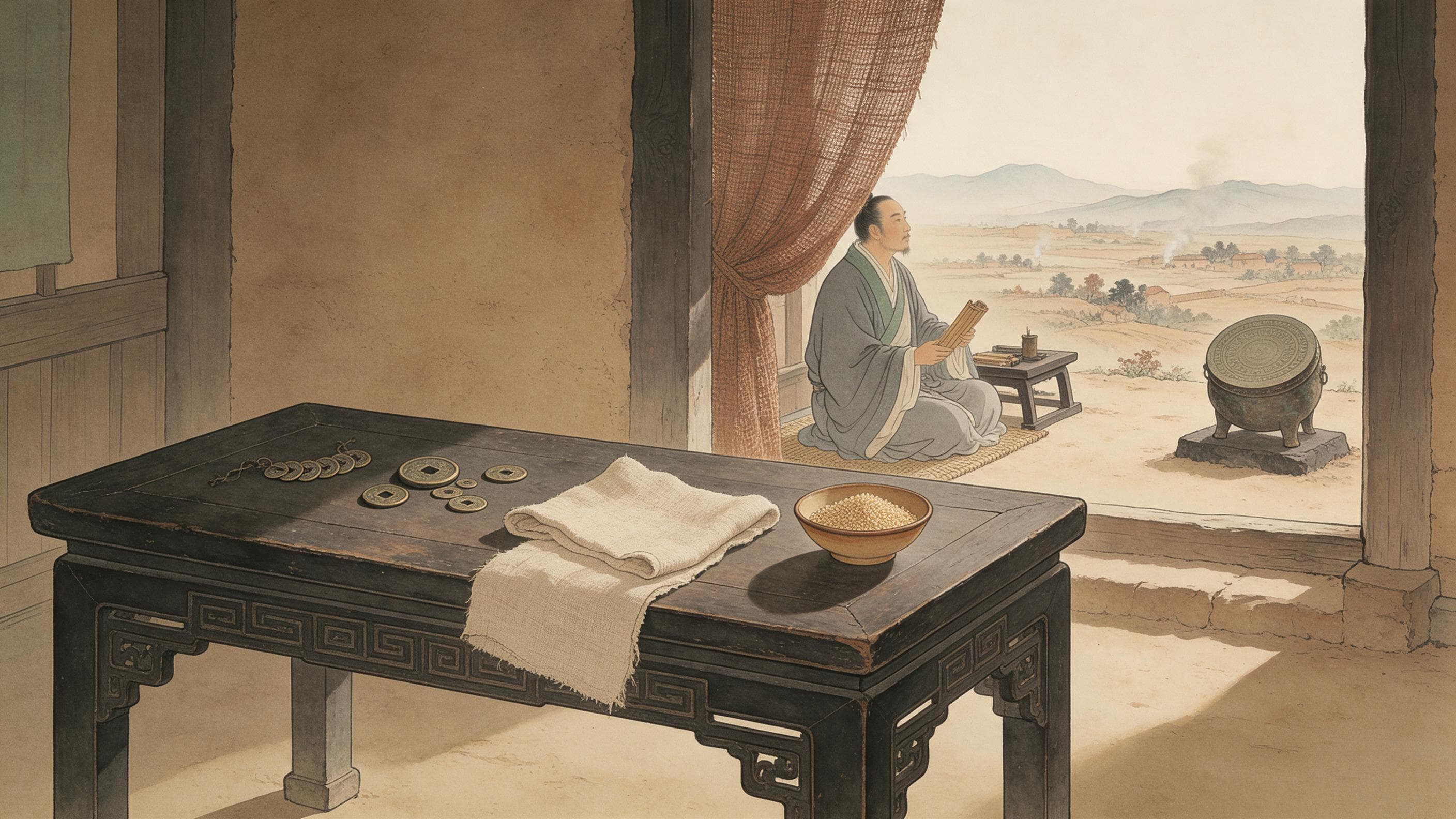
Four words carry it — 'one in thirty' (三十而税一) — from the Book of Han's treatise on the economy: 'thirteen years later, in the second year of Emperor Jing, the people were ordered to pay half the land tax, one in thirty' (後十三歲,孝景二年,令民半出田租,三十而稅一也). The textual layer and the scope first: the Book of Han is an Eastern Han account of Western Han affairs, so this is retrospect; the same measure appears in the Shiji's annals of Emperor Jing as 'the land tax was halved' (除田半租), and dated differently. This article treats land tax only; the poll taxes and the property levy on merchants belong elsewhere.
The Early Han: One in Fifteen
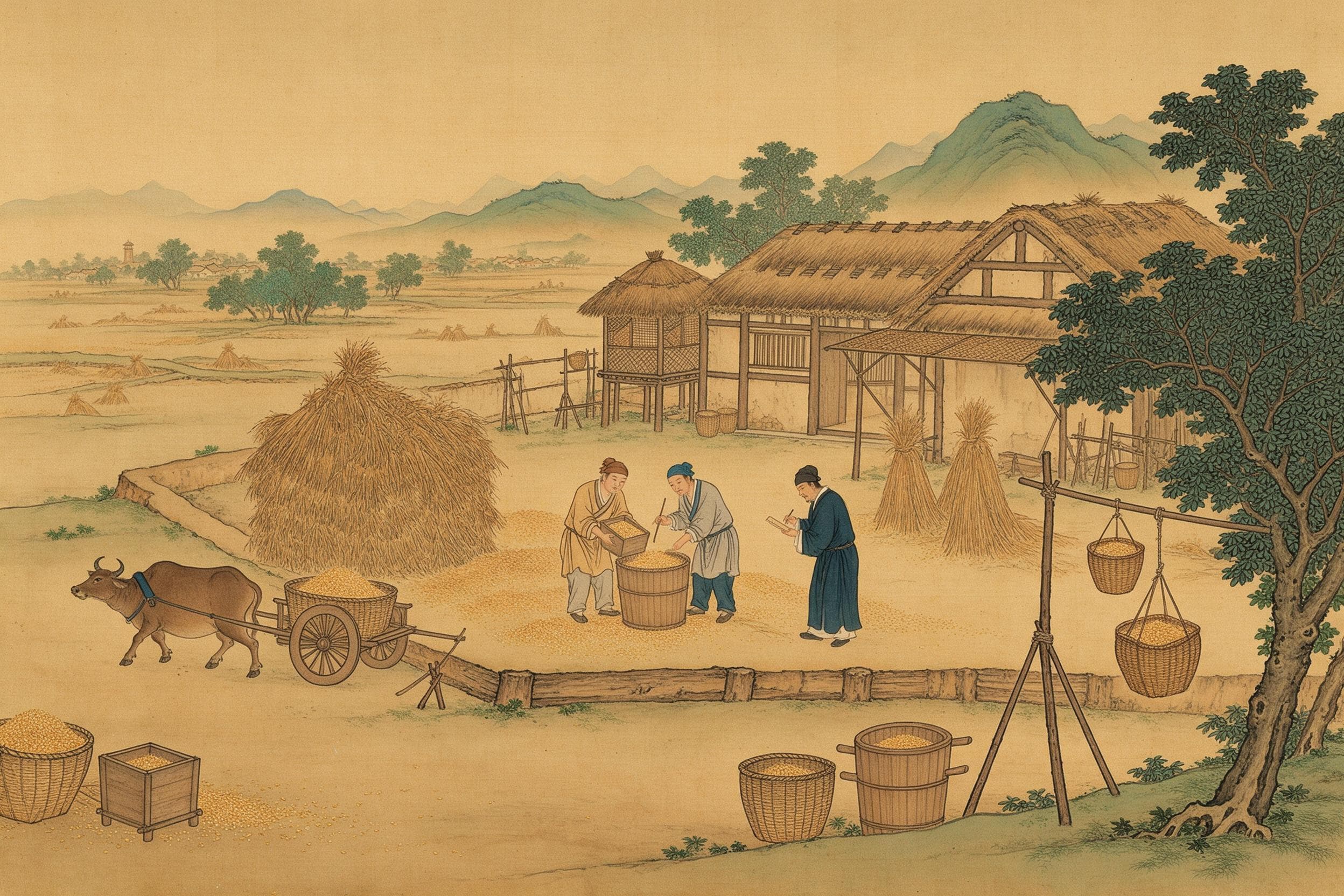
The treatise describes the Han founding after the ruin of Qin: people had lost their work, grain stood at five thousand a shi, men ate one another, more than half died; when the realm was settled there was no store. Then one institutional sentence: 'the emperor therefore simplified the laws and reduced the prohibitions, lightened the land tax to one in fifteen, measured the clerks' salaries and reckoned the government's expenses, and levied on the people accordingly' (上於是約法省禁,輕田租,什五而稅一,量吏祿,度官用,以賦於民). The same passage adds that the revenues of mountains, rivers, parks, markets and shops were 'each kept as private support' — another kind of income, not merged here — and that grain shipped from east of the passes to the capital 'did not exceed several hundred thousand shi a year', while under Emperor Hui and the Empress Lü 'food and clothing increased'.
Under Emperor Wen came two reductions, out of Chao Cuo's advice on grain. If the frontier had five years of food, grain could be bought into the commanderies; if more than a year, then 'from time to time remit and do not collect the farmers' rent'. 'The emperor again followed his words, and issued an edict granting the people half of the land tax for the twelfth year; the next year the land tax on the people's fields was removed' (乃下詔賜民十二年租稅之半。明年,遂除民田之租稅). The grain policy that paid for this was the sale of ranks for grain delivered to the frontier — 'six hundred shi for the rank of shangzao, rising to four thousand shi for the fifth grand master and twelve thousand shi for the grand chief' (六百石爵上造……萬二千石為大庶長). 'The twelfth year' is generally taken as the twelfth year of Emperor Wen, marked here as the usual reading; both sentences are printed without reckoning.
Emperor Jing: Two Accounts
The Shiji's annals, first year: 'In the fifth month, the land tax was halved' (五月,除田半租) — five characters. It gives no rate, and does not say what the rate had been. The Book of Han's treatise: 'Thirteen years later, in the second year of Emperor Jing, the people were ordered to pay half the land tax, one in thirty.' First the interval, then the year, then 'half the land tax', then the rate.
Set side by side, the two differ in year (first year or second) and in wording ('halved the land tax' against 'pay half the land tax, one in thirty'). The four characters 三十而税一 appear only in the Book of Han, not in the Shiji at this point; neither is adjudicated here, and they are not fused into one notice.
Name and Reality: Wang Mang's Retrospect
In the same treatise, Wang Mang later issues an order that says it again: 'The Han lightened the land tax to one in thirty, but there were always the labour dues, and the disabled paid too; and the powerful families encroached, dividing the fields and seizing the tenancies — the name was one in thirty, the reality was one in ten taken five' (漢氏減輕田租,三十而稅一……厥名三十,實什稅五也). The same order goes on to rename 'the fields of the realm as royal fields and the slaves as private dependants, none of them to be bought or sold' (今更名天下田曰王田……皆不得賣買). This is Wang Mang's own order, marked as his words, not an objective statistic: the reason is written in the middle of the sentence.
Dong Zhongshu says something adjacent: 'in antiquity the people were taxed no more than one in ten, and what was asked was easy to supply… but those who plough the fields of a powerful family pay a rent of one in ten taken five' (或耕豪民之田,見稅什五), and of Qin, that 'land tax and poll tax, the profits of salt and iron, were twenty times those of antiquity'. Two rents are in play here: the land tax paid to the state, and the tenancy rent paid to a rich landlord. Both pages have them, and they are not the same thing; Dong Zhongshu's remedy is to 'limit the fields men may name, to relieve what is lacking and block the road of annexation' (限民名田,以澹不足,塞并兼之路).
Two Layers: State Land Tax and Tenancy Rent
'One in thirty' and 'one in ten taken five' therefore cannot be run together into one 'Han peasant burden': the first is the state's rate on land, the second a tenant's rent to a landlord. Wang Mang puts both in one sentence of criticism; this article keeps them apart. The changes of rate are also kept as separate items — one in fifteen at the founding; halved and then removed under Wen; half the tax, one in thirty, under Jing; and Wang Mang's retrospect when he changes the fields to royal land. They are not gathered into a general account of light Han taxation.
What Neither Page Gives
The rates on these pages are fractions only: one in fifteen, one in thirty, one in ten, one in ten taken five. There is no figure of so many dou or sheng to the mu, and the units shi, mu and qing do not appear in the land-tax sentences; converting to a per-mu amount would need a yield, and no yield is computed here, no total revenue is inferred, and no fraction is turned into a percentage argument. Nor are there returns by commandery, collection procedures, household grades or payment deadlines; nor any record of how the reductions were carried out in bad years.
One more limit: when the land tax removed by Emperor Wen was restored, the page says only 'thirteen years later, in the second year of Emperor Jing'; how long 'one in thirty' lasted, and whether it applied everywhere, neither page answers. The poll taxes and the commercial levies are separate subjects and are only fenced off in the opening sentence.
Four fragments, then: one in fifteen at the founding; 'half the land tax for the twelfth year' and then its removal under Wen; half the tax and one in thirty under Jing, dated a year apart in the two books; and Wang Mang's 'name one in thirty, reality one in ten taken five'. The rate sentences carry fractions only; to whom, how much, and how it was collected, neither page says.
Related reading:Asking the Cauldron's Weight: 'It Lies in Virtue, Not in the Vessel' · Burning the Tallies: Debt, Interest and One Night's Fire in Warring States Qi · A Thousand Shi of Fish: Ponds and Sea Rents in Han
Sources & further reading
- 《汉书》卷二十四·食货志(东汉班固撰;维基文库本,页面白文无注,未与中华书局点校本复核) — The land-tax passages: after the Han founding, 'the laws were simplified and the prohibitions reduced, the land tax lightened to one in fifteen' (轻田租,什五而税一); under Emperor Wen, following Chao Cuo's advice on grain, 'an edict was issued granting the people half of the land tax for the twelfth year', and 'the next year the land tax on the people's fields was removed' (赐民十二年租税之半。明年,遂除民田之租税); 'thirteen years later, in the second year of Emperor Jing, the people were ordered to pay half the land tax, one in thirty' (令民半出田租,三十而税一也); Wang Mang's order looking back — 'the Han lightened the land tax to one in thirty, but there were always the labour dues… the name was one in thirty, the reality was one in ten taken five' (厥名三十,实什税五也); and Dong Zhongshu's complaint that those who plough a rich man's fields pay a rent of one in two.
- 《史记》卷十一·孝景本纪(西汉司马迁撰;维基文库本,页面白文无注,未与中华书局点校本复核) — The same measure in the annals of Emperor Jing, dated a year earlier and worded more briefly: in the fifth month of his first year 'the land tax was halved' (除田半租). The annals give no rate; the words 'one in thirty' appear only in the Hanshu.