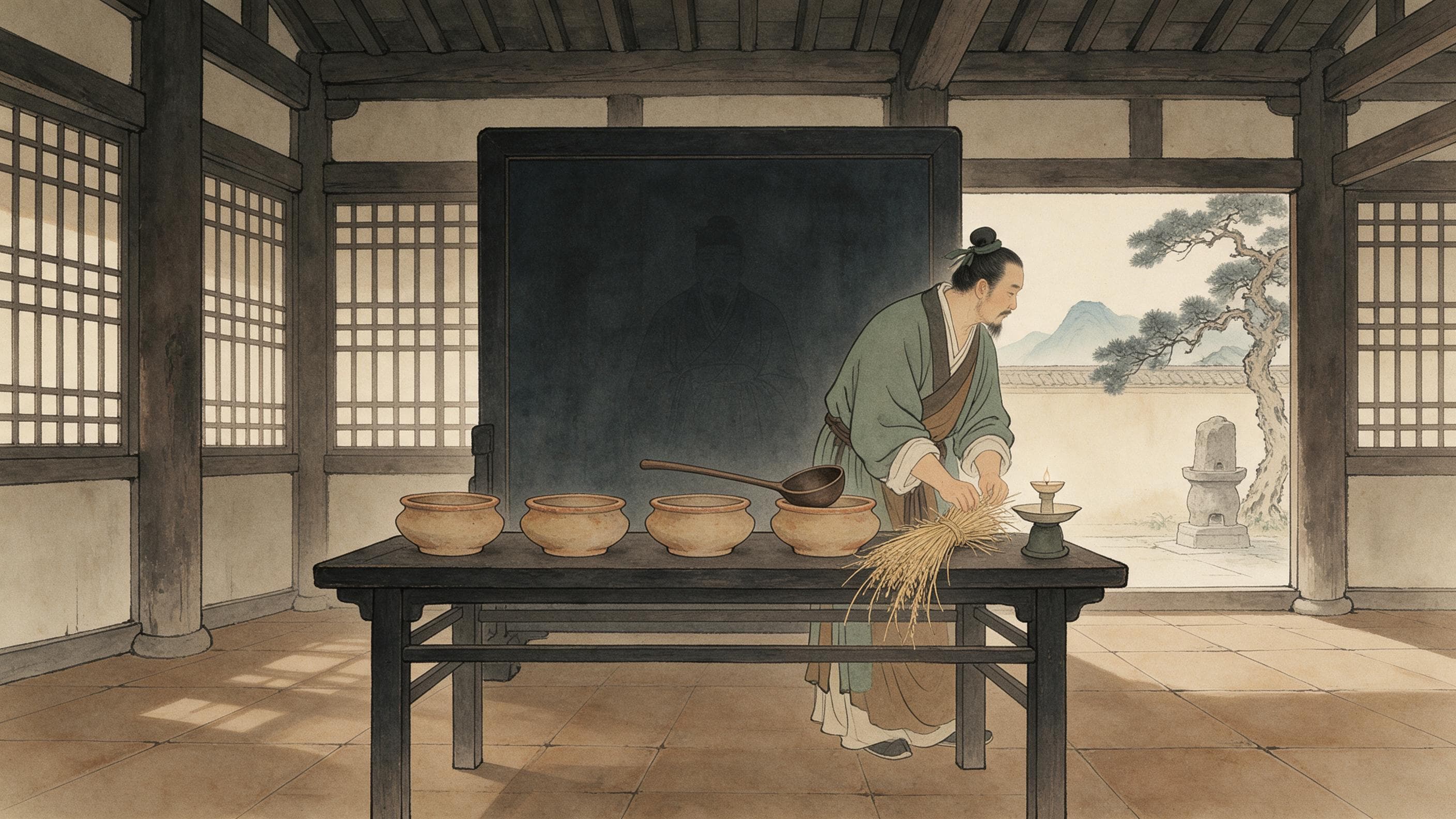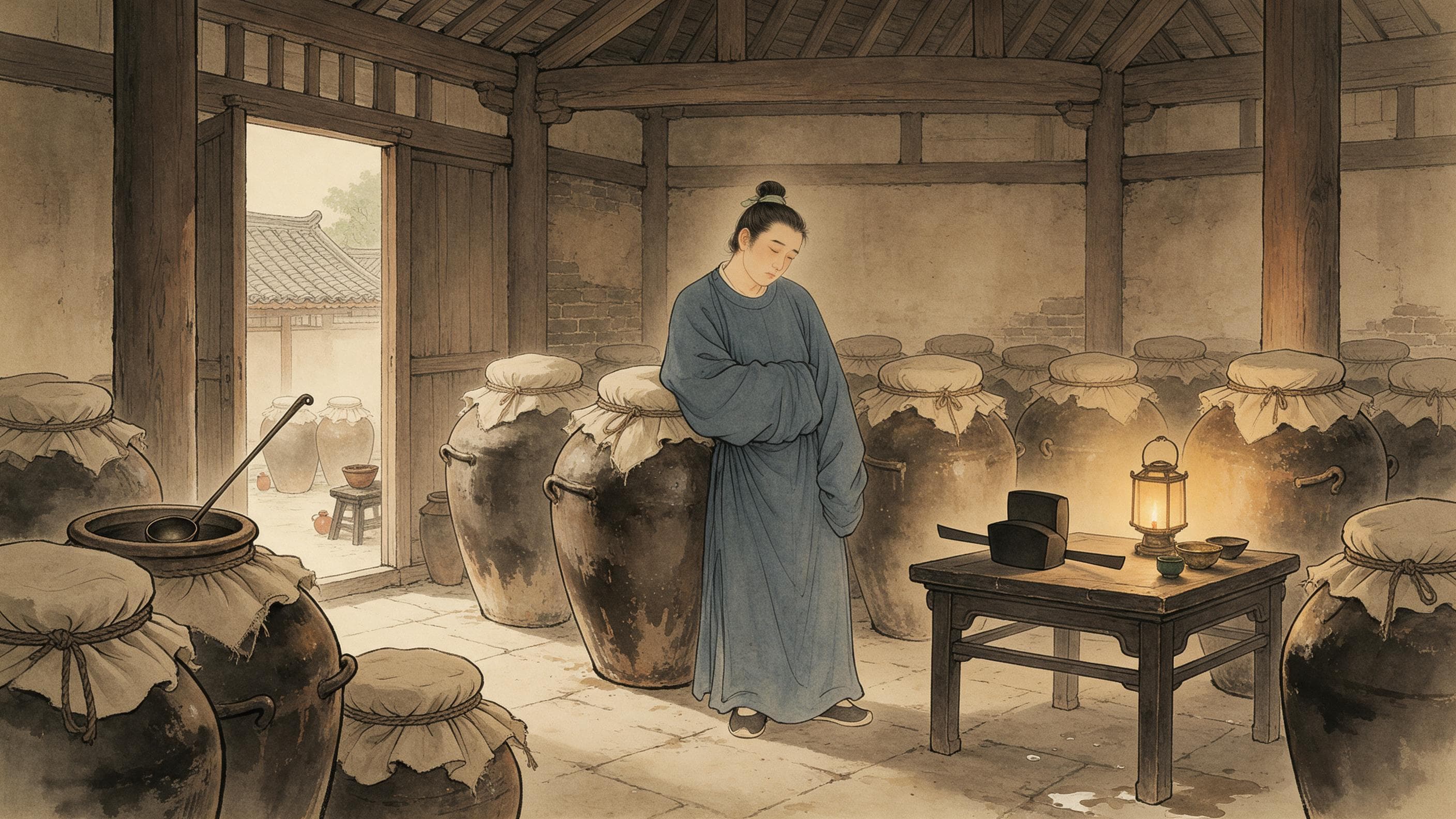
Ruan Ji's request for office is told on both pages, and the amounts do not agree. The Book of Jin's life says: hearing that the cooks of the infantry office brewed well and had three hundred hu of wine in store, he asked for the post of colonel of infantry. The New Account has one sentence: the colonelcy fell vacant, the kitchen held several hundred hu of wine, and Ruan Ji asked for it. Liu Xiaobiao's note then quotes the Wen Shi Zhuan, which says three hundred shi. One vacancy, one store of wine, three ways of writing it; they are set side by side here, and no single figure is chosen.
The Vacancy
The life is fullest: 籍聞步兵廚營人善釀,有貯酒三百斛,乃求為步兵校尉。遺落世事,雖去佐職,恆遊府內,朝宴必與焉 — hearing the kitchen brewed well and had three hundred hu, he asked for the post; once he had it he 遺落世事, let the world's business drop, and though he had left his former staff post he was always about the office and never missed a court feast. The reason for asking and the behaviour afterwards are given in one layer, and that is all.
The New Account's version: 步兵校尉缺,廚中有貯酒數百斛,阮籍乃求為步兵校尉 — several hundred hu, not three hundred. The note quotes the Wen Shi Zhuan: 後聞步兵廚中有酒三百石,忻然求為校尉。於是入府舍,與劉伶酣飲 — three hundred shi of wine, and he asked gladly, then went into the office and drank deep with Liu Ling. Hu and shi are two different measures; both are printed as given, neither is converted into the other, and neither is turned into a modern quantity.
Drink as a Method
The life first gives the ground: 籍本有濟世志,屬魏、晉之際,天下多故,名士少有全者,籍由是不與世事,遂酣飲為常 — he had meant to do something in the world, but in the troubled years between Wei and Jin few famous men survived whole, so he kept out of affairs and drank as a habit. Then two cases: Emperor Wen wished to marry his son to Ruan Ji's daughter, and 籍醉六十日,不得言而止, Ji was drunk for sixty days and the matter could not be raised; Zhong Hui questioned him about current affairs again and again to catch him out, and 皆以酣醉獲免, each time he escaped through drink. Drinking is a method in this life, and that judgement is the biography's own.
The New Account has a verdict of another kind: 王孝伯問王大:「阮籍何如司馬相如?」王大曰:「阮籍胸中壘塊,故須酒澆之」 — Wang Xiaobo asked Wang Da how Ruan Ji compared with Sima Xiangru, and Wang Da said Ruan Ji had a lump in his chest, and so had to pour wine on it. That is Wang Chen's sentence, not a historian's; it is quoted with the speaker named.
Wine and Meat at a Funeral
The New Account has a scene the biography lacks: 阮籍遭母喪,在晉文王坐,進酒肉。司隸何曾亦在坐,曰:「明公方以孝治天下,而阮籍以重喪,顯於公坐,飲酒食肉,宜流之海外,以正風教。」文王曰:「嗣宗毀頓如此,君不能共憂之,何謂?且有疾而飲酒食肉,固喪禮也!」籍飲啖不輟,神色自若 — in mourning for his mother, at Sima Zhao's table, Ruan Ji ate and drank; He Zeng, the metropolitan commandant, said the duke was governing by filial piety and Ruan Ji was drinking and eating meat in heavy mourning in public and should be exiled to the sea for the sake of morals; Sima Zhao answered that Ruan Ji was worn out with grief and that for an invalid to drink and eat meat was itself the mourning rule; Ruan Ji went on eating and drinking, his face unchanged. Three men speak; no verdict is added.
The biography tells the death of his mother more closely: he was playing chess when she died and 對者求止,籍留與決賭, the other man asked to stop and he kept him to finish the game; then 飲酒二斗,舉聲一號,吐血數升 — two dou of wine, one long cry, several sheng of blood; before the funeral 食一蒸肫,飲二斗酒,然後臨訣,直言窮矣,舉聲一號,因又吐血數升,毀瘠骨立,殆致滅性 — he ate a steamed suckling, drank two dou of wine, took leave of the dead saying only that it was over, cried out once, spat several sheng of blood again, and grew so thin that his bones stood out, almost destroying his life. Two dou, several sheng, one steamed dish: as given, not converted.
The New Account: 阮籍當葬母,蒸一肥豚,飲酒二斗,然後臨訣,直言「窮矣」,都得一號,因吐血,廢頓良久 — at his mother's burial he steamed a fat piglet, drank two dou of wine, said only that it was over, cried out once, spat blood and lay prostrate a long while. The note quotes Deng Can's Jin Ji with 飲酒三斗 and 嘔血數升 — three dou, not two, and 嘔 for 吐. So the characters differ (豚 and 肫), the numbers differ (two dou and three), the verbs differ; all three are printed, none merged.
The Whites of His Eyes, and 'Ritual'
The biography's condolence scene: 裴楷往弔之,籍散髮箕踞,醉而直視,楷弔唁畢便去 — Pei Kai came to condole; Ruan Ji sat with his hair down and legs sprawled, drunk and staring, and Pei Kai finished his condolence and left. Asked why he wept when the master of the house did not, Pei Kai said 阮籍既方外之士,故不崇禮典。我俗中之士,故以軌儀自居 — Ruan Ji is a man outside the square, and does not honour the codes; I am a man of the world, and keep to the rules; 時人歎為兩得, contemporaries thought both had got it right. Both speeches are quoted. The same passage has the eyes: 籍又能為青白眼,見禮俗之士,以白眼對之。及嵇喜來弔,籍作白眼,喜不懌而退。喜弟康聞之,乃齎酒挾琴造焉,籍大悅,乃見青眼 — he could show the white or the black of his eyes, and met men of ritual with the white; when Ji Xi came to condole he showed white and Ji Xi withdrew displeased; his younger brother Ji Kang, hearing of it, came with wine and a lute, and Ruan Ji was delighted and showed black. 由是禮法之士疾之若仇,而帝每保護之 — the men of ritual hated him like an enemy, and the emperor protected him; that last clause is the biographer's narration.
The sentence about ritual differs between the pages. The life: 籍嫂嘗歸寧,籍相見與別。或譏之,籍曰:「禮豈為我設邪!」 The New Account: 阮籍嫂嘗還家,籍見與別。或譏之。籍曰:「禮豈為我輩設也?」 — for me, or for my kind: one character apart, both printed. Of the wine-shop woman the life says 籍嘗詣飲,醉,便臥其側。籍既不自嫌,其夫察之,亦不疑也; the New Account says 阮與王安豐常從婦飲酒,阮醉,便眠其婦側。夫始殊疑之,伺察,終無他意 — Wang Anfeng is added, and the husband's suspicion is described in more detail.
The Weight of the Two Pages
The pages are different things. The Book of Jin is a biography compiled in the early Tang, running a life into a single line and adding verdicts such as 由是不與世事, and so he kept out of the world's business. The New Account is a collection of anecdotes made under the Liu Song, one to a line, full of talk, and its commentary quotes the Wen Shi Zhuan, Deng Can's Jin Ji and the Wei Shi Chunqiu for variant versions. This article keeps three layers apart: the biography's narrative, the anecdote, and the quoted note. For the same event the biography gives the summary, the anecdote the scene, the note the variant.
Neither page gives the establishment of the infantry kitchen or where the wine came from, the conversion between hu and shi, the strength of the wine, the colonel's salary, or the month and day of his death (the life gives only 景元四年冬卒,時年五十四, the winter of Jingyuan 4, aged fifty-four). No general theory of Wei-Jin manner is offered here, and Ruan Ji is not turned into a parable of drink ruining office or of feigned madness as a shelter: what the pages give is a series of events with years, speeches and variants.
Related reading:Tao Qian's Resignation: Five Dou of Rice, a Field of Millet, and One Piece of Prose · Twelve Scrolls, 118 Chapters: How an Acupuncture Classic Was Assembled · Ice: Cut in Winter, Given Out in Summer, and Used to Bathe the Dead
Sources & further reading
- 《晋书》卷四十九·阮籍传(唐房玄龄等撰;维基文库本,页面白文无注,未与中华书局点校本复核) — The biography: Ruan Ji of Chenliu, who shut himself up with books for months, roamed the hills for days, loved the Zhuangzi and Laozi, drank and whistled and played the qin; he declined the summons of Jiang Ji, served briefly and left, resigned from Cao Shuang's staff and was proved far-sighted when Shuang was killed. Then 籍本有濟世志,屬魏、晉之際,天下多故,名士少有全者,籍由是不與世事,遂酣飲為常 — he had meant to do something in the world, but in those years few famous men survived, so he kept out of affairs and drank; when Emperor Wen tried to marry his son to Ruan Ji's daughter, Ji was drunk for sixty days and the matter could not be raised; Zhong Hui questioned him on current affairs to trap him, and he escaped each time through drink. 籍聞步兵廚營人善釀,有貯酒三百斛,乃求為步兵校尉 — hearing the cooks of the infantry office brewed well and had three hundred hu of wine in store, he asked for the post of colonel of infantry. The life then gives the nine tin-proclamation written at a drunken desk, the death of his mother with two dou of wine and blood spat, Pei Kai's visit, the blue and white eyes, his sister-in-law and the wine-shop woman, the lonely drives and the cry at Guangwu, and his death in the winter of Jingyuan 4 at fifty-four.
- 《世说新语·任诞》(南朝宋刘义庆撰,刘孝标注;维基文库本,页面白文夹注,未与中华书局点校本复核) — Anecdotes with Liu Xiaobiao's notes: 步兵校尉缺,廚中有貯酒數百斛,阮籍乃求為步兵校尉 — when the post of colonel of infantry fell vacant and the kitchen held several hundred hu of wine, Ruan Ji asked for it; the note quotes the Wen Shi Zhuan: 後聞步兵廚中有酒三百石,忻然求為校尉 — three hundred shi of wine, and he asked gladly. The same chapter has the scene in which, mourning his mother, he eats and drinks at Sima Zhao's table while He Zeng demands he be exiled; 阮籍當葬母,蒸一肥豚,飲酒二斗,然後臨訣,直言「窮矣」,with the note's Deng Can version giving three dou of wine; his sister-in-law's farewell and 禮豈為我輩設也; the wine-shop woman and 阮與王安豐常從婦飲酒; Pei Kai's visit; and 阮籍胸中壘塊,故須酒澆之.