The Yinyi chapter of the Book of Jin collects men who did not take office. Two of them stand here: Sun Deng, who lived in an earthen cave in the hills, wore grass in summer, and played a one-string zither; and Dong Jing, who slept in the White Society, begged in the market and refused good silk. The chapter's title is a category the historian made, not a name the men used. A second page, the Shishuo's chapter on reclusion, gives another version of Sun Deng. The chapter is a list of such men, and a list has a shape: a name, a place, a way of living, and a story that ends without an ending.
Sun Deng: A Cave and a One-String Zither
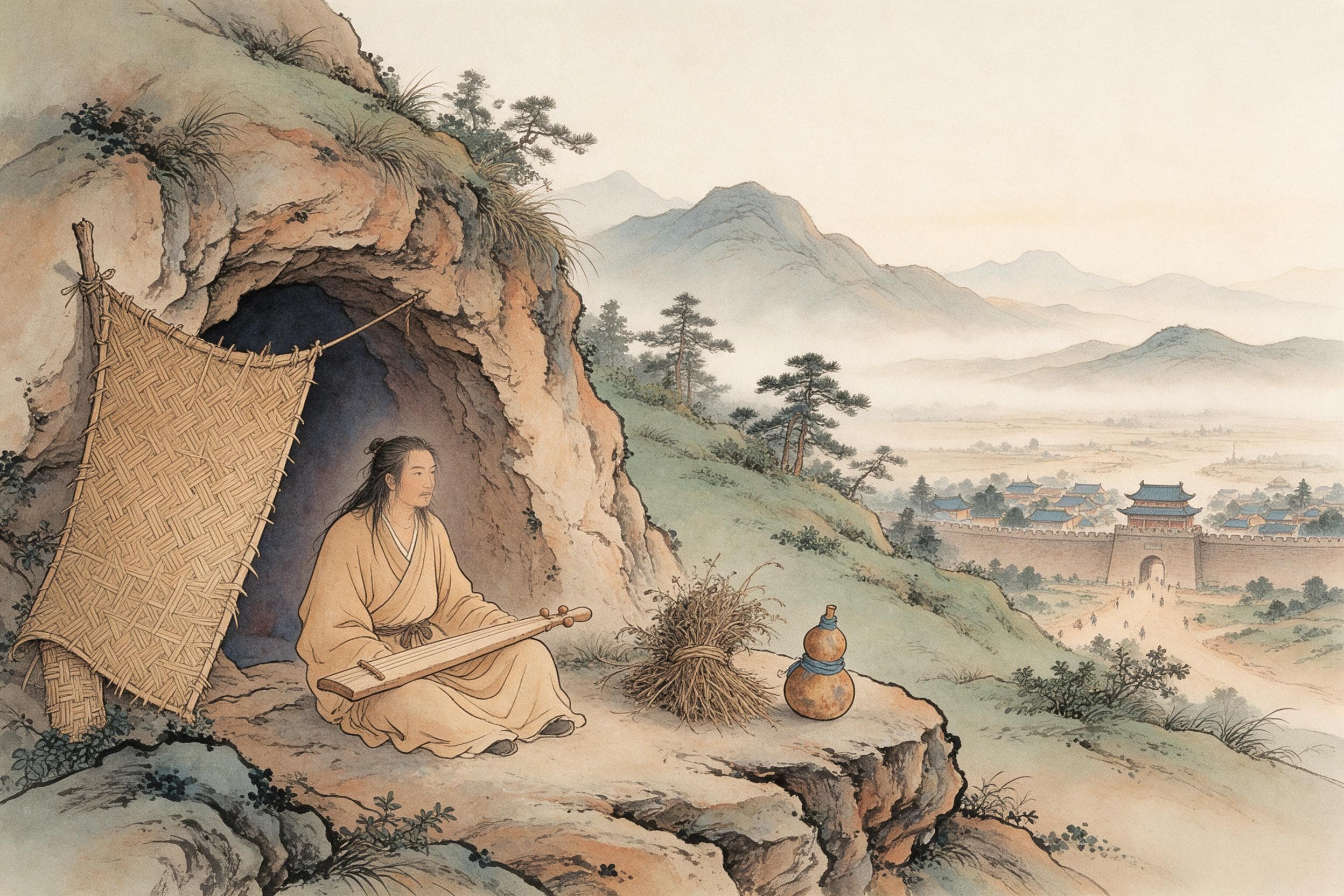
The biography begins with a man and his dwelling: 孫登,字公和,汲郡共人也。無家屬,于郡北山為土窟居之,夏則編草為裳,冬則被髮自覆。好讀《易》,撫一弦琴,見者皆親樂之 — Sun Deng, style Gonghe, a man of Gong in Ji commandery, with no family; he lived in an earthen cave on the north hill, wore grass cloth in summer and in winter covered himself with his hair; he liked reading the Changes and stroked a one-string zither, and all who saw him liked him. The order of facts is worth noticing: no family, then a dwelling, then clothes, then a book, then an instrument. Nothing is said about food, money or a teacher.
The rest of the biography is behaviour rather than teaching. 性無恚怒,人或投諸水中,欲觀其怒,登既出,便大笑 — he had no anger in him: people threw him into water to see him angry, and when he came out he laughed. 時時遊人間,所經家或設衣食者,一無所辭,去皆捨棄 — he went among people now and then, took food and clothes when they were set out, and left them behind when he went. At Yiyang Mountain a charcoal burner spoke to him, knowing he was no ordinary man; 登亦不應, he did not answer. Each item is a small test of temper, and each answer is the same: no anger, no refusal with the food, no reply to the stranger.
He speaks once in the whole biography, and only to a man who had followed him for three years. 嵇康又從之遊三年,問其所圖,終不答…將別,謂曰:先生竟無言乎? At parting the man asks whether he has nothing to say, and Sun Deng answers with fire: 子識火乎?火生而有光,而不用其光,果在於用光。人生而有才,而不用其才,而果在於用才。故用光在乎得薪,所以保其耀;用才在乎識真,所以全其年。今子才多識寡,難乎免於今之世矣!子無求乎 — do you know fire? Fire is born with light and does not use its light; the point lies in using it. So light depends on getting fuel, to keep its brightness, and talent on knowing what is true, to keep its years. You have much talent and little knowledge; it will be hard to escape this age. Ask for nothing. That is his only long speech, and the biography ends 竟不知所終, no one knows where he ended.
Dong Jing: The White Society and Torn Silk
The next life begins the same way, with a name and a place that is not given: 董京,字威輦,不知何郡人也。初與隴西計吏俱至洛陽,被髮而行,逍遙吟詠,常宿白社中。時乞於市,得殘碎繒絮,結以自覆,全帛佳綿則不肯受。或見推排罵辱,曾無怒色 — Dong Jing, style Weinian, of no known commandery; he came to Luoyang with a clerk from Longxi, walked with his hair loose, sang as he went, and often slept in the White Society; he begged in the market and tied torn scraps of silk together to cover himself, refusing whole bolts and good cotton; pushed and insulted, he never showed anger. The list of refusals is exact: torn silk accepted, whole silk refused, anger never shown.
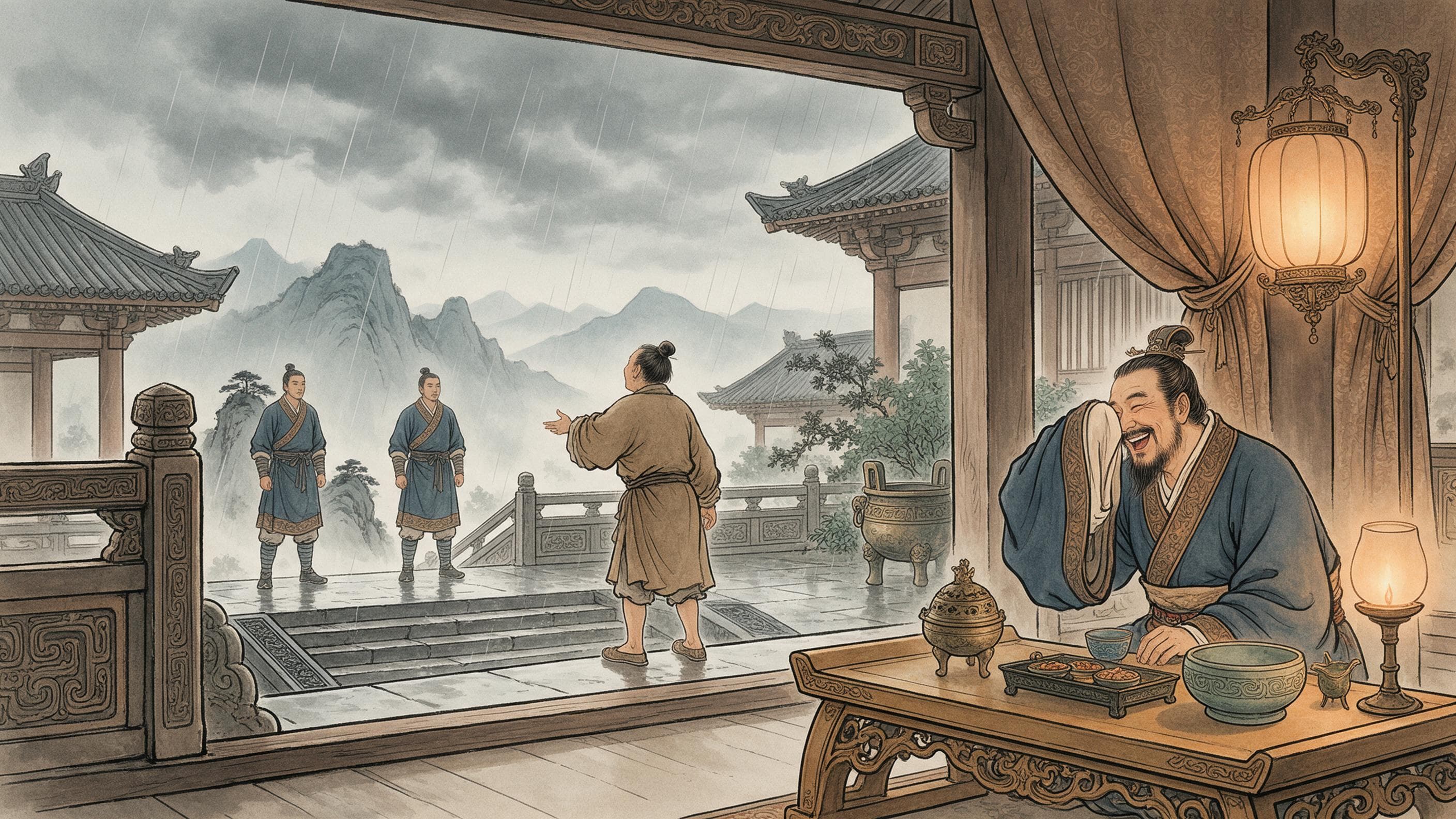
A scholar then serving as 著作郎, 孫楚, 數就社中與語,遂載與俱歸,京不肯坐 — came to the shrine to talk with him and took him home in a carriage, and Dong Jing would not sit down. Sun Chu wrote him a letter 勸以今堯舜之世,胡為懷道迷邦 — this is the age of Yao and Shun, why hide your way and lose the state? — and Dong Jing answered in verse: 周道斁兮頌聲沒,夏政衰兮五常汨… 清流可飲,至道可餐,何為棲棲,自使疲單? and 萬物皆賤,惟人為貴,動以九州為狹,靜以環堵為大. Then 後數年,遁去,莫知所之,於其所寢處惟有一石竹子及詩二篇 — years later he went off, no one knew where; where he had slept there were only a stone bamboo and two poems. The letter and the poem are the only argument in the chapter, and the argument is not about politics but about where a man should be.
A Recluse Is the Historian's Category
The chapter opens by explaining why these men are in it. The preface says 今美其高尚之德,綴集於篇 — we admire their lofty virtue and gather them into a chapter. 隱逸 is therefore the historian's classification, not a self-description; nothing on the page has either man calling himself a recluse. The entries vary too: Sun Deng has 無家屬, Dong Jing is 不知何郡人也; one is given a commandery, the other is not. A category of this kind does two things at once: it honours the men and it files them, and the filing is the historian's work.
What the page does not give is as steady as what it gives. How large the earthen cave was, how a one-string zither was played, what the White Society was, how torn silk was tied into a garment — none of it is on the page, and this article supplies none. The figures that are there are kept: three years of following, several years before he left, two poems, one stone bamboo, and the scraps of silk.
Two Versions of Sun Deng
The Shishuo page keeps Sun Deng inside another man's story, and its note supplies a description of its own: 孫登者,不知何許人。無家,於汲郡北山土窟住。夏則編草為裳,冬則被髮自覆。好讀易,鼓一絃琴,見者皆親樂之. Set beside the Book of Jin, two things differ: the note does not know his commandery, while the biography makes him a man of Gong in Ji; and the note has him 鼓, striking the zither, where the biography has him 撫, stroking it. The cave, the grass, the hair and the zither are the same.
The Shishuo's body text puts the whole meeting into one line, and the first item on that page is not about Sun Deng at all but about Ruan Ji whistling on Sumen Mountain; a note by Wang Yin identifies that mountain man with Sun Deng. The identification is a commentator's, and this article does not take it as fact. What the two pages agree on is the dwelling and the instrument, not a life. The two pages are not two witnesses to one life; they are two ways of placing one man, one in a chapter of types and one in an anecdote.
What This Article Leaves Out
It does not write 'Wei-Jin style' or a history of reclusion as a movement: the material is two biographies and a chapter preface, and the men are in the chapter because a historian put them there. It offers no psychology of why a man leaves office, no reconstruction of a cave or a zither, and no filling of the missing trades and places. The two contemporaries appear only as far as the page brings them: one visit that got no answer, one parting that got a speech. The article on Tao Qian takes another man from the same chapter, who left an office and wrote a poem about it; this one is about men described by where they lived and what they ate. What the chapter gives is a set of habits and a few objects; the reasoning behind them is mostly left to the one speech and one poem.
Related reading:Bureaus in the Sky: 118 Star Offices, 783 Stars · Xiao: A Battle Where Nobody Listened to the Old Men, and an Oath Written After · Renden: A Chapter of Men Who Broke the Rites
Sources & further reading
- 《晉書》卷九十四·隱逸傳(唐房玄齡等撰;維基文庫本,頁面白文) — The chapter preface 今美其高尚之德,綴集於篇; the 孫登 biography (孫登,字公和,汲郡共人也。無家屬,于郡北山為土窟居之,夏則編草為裳,冬則被髮自覆。好讀《易》,撫一弦琴…性無恚怒…登亦不應…嵇康又從之遊三年…子識火乎…竟不知所終) and the 董京 biography (董京,字威輦,不知何郡人也…常宿白社中…得殘碎繒絮,結以自覆…孫楚…京答之以詩…後數年,遁去).
- 《世說新語》棲逸第十八(南朝宋劉義慶撰,梁劉孝標注;維基文庫本,頁面白文附注) — The page's first item is 阮步兵嘯…蘇門山中… about Ruan Ji; the second puts Sun Deng inside a story about Ji Kang. The note to the second quotes 《康集·序》: 孫登者,不知何許人。無家,於汲郡北山土窟住。夏則編草為裳,冬則被髮自覆。好讀易,鼓一絃琴,見者皆親樂之; 王隱《晉書》 adds 孫登即阮籍所見者也.