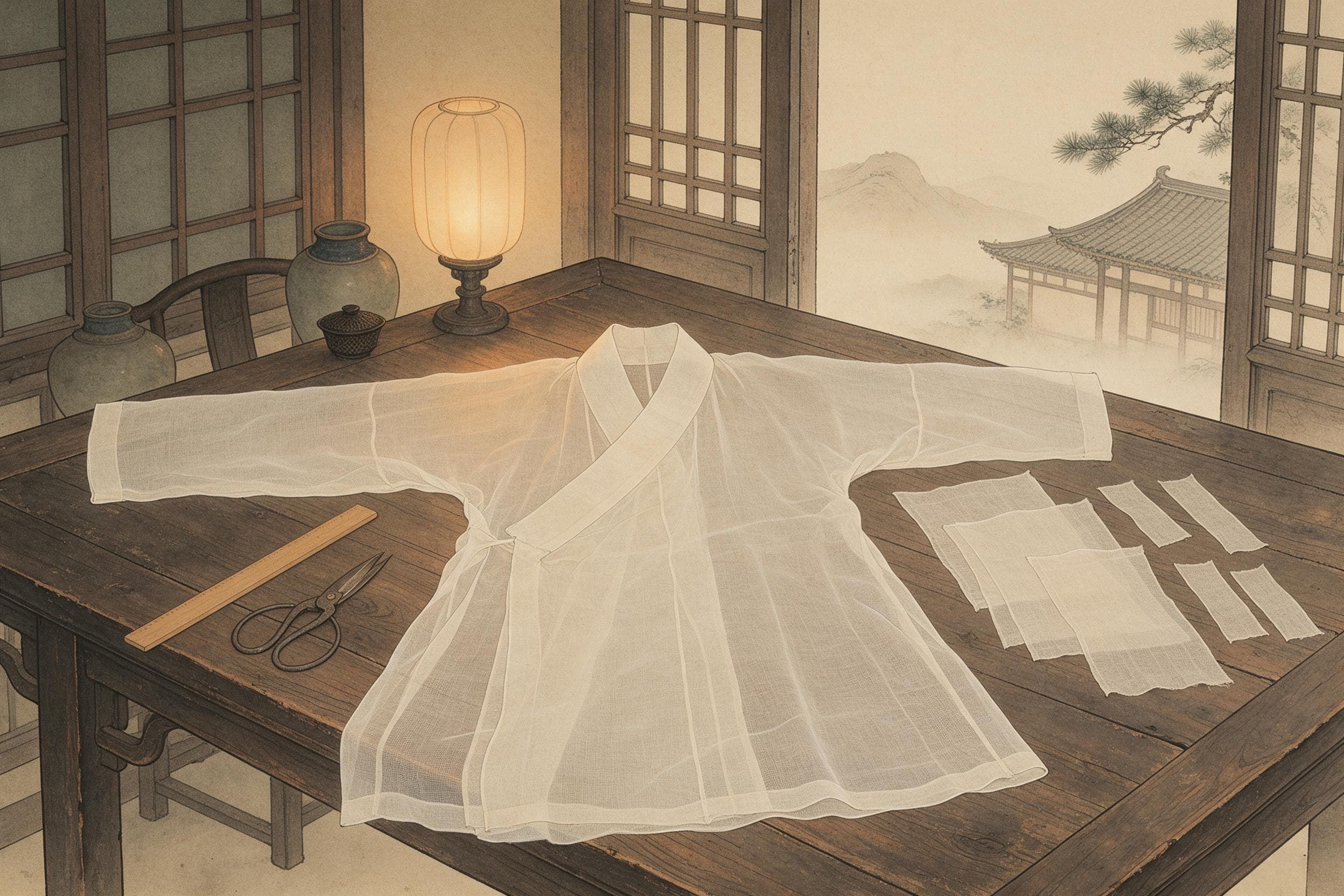
The robe is 128 centimetres long, 190 across the sleeves, and weighs forty-nine grams. The other, cut to curve, is longer — 160 by 195 — and weighs forty-eight. Two garments spanning a grown woman's arms, each lighter than a hen's egg. Held up, the cloth passes three-quarters of the light; folded five or six times over a newspaper, the report says, the print below is still legible. The question the object raises is not whether it is beautiful. It is how anyone makes a garment out of something this thin.
Both came from Mawangdui Tomb 1, excavated in 1972 near Changsha: the burial of Xin Zhui, wife of the chancellor of the Changsha kingdom, marquis of Dai, who died around fifty, some 2,200 years ago. They are now called susha danyi, “plain gauze single-layer robes”; the accurate older name is susha chanyi, a robe with no lining — “chan, a garment not doubled,” as the Shuowen glosses it. Plain gauze was already a luxury fabric in Zhou times, used as the lining of grander robes. Two cautions at the start. These are the grave goods of a marquis's household, not what ordinary people wore. And the colour is not the fabric's own: it was white when made, stained by fluid in the coffin, and exposure to air has since turned it a faint greyish buff.
Seven pieces
The straight-hem robe answers the question of cutting. It is a one-piece garment, top and skirt joined, made from seven pieces of cloth: four for the upper part, each a full bolt-width wide, and three for the lower, each a little more than half a bolt. The bolt is not a metaphor here: a loom's width fixes the width of every piece, and the cutting plan is built around that limit. The collar crosses and fastens to the right, lapel joined to collar and running down to a Y at the throat. The straight-hem version ties at the front. The curved-hem version is longer, and its lapel must travel round the back before returning to the front: 160 centimetres long, 195 across the sleeves, a 7-centimetre collar band, 5.5-centimetre cuff bands, 27-centimetre cuffs, a 48-centimetre waist, about 2.6 square metres of gauze — and 48 grams.
Forty-nine grams
The lightness is in the weave. Warp 58 to 64 threads a centimetre, weft 40 to 50, open enough to pass 75 per cent of the light. The silk came from three-sleep silkworms — larvae that moult three times, each weighing a little over a gram — whose thread is about a sixth the thickness of a human hair. Thin cloth is not automatically light: the difficulty is weaving thread this fine this openly, then cutting and sewing it without heavy facings. What the robe was for is not settled — an undergarment, a wedding dress, or simply something made for the tomb. Most scholars, the report notes, think it was worn over a bright brocade robe as a transparent outer layer. The report's superlatives — earliest, thinnest, lightest surviving silk garment — are the report's; with no comparable garment to check against, they stay a claim.
The people who wove it: series, support, head
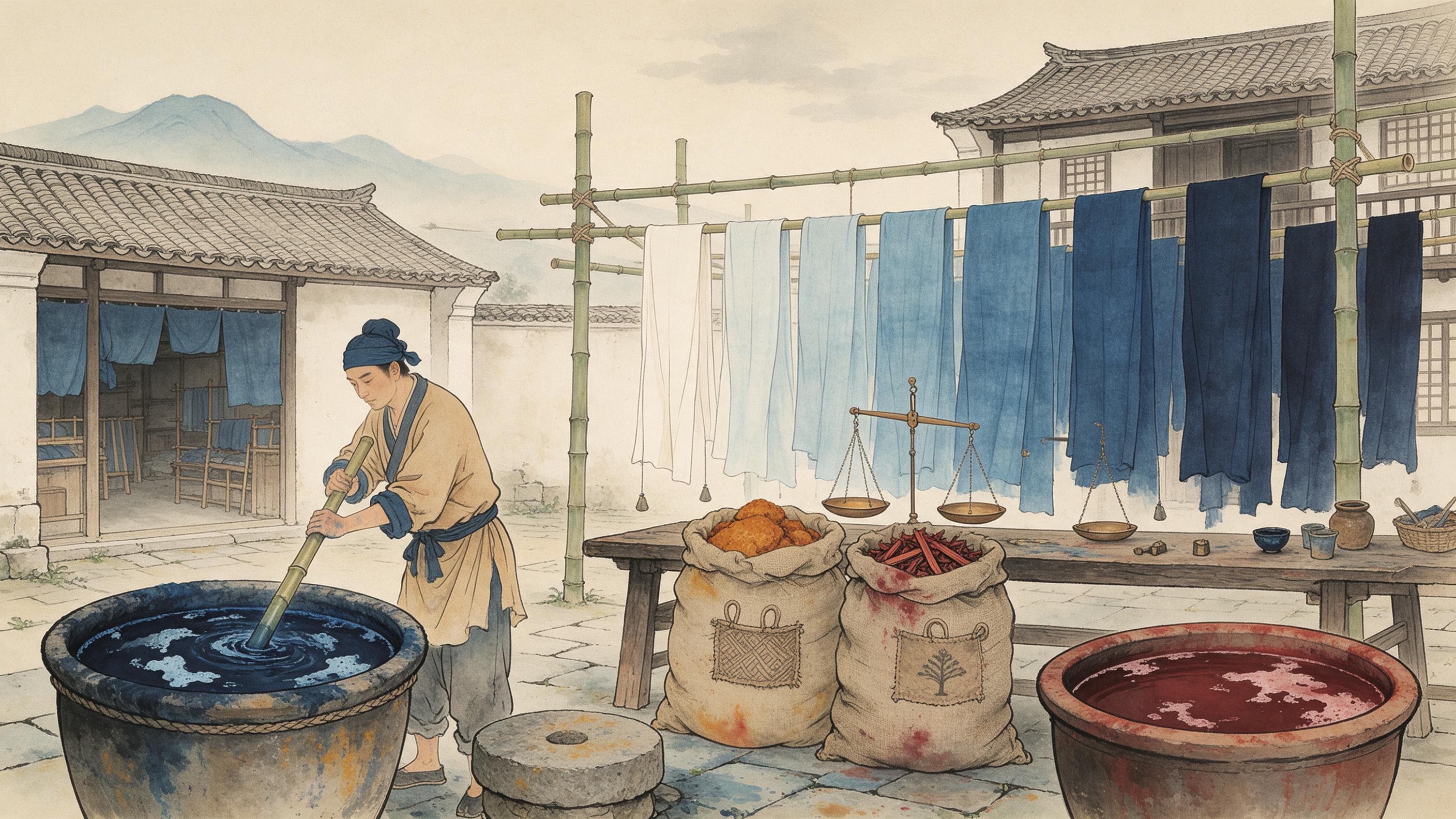
The regulations supply the arithmetic behind such cloth. Ribbons were woven to a counted standard: “one series” of single twisted threads, four series to a “support,” five supports to a “head,” five heads to a “pattern,” all one chi six cun wide — a bolt-width, the same measure that governs the cloth; and “the more heads, the finer the threads.” The ribbon (绶, shou) began as a thong: when the old jade-and-apron insignia fell out of use, Qin kept the knot and cord as a badge. Its heads (首, also shou), the count of thread-groups, then measure rank. The emperor's yellow-and-red ribbon ran two zhang nine chi nine cun and five hundred shou; a king's, two zhang one chi and three hundred; a duke's, marquis's or general's, one zhang seven chi and a hundred and eighty. Fineness of thread and height of rank are counted in one unit.
Rank on the head: caps
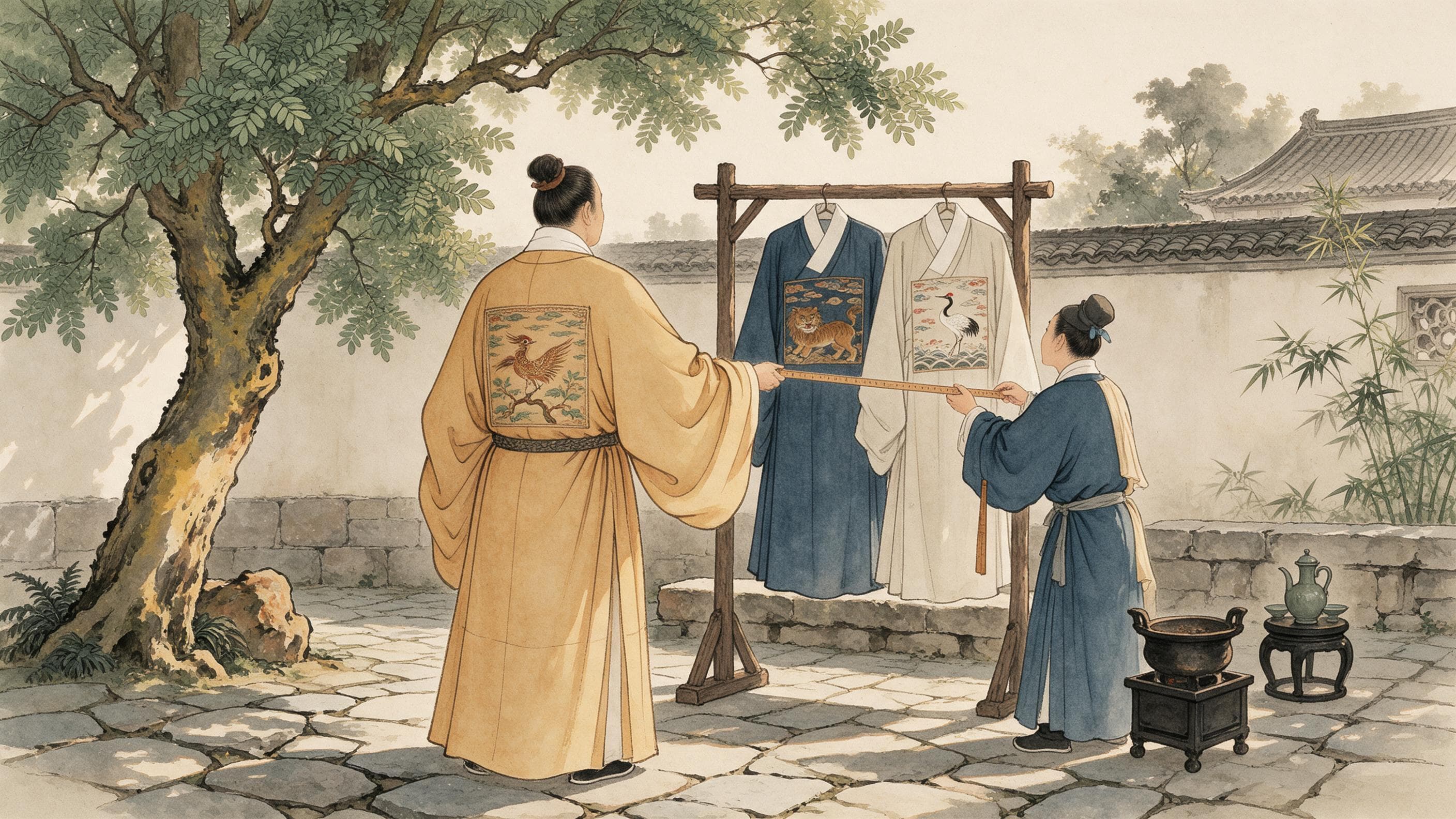
Rank was worn on the head too. The scholar's jinxian cap: seven cun high in front, three behind, eight long; three ridges for a duke or marquis, two from the middle two-thousand-bushel rank down to the erudites, one below that. The law officer's cap was five cun high; the guard's, four cun in front, four long, three behind. The regulations then go down the body: for the empress at the ancestral temple, dark blue above and black below; for the silkworm ceremony, green above and pale below, “both in the shenyi cut.” These are regulations from the Hou Hanshu, fixed in the second year of Yongping, AD 59 — two centuries after Xin Zhui was buried. They describe what ought to be worn, not what she wore.
The ribbons make the ladder visible. Emperor: yellow and red, four colours, 2 zhang 9 chi 9 cun, 500 heads. King: red, 2 zhang 1 chi, 300. Duke, marquis or general: purple, 1 zhang 7 chi, 180. Nine ministers and the two-thousand-bushel ranks: green, 1 zhang 7 chi, 120. The thousand- and six-hundred-bushel ranks: black, 1 zhang 6 chi, 80. Four hundred and below: yellow, 1 zhang 5 chi, 60. At the bottom, the blue-black ribbon of the hundred-bushel rank: one colour, 1 zhang 2 chi, no heads given. Colour, length and thread count fall together.
What colours you were allowed
Marriage stated the same thing in colour. A princess, a consort, a palace lady: twelve colours, in brocade, damask and silk. Above six hundred bushels: nine colours, and no cinnabar, purple or dark blue. Above three hundred: five. Above two hundred: four. “For merchants, xiang and piao only” — two pale shades, and nothing else. A merchant could be rich; the wardrobe stayed shut. The rulebook is not interested in taste: colour and length were meant to announce at a glance what a person was.
Put the halves together and the robe is two things at once. It is seven pieces of cloth, about 2.6 square metres of gauze, a warp of 58 to 64 threads a centimetre, silk from a worm a little over a gram, a finished garment of 48 or 49 grams — and it is the grave good of a marquis's wife, in a tomb furnished with lacquer and silk. The rulebook is two hundred years later and belongs to another court, but it shows what the same culture did with cloth: measured it in cun, chi and zhang, counted it in heads, and handed it out by rank. What the sources do not give is a price, or the hours in a single robe. Nobody recorded those. What was recorded is the cut and the scale.
Sources & further reading
- 范晔《后汉书》卷一百二十·志第三十·舆服下(冠服、佩绶、后夫人服) — The *jinxian* cap seven cun high in front; the law officer's cap five cun; ribbons of rank from the emperor's 2 zhang 9 chi 9 cun and 500 heads down to 1 zhang 5 chi and 60; the thread-count unit of series, support, head and pattern; marriage colours by rank, ending with 'for merchants, xiang and piao only'.
- 周惠斌〈素纱单衣的绝代芳华〉,《中国社会科学报》2024-12-27 — The two Mawangdui robes: straight-hem 128 by 190 cm, 49 g; curved-hem 160 by 195 cm, collar band 7 cm, cuff band 5.5 cm, cuff 27 cm, waist 48 cm, about 2.6 square metres of gauze, 48 g; seven pieces, four upper and three lower; warp 58–64 and weft 40–50 threads per cm, 75 per cent light transmission; three-sleep silkworms; colour changed by coffin fluid; the layered-over-brocade use is 'most scholars think'.