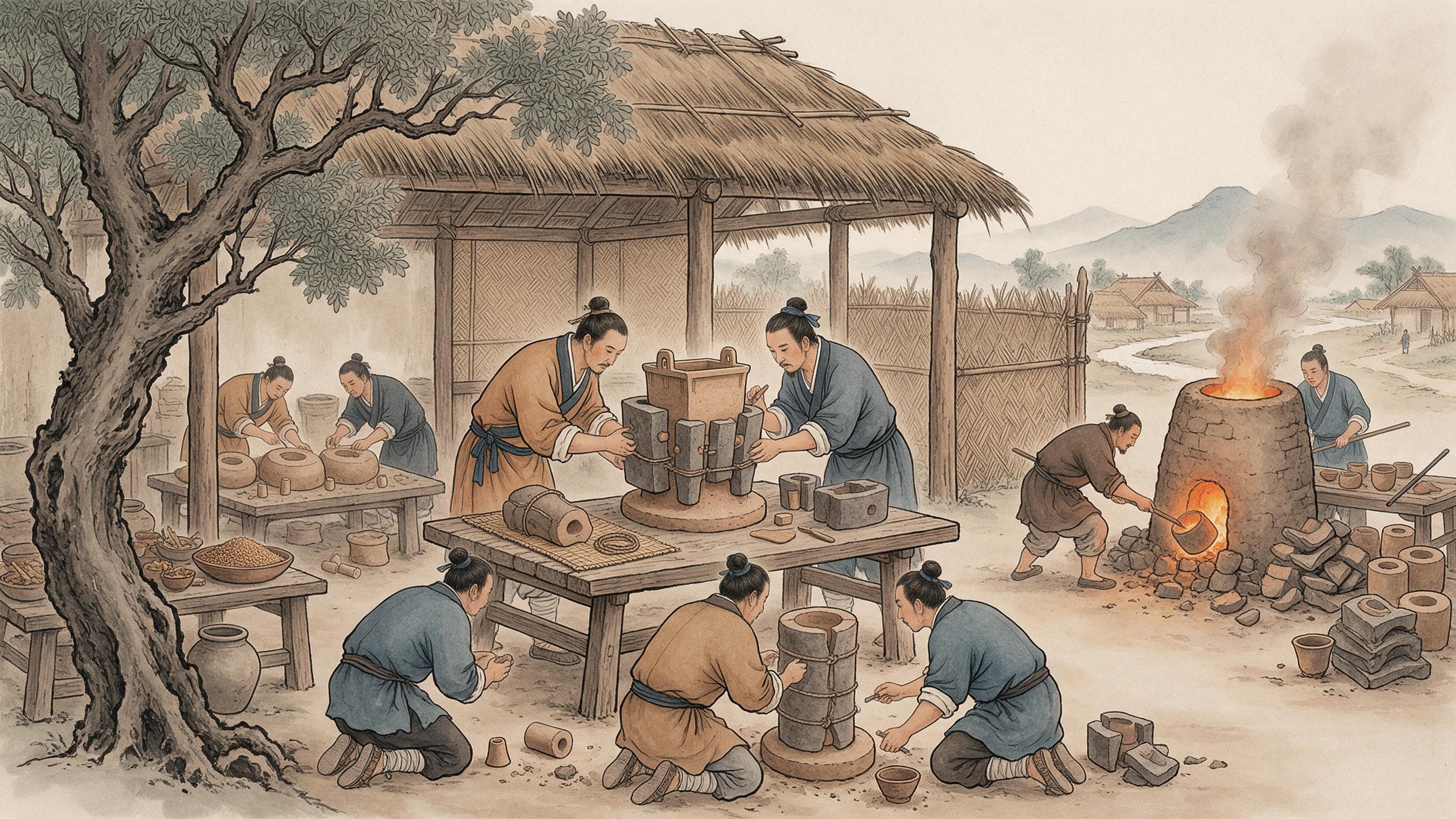
The object weighs 832.84 kilograms. It stands 133 centimetres to the top of its handles, is 116 centimetres long and 79 wide, and it was cast in the reign of Wu Ding, a Shang king of the late thirteenth century BCE. It is now in the National Museum of China, where it is called the Hou Mu Wu ding (后母戊鼎); for most of the twentieth century it was called the Si Mu Wu ding (司母戊鼎). What it took to make is the best-documented piece of Shang industrial history we have: the body and four legs were cast in one pour, and the body alone needed eight fired clay mould sections, each leg three more, the base and the interior four apiece; the two handles were cast on afterwards, by packing mould around the finished body. What the metal cost in labour is arithmetic: the raw material came to more than a thousand kilograms, a crucible of the period held about 12.5 kilograms of bronze, so the pour needed over seventy crucibles and, by one estimate, between one hundred and three hundred people working at once.
A recipe, a mould and a name
Analysis of the finished metal gives 84.77 per cent copper, 11.64 per cent tin and 2.79 per cent lead — a ratio the Guangming Daily account notes is close to what the Kaogong ji (考工记), a crafts manual written centuries later in the Warring States period, prescribes for cauldrons. The comparison is worth making precisely because of the gap: a Shang founder and a Warring States author, perhaps seven centuries apart, working within the same practical range. And the name is worth stating carefully. The National Museum now uses 后母戊; the older reading, 司母戊, is still widely met. Most specialists, the museum's own account says, prefer 后, reading it in the sense of the 后 of 皇天后土, a title of honour, so that the inscription means roughly "this great vessel for Mother Wu". That is a scholarly preference, not a correction set in stone, and the object has been known by both names.
Making the moulds was a technology of its own. Liu Yu's study of Yinxu casting describes ding moulds dividing vertically from three blocks into six, with separate sections for neck and belly, and a round lei built in five horizontal layers and six vertical blocks. Blind cores turned hollow legs into solid columnar ones. Small chaplets held the gap between mould and core, cutting casting faults; beast heads were made in inserted composite moulds. After the pour came soldering — bronze soldering in use by the late Shang, lead soldering possibly. The Xiaomintun and Miaopu Beidi workshops used clay of high silt, low clay and high porosity, washed from local earth. Who ran them is not recorded anywhere.
One tomb, 1,928 objects
If the ding shows what a state could make, the tomb of Lady Hao (妇好) shows what a single death could carry. Excavated in 1976 inside the palace-temple precinct at Yinxu, it is the only intact royal Shang tomb whose occupant can be identified from the oracle-bone inscriptions — Fu Hao, consort of Wu Ding. The pit held 1,928 objects: 468 bronzes, 755 jades, 63 stone pieces, 47 of gemstone, 564 of bone, three ivory vessels, and more than six thousand cowrie shells. Some accounts of the same tomb give 1,982 objects and 757 jades; the excavation institute's own figures are the ones used here. Of the 468 bronzes, 210 were ritual vessels — 44.8 per cent — and their composition is the interesting part: cooking vessels of three types made up about a fifth of the ritual set, serving vessels of only one type, the gui, and wine vessels 74 per cent, in fifteen different forms. There were 53 gu cups and 40 jue. In one tomb, dozens of matching drinking cups.
That is what "status" looked like in hard numbers: not a unique treasure but a set, assembled to a specification, heavy on wine. The Zhou writers who later explained the Shang collapse blamed exactly this — the Book of Documents' chapter on wine, a Zhou text, accuses the last Shang rulers of drowning in drink. It should be quoted as what it is, the victors' diagnosis, not as Shang self-description. The tomb also held 134 bronze weapons, 91 of them ge halberd blades and 37 arrowheads, and 54 jade weapons which, on inspection, show no wear at all: parade pieces. Two large bronze yue axes, nearly forty centimetres long and about nine kilograms each, are the ritual counterpart of that arsenal.
A hundred and thirty-one name tags
A generation later, another great tomb makes the same point differently. Tomb 54 at Huayuanzhuang East belongs to a man known as Ya Zhang (亚长); 131 of its bronzes carry the characters 亚长 or just 长. 亚 is a military title, 长 the family name, so the vessels are, in effect, name tags. Comparing tomb size, human and animal sacrifices, and the number of ritual bronzes and jades with other graves, the excavators concluded that his rank came second only to Lady Hao — a judgement from comparison, not a rule from a text. The showpiece is a bronze zun shaped like an ox: 40 centimetres long, 22.5 high with its lid, 7.1 kilograms, modelled on the wild water buffalo, its surface carrying more than twenty kinds of ornament. He also took seven yue axes into the grave; Lady Hao had four. A soldier's rank, restated in metal.
The jade is older than the tomb
The jades are stranger than the bronzes. Of the 755 pieces in Lady Hao's tomb, more than two hundred predate Wu Ding by generations or centuries, and one study traced 28 of them to still earlier cultures — Xinglongwa and Hongshan far to the north-east, Qijia in the north-west, Longshan and Taosi in the centre, Erlitou, the site associated with the Xia. A woman of the thirteenth century BCE was buried with objects already a thousand years old. Nor were jades used the way later handbooks imply: by the Shang, jade cong tubes were often simply ornaments — one with a bore of six centimetres could be worn as a bracelet — jade weapons show no cutting edge wear, and jade copies of farming tools are ritual pieces, not tools.
Where the raw stone came from is one of the good open questions. The jade is mostly nephrite, tremolite. One line of argument holds that its mineral signature differs from central Chinese deposits and points to Khotan in Xinjiang; another notes that certain yellow-white pieces from Anyang closely resemble Gansu tremolite. The author of the survey used here states the position plainly: most of this work rests on visual inspection and simple tests, and there is no decisive evidence of source. So: probably distant, possibly north-west, route unknown. The honest version reads better than a confident one.
What two tombs can and cannot say
Both tombs are high elite graves from the last century and a half of the Shang. They are points, not a map. The sources give no statistics for bronze or jade in ordinary burials, which mostly contain pottery, so nothing here should be turned into "the Shang used bronze vessels". Nor is there an extant Shang statute linking numbers of ding to ranks — the later ritual classics that do so, the Rites of Zhou and the Book of Rites, are precisely the texts that must not be read back into the Shang. Nor do the sources identify the copper, tin or lead mines: raw material had to travel, from where is still a research question, and the popular answers should be left alone. And the jade route itself, the "jade road" some scholars trace from Khotan through the Hexi corridor, remains a hypothesis that its own proponents describe as unproven.
Put the three things side by side. A cauldron of 832.84 kilograms, whose moulds, crucibles and crew can be counted. A tomb holding 1,928 objects arranged as a set, with wine at the centre, because a rank had a shape. And 755 jades, two hundred of them older than the woman they were buried with, from cultures whose names she could not have known. Bronze measured the power of the living; jade measured time. The Shang elite owned both, and took them into the ground.
Sources & further reading
- 翁淮南〈「后母戊」大方鼎:人类青铜文化的「中国样本」〉(Guangming Online, 2023-07-26; the author heads the National Museum's library) — The 832.84 kg ding: eight body moulds, three per leg, ears cast on afterwards; over a tonne of metal, 12.5 kg crucibles, seventy-odd crucibles, 100–300 men; alloy 84.77/11.64/2.79 per cent; the Si Mu Wu / Hou Mu Wu naming dispute.
- 韩鼎〈见器如晤——在考古材料中遇见多面的妇好〉(Chinese Social Sciences Net, 2023-04-20) — Lady Hao's tomb object by object: 1,928 items, 468 bronzes, 210 ritual vessels, 74 per cent wine vessels, 53 gu and 40 jue, 755 jades including 200-plus heirlooms; jade weapons without wear; the Shang wine-drinking critique quoted from the Book of Documents.
- 中国社会科学院考古研究所〈重现殷商盛世 讲述传奇一生——妇好墓发掘四十周年特展隆重开幕〉(China Archaeology Network, 2016-03-08) — The excavation institute's official figures for M5: 1,928 objects, 468 bronzes, 755 jades, four bronze yue axes.
- 刘煜(梁一凡整理)〈讲座回顾丨刘煜:殷墟青铜器制作技术研究〉(China Archaeology Network, 2023-05-04) — How Shang bronzes were cast: ding moulds dividing from three blocks into six, a round lei in five layers and six blocks; blind cores, chaplets, inserted composite moulds; bronze soldering, lead soldering possibly; the Xiaomintun and Miaopu Beidi workshops and their high-silt, low-clay, high-porosity clay.
- 王文洁〈一位殷商贵族将军的鲜活人生〉(Science and Technology Times, 2024-03-02) — Tomb M54 of Ya Zhang: 131 inscribed bronzes, seven yue axes against Lady Hao's four, the 7.1 kg ox-shaped zun, and the excavators' judgement that his rank came second only to hers.
- 徐成〈「玉石之路」:中华文明统一性的史前基础〉(National Humanities History, 2024-09-24) — Jade sources for Shang tombs: Khotan hypothesis versus Gansu hypothesis, with the author's own caveat that no decisive sourcing evidence exists.