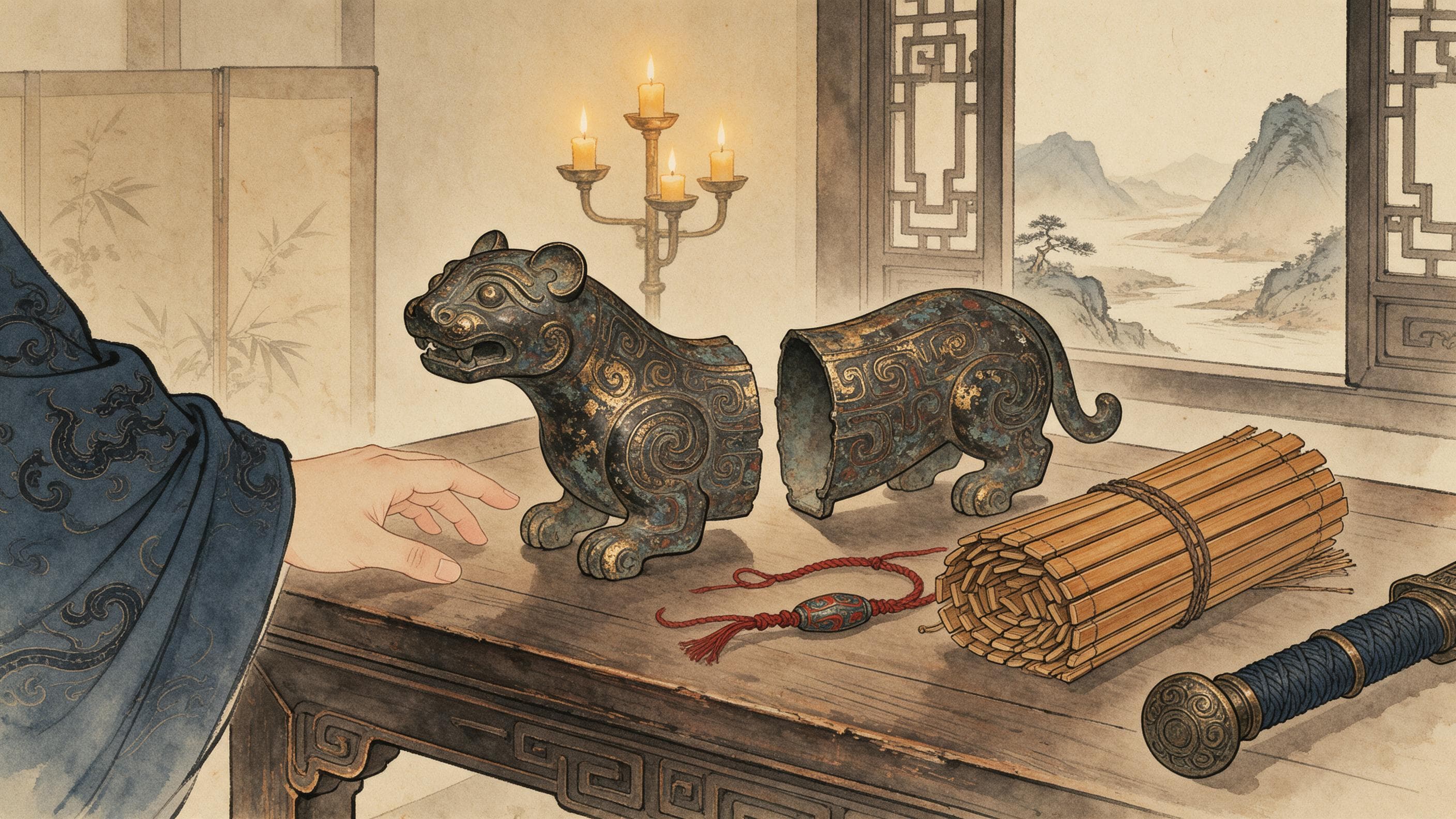
The best summary of the Announcement to Kang is not in the announcement. The Shiji says that when Kang Shu was enfeoffed, 'the Duke of Zhou, fearing that Kang Shu was young, repeated his charge to him: you must seek out the worthy men, gentlemen and elders of Yin, ask why their former dynasty rose and why it fell, and set your mind on caring for the people' (必求殷之賢人君子長者,問其先殷所以興,所以亡,而務愛民). A place just conquered: the first instruction is to go and question the old men of the previous dynasty. This piece is about the text that charge introduces — the Kanggao, a proclamation, not a code.
One: who was enfeoffed, and where
The background first. After the conquest the Yin remnant was given to Wu Geng, son of the last Shang king; when Guan Shu, Cai Shu and Wu Geng rebelled, 'the Duke of Zhou raised troops against Yin by King Cheng's command, killed Wu Geng and Guan Shu, banished Cai Shu, and gave Wu Geng's remaining Yin people to Kang Shu as lord of Wei, to dwell between the He and Qi on the old Shang ground' (殺武庚祿父、管叔,放蔡叔,以武庚殷餘民封康叔為衞君,居河、淇閒故商墟). The place is precise — between the He and the Qi, on the ruins of Shang — and the man was the youngest full brother of King Wu.
Three texts went with the fief: 'he told him how Zhou's fall came from indulgence in wine… he made the Zicai to show that a gentleman has a model to follow, and so they are called the Kanggao, the Jiugao and the Zicai, with which he charged him' (爲梓材……故謂之《康誥》、《酒誥》、《梓材》以命之). The result is one sentence: 'when Kang Shu took the state, having been charged in this way, he was able to harmonise and gather his people, and the people were greatly pleased' (能和集其民,民大說). Later he was made Zhou's minister of crime. That is all the page gives on his rule — one sentence — and this piece neither adds to it nor invents an administration for him.
Two: whose is the 'king' who speaks
The whole text runs on 'the king, as if to say', and the first words are: 'Meng Hou, my younger brother, the little one Feng' (孟侯,朕其弟,小子封). The speaker calls the lord of Wei his younger brother, so he is an elder brother of Kang Shu. The Shiji names him — the Duke of Zhou 'repeated his charge to Kang Shu'. One common reading has the Duke of Zhou speaking for the young King Cheng; another has King Cheng speaking himself. The two are set side by side here and not decided, and the body of this piece says only 'the king'. One more layer: the page's header attributes the chapter to Ji Dan, the Duke of Zhou, while the text itself says only 'the king' — the header is later editorial matter and cannot settle who speaks.
Three: a four-word spine
The spine of the charge is four characters long, and it begins as praise of the father: 'your great and illustrious deceased father, King Wen, was able to illustrate virtue and be cautious in punishment, and did not dare treat the widower and the widow with contempt' (惟乃丕顯考文王,克明德慎罰,不敢侮鰥寡). Then the same measure is handed to Kang Shu: 'illustrate your punishments with care' (敬明乃罰). These are quoted as the text's sentences; this piece does not turn them into a theory of government.
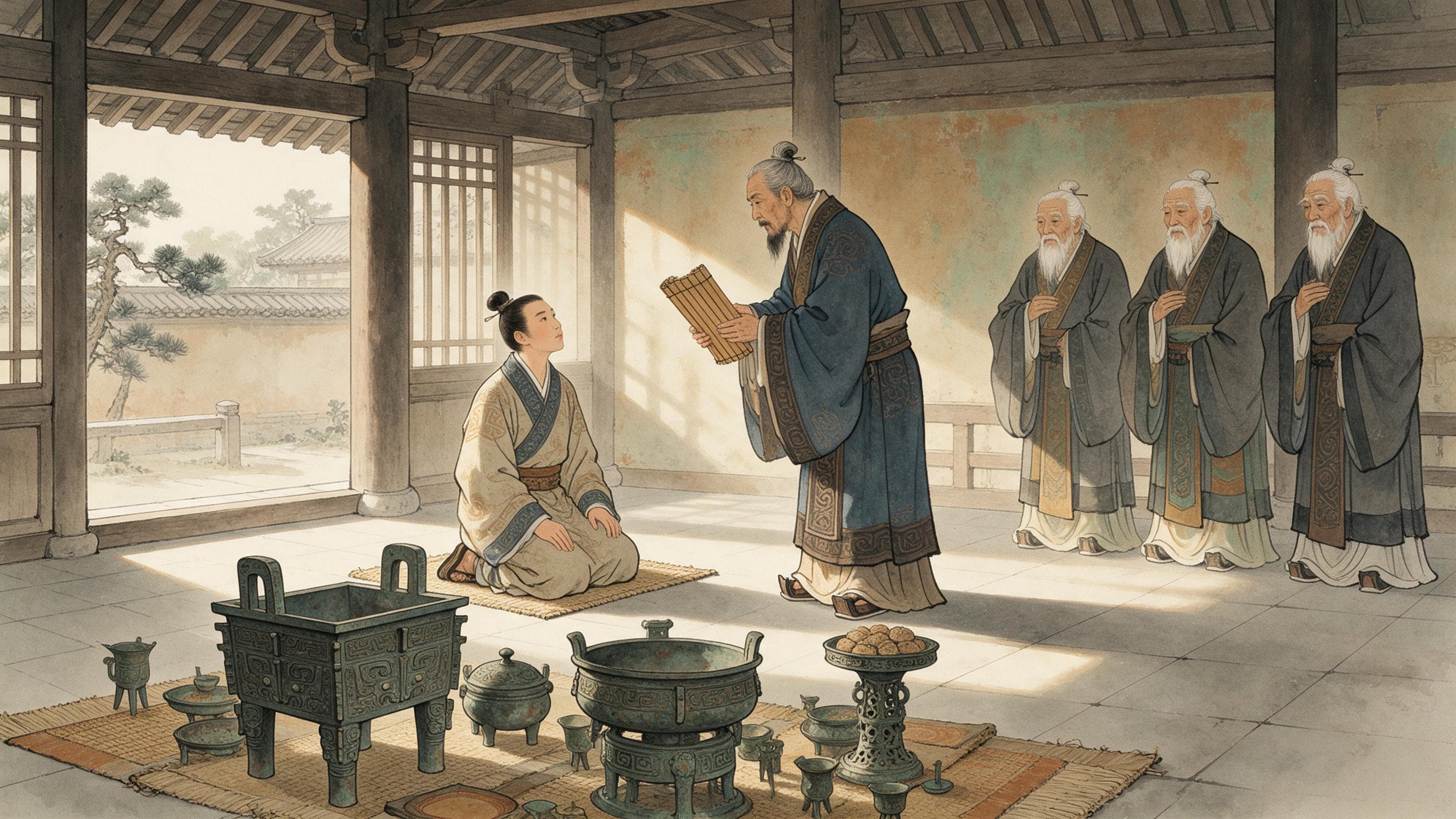
What the charge asks him to do first is to ask. 'Go and seek out on every side the former wise kings of Yin, to protect and govern the people. Do not fail to keep far in mind the venerable adults of Shang, and take their instruction to heart' (往敷求于殷先哲王……汝丕遠惟商耇成人,宅心知訓). The 'venerable adults' are generally taken to be old men of proven worth; the page carries no note. The same speech gives 'make a new people' (作新民) and a proverb on grievance: 'grievance lies not in what is great, nor in what is small' (怨不在大,亦不在小).
Four: three standards for judging
The sharpest standard turns on intention, not on the size of the offence: 'if a man has a small offence, and it is not a mischance but something he has done habitually and deliberately, then though his offence be small, he must not but be killed. But if he has a great offence, and it is not habitual but a mischance and a disaster, and he has in fact confessed the whole of his guilt, then he must not be killed' (人有小罪,非眚,乃惟終自作不典……乃不可不殺……乃有大罪,非終,乃惟眚災……時乃不可殺). 眚 is generally read as a mischance or error, and 非眚 as its opposite; the page glosses neither.
The second standard is about time: 'for important prisoners, ponder them for five or six days, up to a ten-day period, and only then decide the important prisoners' (要囚,服念五六日,至于旬時,丕蔽要囚). That is quoted as a charge to hold and think; this piece does not call it an established procedural limit. The third is precedent: 'in external affairs, set out your standards and follow this Yin punishment in its order' (外事,汝陳時臬,司師兹殷罰有倫); 'decide punishments by the Yin constant law, using its fitting punishments and fitting killings, and do not simply follow yourself' (罰蔽殷彝,用其義刑義殺,勿庸以次汝封). Yin punishment and Yin constant law are generally taken to mean Yin precedents and standing rules (the page gives no gloss); this piece reconstructs no Shang law and quotes no oracle text.
Five: the punishment is not yours
The last line of the spine is that the power to punish is not the lord's own: 'it is not you, Feng, who kill or punish men — let no one kill or punish men of himself; it is not for you, Feng, to say I will cut off his nose or his ear — let no one cut them off himself' (非汝封刑人殺人,無或刑人殺人……無或劓刵人). The two similes that go with it are gentler: 'as if you had a sickness, the people will cast off their faults entirely; as if you were guarding an infant, the people will be at peace and well governed' (若有疾,惟民其畢棄咎。若保赤子,惟民其康乂).
One more clause puts family crimes high: 'the great evil and the great hatred — how much more so when it is unfilial and unfriendly' (元惡大憝,矧惟不孝不友), with sons who do not serve their fathers' affairs, fathers who do not cherish their sons, younger brothers who do not respect elder brothers; for these, 'hasten to apply the punishments King Wen made; punish them without pardon' (曰乃其速由文王作罰,刑兹無赦). Quoted as written; this piece does not expand it into an ethical doctrine.
The charge closes shortly: 'go, Feng. Do not neglect the reverent statutes; hear my charge to you, and with the Yin people you shall enjoy your line for generations' (往哉,封!勿替敬典,聽朕告汝乃以殷民世享). But it remains a speech, not a code: no numbered articles, no list of penalties. What the two pages do not give: any single case, the details of how punishments were carried out, or Kang Shu's actual administration beyond that one sentence. The building of the new capital at Luo, mentioned in the opening line, belongs to another subject and is only gestured at; the lineage of Wei is not traced; no reign year is converted into a Western date. What the pages leave is a charge to go and ask the old men, a four-character spine, three standards, and one sentence saying the punishment is not yours.
Related reading:Three Hundred and Fifty-Nine Chapters: How Many Laws Did Han China Have? · Governor, Commandant, Inspector: Qin's Commandery and County Officers · When Coins Ran Short: Small Coins and a Proposal to Abolish Money
Sources & further reading
- 《尚书·康诰》(维基文库本,未与点校本复核) — The proclamation itself, about 1,400 characters. The king addresses 'Meng Hou, my younger brother, the little one Feng' (孟侯,朕其弟,小子封), praises King Wen for being 'able to illustrate virtue and be cautious in punishment' (克明德慎罰), tells him to seek out the former wise kings of Yin and to keep in mind 'the venerable adults of Shang' (商耇成人), and to 'make a new people' (作新民); then the judicial charge — the small offence deliberately and habitually done that must be killed, the great offence by mischance and not repeated that must not be killed (非眚……乃惟終……/非終,乃惟眚災……時乃不可殺), the instruction to ponder important prisoners 'five or six days, up to a ten-day period' (要囚,服念五六日,至于旬時), the use of Yin precedent (司師兹殷罰有倫;罰蔽殷彝), the sentence that punishment is not the lord's own (非汝封刑人殺人), and the close 'do not neglect the reverent statutes… with the Yin people you shall enjoy your line for generations' (勿替敬典……殷民世享). The page carries editorial correction brackets in the text (庸(用), 衣(殷), 宅(度), 已(嘻) and many others); those are the transcribers' variant marks, not the original, and quotations here take the main text only. The page header attributes the chapter to Ji Dan (the Duke of Zhou), while the text itself says only 'the king'.
- 司马迁《史记》卷三十七〈卫康叔世家〉(维基文库本,未与点校本复核) — Why the proclamation was made: after the conquest the Yin remnant was given to Wu Geng, son of the last Shang king; when Wu Geng, Guan Shu and Cai Shu rebelled, the Duke of Zhou 'raised troops against Yin by King Cheng's command, killed Wu Geng and Guan Shu, banished Cai Shu, and gave Wu Geng's remaining Yin people to Kang Shu as lord of Wei, to dwell between the He and Qi on the old Shang ground' (以武庚殷餘民封康叔爲衞君,居河、淇閒故商墟). 'Fearing that Kang Shu was young, he repeated his charge to him: you must seek out the worthy men, gentlemen and elders of Yin, ask why their former dynasty rose and why it fell, and set your mind on caring for the people' (必求殷之賢人君子長者……而務愛民). Then the three texts, the one-line result ('he was able to harmonise and gather his people, and the people were greatly pleased' 能和集其民,民大説), and his later appointment as Zhou's minister of crime. The page has editorial -{…}- marks, which are not quoted.