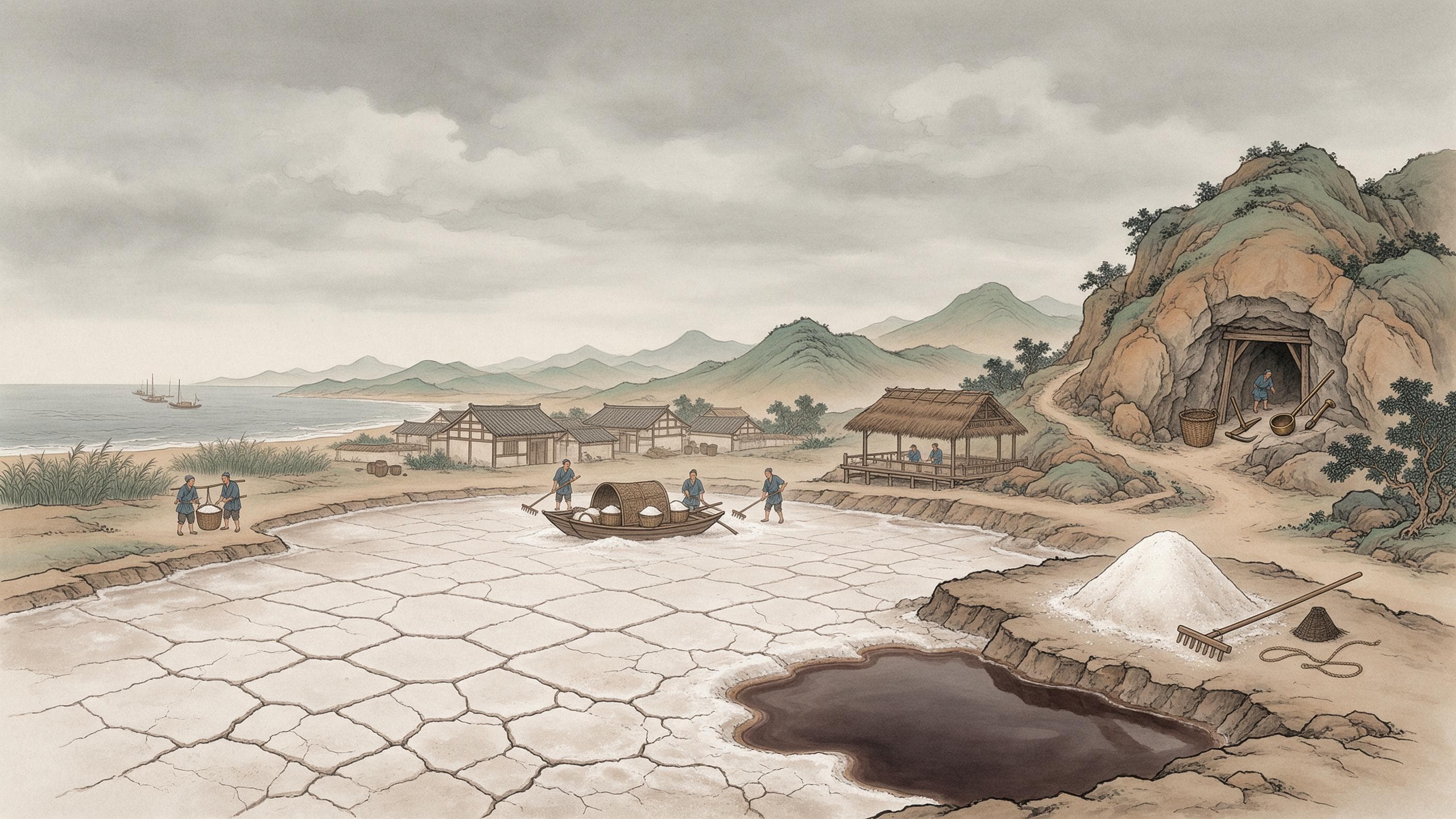
Two revenues, one consequence. The page gives the account in one line: 吳有豫章郡銅山 — the kingdom of Wu had a copper mountain in Yuzhang commandery — and then 以故無賦, and on that account there were no taxes. A kingdom that took nothing from its fields needs an explanation, and both pages give the same one: metal out of a mountain, salt out of the sea, and men brought in from elsewhere to work them. This article is about those two revenues, that labour and what came of them, not the life of the king who held them. The two revenues are given as an entry, not as a policy.
The Copper Mountain in Yuzhang
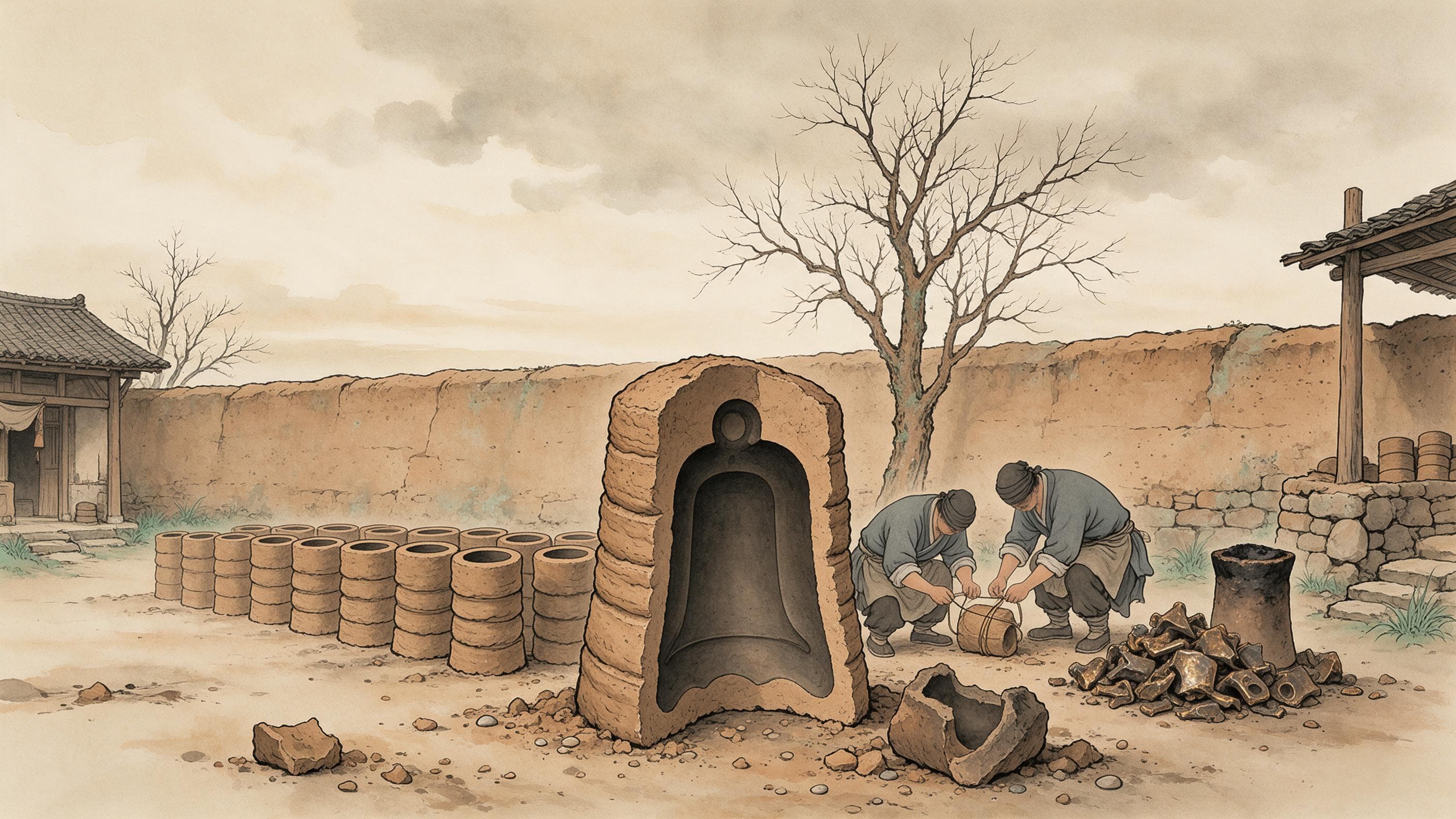
The Shiji's sentence, as the page prints it: 吳有豫章郡銅山 — the copper mountain — then 濞則招致天下亡命者, and after that a marked character this article does not quote across. What the page says plainly on the other side of the mark is 煮海水為鹽,以故無賦,國用富饒: sea water boiled for salt, no taxes, a full treasury. The Hanshu has the same event in its own words: 吳有豫章郡銅山,即招致天下亡命者盜鑄錢,東煮海水為鹽,以故無賦,國用饒足 — no 濞則, 東 before 煮, and 饒足 for 富饒.
The caution is not pedantry. The Shiji page prints 亡命者(益)[盜]鑄錢, and the bracketed characters are a collator's correction, so that phrase cannot be quoted as continuous text; 招致天下亡命者 can, and 鑄錢 is used here as a word rather than as a settled character in that sentence. For the marked place the Hanshu is the plain witness: its sentence has the casting with no brackets at all. That is the first reason these two pages are set side by side instead of one being kept as backup — the Shiji here is a text with corrections in it, and the Hanshu is the same story in a later, smoother telling.
The Sentence in the Memorial
The sentence most often put on this story — 即山鑄錢,煮海水為鹽 — is in neither narrative opening. It comes from Chao Cuo's memorial against Wu, and each page has its own version. The Shiji: 即山鑄錢,煮海水為鹽,誘天下亡人,謀作亂 — coining at the mountain, boiling sea water for salt, luring in fugitives, plotting rebellion. The Hanshu: 公即山鑄錢,煮海為鹽,誘天下亡人謀作亂逆 — with 公 in front, 煮海 without 水, and 逆 at the end. The whole line is a charge, not a description: the two revenues and the one labour supply listed together as evidence of intent.
What the cutting took was the same ground. When the memorials were acted on, the Shiji says 因削吳之豫章郡、會稽郡 — Yuzhang and Kuaiji cut away from Wu; the Hanshu keeps the pair in another sentence, 乃削吳會稽、豫章郡書至, which records only the document arriving. Yuzhang is where the copper mountain is; the page does not say where the salt works stood, and this article does not supply them a coast. The cut is noted and the war is not: both pages give the seven states in a few lines.
The Men Who Had Nothing to Lose
The labour is one clause on both pages: 招致天下亡命者 — summoning in men who had lost their registration and gone. 亡命 and 亡人 are copied as the pages write them, and not turned into modern talk about desperadoes, because the pages do not describe these men at all. What they describe is Wu shielding them: 佗郡國吏欲來捕亡人者,訟共禁弗予 (the Hanshu has 它 and 頌共禁不與) — when officials of other commanderies came to arrest fugitives, Wu's people argued and refused to give them up; the Hanshu has 頌共禁不與. That is the social side of the two revenues: the coin and the salt were worked by men the rest of the empire was hunting.
Put the three together and the entry is complete: a mountain with copper, a sea to boil, men who could not go home. Technique, output, numbers of workers, salt administration — none of it is on either page and none is added here. 即 is generally read as 就, coining at the mountain itself, and no more is made of it. The two revenues are never given as figures anywhere: no sum of coin, no weight of salt. Nor is the 東 of the Hanshu explained: it is kept as the page has it.
No Taxes
The consequence is written as household economy: 然其居國以銅鹽故,百姓無賦。卒踐更,輒與平賈。歲時存問茂材,賞賜閭里 — because the kingdom lived on copper and salt, the common people paid no tax; men on shift duty got the going wage, 踐更 being generally taken as service by rotation and 平賈 as the current price; at the proper seasons the worthy were enquired after and the lanes rewarded; and the Hanshu writes 予 for 與. Which levies were waived the pages do not say — only that the people paid no tax — and no tax list is filled in here.
How long it lasted is where the numbers part: 如此者四十餘年,以故能使其眾 — so for more than forty years, and on that account he could move his people; the Hanshu reads 三十餘年. The two figures are set side by side and not reconciled. 能使其眾 is the phrase both pages use, and it deserves a pause: the clause that praises light levies also describes a lord who could raise and hold a following. The verdicts land in the same place. The Shiji's 太史公曰 has 能薄賦斂,使其眾,以擅山海利 — light levies, a people he could move, and the profits of mountains and seas — and elsewhere in the same remark, 故古者諸侯地不過百里,山海不以封. The Hanshu's 贊曰 has 吳王擅山海之利,能薄斂以使其眾.
Mountains and Seas Are Not Enfeoffed
Both verdicts carry the rule: 山海不以封, mountains and seas are not granted in fief. The Hanshu gives it with a reason, 古者諸侯不過百里,山海不以封,蓋防此矣 — in antiquity a lord's land did not exceed a hundred li and mountains and seas were not enfeoffed, precisely to guard against this; the Shiji has the same rule in the same place. Neither page calls it law: 不以封 is about what may be granted, not about who collects the salt and the coin. The pages put it in the judgement, not in a statute, and this article does the same, without turning it into a general essay on princely economies.
Then the edict gathers the four parts into a charge. 天子制詔將軍 opens it on both pages, with 曰 in the Shiji only, and the two texts part at two characters: the Shiji has 吳王濞倍德反義,誘受天下亡命罪人,亂天下幣,稱病不朝二十餘年; the Hanshu has 背德 for 倍德 and 稱疾 for 稱病. The span 誘受天下亡命罪人,亂天下幣 is identical in both — drew in the desperate criminals of the world, threw the coinage of the world into confusion — the men and the coin in one sentence, which is what the two revenues and the labour supply come to as an accusation. Note what the edict does not say: it does not charge the king with illicit coining. On the pages the casting is 盜鑄錢, done by the men he summoned; the charge against him is 亂天下幣, confusing the coinage, not forging it himself.
Boundaries and variants, one line each. The war: both pages give the seven states in a handful of lines and none of it is filled in. The man: son of the emperor's elder brother, made king of three commanderies and fifty-three cities because Wu and Kuaiji were judged too light and fierce to be left without a strong lord; no more of his life is told. The coin: the court's repeated seizure of the coinage is another article, the salt-and-iron debate another, the death penalty for illegal coining another, and no general essay on regional separatism is written here. Variants kept apart: 富饒 and 饒足; 卒踐更,輒與平賈 and 輒予平賈; 訟共禁弗予 and 頌共禁不與; 四十餘年 and 三十餘年; 煮海水為鹽 and 煮海為鹽, with and without 東; 濞則 in the Shiji and nothing in its place in the Hanshu; 倍德 and 背德, 稱病 and 稱疾 in the edict. The minister's name is page-bound too: this Shiji chapter writes 晁錯, this Hanshu chapter writes 朝錯, and each page keeps its own spelling. The Hanshu is longer than the Shiji throughout this stretch, and nothing here is treated as two independent witnesses.
Related reading:Who May Cast the Coin: The Five-Zhu and Three Seizures of the Mint · A Clamp on the Left Foot: Why the Han State Took Salt and Iron · Forging Coins: One Death Sentence and Hundreds of Thousands Convicted
Sources & further reading
- 《史记》卷一百六·吴王濞列传第四十六(西汉司马迁撰;维基文库本,白文无注,页头未标 textquality,未与中华书局点校本复核) — The shorter narrative, and the one whose single sentence carries the whole subject: 吳有豫章郡銅山,濞則招致天下亡命者盜鑄錢,煮海水為鹽,以故無賦,國用富饒 — a copper mountain in Yuzhang commandery, men with nothing to lose summoned in from everywhere, coin cast, sea water boiled for salt, and on that account no taxes and a full treasury. The page prints an editorial mark in that sentence (亡命者(益)[盜]鑄錢), so this article quotes only the spans without marks. It also has the household side: 然其居國以銅鹽故,百姓無賦。卒踐更,輒與平賈。歲時存問茂材,賞賜閭里, the refusal to surrender fugitives, 它郡國吏欲來捕亡人者,訟共禁弗予, and the duration, 如此者四十餘年,以故能使其眾. The phrase 即山鑄錢,煮海水為鹽 appears in this chapter only in Chao Cuo's memorial, where it is a charge: 即山鑄錢,煮海水為鹽,誘天下亡人,謀作亂. The cut is recorded as 因削吳之豫章郡、會稽郡. The chapter's 太史公曰 adds 能薄賦斂,使其眾,以擅山海利 and 山海不以封. Text obtained through the Wikisource export service (ws-export.wmcloud.org); the page header (textquality) could not be re-checked in that export and is reported as the pack records it.
- 《汉书》卷三十五·荆燕吴王传第五(东汉班固撰;维基文库本,白文无注,页头未标 textquality,未与中华书局点校本复核) — The same event, in Ban Gu's wording, and longer throughout: 吳有豫章郡銅山,即招致天下亡命者盜鑄錢,東煮海水為鹽,以故無賦,國用饒足 — no 濞則, 東 before 煮, 饒足 for 富饒. The chapter is not an independent witness: it expands the Shiji, and the two are set side by side in this article rather than used to corroborate each other. Its own variants: 輒予平賈 for 輒與平賈, 頌共禁不與 for 訟共禁弗予, 三十餘年 for 四十餘年, and in the memorial 公即山鑄錢,煮海為鹽,誘天下亡人謀作亂逆, with 公 in front, 煮海 without 水, and 逆 at the end. The cut is recorded in a different sentence, 乃削吳會稽、豫章郡書至. The 贊曰 ends 吳王擅山海之利,能薄斂以使其眾, and quotes the rule 古者諸侯不過百里,山海不以封,蓋防此矣. Note that this chapter writes the remonstrating minister 朝錯 where other chapters of the Hanshu write 晁錯; the spelling is kept page by page. Text obtained through ws-export.wmcloud.org; the page header could not be re-checked in that export.