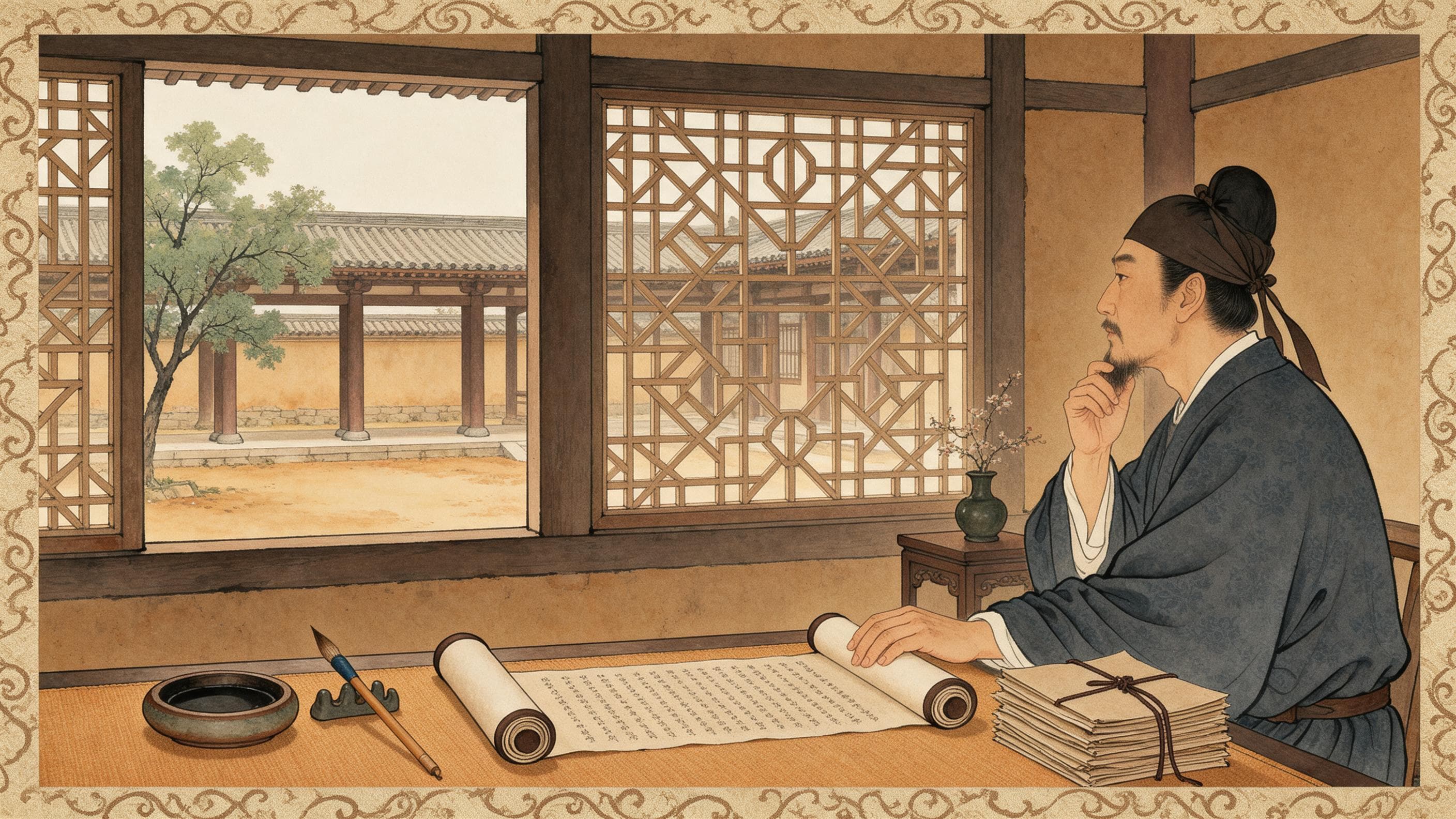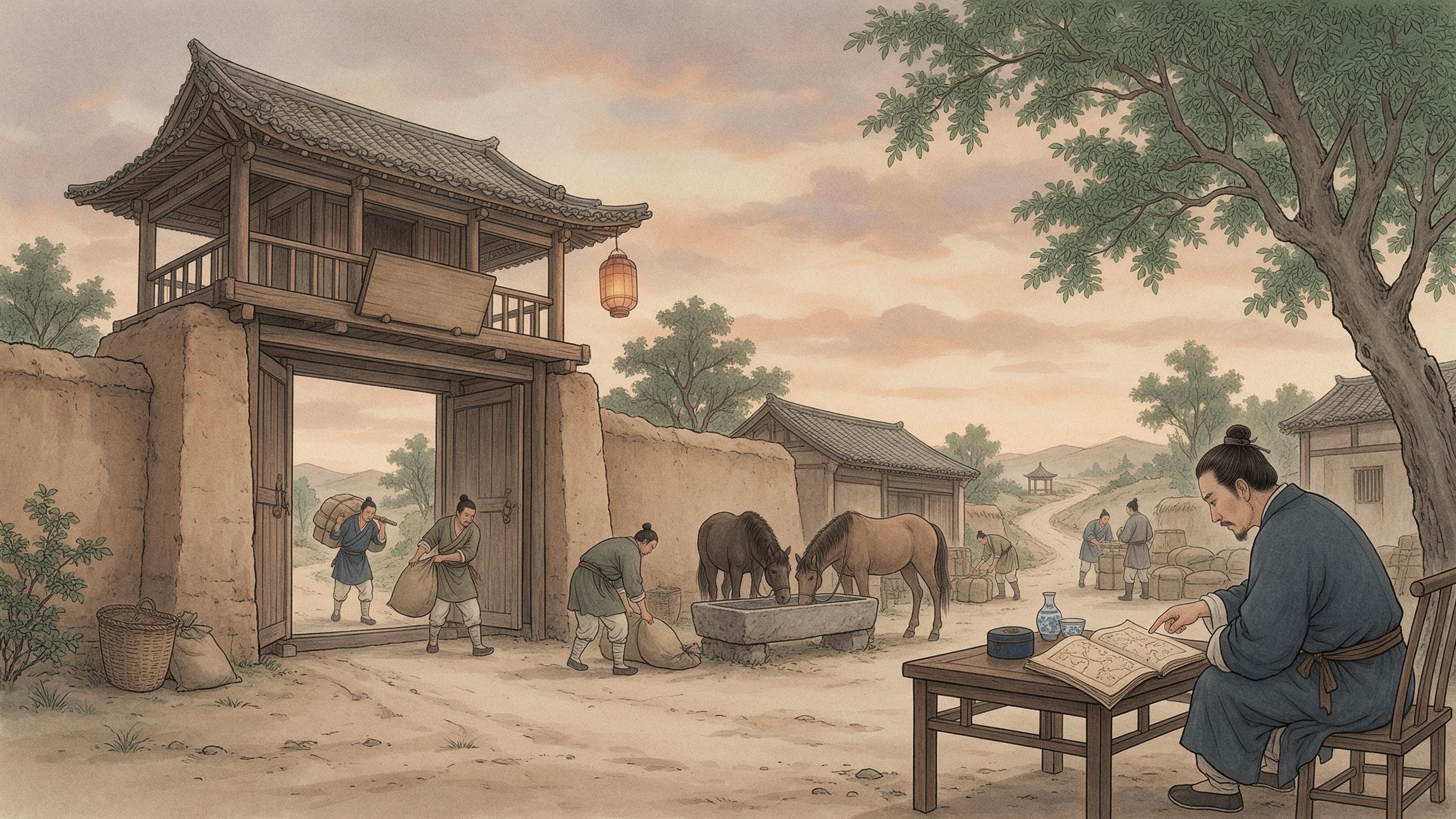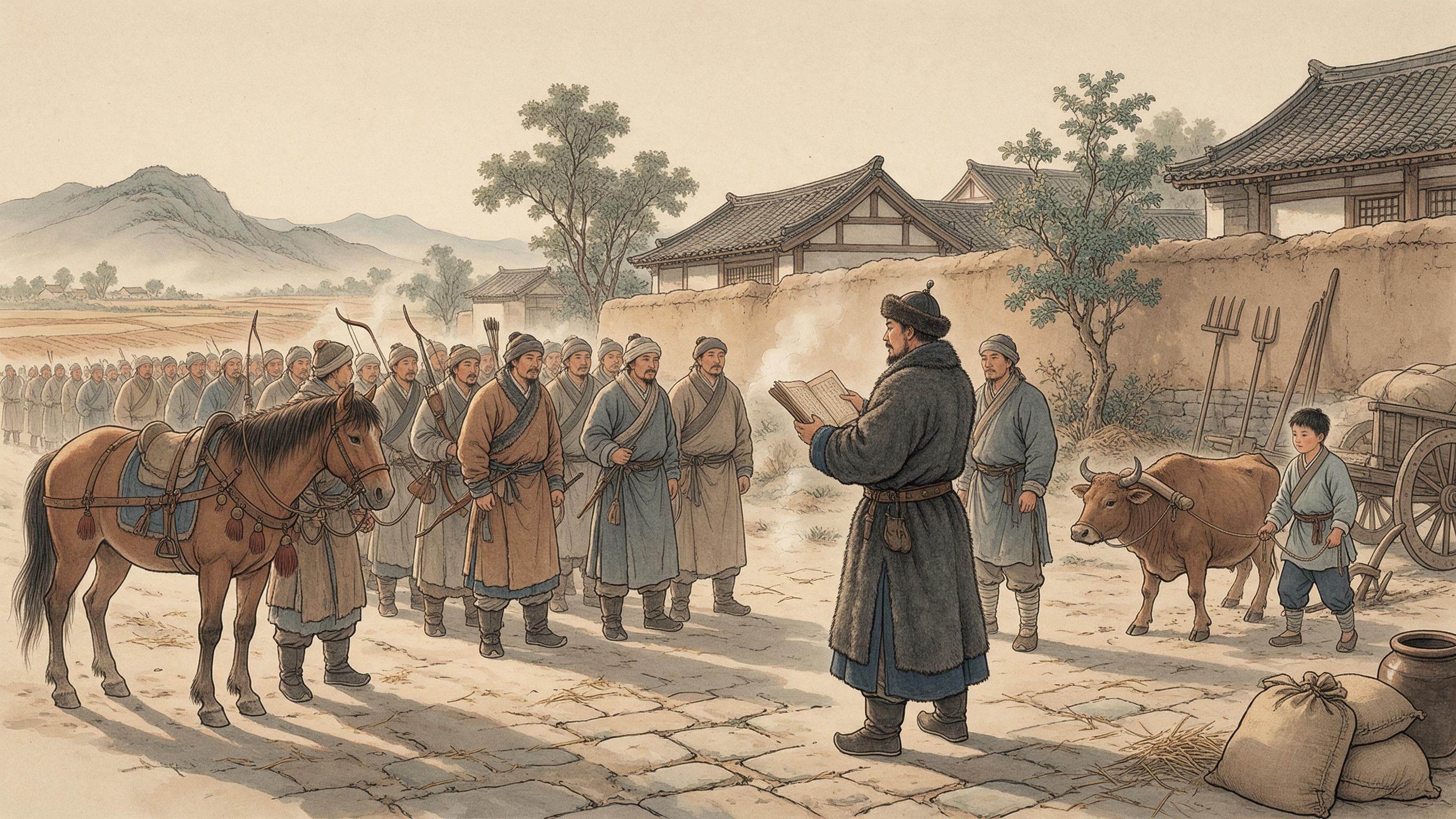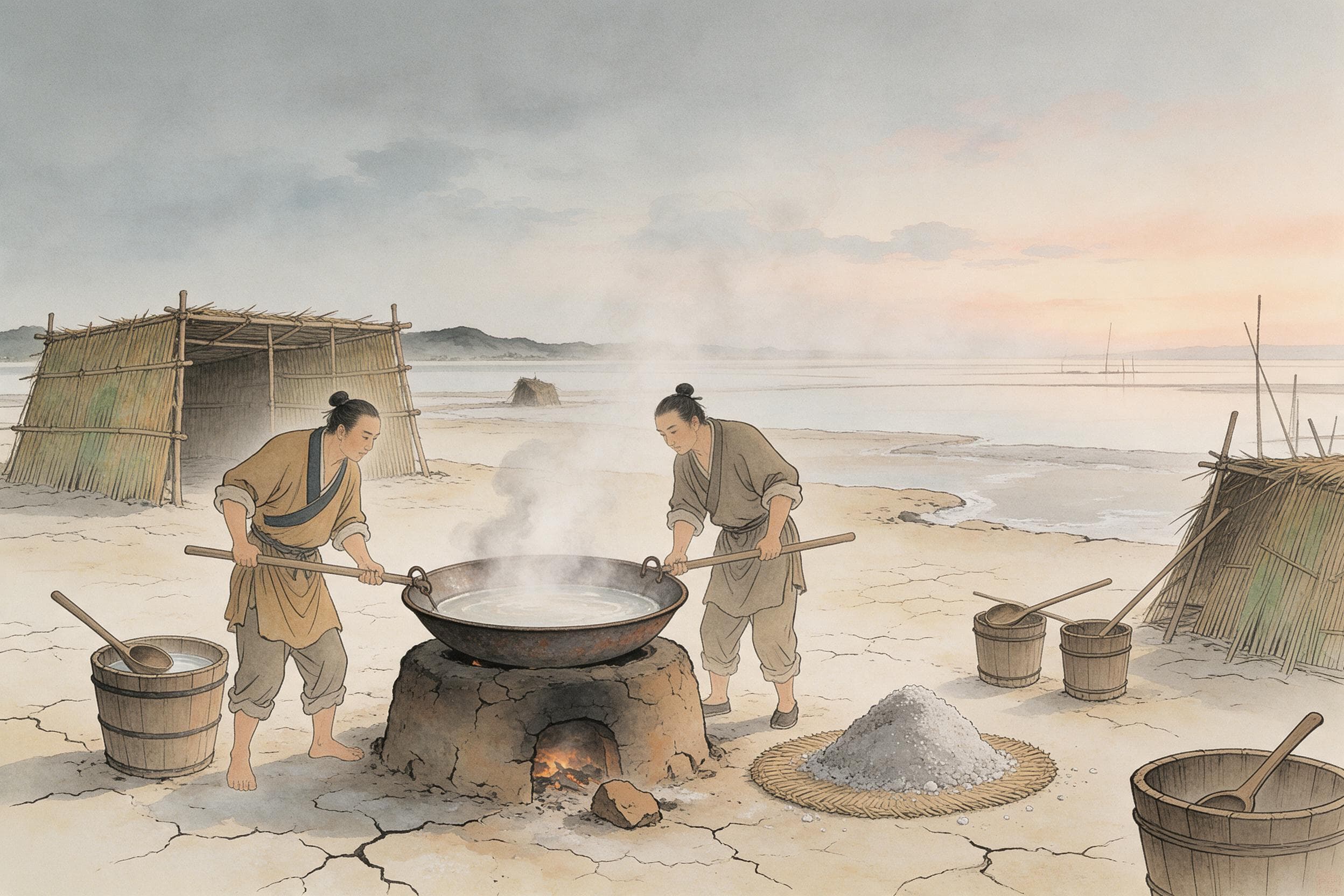
The Records of the Grand Historian list two men in one breath: Yi Dun, who rose by boiling salt from the salt lakes, and Guo Zong of Handan, who made his fortune smelting iron and became 'as rich as a king' (与王者埒富). The same chapter gives the Zhuo family of Shu, who were moved from Zhao by Qin with nothing but a handcart and later 'stoked the furnaces at the iron mountain' near Linqiong until they owned a thousand slaves, with ponds, fields and hunting 'like a ruler's'. Salt came from the lakes, iron from the mountains, and no household could make either for itself. Then the next chapter supplies the other half: anyone who privately cast iron tools or boiled salt had an iron clamp fixed to the left foot and his equipment confiscated — 釱左趾,没入其器物. Between the fortune and the shackle lies the Han story of salt and iron.
Two trades that made kings
The chapter on merchants and wealth treats getting rich as a skill, so it lists people and trades, never tonnages. Yi Dun started from 盬 salt, the salt of the lakes; Guo Zong from ironworks at Handan; the Zhuo family from an iron mountain at Linqiong; Cheng Zheng also smelted and 'matched the Zhuo family in wealth, both living at Linqiong'. What they had in common was control of mountain-and-sea resources and of furnaces, not of fields. The stance of the chapter should be flagged: Sima Qian admired these men, ranking the merchant's craft with the strategies of ministers and the laws of Shang Yang. That is a historian's judgement, not a government ledger. How much salt or iron they produced in a year, and at what prices, is nowhere in the text, and is not invented here.
The state sends its men in
Under Emperor Wu the state moved into both trades directly. The Records report that 'Dongguo Xianyang and Kong Jin were made assistant ministers of agriculture, in charge of salt and iron; Sang Hongyang, for his skill at calculation, was employed at court'. The three men's origins are the interesting part: Dongguo Xianyang was a great salt-boiler of Qi, Kong Jin a great iron-founder of Nanyang, both of whom had made a thousand pieces of gold in their own trades; Sang Hongyang was the son of a Luoyang merchant. The verdict in the text: 'the three of them could split the autumn down when talking of profit' — analyse a gain down to the tip of an autumn hair. The men regulating salt and iron were salt and iron men.
The state issues the pans
The core of the system survives in a single memorial from Kong Jin and Dongguo Xianyang. The mountains and seas, they said, are 'the treasure of heaven and earth', properly belonging to the imperial household; the emperor, not keeping it private, assigned it to the Minister of Agriculture 'to support the taxes'. The method: 愿募民自给费,因官器作煮盐,官与牢盆 — recruit people to work at their own expense, using official equipment, with the office supplying the boiling pans (牢盆). Why? Because 'idlers and strange folk wish to monopolise the goods of mountains and seas, to grow rich and profit by commanding the poor'. Hence the penalty: 敢私铸铁器煮盐者,釱左趾,没入其器物 — anyone daring to cast iron tools or boil salt privately has an iron clamp fixed to the left foot and his equipment confiscated. In commanderies without iron, a small iron office was set up under the county. Two words deserve unpacking: 釱 is an iron shackle and 左趾 the left foot; 牢盆 was the boiling pan the office gave the salt boilers, and what exactly 牢 means in the compound has been argued over — what is certain is that the equipment came from the state.
The magnates become officials
The most revealing step was co-option rather than destruction: 使孔仅、东郭咸阳乘传举行天下盐铁,作官府,除故盐铁家富者为吏 — the two men were sent by post-chaise across the empire to establish salt and iron offices, and the wealthy men of the old salt and iron houses were appointed as officials. The consequence follows at once: 吏道益杂,不选,而多贾人矣 — the route into office grew mixed, selection was bypassed, and merchants multiplied among the officials. Kong Jin himself was made Minister of Agriculture within three years and ranked among the Nine Ministers; Sang Hongyang later took over the whole salt and iron administration. The state did not crush the salt and iron merchants; it took them, and their trade, into the government. The apparatus then spread: equal-supply and salt-and-iron offices were established county after county, and the business grew so large that a new office, the Water衡, was created with an eye to taking over salt and iron.
Where the money went
The money had destinations. The newly established frontier commanderies, the text says, rebelled from time to time; the court sent troops south, and 'the expense was all supplied by the Minister of Agriculture'. And 大农以均输调盐铁助赋,故能赡之 — the minister used the equal-supply system to channel salt and iron revenue into supporting the taxes, and so could pay for it. Later a stabilisation office was set up in the capital to 'gather the goods of the empire, selling when dear and buying when cheap', leaving the great merchants 'no room for large profits'. After the property levies that followed, 'merchants of middle rank and above were ruined for the most part', while 县官有盐铁缗钱之故,用益饶矣 — because the government had salt, iron and coin, its funds grew ample. All of this is the account of the Records, and that account is critical of the profit-makers: it is a historian's stance, not a ledger.
The line between documented and missing is unusually sharp here. Documented: that salt and iron could make men as rich as kings; that under Emperor Wu the state appointed salt and iron commissioners, issued boiling pans, recruited boilers at their own expense, clamped the left foot of private producers and confiscated their gear, and made the old magnates into officials; that salt, iron, equal-supply and stabilisation formed one fiscal system whose proceeds went mainly to the army and the court. Missing: any salt price, iron price, output figure, or wage for the men at the pans and furnaces; the internal organisation of the works is not described; and the two chapters pull in opposite directions — one praises wealth, the other condemns profit — so neither can be read as statistics. One question the histories leave open: once the salt merchants became salt officials, who set the price of salt? That the two sources themselves are partisan — one praising the merchant, one condemning the profit-maker — is part of what the period left behind, and both must be read at a discount.
Sources & further reading
- 司马迁《史记》卷一二九·货殖列传 — 「猗顿用盬盐起。而邯郸郭纵以铁冶成业,与王者埒富」;蜀卓氏「用铁冶富」、迁临邛「即铁山鼓铸」、富至僮千人;程郑「亦冶铸」「富埒卓氏」
- 司马迁《史记》卷三〇·平准书 — 东郭咸阳、孔仅领盐铁事;孔仅、咸阳上言「山海,天地之藏」至「官与牢盆」,及「敢私铸铁器煮盐者,釱左趾,没入其器物」;「使孔仅、东郭咸阳乘传举行天下盐铁,作官府,除故盐铁家富者为吏」;「大农以均输调盐铁助赋」;平准钱物与告缗之后「县官有盐铁缗钱之故,用益饶矣」