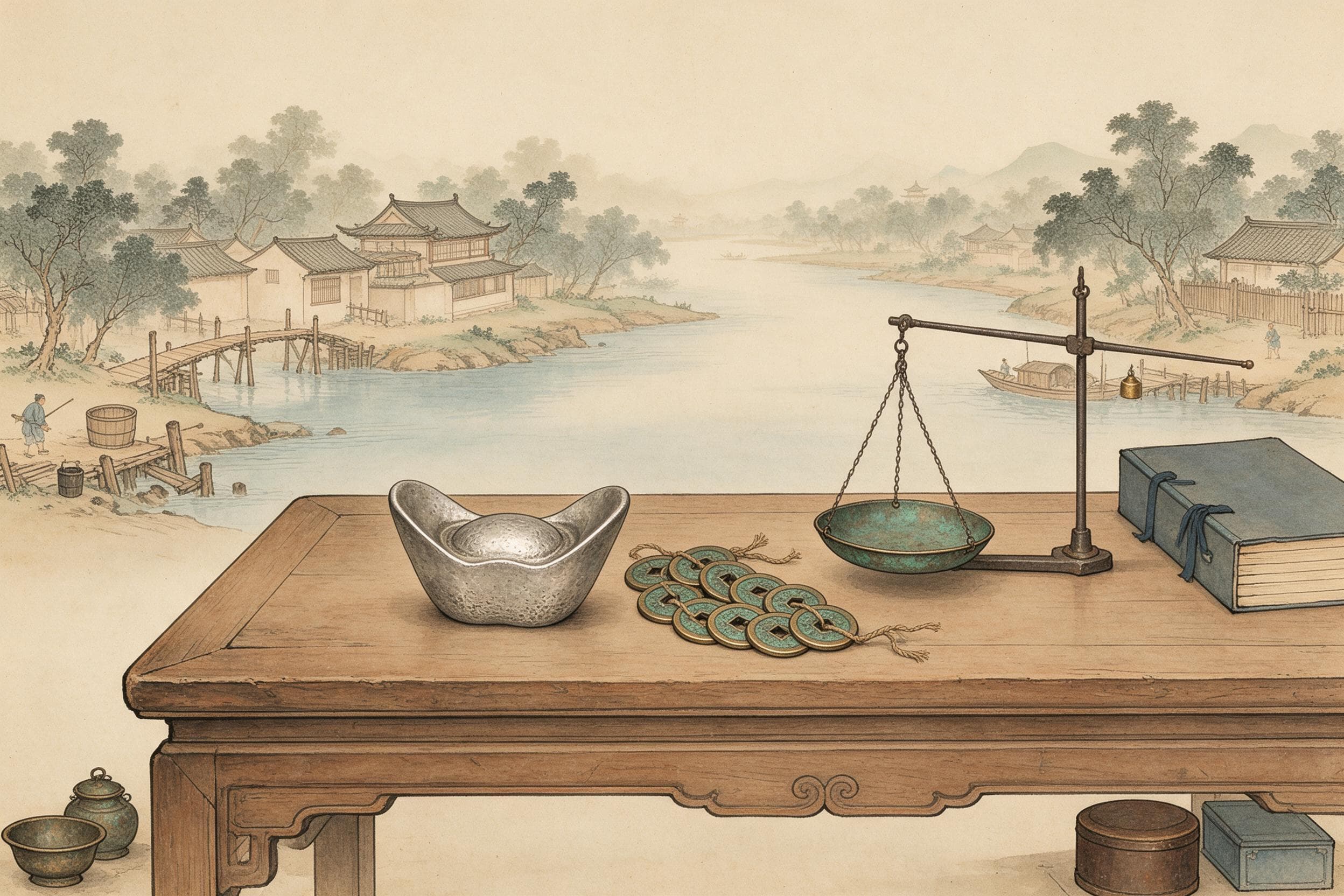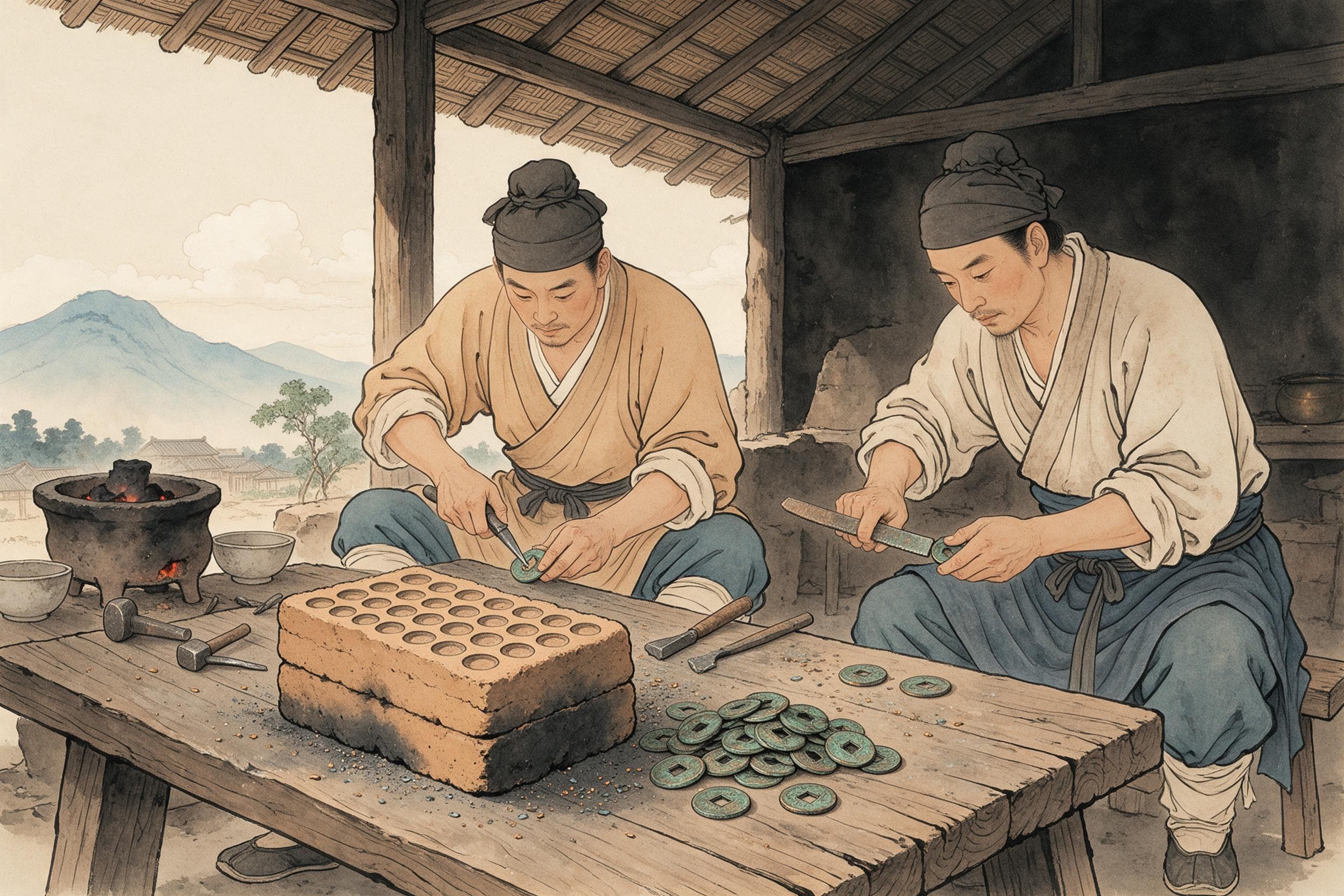
A Han five-zhu coin carries two characters on its face and a raised rim around its edge. The rim was not decoration. According to the Han shu's treatise on the economy, the coin was cast with 'a rim around its substance' so that people 'could not scrape the lead off' — scraping bronze dust from coins was a trade in itself, and a rim made it unprofitable. In 118 BCE the court 'abolished the half-liang coin and put the five-zhu into use'. Five zhu is a weight: the coin was named for what it was supposed to weigh.
A rim, and the reason for it
The coin before it was the three-zhu. The Shiji says 'the officials reported that the three-zhu coin was light and easy to counterfeit'; the Han shu says 'a light coin is easy to counterfeit with'. So 'the commanderies were asked to cast five-zhu coins'. The Shiji has it 'with a rim below, so that the bronze cannot be scraped off'; the Han shu 'with a rim around its substance, so that the lead cannot be scraped off' — the same measure, differently worded. Both words mean the bronze dust. The five-zhu was heavier than the three-zhu and its rim higher, so both counterfeiting and scraping cost more.
The date is in the Han shu's annals: in the third month of the fifth year of Yuanshou, 'the half-liang coin was abolished and the five-zhu put into use'. That is an explicit date. But the annals record only this one act; they say nothing about where the right to cast moved, and the red-edged coin and the three officers of Shanglin cannot be found in that chapter. The annals cannot be used to date the economic treatise.
First seizure: the red-edged coin
The five-zhu was handed to the commanderies, and a new problem followed. Both histories say: 'the commanderies cast coins, the people counterfeited many, and the coins grew light.' The ministers then asked that 'the capital cast the official red-edged coin, one to five, and that taxes be paid only in red-edged coin' — a separate coin from the capital, one of them worth five ordinary ones, required for tax payments. One to five was an expedient rate, not a reform of value. It did not hold: 'two years later the red-edged coin fell in value, people used it by trickery, it was inconvenient, and it was abolished'. The rate was set by decree; what the market did with it is not recorded.
Two stages must be kept apart. The red-edged coin was cast 'at the capital', by the office of the Bell Officer — and the Bell Officer was later one of the three officers of Shanglin. Casting at the capital is not the same as 'the three officers of Shanglin alone shall cast'; that came only after the red-edged coin failed. Merge the two steps and the seizure of the mint looks like a single act, which it was not.
Second seizure: the parks alone may cast
After the red-edged coin failed, both histories record the same order: 'all commanderies are forbidden to cast; the three officers of Shanglin alone shall cast. When coins were plenty, it was ordered that no coin but the three officers' should pass; all coins previously cast by the commanderies were melted down and their bronze sent in to the three officers.' The provinces stopped casting, only the parks minted, only park coin circulated, and old provincial coin was destroyed for its metal. The right to cast had come to the centre. Neither book dates this step; the conventional dating puts the red-edged coin in 115 BCE and the three officers in 113, and where those years are used here they are marked as conventional, not as the text's.
The total is in the Han shu: 'from the fifth year of Yuanshou under Emperor Wu, when the three officers first cast five-zhu coins, to the Yuanshi era of Emperor Ping, 28,000,000,000-odd coins were made.' From 118 BCE to about 5 CE, some two hundred and eighty thousand millions. The sentence ends with 'it is said', marking it as approximate; it is quoted as it stands, not converted into a count of coins or into modern money.
The cost: a hundred thousand not ploughing
The Han shu also preserves a sentence of Gong Yu, under Emperor Yuan: 'For casting coin and gathering copper, a hundred thousand a year do not plough, and many people fall into punishment for illegal casting. The rich store coin till their rooms are full, and are still not satisfied.' A hundred thousand a year taken from the fields, punishments multiplying, hoards that never fill. This is an argument with a position, not a statistic: the hundred thousand is a round figure and the source gives neither where the men came from nor how long they served. It is a memorial, not a census.
What can and cannot be written divides here too. The purchasing power of a five-zhu, the price of grain, wages — not one sentence in the sources, and none is supplied. The cost of casting, the price of copper, the measured weight and alloy of surviving coins — not verified in this round, and marked as pending. How much each province cast, or what sentence a counterfeiter actually received — absent. And the rim is described only as a defence against scraping, not elevated into a history of anti-counterfeiting technique.
A crack in the text
The Han shu's treatise contradicts itself. Its narrative is clear: after 118 BCE the commanderies cast the five-zhu, they cast badly, the capital cast the red-edged coin, that failed, and only then did the three officers of Shanglin alone cast. But its closing sentence says 'from the fifth year of Yuanshou, when the three officers first cast five-zhu coins' — which puts the three officers at the very start. Both statements stand in one chapter, and this piece does not reconcile them or choose between them. The crack shows something real: which year the three officers were established the sources themselves cannot say, and the conventional dates are later editors' arrangement. One sentence stands in the body, one in the closing summary: the two do not meet.
Back to the coin: one rim round the edge, and not much bronze to scrape; the right to cast moving in twenty years from the commanderies to the capital and from the capital to the imperial parks, each step with a technical reason — light coin, bad casting, a fallen red-edged coin. The ledger says 28,000,000,000-odd; the cost says a hundred thousand a year not ploughing. Which year counts as the three officers' first casting, Ban Gu gives twice. The rules can be written exactly; the dates cannot. Two of the three steps are dated only by later editors.
Sources & further reading
- 《史记》卷三十·平准书(西汉司马迁;维基文库) — The earliest account, written under the Han and critical of the profit officials: the three-zhu coin being light and easy to counterfeit, so the commanderies were asked to cast five-zhu coins with a raised rim 'so that the bronze cannot be scraped off'; the commanderies' coins growing light, so the capital cast the red-edged coin at one to five; two years later the red-edged coin fell, and all commanderies were forbidden to cast while the three officers of Shanglin alone minted, old coins melted down and their bronze sent in. No dates are given for any of the three steps.
- 《汉书》卷二十四·食货志、卷六·武帝纪(东汉班固;维基文库) — Eastern Han compilation. The economic treatise repeats the sequence with variant wording and adds two things the *Shiji* lacks: the total 'from 118 BCE to the Yuanshi era of Pingdi, 28,000,000,000-odd coins', and Gong Yu's complaint that 'a hundred thousand a year do not plough' for copper. The same treatise's closing sentence dates the three officers' first casting to 118 BCE, contradicting its own earlier sequence. The annals (juan 6, https://zh.wikisource.org/wiki/%E6%BC%A2%E6%9B%B8/%E5%8D%B7006) give only the dated act: in 118 BCE the half-liang was abolished and the five-zhu put into use.