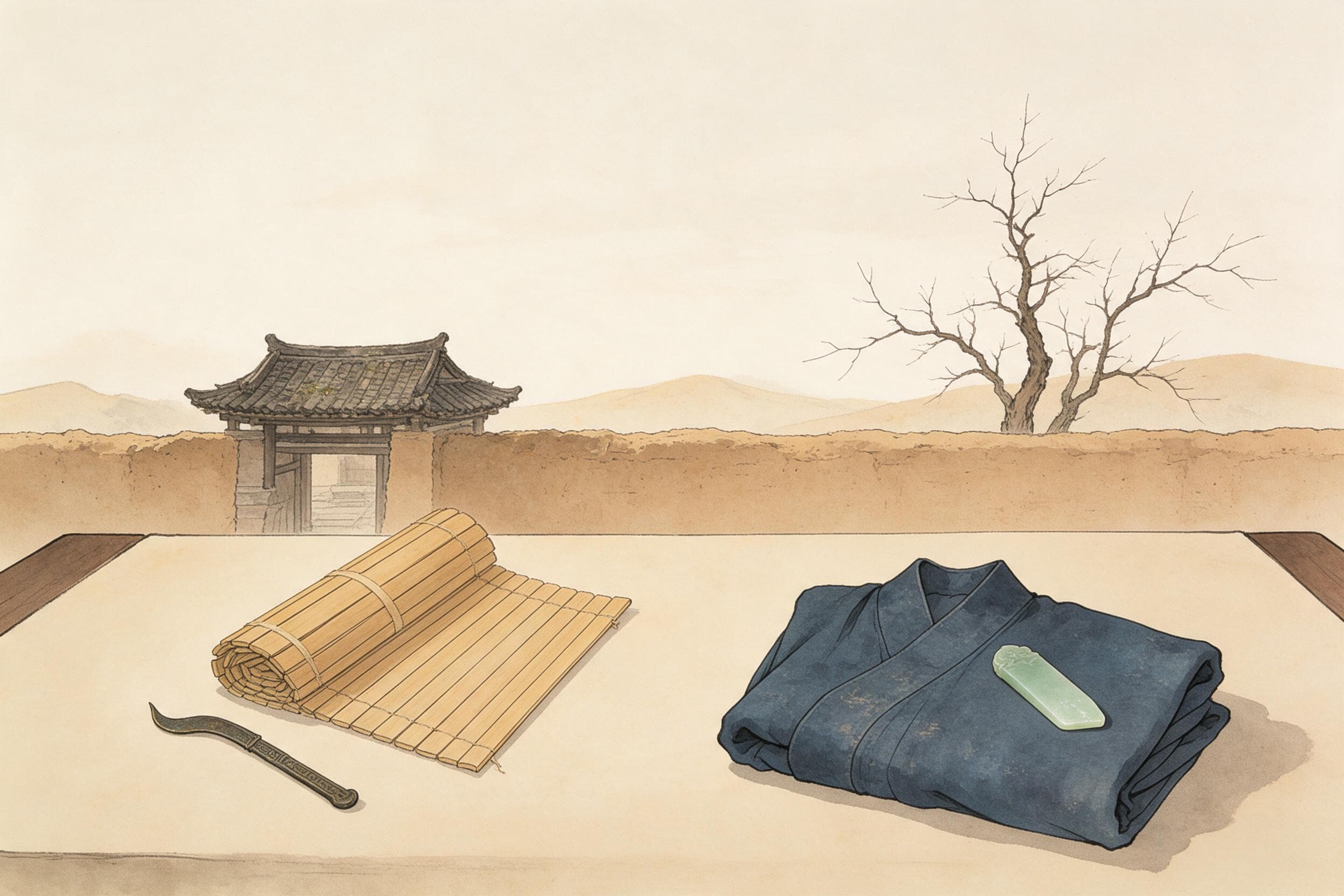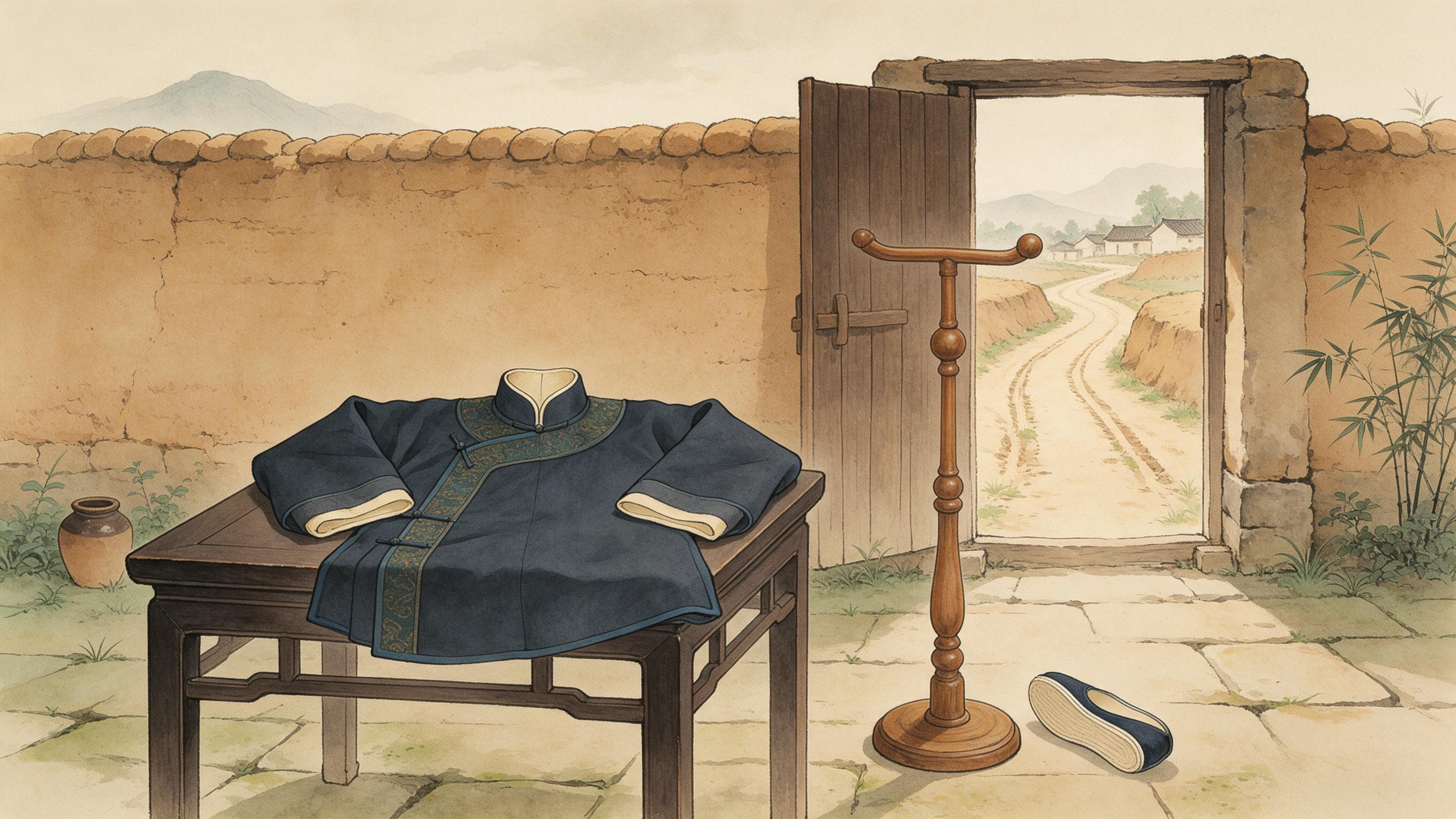
The order takes one line in the Shiji: 上令鼂錯衣朝衣斬東市 — the emperor ordered that Chao Cuo be cut down at the Eastern Market in his court dress. The sentence stops on the clothing: he was not stripped of office, and the robe of his rank was still on him. The difference between a trial and a liquidation is in that detail.
A Man in Four Characters
The Shiji begins: 鼂錯者,潁川人也,學申商刑名於軹張恢先所 — Chao Cuo, a man of Yingchuan, who studied the penal doctrine of Shen and Shang under Zhang Hui of Zhi; the Hanshu writes 生 where the Shiji writes 先, one character apart, and both readings stand here. 錯為人陗直刻深 — as a man he was steep and straight, exacting and deep; the Hanshu writes 峭 for 陗. Neither page glosses them. He was sent to learn the Documents: 天下無治尚書者,獨聞濟南伏生故秦博士……年九十餘 — the Hanshu has 亡 for 無 and 齊 for 濟南. He came back from 受尚書伏生所, and he pleased the heir: 太子家號曰, 智囊 — the heir's household called him the wisdom bag.
Under Emperor Wen he sent up memorial after memorial, 數上書孝文時,言削諸侯事 — the Shiji says 書數十上, the Hanshu 書凡三十篇; both counts stand. The emperor did not follow them but 奇其材, thought him talented. He also made enemies: 袁盎諸大功臣多不好錯 in the Shiji, 爰盎 in the Hanshu — each page its own spelling.
The first man he broke was the chancellor Shen Tu Jia. His office stood inside the precinct of the 太上 shrine, its gate opened east and was inconvenient, so 錯乃穿兩門南出,鑿廟壖垣 — he cut two doors through to the south and hacked the precinct wall (the Hanshu has 穿門南出 and writes the wall 堧). The chancellor 欲因此過為奏請誅錯, wanted to use the fault to ask for his death; the emperor answered 此非廟垣,乃壖中垣,不致於法 — that is not the shrine wall but the precinct wall, the law does not reach it; the chancellor apologised. Out of court: 吾當先斬以聞,乃先請,為兒所賣,固誤 — I should have cut his head off and reported after; asking first let a boy sell me, my mistake. The Hanshu has the same line without 為兒所賣. 丞相遂發病死,錯以此愈貴 — the chancellor fell ill and died, and Cuo was the more honoured for it.
It Is So. Not So, and the Temple Is Not at Peace
Under Emperor Jing he rose to grand secretary and memorialised: 請諸侯之罪過,削其地,收其枝郡 — for the crimes of the principalities, cut their land and take in their branch commanderies; the Hanshu has 支郡. The memorial went to the lords and clan: 莫敢難 — none dared dispute — 獨竇嬰爭之, only Dou Ying argued, 由此與錯有卻 (Hanshu: 繇此與錯有隙). He also changed thirty chapters of ordinances: 錯所更令三十章,諸侯皆諠譁疾鼂錯 — the principalities clamoured and hated him (Hanshu: 諸侯讙譁).
Then his father came from Yingchuan. The Shiji's question: 侵削諸侯,別疏人骨肉,人口議多怨公者,何也 — you carve up the principalities and set kin apart, and people talk and resent you; why? The Hanshu: 疏人骨肉,口讓多怨,公何為也. The son's answer is the sentence the piece is built on: 固也。不如此,天子不尊,宗廟不安 — it is so; if it were not so, the Son of Heaven would not be honoured and the ancestral temple would not be at peace. The father: 劉氏安矣,而鼂氏危矣,吾去公歸矣 — the Liu are at peace and the Chao are in danger; I am going home (Hanshu: 晁氏危). 遂飲藥死,曰:吾不忍見禍及吾身 — he took poison and died, saying he could not bear to see the trouble reach him (Hanshu: 禍逮身). Then the interval both pages keep: 死十餘日,吳楚七國果反,以誅錯為名 — some ten days later Wu, Chu and the five other states rose, using the killing of Cuo as their name (Hanshu: 後十餘日……俱反).
Dismiss the Attendants
Here the Hanshu adds a room. 上與錯議出軍事,錯欲令上自將兵,而身居守 — the emperor was discussing the campaign with Cuo, who wanted the emperor to lead while he held back. Yuan Ang is brought in. 願屏左右 — let the attendants withdraw; 上屏人,獨錯在 — the emperor dismissed them, and Cuo alone was left; 臣所言,人臣不得知 — what I have to say no subject may hear; 乃屏錯 — so Cuo was dismissed; 錯趨避東箱,甚恨 — he hurried out and stood in the eastern side-room, hating it bitterly (東箱 generally the eastern wing). The Shiji has this as one line: 鼂錯在前,及盎請辟人賜閒,錯去,固恨甚 — Cuo was present, and when Ang asked for a private word Cuo withdrew, and hated it deeply. The five moves are the Hanshu's; the line is the Shiji's; neither displaces the other.
Yuan Ang's advice is Hanshu only: 獨有斬錯 — there is only the one plan, cut off Cuo; 發使赦吳楚七國,復其故地,則兵可毋血刃而俱罷 — send envoys, pardon the seven states, restore their lands, and the armies stop without bloodshed. The emperor 默然,良久曰:顧誠何如,吾不愛一人謝天下 — was silent a long while, then said: if it is so, I do not grudge one man to apologise to the world. 吾不愛一人謝天下 is the emperor's, quoted as his.
The Impeachment
Ten days on, the chancellor Qing Di, the commandant Jia and the commandant of justice Lan 劾奏錯, impeached him. Hanshu only, three charges whole: 錯不稱陛下德信,欲疏群臣百姓,又欲以城邑予吳,亡臣子禮,大逆無道 — no answer to the emperor's virtue and trust, the officials and people set apart, cities to be given to Wu, no subject's duty, great treason. The sentence: 錯當要斬,父母妻子同產無少長皆棄巿 — Cuo is to be cut at the waist, and his parents, wife, children and siblings, old and young alike, all exposed in the market; 臣請論如法 — we ask that he be judged according to the law; 制曰:可 — the imperial reply: approved. 要斬 is generally taken as cutting at the waist. What the paperwork is worth is decided by the next four characters.
The Hanshu alone has these two sentences. 錯殊不知 — Cuo knew nothing about it. 乃使中尉召錯,紿載行巿 — the commandant of the capital was sent to summon him, and they tricked him into a carriage and took him to the market (紿載行巿 is generally read as deceiving him into the cart). Then: 錯衣朝衣斬東巿 — Chao Cuo was cut down at the eastern market in his court dress. The endings side by side: 上令鼂錯衣朝衣斬東市, an order in front and 市; and 錯衣朝衣斬東巿, no order and the old form 巿. Both pages have the Eastern Market; each spelling is kept.
What Deng Gong Said
Afterwards the emperor asked Deng Gong, back from the front, whether the rising had stopped now that Cuo was dead. Deng Gong: 吳王為反數十年矣,發怒削地,以誅錯為名,其意非在錯也 — the king of Wu had been at revolt for decades; angry at lost land, he used Cuo's death as a name, and never meant Cuo (Hanshu: 數十歲矣……其意不在錯也). The consequence, in the Shiji's words: 且臣恐天下之士噤口,不敢復言也 — I fear the realm's scholars will shut their mouths and never speak again (Hanshu: 拑口). The defence: 夫鼂錯患諸侯彊大不可制,故請削地以尊京師,萬世之利也 — Cuo saw the principalities too strong to hold and asked to cut their land, a benefit for ten thousand generations; 計畫始行,卒受大戮,內杜忠臣之口,外為諸侯報仇 — the plan had barely begun and he met the great execution; inwardly it stops loyal mouths, outwardly it takes revenge for the principalities. The emperor 默然良久 (Hanshu: 喟然長息), then: 公言善,吾亦恨之 — you speak well; I regret it too. The last word either page gives him; no rehabilitation is added.
The Hanshu closes with Ban Gu: 晁錯銳於為國遠慮,而不見身害 — Cuo was keen in far-reaching plans for the state and did not see the harm to himself; his father saw it, 經於溝瀆, ended in a ditch (generally taken as poison), 亡益救敗, no help against the disaster, and no match for Zhao Kuo's mother, who saved her clan (generally, the mother who memorialised against her son); 悲夫!錯雖不終,世哀其忠 — alas, Cuo did not end well, and the world grieves for his loyalty. The Shiji carries no such verdict. What neither page has: an age for Cuo, a date, an interrogation, a sentence read out to him. Four boundaries, one line each: mutilation abolished, the Han statutes, Zhang Shizhi's three cases, Ji Bu's hiding — other articles; and the Eastern Market is only a place name on both pages, so no general note about executions there is added.
Related reading:Three Hundred and Fifty-Nine Chapters: How Many Laws Did Han China Have? · Three Cases: How Zhang Shizhi Passed Sentence · The Classic Masters: How a Text Was Handed Down
Sources & further reading
- 《史记》卷一百一·袁盎鼂错列传第四十一(西汉司马迁撰;维基文库本,白文无注,页头未标 textquality,未与中华书局点校本复核) — The shorter account, and its brevity is part of the argument. Chao Cuo of Yingchuan studied the penal doctrine of Shen and Shang; 錯為人陗直刻深; he was sent to study the Documents with the ninety-year-old Fu Sheng, and the heir apparent's household called him 智囊. He memorialised repeatedly on cutting the principalities (書數十上); Emperor Wen did not listen but thought him talented. His father came from Yingchuan and asked why he was carving up the royal kin; the answer is the sentence the article is built on, 固也。不如此,天子不尊,宗廟不安; the father said 劉氏安矣,而鼂氏危矣, took poison and died. Ten days later the seven states rose 以誅錯為名, and the account of the killing is a single sentence: 上令鼂錯衣朝衣斬東市 — the emperor ordered it, the dress is named, the place is written 東市. The page also has one compressed line for the private audience, 鼂錯在前,及盎請辟人賜閒,錯去,固恨甚, and Deng Gong's protest, 其意非在錯也 and 內杜忠臣之口,外為諸侯報仇, ending with the emperor's 公言善,吾亦恨之. Note the name is written 鼂錯 throughout this page. Text obtained through the Wikisource export service (ws-export.wmcloud.org); the page header (textquality) could not be re-checked in that export and is reported as the pack records it.
- 《汉书》卷四十九·爰盎晁錯传第十九(东汉班固撰;维基文库本,白文无注,页面标 textquality 25%,未与中华书局点校本复核) — The fuller account, and the one that shows the procedure being assembled. Its name is written 晁錯 and its market 東巿 — both pages have the Eastern Market, in different forms of the character. What Ban Gu adds is the room and the paperwork: the emperor discussing the campaign with Cuo; the audience at which Ang asks 願屏左右, then 臣所言,人臣不得知, then 乃屏錯, and Cuo 趨避東箱,甚恨; the advice 獨有斬錯 and 兵可毋血刃而俱罷; the emperor's 吾不愛一人謝天下; the full impeachment by the chancellor, the commandant and the commandant of justice with three charges and the sentence 錯當要斬,父母妻子同產無少長皆棄巿, answered 制曰:可; and then the seven characters that undo the proceeding — 錯殊不知, and 乃使中尉召錯,紿載行巿 — before 錯衣朝衣斬東巿. It ends with Ban Gu's judgement, 錯雖不終,世哀其忠. The longer stretches of this chapter on frontier defence and the examination answers are not used in this article. Text obtained through ws-export.wmcloud.org; the page header could not be re-checked in that export.