Start with one entry: 鄯善國,本名樓蘭,王治扞泥城,去陽關千六百里,去長安六千一百里。戶千五百七十,口萬四千一百,勝兵二千九百十二人 — Shanshan, formerly Loulan, the king's seat at Hanni, 1,600 li from Yangguan and 6,100 from Chang'an, 1,570 households, 14,100 mouths, 2,912 able-bodied soldiers. That is what a Han account of the Western Regions looks like: not a travel tale but a register, with the same handful of items standing behind every name: a seat, two distances, three counts of people, a list of officers.
Two Lists, Two Numbers
The Hanshu opens by making the count unstable: 西域以孝武時始通,本三十六國,其後稍分至五十餘 — first opened under Emperor Wu, originally thirty-six states, afterwards gradually divided to more than fifty. The Houhanshu gives a second figure: 武帝時,西域內屬,有三十六國 … 哀平間,自相分割為五十五國 — thirty-six under Wu, and by the reigns of Ai and Ping divided among themselves into fifty-five; a third appears at the height of the Han, 五十餘國悉納質內屬. It even names some of the moves: 小宛、精絕、戎廬、且末為鄯善所併; 渠勒、皮山為于窴所統; 郁立、單桓、孤胡、烏貪訾離為車師所滅 — absorbed, and then 後其國並復立, the states were set up again. One stretch of ground, and the lists count it differently. This article sets the figures side by side, adds none of them up and reconciles none of them, because the point of the pages is that the number was moving.
What the two books are to each other, the Houhanshu says itself: 班固記諸國風土人俗,皆已詳備前書。今撰建武以後其事異於先者,以為《西域傳》,皆安帝末班勇所記云 — Ban Gu's record of the states is already full in the Former Book; this one writes only what differed after the Jianwu reign, and all of it comes from Ban Yong at the end of Emperor An. A record and its continuation, not two independent observations; so the two are never used here to corroborate one another, only set out as two versions where they differ — on the number, on the river, and even on the verb for following a river.
Walled Towns, Fields, Herds
The Hanshu fixes what kind of place this is in one sentence: 西域諸國大率土著,有城郭田畜,與匈奴、烏孫異俗 — for the most part settled, with walled towns, fields and herds, and customs unlike those of the Xiongnu and the Wusun. 土著 is generally taken to mean settled. The sentence also explains what followed: 故皆役屬匈奴 — and so they were all subject to the Xiongnu. The subject of this article is these walled states, not the steppe: a country one can count by the mouths in it.
Walled does not mean all farming. Shanshan's own entry says: 地沙鹵,少田,寄田仰谷旁國 — salty waste, little land, the fields themselves lying in neighbouring states and the grain bought from them; and 民隨率牧逐水草,有驢馬,多橐它 — the people follow water and grass with their herds, keep donkeys and horses, and many camels. On the Xiongnu holding of the region the two books differ in wording: the Hanshu has 匈奴西邊日逐王置僮僕都尉,使領西域,常居焉耆、危須、尉黎間,賦稅諸國, the Houhanshu only 匈奴斂稅重刻,諸國不堪命. Both are given; neither replaces the other, and no combined figure is produced.
Two Roads, Three Doors
Out of the passes there are two roads. The Hanshu: 從鄯善傍南山北,波河西行至莎車,為南道,南道西逾蔥嶺則出大月氏、安息; and 自車師前王廷隨北山,波河西行至疏勒,為北道,北道西逾蔥嶺則出大宛、康居、奄蔡焉. The Houhanshu writes the same roads with 陂河 for 波河 — one character apart, and neither is corrected here. Two roads, four exits, all beyond the Congling.
The Houhanshu then turns the word 門戶 into three distances: 北通伊吾千餘里, then 自伊吾北通車師前部高昌壁千二百里, then 自高昌壁北通後部金滿城五百里, and one line: 此其西域之門戶也 — these are the doors of the Western Regions, which is why the Wuji colonel 更互屯焉, garrisoned them by turns. Yiwu 地宜五穀、桑麻、蒲萄, and north of it Liuzhong 皆膏腴之地; hence 漢常與匈奴爭車師、伊吾,以制西域焉. The li are copied as they stand, and the order they are given in — west out of Dunhuang, then north by three stages — is the point.
The river in the middle of this ground gets a paragraph of its own. The Hanshu: 其河有兩原 — two sources, one in the Congling and one in Khotan; 于闐在南山下,其河北流,與蔥嶺河合,東注蒲昌海 — the Khotan river runs north from the southern mountains, joins the Congling river, and goes east into Puchang Sea; 蒲昌海,一名鹽澤者也,去玉門、陽關三百餘里,廣袤三四百里; 其水亭居,冬夏不增減 — the water stands there and neither rises nor falls, winter or summer. Then the inference the whole passage seems written to reach: 皆以為潛行地下,南出於積石,為中國河 — men supposed it ran underground and came out again at Jishi as the Yellow River of China. The Houhanshu has the same two sources and the same sea, 蒲昌海一名鹽澤,去玉門三百餘里, and no underground river: the river that goes under the ground and comes out as China's own belongs to the Hanshu alone.
What Follows a State's Name
Take a large one: 大宛國,王治貴山城,去長安萬二千五百五十里。戶六萬,口三十萬,勝兵六萬人。副王、輔國王各一人 — sixty thousand households, three hundred thousand mouths, sixty thousand able-bodied soldiers, with the distances east, north and south-west after them. Shanshan's entry closes with its officers: 輔國侯、卻胡侯、鄯善都尉、擊車師都尉、左右且渠、擊車師君各一人,譯長二人. The frame is another set of figures: 東西六千餘里,南北千餘里, east 厄以玉門、陽關, west 限以蔥嶺. The Protector General sat at Wulei city, 去陽關二千七百三十八里, because 土地肥饒,於西域為中 — fertile, and in the middle of the region, which the page treats as reason enough. On the office itself the page gives only a few lines: 都護之起,自吉置矣; its powers, 督察烏孫、康居諸外國,動靜有變以聞。可安輯,安輯之;可擊,擊之; and later 復置戊己校尉,屯田車師前王庭. Behind it stood 列四郡,據兩關, the posts 往往起亭, and 輪台、渠犁皆有田卒數百人. This article writes when the office began, where it sat and what it could do, and leaves the institutional history, the chain of command and the later reorganisations alone.
At the End of the List, Grapes
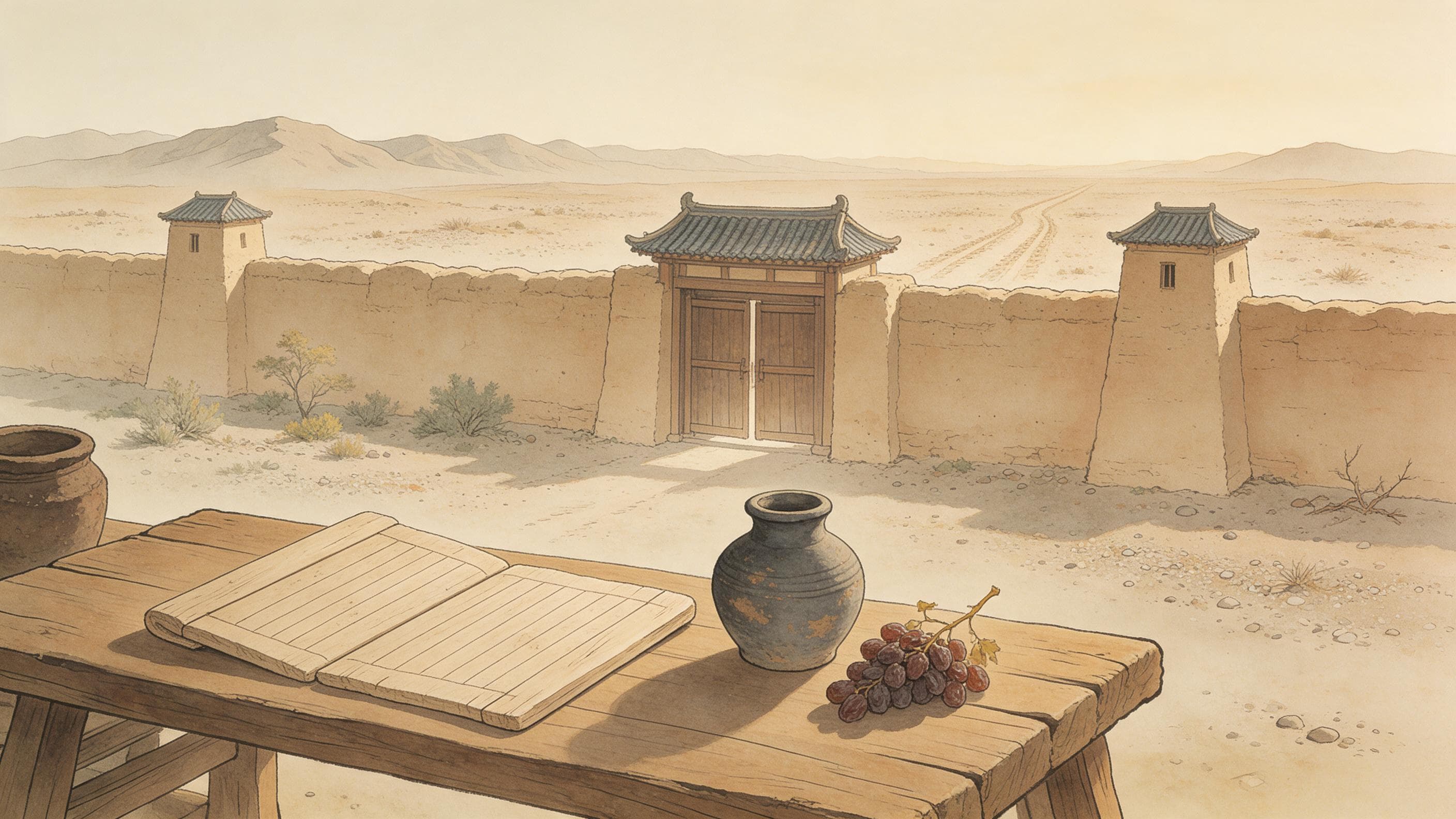
Inside Dayuan's entry is the best sentence in the whole text: 大宛左右以蒲陶為酒,富人藏酒至萬餘石,久者至數十歲不敗。俗耆酒,馬耆目宿 — they make wine of the grape; the rich store more than ten thousand shi of it, some of it unspoiled after several tens of years; they are fond of drink, and their horses of alfalfa. 蒲陶 and 目宿 are copied as the page has them, generally understood as grape and alfalfa. The seeds have their own line: 漢使采蒲陶、目宿種歸, and because horses were many and foreign envoys numerous, 益種蒲陶、目宿離宮館旁,極望焉 — planted beside the palaces and lodges until they stretched as far as the eye could see. At the end of the register there is a vine.
Dayuan itself has two more lines: 宛別邑七十餘城,多善馬。馬汗血,言其先天馬子也 — seventy-odd walled towns and many good horses, whose sweat was blood, said to be foaled by heavenly horses; and when Han envoys' deserters surrendered, 教鑄作它兵器, they taught the casting of other weapons. West of it the page gives a few customs, the most concrete thing in the whole text: 自宛以西至安息國,雖頗異言,然大同,自相曉知也。其人皆深目,多鬚髯。善賈市,爭分銖。貴女子,女子所言,丈夫乃決正 — speech somewhat different but broadly the same and mutually understood; the people deep-eyed and heavily bearded; good traders, haggling over a fraction of a grain; they honour women, and what a woman says her husband carries out. Also 其地無絲漆,不知鑄鐵器 and 得漢黃白金,輒以為器,不用為幣 — Han gold and silver become vessels, not money.
The western end of the list breaks first. 西域自絕六十五載,乃復通焉, and in sum 自建武至於延光,西域三絕三通 — three times cut off, three times reopened, in the century and a half the page covers. At the height, 五十餘國悉納質內屬 and Gan Ying 窮臨西海而還; then 烏孫、蔥嶺已西遂絕, and after that 自陽嘉以後,朝威稍損,諸國驕放,轉相陵伐. The Houhanshu also records the argument about holding the region at all: Chen Zhong's 收三十六國,斷匈奴右臂 — take the thirty-six states and break the Xiongnu's right arm — and Zhang Dang's three plans: the upper, 酒泉屬國吏士二千餘人 gathered at the Kunlun pass to strike the Huyan king first; the middle, a military commandant with 將士五百人; the lower, abandon Jiaohe city. This article stays with the register itself: names, seats, distances, households, mouths, soldiers, officials, produce, a few customs. No campaigns narrated, no trade list, and 張騫始開西域之跡 stays at eight characters — the page gives it no more.
Related reading:Felt Tents, Meat and Leather: The Xiongnu as the Han Saw Them · Horses in the Lanes: Price, Prohibition and a Bronze Model · Heqin: A Letter, a Princess, and an Annual Tribute of Silk and Grain
Sources & further reading
- 《汉书》卷九十六上·西域传第六十六上(东汉班固撰;维基文库本,白文无注,页面标 textquality 25%,未与中华书局点校本复核) — The first of the two lists. It opens by making its own number unstable: the Western Regions were first opened in the time of Emperor Wu, and were 本三十六國,其後稍分至五十餘 — originally thirty-six states, afterwards gradually divided to more than fifty. Then the frame: 南北有大山,中央有河,東西六千餘里,南北千餘里, bounded east by Yumen and Yangguan and west by the Congling; the river has 兩原, one in the Congling and one in Khotan, flowing east into 蒲昌海, also called 鹽澤, 廣袤三四百里, whose water 冬夏不增減, so men supposed it ran underground and came out at Jishi as the Yellow River. One sentence fixes the object of this article: 西域諸國大率土著,有城郭田畜,與匈奴、烏孫異俗,故皆役屬匈奴 — settled for the most part, with walled towns, fields and herds, unlike the Xiongnu and Wusun, and therefore subject to the Xiongnu, whose Rizhu king set a 僮僕都尉 over them and taxed them. Two roads follow, each with its exits beyond the Congling, then the entries — Shanshan (formerly Loulan, its king's seat, 戶千五百七十,口萬四千一百,勝兵二千九百十二人, its subordinate lords and two interpreters, and 地沙鹵,少田,寄田仰谷旁國) and Dayuan (戶六萬,口三十萬,勝兵六萬人; 宛別邑七十餘城,多善馬; and the wine, 富人藏酒至萬餘石,久者至數十歲不敗). From Dayuan come the seeds, 漢使采蒲陶、目宿種歸, planted until 極望焉, and the customs west of it, 深目,多鬚髯, 爭分銖, 貴女子,女子所言,丈夫乃決正, and 得漢黃白金,輒以為器,不用為幣. The office is dated in the same preface: 都護之起,自吉置矣, seat at Wulei, 去陽關二千七百三十八里, chosen because 土地肥饒,於西域為中. Text obtained through the Wikisource export service (ws-export.wmcloud.org); the page header (author, textquality) could not be re-checked in that export and is reported as the pack records it.
- 《后汉书》卷八十八·西域传第七十八(南朝宋范晔撰,司马彪等;维基文库本,白文无注,页头未标 textquality,未与中华书局点校本复核) — The second list, and it counts differently: 武帝時,西域內屬,有三十六國 … 哀平間,自相分割為五十五國 — thirty-six at the start, fifty-five by the reigns of Ai and Ping; at the height, under Emperor He, 五十餘國悉納質內屬. It also names some of the moves: 小宛、精絕、戎廬、且末為鄯善所併, 渠勒、皮山為于窴所統, 郁立、單桓、孤胡、烏貪訾離為車師所滅. Above all it states its relation to the first list: 班固記諸國風土人俗,皆已詳備前書。今撰建武以後其事異於先者,以為《西域傳》,皆安帝末班勇所記云 — a record and its continuation, not two independent observations, which is how this article treats them. The preface carries the rest: the two roads again, with 陂河 for the Hanshu's 波河; three gateways north from Dunhuang, 北通伊吾千餘里, 千二百里 to the Gaochang wall, 五百里 on to Jinman city, 此其西域之門戶也; Yiwu 地宜五穀、桑麻、蒲萄 and Liuzhong 皆膏腴之地; 西域自絕六十五載,乃復通焉 and 自建武至於延光,西域三絕三通; Ban Chao's 五十餘國 and Gan Ying, who 窮臨西海而還; Zhang Dang's three plans; Chen Zhong's 收三十六國,斷匈奴右臂; and the end, 烏孫、蔥嶺已西遂絕. Text obtained through ws-export.wmcloud.org; the page header could not be re-checked in that export.