In the seventh year of Yuanfeng the edict contains seven characters: 'make the seventh year the first year' (其以七年為元年). The reign period changed. The calendar it introduced is, in the Hanshu, one sentence: 'the rule: one month is twenty-nine days and forty-three eighty-firsts of a day' (法,一月之日二十九日八十一分日之四十三). Everything else in the chapter is process — who was asked, what was tried, which two instruments were set up, whose system lost, and who was still arguing twenty-seven years later.
Before the reform: Qin's first month
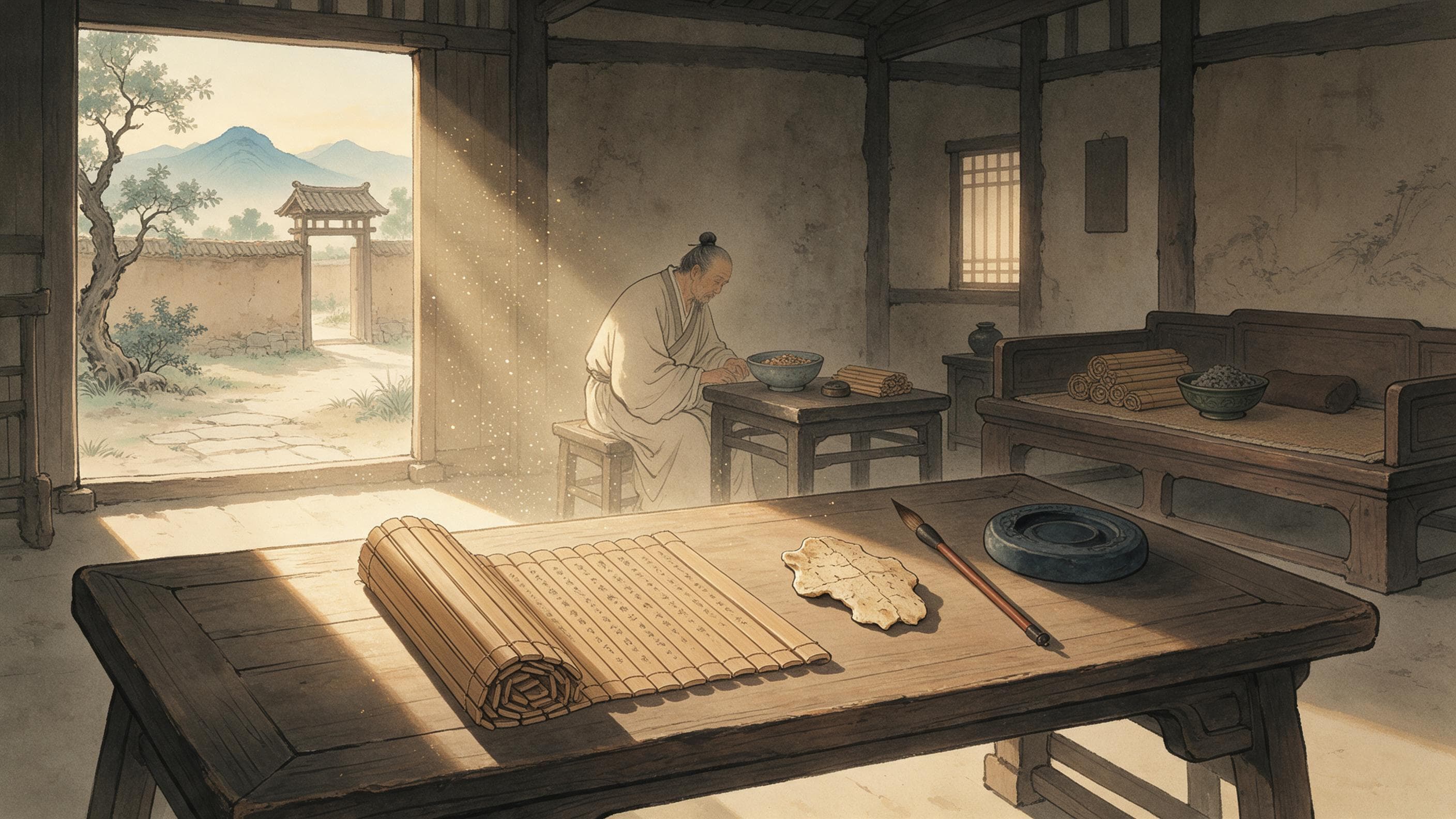
The Hanshu starts with a report and an edict. In Yuanfeng 7, 'a hundred and two years after Han arose' (漢興百二歲矣), Gongsun Qing, Hu Sui and the grand astrologer Sima Qian said 'the calendar record is ruined and the first month should be corrected' (曆紀壞廢,宜改正朔). The emperor had the scholars debate it, and their answer was a principle: 'a king must correct the first month and change the colours, so as to make clear he has received the mandate of heaven' (帝王必改正朔,易服色,所以明受命於天也). Then the edict, which admits the failure before giving the order: 'recently the officials said the calendar was not fixed… I have extended inquiries and examined the star measures, but could not match them' (未能讎也) — and ends with the seven characters. Note what it does not contain: no month length, no year length, no number.
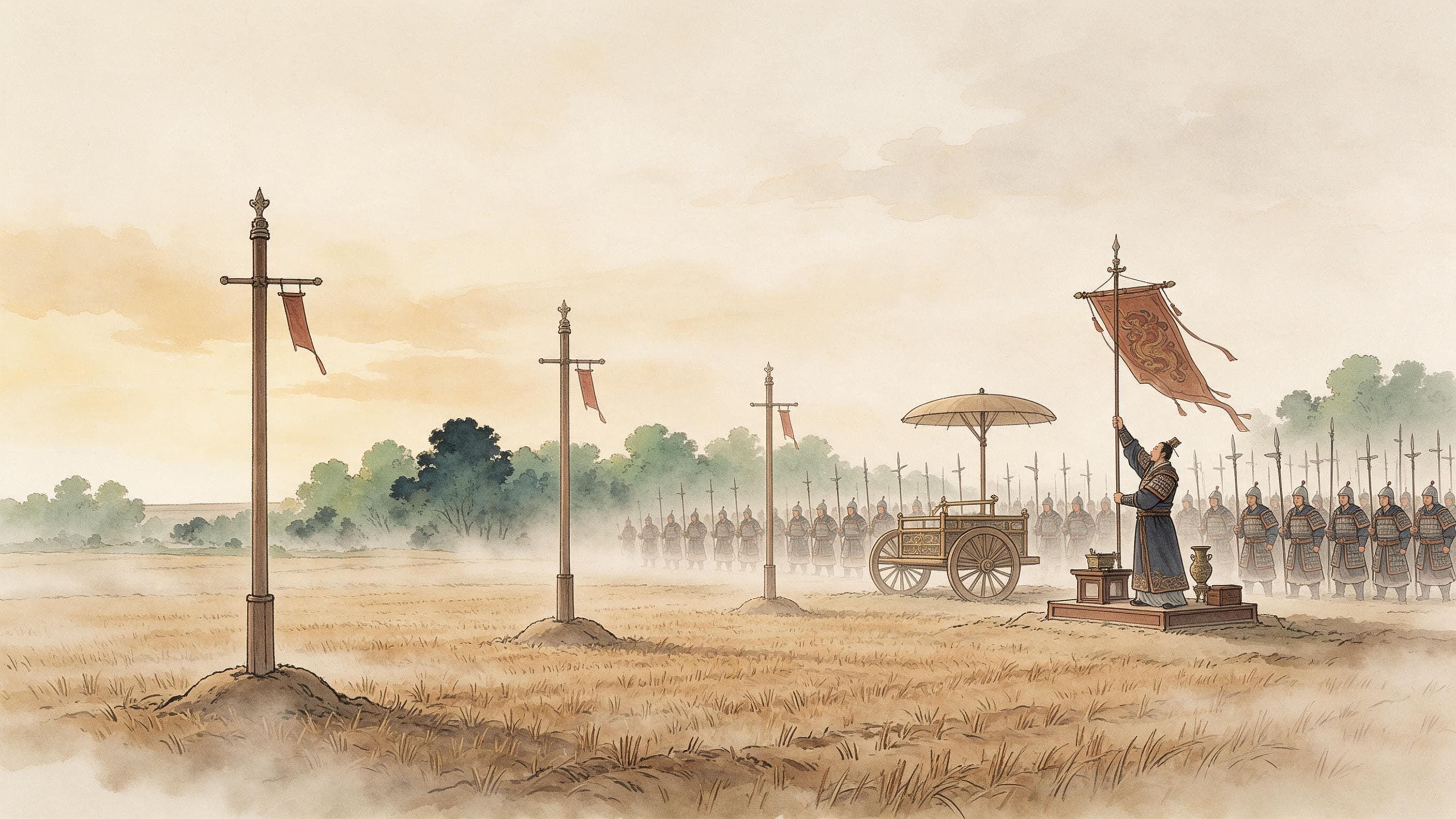
The Shiji pulls the same reform further back. It opens with a principle: 'when a king changes surname and receives the mandate he must be careful of the beginning, correct the first month, change the colours, and trace back to the celestial origin' (王者易姓受命,必慎始初,改正朔,易服色,推本天元). Then the history of not doing it: Han arose, believed it had the Water virtue, and 'therefore carried on Qin's first month and colours' (故襲秦正朔服色); under Wendi, Gongsun Chen proposed the change on the Five Powers argument and Chancellor Zhang Cang had it dismissed; Xin Yuan Ping raised the same matter, then rebelled, and Wendi 'dropped it and never asked again' (廢不復問). In this telling the reform is the end of a long postponement.
Three first months
What 'correcting the first month' means is set out in the Shiji in one sentence about three first months: 'the Xia took the first month, the Yin took the twelfth, the Zhou took the eleventh. The first months of the three kings are like a cycle; exhausted, they return to the beginning. When the world has the way, the order is not lost; when it does not, the first month is not carried out among the lords' (夏正以正月,殷正以十二月,周正以十一月。蓋三王之正若循環,窮則反本). These are month numbers, not modern dates, and this article keeps them as month numbers.
Which side the reform took is also one phrase: after Tang Du and Luoxia Hong worked, 'the degrees of the sun and the day were the same as the Xia first month' (然後日辰之度與夏正同). Back to the Xia reckoning — that is the direction. Which month of a solar year that was, neither page says; nor does either page say which month Qin's first month fell in, only that Han at first carried Qin's on.
The first team could not compute
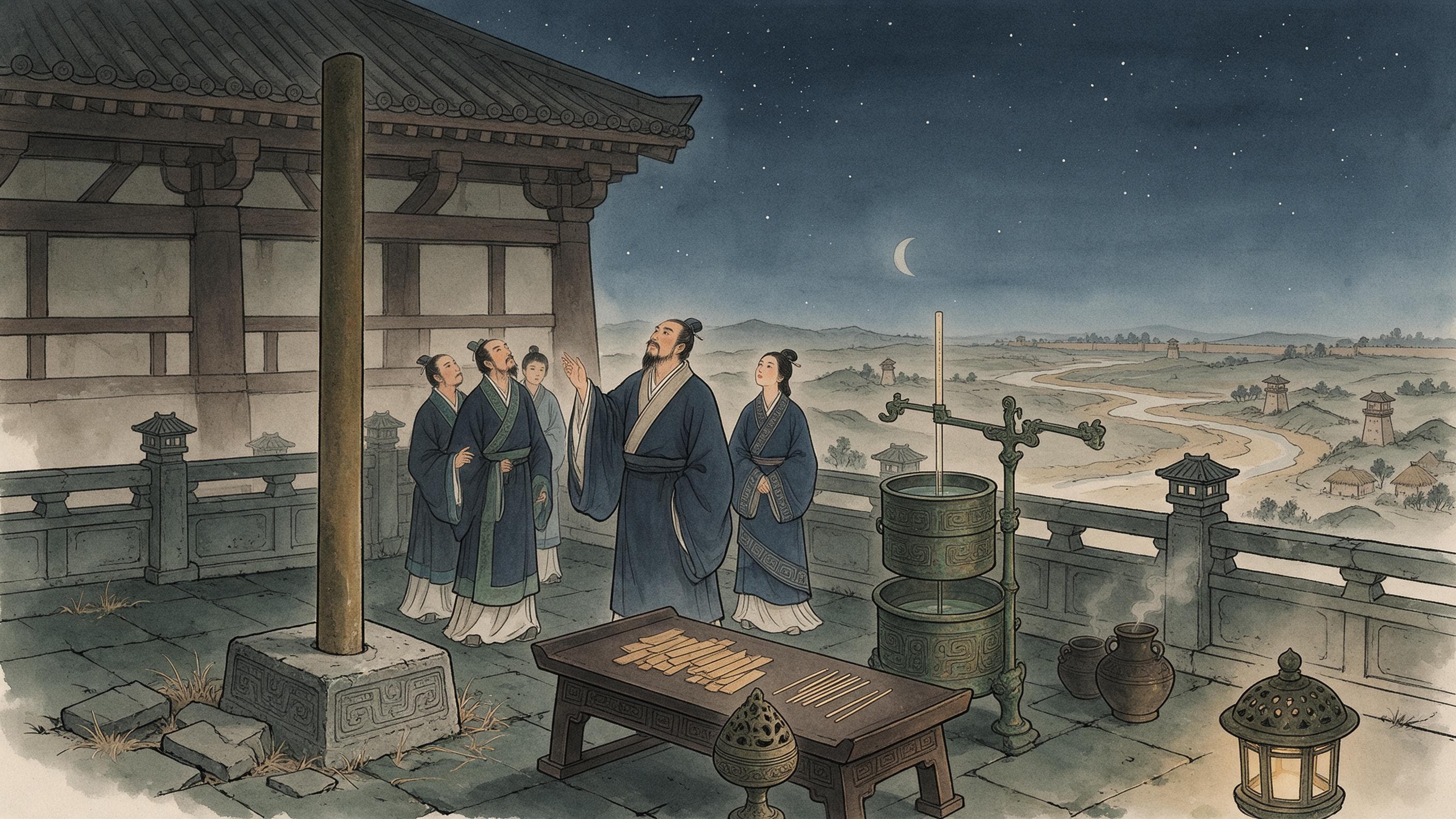
The first commission is a list of names and a set of instruments. The edict went to 'Qing, Sui and Qian, with the court gentleman Zun and the grand astrologer She Xing, to deliberate and make the Han calendar' (遂詔卿、遂、遷與侍郎尊、大典星射姓等議造漢曆). The method is given in one line: 'they fixed east and west, set up a gnomon, lowered the water clock, to pursue the distances of the twenty-eight mansions in the four quarters, and by the end determined new moons and dark moons, the solstices and equinoxes, stations and retrogradations, crescents and full moons' (乃定東西,立晷儀,下漏刻……以定朔晦分至,躔離弦望). Then the failure: 'Xing and the others reported that they could not do the calculations, and asked to recruit calendar men, to make new fine measures, each adding or subtracting as he could, in order to make the Han Taichu calendar' (姓等奏不能為算,願募治曆者). The reform begins with an admission that the first team could not compute.
Twenty-odd men
The second team is the one usually quoted, and the Hanshu gives its composition rather than its biographies: 'they chose the calendar man Deng Ping, and Ke of the Changle staff (司馬可), Yi Jun of Jiuquan (酒泉候), the court gentleman Zun, and calendar men from among the people, twenty-odd in all; the diviner Tang Du and Ba's Luoxia Hong were among them. Du divided the celestial field, and Hong turned the calculations' (凡二十餘人……都分天部,而閎運算轉曆). The list is the point: officials, a frontier officer, a palace gentleman, and unnamed men 'from among the people'. The 'Qian' of the first commission is generally thought to be Sima Qian, though the page writes only Qian.
One line, and an argument that did not end
The adopted rule is a fraction, not a decimal: 'the rule: one month is twenty-nine days and forty-three eighty-firsts of a day'. It is not converted here, and no modern month length is derived from it. Where the denominator comes from, the same page says in its own words: 'its method takes the pitch pipes as the basis of the calendar: the capacity of one yue is eighty-one cun, and that is the division of one day' (其法以律起曆……律容一龠,積八十一寸,則一日之分也). Hence the name: 'the eighty-one-part pitch-pipe calendar' (八十一分律曆).
Two calculations competed within the same reform, and the reason given for the choice is administrative: 'first borrowing half a day is called the yang calendar; not borrowing it is called the yin calendar… Ping said: in the yang calendar the new moon always rises before dawn, which is convenient for the assembled marquises, kings and ministers to appear at court' (先藉半日,名曰陽曆……以朝諸侯王群臣便). Convenience at court is the reason the text gives. The decision followed: 'he ordered Qian to use the eighty-one-part calendar made by Deng Ping, and abolished seventeen schools as too far off' (罷廢尤疏遠者十七家). A eunuch, Chunyu Lingqu, checked it and found the new moons, dark moons, crescents and full moons 'all the closest' (皆最密), 'the sun and moon like joined jades, the five planets like a string of pearls' — praise, quoted as praise. Deng Ping became assistant to the grand astrologer.
The Shiji supplies what the Hanshu lacks and lacks what the Hanshu has. It has no Deng Ping, no twenty-odd men, and never says 'eighty-one parts'; it has the same edict in other words — 'make the seventh year the first year of Taichu' (其更以七年為太初元年), year name Yanfeng Tige, month name Biju, day jiazi, midnight, new moon at dawn, winter solstice — and the Hanshu has 閼逢 for 焉逢 in the year name, one character apart, both kept. It also has a table, the Ganzhi Sequence (曆術甲子篇), with columns of great and small remainders: 'the great remainder is the day, the small remainder is the month' (大餘者,日也。小餘者,月也). The table is noted as a table; its numbers are not converted. Nor did the argument end: twenty-seven years later, in the third year of the later Yuanfeng (元鳳), the grand astrologer Zhang Shouwang memorialised that 'the yin and yang are not in tune, which is the fault of a calendar that should be changed'; the calendar officer Xianyu Wangren cross-examined him and he would not yield; over twenty men under Ma Guang observed and graded the systems, eleven families in all, and the Taichu calendar came first. What neither page gives is the observations, the errors, or the year the calendar stopped being used.
Related reading:The Men on Mount Tai: Who Went Up to Seal the Summit · Lowering the Coffin: The Day of the Burial · Two Books About Wine: An Office Manual and a Recipe
Sources & further reading
- 班固《汉书》卷二十一〈律历志上〉(维基文库本,未与点校本复核) — The reform in order. In Yuanfeng 7, 'a hundred and two years after Han arose', Gongsun Qing, Hu Sui and the grand astrologer Sima Qian say the calendar record is ruined and the first month should be corrected; the scholars argue that a king must 'correct the first month and change the colours' to show he has the mandate; the edict admits the star measures could not be matched and ends 'make the seventh year the first year' (其以七年為元年). The first commission — Qing, Sui, Qian, the court gentleman Zun and the grand astrologer She Xing — sets up gnomon and water clock, then reports it 'could not do the calculations' (不能為算) and asks to recruit others. The second team: Deng Ping, a Ke of Changle, Yi Jun of Jiuquan, the court gentleman Zun and calendar men from among the people, 'twenty-odd in all', with Tang Du dividing the sky and Luoxia Hong turning the calculations. The rule adopted is one line: 'one month is twenty-nine days and forty-three eighty-firsts of a day' (一月之日二十九日八十一分日之四十三), with the denominator explained by 'the capacity of one yue is eighty-one cun, and that is the division of one day'. The yang and yin calendars differ by borrowing half a day, and the yang is chosen because its new moon rises before dawn, 'convenient for the marquises, kings and ministers to appear at court'. Seventeen schools are abolished, a eunuch re-checks the result as 'the closest', and Deng Ping is made assistant to the grand astrologer. Twenty-seven years later Zhang Shou Wang is still disputing it.
- 司马迁《史记》卷二十六〈历书〉(维基文库本,未与点校本复核) — A different account, longer in principle and shorter in personnel. It opens with the rule that a new dynasty 'must be careful of the beginning, correct the first month, change the colours, and trace back to the celestial origin' (改正朔,易服色,推本天元); recalls that Han 'carried on Qin's first month and colours' (襲秦正朔服色); that under Wendi Gongsun Chen's proposal was dismissed by Zhang Cang and Xin Yuan Ping's ended in rebellion, after which the matter was dropped. It states the three first months in full: 'the Xia took the first month, the Yin the twelfth, the Zhou the eleventh; the first months of the three kings are like a cycle' (夏正以正月,殷正以十二月,周正以十一月). After Tang Du and Luoxia Hong, 'the degrees of the sun and the day were the same as the Xia first month'; the edict then reads 'make the seventh year the first year of Taichu' (其更以七年為太初元年), with the year name Yanfeng Tige, month name Biju, day jiazi, midnight, new moon at dawn, winter solstice — followed by the Ganzhi Sequence table of great and small remainders, 'the great remainder is the day, the small remainder is the month'. The Shiji has no Deng Ping, no twenty-odd men, and never uses the phrase 'eighty-one parts'.