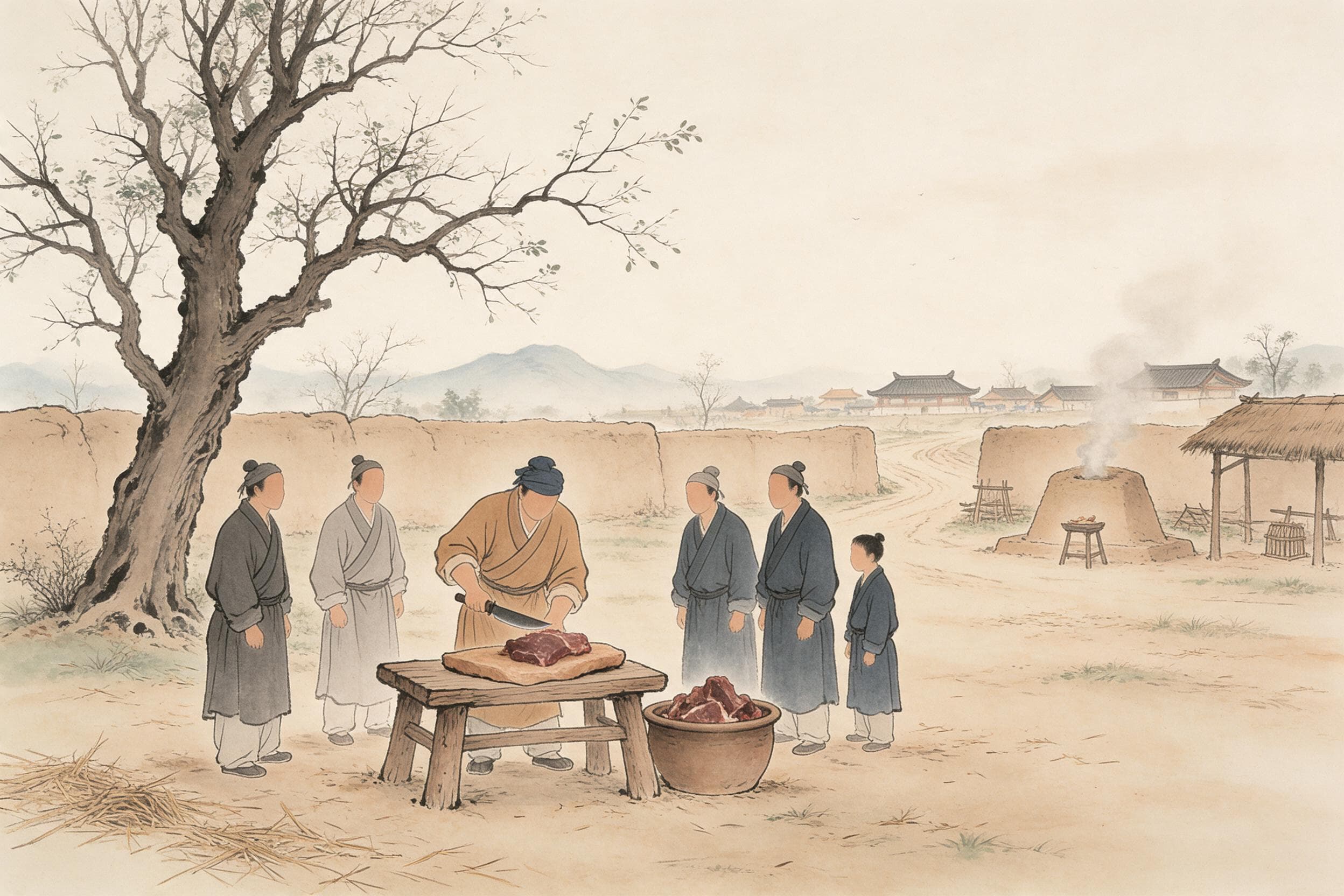
The whole subject is a few dozen characters. At the altar of the ward, a poor young man acted as the officer in charge of the meat and divided it very evenly; the elders said, Good, this boy Chen is fit to be the officer; and he answered: Ah — if I could but officiate over the world as I have over this meat. That is the scene. Neither page says who gave him the job or what he was paid for it: it begins with the division and ends with the division. The rest of the two chapters — poverty, a rich man's granddaughter, a chancellorship, six secret stratagems — is context. This article is about one piece of meat and one word: 宰.
The Ward Altar, and the Word
The Shiji has it this way: 里中社,平爲宰,分肉食甚均。父老曰:善,陳孺子之爲宰!平曰:嗟乎,使平得宰天下,亦如是肉矣! The page is plain text and explains none of the three names it uses: 社, the altar and the sacrificial unit; 里, the ward; 宰, conventionally the man who presides over the cutting and the handing out. Each is given as a name only. The weight of the sentence falls on 均, even: 分肉食甚均, he divided the meat very evenly, with an extra 食 in the phrase that the Hanshu does not have. The elders' praise, 善,陳孺子之爲宰, is good, this boy Chen as the officer — 孺子 being the word for a youngster, and the praise being the elders' speech, not the narrator's.
The sentence turns on 宰. In 平爲宰 it is a noun: the man who runs the division at the altar. In 宰天下 it works as a verb: to govern, to preside over a realm, with the chancellor's office standing behind it. One word, two readings, and a whole later life between them. The joke, if it is a joke, is that the smallest job in the ward supplies the name of the largest office in the empire. The page never points this out; it leaves the sentence standing, and the double reading is the conventional one rather than a gloss the page supplies.
Both Historians Read It as Ambition
Sima Qian, in his verdict at the end of the chapter, turns the meat into intention: 方其割肉俎上之時,其意固已遠矣 — when he was cutting meat on the offering board, his mind had already gone far. That sentence sits in 太史公曰, the historian's own comment, and is not a report of fact; the verdict opens with 陳丞相平少時,本好黃帝、老子之術, and ends by calling him a worthy chancellor who began and ended well. The 索隱述贊 appended after it adds 宰肉先均, he divided the meat first and evenly — a tag added by a later hand, not Sima Qian's text, and useful here only as evidence that later readers saw the same thing.
Ban Gu uses six characters in his appraisal: 陳平之志,見於社下 — Chen Ping's aim was visible beneath the altar. 志 is aim or intent; 社下 is the ground below the altar. One historian says the mind had gone far, the other says the aim was seen at the altar; one puts the meat at the end of a life, the other at the start of a career. Both hang their verdict on the same small piece of meat. Neither verdict is evidence about the altar; both are evidence about the historians. That is the warrant for this article, and the warrant is the two books', not the writer's.
A Hereditary House, and One Section of Four
The frames differ first. In the Shiji Chen Ping has a 世家, a hereditary house: chapter 56, the Chen Chancellor's House, a chapter of his own, with Wang Ling attached to it. In the Hanshu he is one section of a four-man collective biography: chapter 40, the joint account of Zhang, Chen, Wang and Zhou, where Zhang Liang, Chen Ping, Wang Ling and Zhou Bo share one juan and Chen Ping gets a stretch of it. A 世家 is where the Shiji puts hereditary houses and states; a 传 is a life, or a group of lives. The same altar and the same sentence, in two different frames — and in the second the frame is visibly shared.
More useful still is where the Yellow Emperor and Laozi sentence is put. The Shiji keeps it for the verdict: 陳丞相平少時,本好黃帝、老子之術. The Hanshu puts it in the narrative: 少時家貧,好讀書,治黃帝、老子之術. One fact, two layers — comment in one book, statement in the other. That is the cleanest example of the difference between the two histories, and the reason this article keeps 'how the historians read it' apart from 'how Chen Ping lived'.
Three Variants, One Contradiction
The same scene differs in three places, set side by side here and not adjudicated. 分肉食甚均 in the Shiji against 分肉甚均 in the Hanshu: the extra 食, meat as food rather than meat as offering. 父老曰 against 里父老曰: the elders, or the elders of the ward — a small shift from the men present to the office they hold. 亦如是肉矣 against 亦如此肉矣: like this meat, or like that meat — near or far, a gesture at the board in front of him or at the trade he has just performed. None of the three changes the sense, and all three are there: two transcriptions rather than one original.
Then there is a contradiction not to be smoothed over. Earlier the Shiji says his sister-in-law resented him — 其嫂嫉平之不視家生產,曰:亦食糠覈耳。有叔如此,不如無有, that he ate husks and a brother like that was worse than none — and that 伯聞之,逐其婦而棄之: his elder brother heard it and drove out his wife. Later in the same chapter the slander of Zhou Bo and Guan Ying says 臣聞平居家時,盜其嫂: we hear that Ping, while living at home, took his brother's wife. The wife had already been driven out; the slander still has him taking her. The chapter does not reconcile this, and neither does this article: both passages stand as written, neither convicts him nor explains him. Wei Wuzhi's answer to the king separates 能 from 行 — 臣所言者,能也;陛下所問者,行也 — a real distinction, but it answers a question about hiring, not this contradiction.
The Other Half of the Word, and the Limits
The second half of 宰天下 is given in one exchange. Emperor Wen asked the right chancellor, Zhou Bo, how many cases were judged in a year (天下一歳決獄幾何) and how much grain and money came in (天下一歳錢穀出入幾何); Zhou Bo said twice that he did not know, and 汗出沾背, the sweat ran down his back. Asked the same, Chen Ping said 有主者 — there are those whose business it is: for cases, 責廷尉, lay it on the commandant of justice; for grain and money, 責治粟內史, on the grain officer. The emperor pressed him: 苟各有主者,而君所主者何事也 — if each has his own business, what is yours? Then the definition: 宰相者,上佐天子理陰陽,順四時,下育萬物之宜,外鎮撫四夷諸侯,內親附百姓,使卿大夫各得任其職焉 — the chancellor assists the Son of Heaven in ordering yin and yang and following the four seasons, brings the ten thousand things to their proper growth below, quiets the four directions and the lords without, draws the hundred clans close within, and sees that each officer and grandee holds his own office. Five clauses, and that is the word 宰 answered at last — not the meat, but the office the meat was named after.
He ends with a verdict on himself: 我多陰謀,是道家之所禁。吾世即廢,亦已矣,終不能復起,以吾多陰禍也 — I have used too many secret schemes, which the Daoists forbid; if my line falls, it falls; it will never rise again, because I have piled up too much hidden harm. 陰謀 is the scheming, 陰禍 the harm it leaves behind, and the sentence closes the line that began at the altar: the boy who could run a division ends by counting what his cleverness cost. The six stratagems get a number and no more: 凡六出奇計……奇計或頗祕,世莫能聞也 — six secret plans, and they were kept secret enough that the world could not hear of them. Limits: no biography of Chen Ping; no account of how a ward altar was organised, what it cost, or how the meat was allocated, since neither page gives any; no reading of 分肉甚均 as the reason he became chancellor, which is the historians' hint and not a cause; and no quotation of the 索隱述贊 as Sima Qian. This site has written about the she-altars of the ritual year, about the altar of a fallen dynasty, and about comparing the two merchant chapters; this piece is one piece of meat and one word.
Related reading:Dog-Killing, Cloth-Selling, Flute at Funerals: What the Han Founders Did Before · The Wandering Knights: Zhu Jia, Ju Meng and Guo Jie · Model Officials: How a Historian Turns a Man into a Good Magistrate
Sources & further reading
- 《史記》卷五十六·陳丞相世家第二十六(西漢司馬遷撰;維基文庫本,白文無注,頁面標 textquality 75%,未與中華書局點校本複核) — A hereditary house, not a collective biography: Sima Qian gave Chen Ping a chapter of his own and attached Wang Ling to it. The scene is one sentence — 里中社,平爲宰,分肉食甚均。父老曰:善,陳孺子之爲宰!平曰:嗟乎,使平得宰天下,亦如是肉矣! — and the historian's verdict makes the pun explicit: 陳丞相平少時,本好黃帝、老子之術。方其割肉俎上之時,其意固已遠矣. Before it: 少時家貧,好讀書,有田三十畝,獨與兄伯居。伯常耕田,縱平使遊學; 其嫂嫉平之不視家生產,曰:亦食糠覈耳。有叔如此,不如無有。伯聞之,逐其婦而棄之; 戸牖富人有張負,張負女孫五嫁而夫輒死……負隨平至其家,家乃負郭窮巷,以弊席爲門,然門外多有長者車轍. After it: the chancellorship (有主者; 責廷尉; 責治粟內史; 宰相者,上佐天子理陰陽…使卿大夫各得任其職焉), the slander (平居家時,盜其嫂; 如冠玉耳), 魏無知's 能/行 distinction, 凡六出奇計…奇計或頗祕,世莫能聞也, and his own last word: 我多陰謀,是道家之所禁……以吾多陰禍也. The 索隱述贊 at the end (宰肉先均…) is later addition, not Sima Qian.
- 《漢書》卷四十·張陳王周傳第十(東漢班固撰;維基文庫本,白文無注,頁頭未標 textquality,未與中華書局點校本複核) — The same scene inside a four-man collective biography (張良、陳平、王陵、周勃), Chen Ping as one section. Three variants: 分肉甚均 for 史記's 分肉食甚均; 里父老 for 父老; 亦如此肉 for 亦如是肉. Ban Gu's verdict: 陳平之志,見於社下. One structural difference is usable: Ban Gu puts 治黃帝、老子之術 into the narrative opening (少時家貧,好讀書,治黃帝、老子之術), where Sima Qian keeps it for 太史公曰. The section also contains 其嫂疾平之不親家生産…逐其婦棄之 and, later, the slander 聞平居家時盜其嫂; and 奇計或頗祕,世莫得聞也.