Two fragments, two different things. The Records of the Grand Historian, in its chapter on merchants, says 'a thousand shi of fish from a pond by the water' (水居千石魚陂) — a pond producing a thousand shi of fish. The Book of Han, in its treatise on the economy, says the sea rent was 'increased threefold' (增海租三倍) — a tax on fishing at sea. One is an asset, the other a tax and a state venture; this article keeps them in separate sections rather than merging them into Han fisheries. On the unit: 石 is a measure of capacity, written shi in what follows, not converted into kilograms or modern money.
Uncrowned Marquises: A List of Countable Assets
The chapter first names the kind of man it means: 'those who have no rank or salary, no income from fief or estate, and yet whose living may be compared to such — these are called uncrowned marquises' (今有無秩祿之奉,爵邑之入,而樂與之比者,命曰素封). The comparison is made by income: a fief lord takes rents and taxes 'two hundred a household a year, a thousand households two hundred thousand', while a commoner house of a million takes the same in interest, two thousand on every ten thousand; so a list of productive assets is converted into holdings 'equal to a thousand-household marquis'.
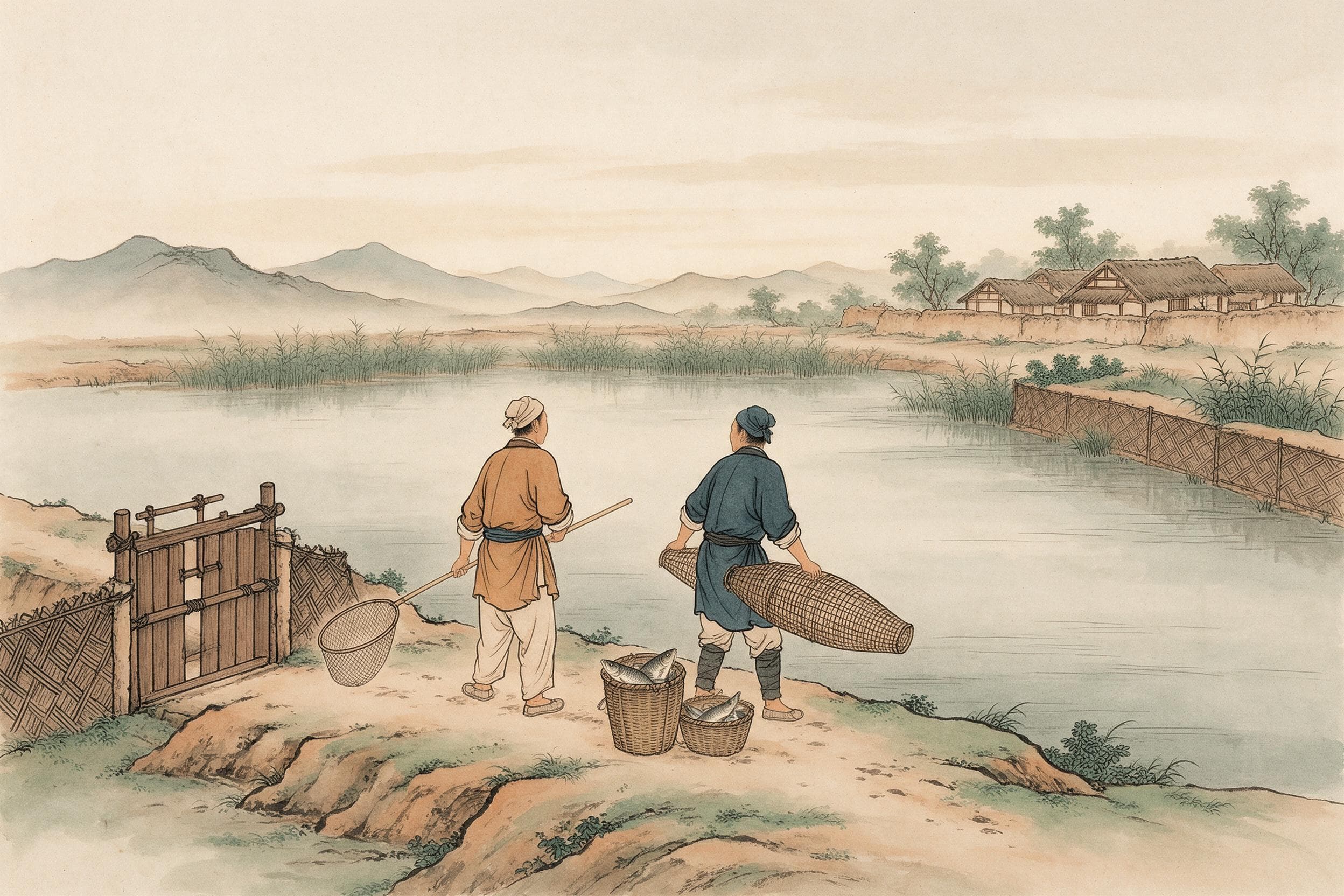
The list as printed: 'Thus it is said: on dry land, two hundred hooves of horses; cattle by horn and hoof a thousand; sheep by the thousand feet; in the marshes, pigs by the thousand feet; by the water, a thousand shi of fish from a pond; in the hills, a thousand rods of timber' (故曰陸地牧馬二百蹄,牛蹄角千,千足羊,澤中千足彘,水居千石魚陂,山居千章之材). There follow 'a thousand date trees at Anyi; a thousand chestnuts in Yan and Qin; a thousand oranges in Shu, Han and Jiangling; a thousand mu of lacquer in Chen and Xia; a thousand mu of mulberry and hemp in Qi and Lu; a thousand mu of bamboo on the Wei' (安邑千樹棗……渭川千畝竹), with plots of ginger and leek and fields by the city wall; and the passage closes: 'such men are all equal to a thousand-household marquis' (此其人皆與千戶侯等). In the list the fish pond stands beside horses, cattle, sheep and timber — an asset whose yield can be counted.
The list counts; it does not manage. How large the pond was, what fish were in it, who worked it, whether it was rented out, where the fish were sold, how many crops a year — neither page says. 'A thousand shi' is a figure for output and is printed as it stands; how it was reckoned, the page does not say, and nothing is supplied here.
The Sea Rent: Threefold
The Book of Han's treatise records the finances of the reigns of Zhao and Xuan. Geng Shouchang, acting director of agriculture, 'was favoured by the emperor for skill in calculation and for pressing profitable schemes'; he first proposed buying grain near the capital to save the transport levies from east of the passes, 'and further proposed increasing the sea rent threefold, and the emperor followed his plan in every case' (又白增海租三倍,天子皆從其計). He says only 'threefold': what the rent had been, what it came to, whether it was levied by boat, by net or by catch, the page does not give. 海租 is printed as it stands; that it means a tax on fishing is the usual reading, marked here as such and not expanded.
The objection came from the imperial secretary Xiao Wangzhi, with two examples: 'a former clerk of the censorate, Xu Gong, whose family is in Donglai, says that in former years when the sea rent was increased, the fish did not come out. The elders all say that in Emperor Wu's time the county offices once fished the sea themselves, and the sea fish did not come out; afterwards it was given back to the people, and then the fish came out' (故御史屬徐宮家在東萊……後復予民,魚乃出). Xiao explains this as the response of things to yin and yang, and adds that Geng's scheme of granaries and boats would cost more than twenty thousand times ten thousand; he ends by asking that things be left as they were (宜且如故), and the emperor did not listen.
Two layers here. 'Sea rent' is a tax; 'the county offices fishing the sea themselves' is a state venture. Both come from Xiao Wangzhi's mouth, but one is a tax rise and the other is the state taking the fishing into its own hands; they are kept apart here and not merged into 'Han state fisheries'. Nor was the sea rent the only thing he opposed: the Book of Han adds that the transport measure 'proved convenient' — the part he argued against turned out well, while the threefold rent went through.
Two Sources, Two Kinds of Text
The chapter on merchants is Sima Qian's argument: he names the 'uncrowned marquis', draws up the asset list, and makes the comparison with a fief. It is argument, not a ledger. The treatise on the economy is Ban Gu recording the financial debates of Zhao and Xuan: Geng's proposal, Xiao's objection, what the emperor accepted and what he did not — speech and event. The two pages are written differently, and each is quoted here at its own level.
What Neither Page Gives
Neither gives a fish price, a yield per acre, the area of the pond, the species, the status of the fishermen, the rate or total of the sea rent, the output and labour of the state venture, or any relation between the pond and the sea rent. Shi are not converted into kilograms and sums are not converted into modern money; the figure of grain at five cash a shi is not in these materials. Only what the two pages contain is written here.
The Historian's Judgement
The chapter closes with Sima Qian's own verdict: 'From this we see that wealth has no fixed profession and goods no constant owner; the capable gather like spokes, the incapable fall apart. A house of a thousand in gold is the equal of a city's lord, and one of ten thousand shares the joy of a king. Are these indeed what is called the uncrowned marquis? Are they not?' (由是觀之,富無經業……豈所謂素封者邪?非也). Those are his words, marked as his. Xiao Wangzhi's talk of yin and yang is likewise an explanation inside his own memorial, a speaker's position rather than a statement of fact; neither is used here as an objective record.
What can be established is this: one pond yielding 'a thousand shi of fish', listed by Sima Qian as equal to a thousand-household marquis; a sea rent that could be 'increased threefold', accepted by the emperor; and an objector who cited two cases — after the rent was raised the fish did not come out, and after the state fished the sea itself the fish did not come out — and was not listened to. How the pond was run and how the tax was levied, neither page says.
Related reading:Two chi Two cun: The Standard Bolt and the Cloth That Could Not Be Sold · Burning the Tallies: Debt, Interest and One Night's Fire in Warring States Qi · Thirty Cash a Jin: The Jin State's Salt Price and Its Ten-Cash Cost
Sources & further reading
- 《史记》卷一百二十九·货殖列传(西汉司马迁撰;维基文库本,页面白文无注,未与中华书局点校本复核) — The 'uncrowned marquis' passage: those who have no rank or fief income yet whose income equals a fief's are named su feng; a thousand-household lord takes two hundred thousand a year, and a commoner house of a million takes the same. The assets listed as equal to a thousand-household marquis include horses, cattle, sheep, pigs, 'a thousand shi of fish from a pond by the water' (水居千石魚陂), timber, and orchards. The chapter closes with Sima Qian's own argument that wealth has no fixed profession and no constant owner, and asks whether these are indeed 'uncrowned marquises'.
- 《汉书》卷二十四·食货志(东汉班固撰;维基文库本,页面白文无注,未与中华书局点校本复核) — Under Emperor Xuan, the grand-agriculture officer Geng Shouchang, 'further proposed to increase the sea rent threefold, and the emperor followed his plan in every case'; the imperial secretary Xiao Wangzhi objected, citing a clerk whose family was in Donglai: 'in former years when the sea rent was increased, the fish did not come out', and the elders' saying that 'in Emperor Wu's time the county offices once fished the sea themselves and the sea fish did not come out; afterwards it was given back to the people, and then the fish came out'. He read this as the response of things to the yin and yang; the emperor did not listen, and the transport measure proved convenient.