Two sentences are often read together, though they belong to different moments and different things. The first is the promise at the pass: 'I have made a covenant with you, elders: the law is three clauses only — he who kills shall die; he who wounds or steals shall be punished according to his crime' (與父老約,法三章耳:殺人者死,傷人及盜抵罪). The second is the historian's later explanation: 'the law of three clauses was not enough to check wickedness; thereupon the chancellor Xiao He… took what suited the time and made the law in nine chapters.' One is a slogan; the other is a code.
The Day He Entered the Pass
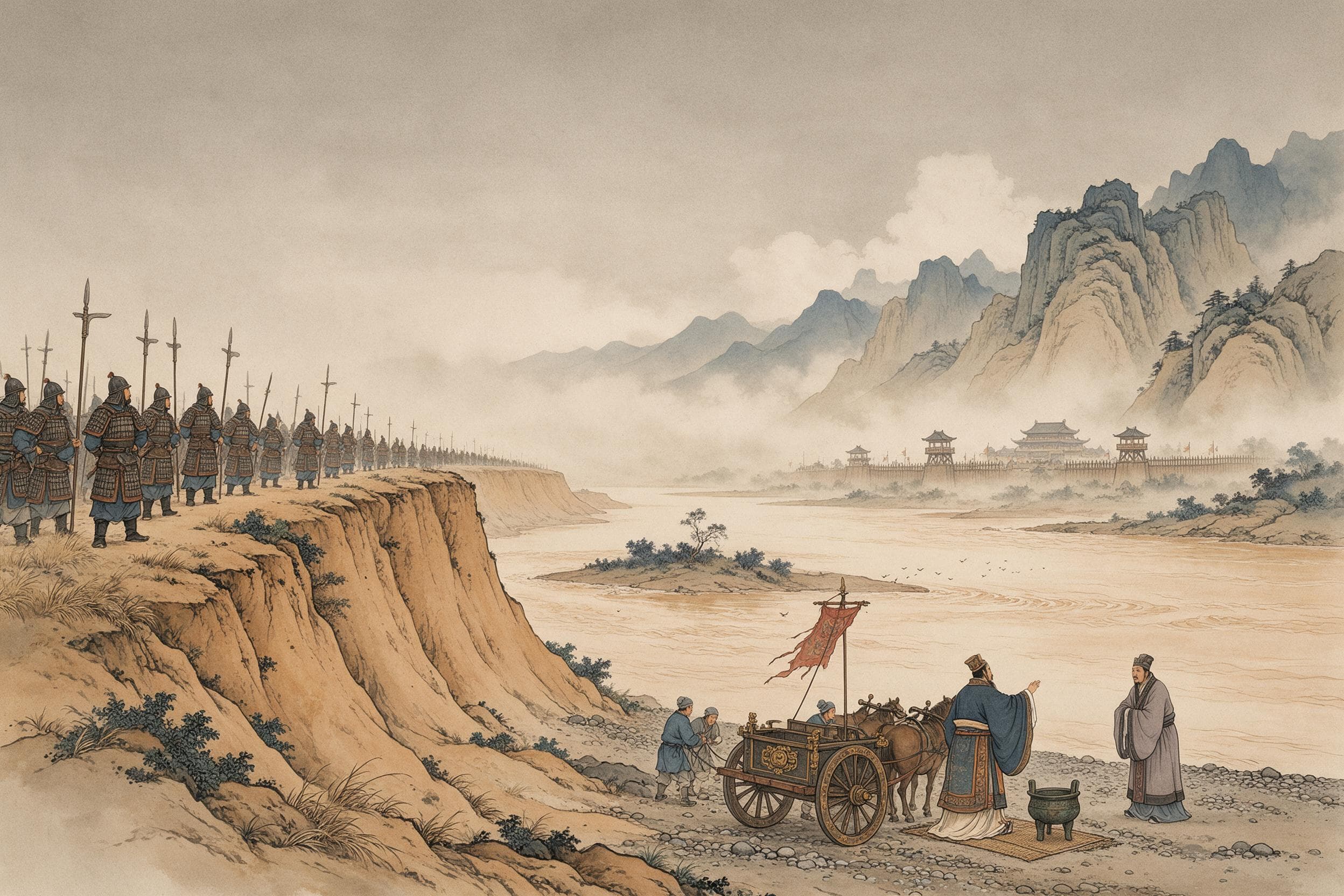
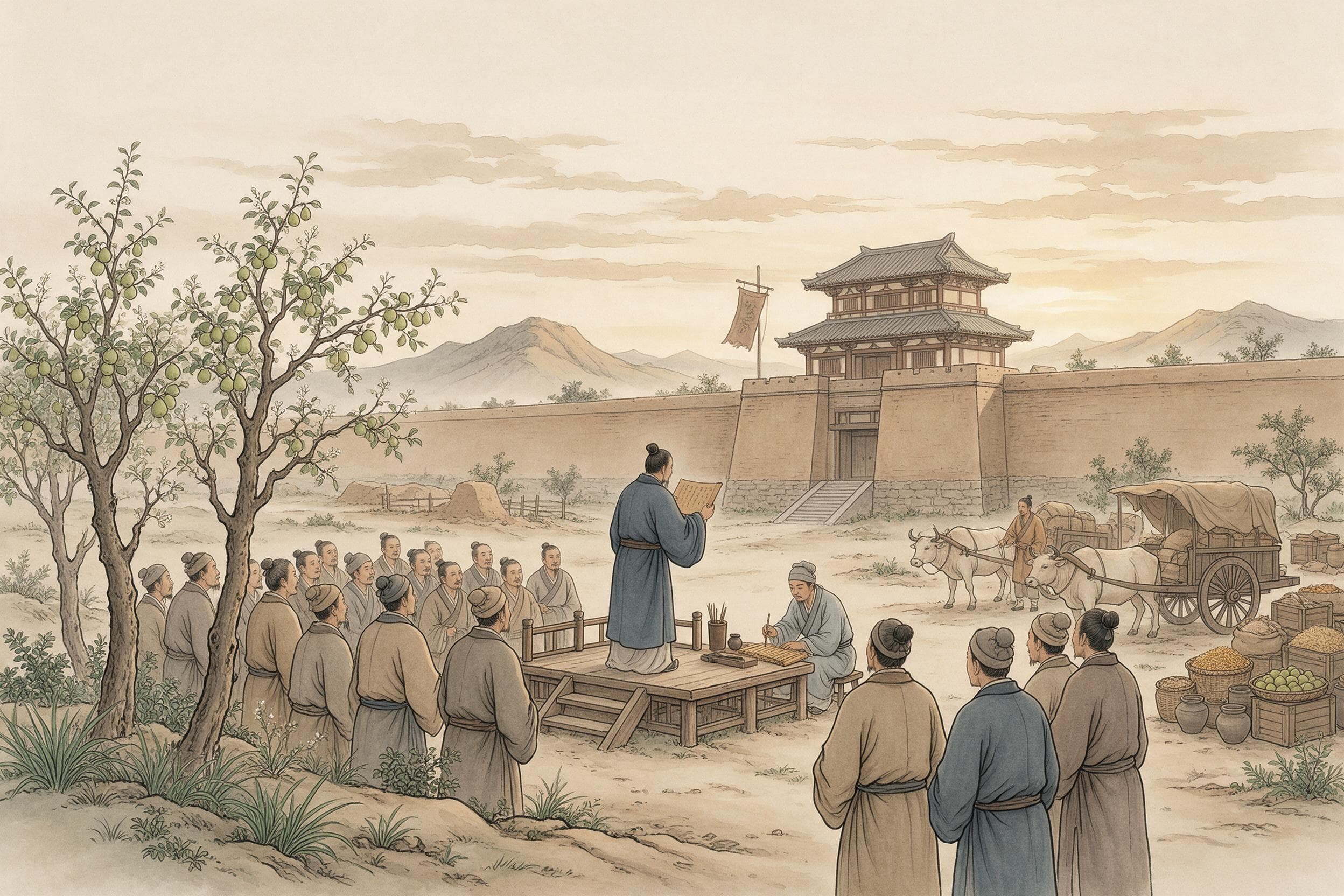
In the tenth month of the first year of Han (206 BCE) the Shiji has Liu Bang's army arrive at Bashang first; the Qin heir surrenders in a plain cart with a white horse, his neck bound with a cord. Liu Bang enters Xianyang, wants to lodge in the palace, is dissuaded by Fan Kuai and Zhang Liang, seals the treasuries and camps outside the walls. Then he summons the elders and notables of the counties. First the hardship: 'Elders, you have suffered from Qin's harsh laws a long time — those who criticised were executed with their kin; those who spoke together were put to death in the market.' Then his claim: the lords had agreed that whoever entered the pass first should rule it. Then the three clauses: the killer dies; the injurer and the thief are punished according to the crime; 'all the rest of the Qin law is abolished; the officials stay at their posts as before.' He is careful not to claim the throne outright: he says he waits outside the walls for the other lords to settle the terms.
Then the effect: messengers are sent with the Qin officials through the counties and villages to proclaim it; the people rejoice and bring cattle, sheep and wine for the troops; Liu Bang declines the gifts, saying the granaries are full and he will not put them to expense, 'and they rejoiced the more, fearing only that he would not become king of Qin'. The passage reads like a piece of political theatre: abolish the harsh law, refuse the gifts, and the hearts of the people come over.
But three clauses are only three sentences: the killer dies; the injurer and the thief 'pay according to the crime'. How the payment is assessed, how wounds are graded, how much theft counts, who tries the case, whether redemption is allowed, whether collective liability survives — none of it is here. It is not a statute book but a promise: abolish the harsh Qin law, keep three principles.
Three Clauses Were Not Enough
The Han shu's treatise on punishment takes up the story: 'When Han arose, Gao Zu had just entered the pass and made a covenant of three clauses… He abolished the harsh and petty, and the myriad people rejoiced. Afterwards, with the four frontiers not yet attached and weapons not yet rested, the law of three clauses was not enough to check wickedness; thereupon the chancellor Xiao He… took what suited the time and made the law in nine chapters' (三章之法不足以禦姦…作律九章). The reason for the step is given by the historian, not by the clauses: not that the three were wrong, but that they could not check crime; and the method was selection — 'taking what suited the time' out of the Qin law.
That sentence matters: Han inherited Qin law. The nine chapters were not built from nothing but compiled out of Qin statutes. The same treatise says that with Xiao He and Cao Shen as chancellors government was 'filled with non-action', following the people's wishes without disturbing them, so that food and clothing increased and 'punishments were seldom used'. The mildness of early Han is mildness relative to Qin, not the absence of law; law and leniency sit side by side in this chapter.
Which Nine Chapters
The answer is blunt: the treatise says 'made the law in nine chapters' and nowhere lists them. So this article lists no chapter names. Later catalogues explain the nine as six chapters with three added; that is a much later account, not in the two pages used here, and this article neither quotes it nor fills in the names from it.
The same holds for the chain 'Li Kui's Book of Law in six chapters — Shang Yang received it for Qin — Xiao He expanded it to nine': that is a later history of law. The treatise is a survey of punishments, not a catalogue of statutes. This page of it contains neither Li Kui nor the Book of Law. The chain can be mentioned, but only as a later account; using it to explain where the nine chapters came from is interpretation, not quotation.
What Can and Cannot Be Written
It cannot be written that the three clauses were a Han code — they are three principles with no procedure and no penalties; nor that the nine chapters were called such-and-such — the treatise does not list them; nor that early Han abolished Qin law — the opposite: Xiao He selected from it. What can be written: the scene at the pass and the text of the three clauses; the treatise's reason and method; the four words 'made the law in nine chapters'; and the note that punishments were seldom used.
One contrast is worth adding: the three clauses were addressed to the elders, the nine chapters to the officials. One is a political promise — I will not use Qin's machinery against you; the other is administrative technique — a case still needs a rule to stand on. They follow one another in the same history, and the distance between them is exactly the distance between a slogan and a code — the line the historian himself draws when he says the three were not enough.
What Is Not Here
No evidence that cases were actually judged by the three clauses alone; no account of how cases were handled in the interval; no names or text of the nine chapters; no list of which Qin articles Xiao He took; no procedure of early Han courts. Neither page has them. What this article writes is how the histories tell the step from three clauses to nine, not a reconstruction of Han law.
Between three slogans and a code of nine chapters stands one sentence of explanation: three clauses were not enough to check wickedness. The slogan won hearts; the code kept order; Han inherited Qin law, and early Han's mildness was Qin's frame with a few cuts made in it. As for what those nine chapters looked like, these two pages give four words and no more: 'made the law in nine chapters.'
Related reading:A Square Li Divided Nine Ways: Mencius's Well-Field on Paper · Nine Provinces, Two Inventories: The Tribute List of the Yugong · Ten Gravest Crimes: Reading the Bei Qi Code Through the Sui History
Sources & further reading
- 司马迁《史记》卷八·高祖本纪(西汉;维基文库本,未与点校本复核) — The scene at the Qin capital. In the tenth month of the first year of Han, Liu Bang's army reaches Bashang, the Qin heir surrenders, and after being advised not to lodge in the palace he seals the treasuries and camps outside. He then summons the elders and notables of the counties: 'Elders, you have suffered from Qin's harsh laws a long time — those who criticised were executed with their kin, those who spoke together were put to death in the market. I have agreed with the other lords that whoever enters the pass first shall rule it, and I am to rule Guanzhong. I have made a covenant with you, elders: the law is three clauses only — he who kills shall die; he who wounds or steals shall be punished according to his crime. All the rest of the Qin law is abolished. The officials shall stay at their posts as before' (與父老約,法三章耳:殺人者死,傷人及盜抵罪). Messengers are sent through the counties and villages to proclaim it; the people rejoice, bring cattle, sheep and wine to the troops, and Liu Bang declines the gifts, saying the granaries are full, so that they rejoice the more. The chapter gives the three clauses and the scene, no procedure and no penalties.
- 班固《汉书》卷二十三·刑法志(东汉;维基文库本,未与点校本复核) — The Eastern Han treatise that explains the step from three clauses to a code: 'When Han arose, Gao Zu had just entered the pass and made a covenant of three clauses: he who kills shall die; he who wounds or steals shall be punished according to his crime. He abolished the harsh and petty, and the myriad people rejoiced. Afterwards, with the four frontiers not yet attached and weapons not yet rested, the law of three clauses was not enough to check wickedness; thereupon the chancellor Xiao He selected from the Qin law and, taking what suited the time, made the law in nine chapters' (三章之法不足以禦姦…作律九章). The treatise mentions the nine chapters here and nowhere lists their names; it also says that under Xiao He and Cao Shen as chancellors government was 'filled with non-action', and punishments were seldom used. This page of the treatise contains no Li Kui and no Book of Law (法經); the six-chapter lineage is a later account, not part of these two pages.