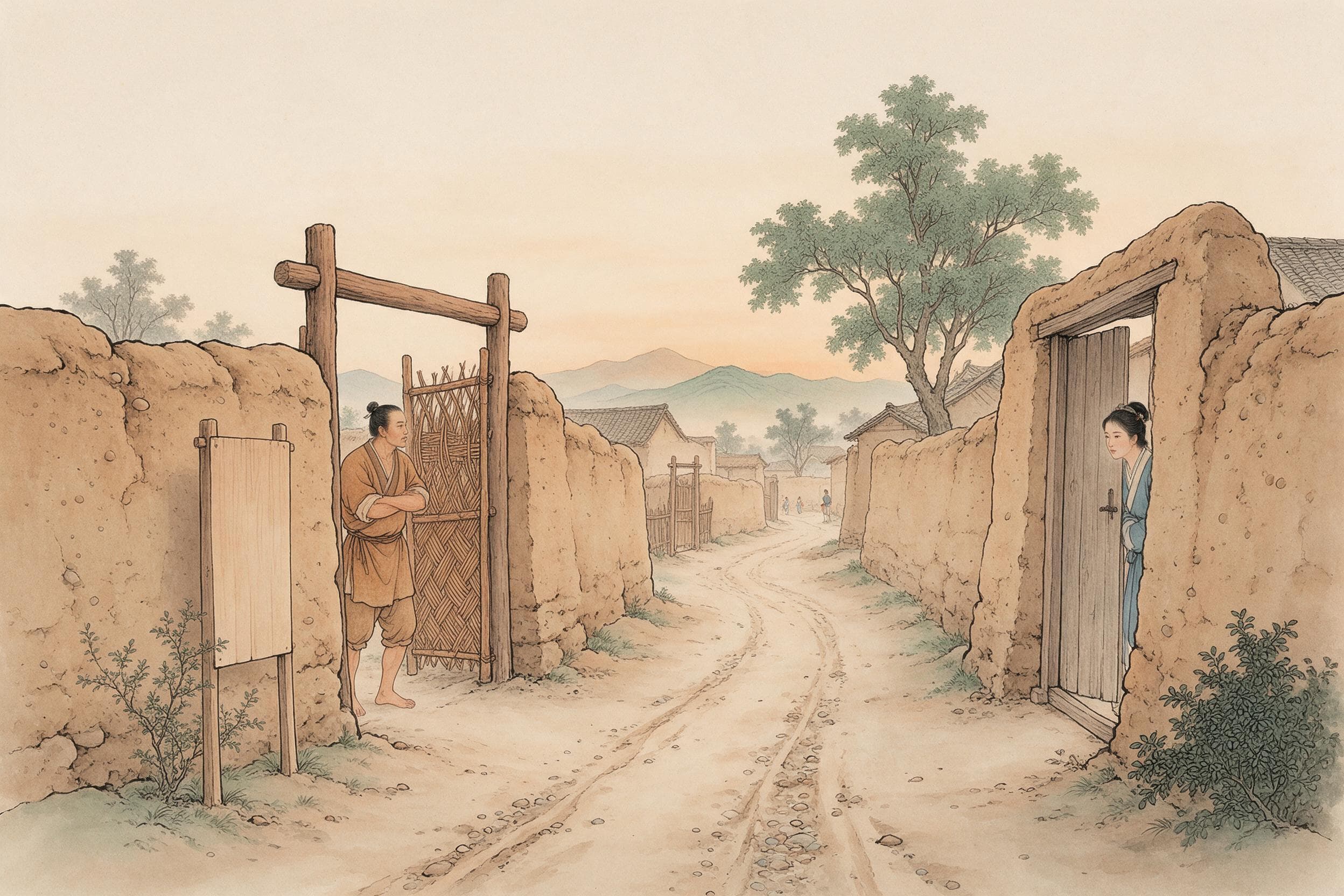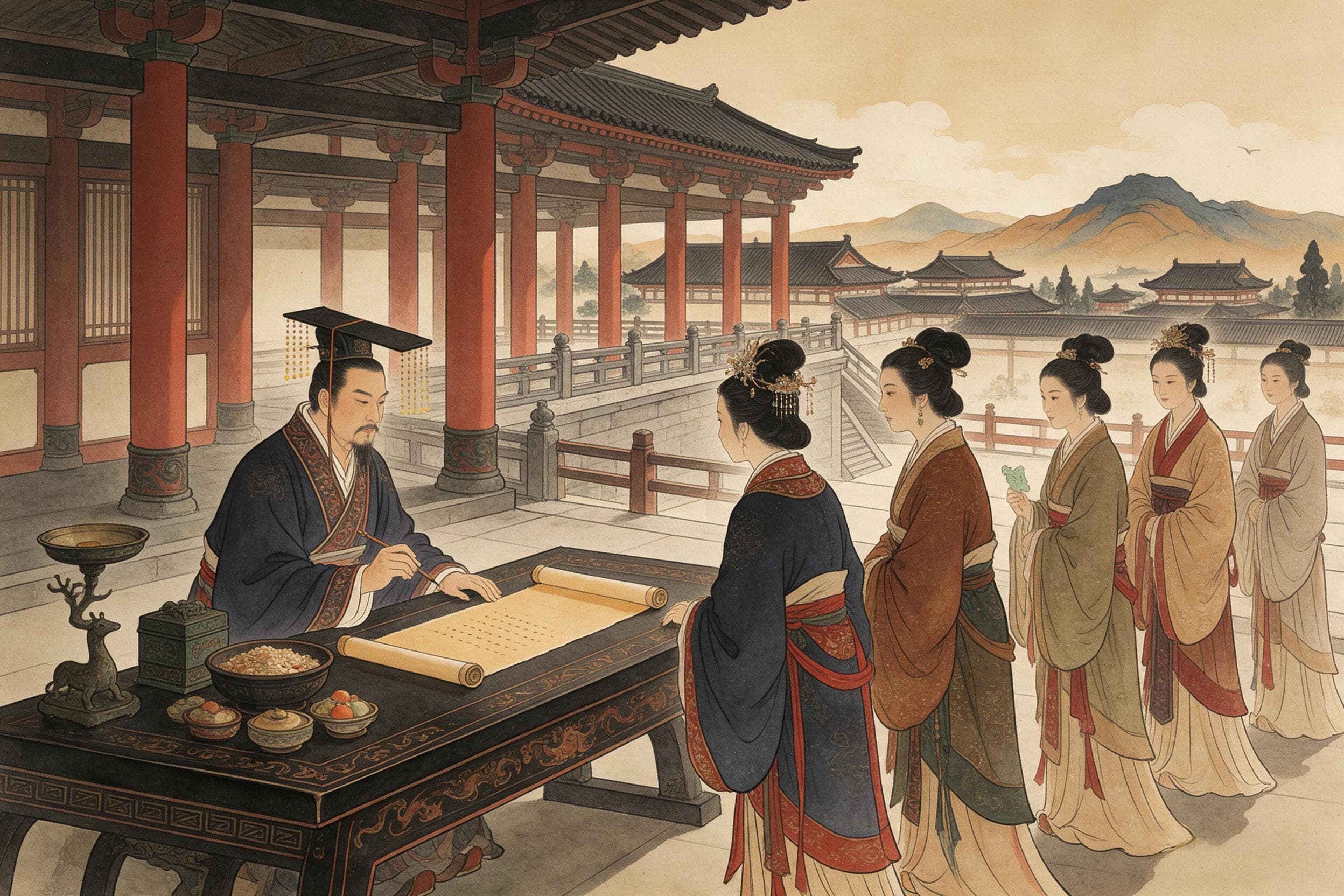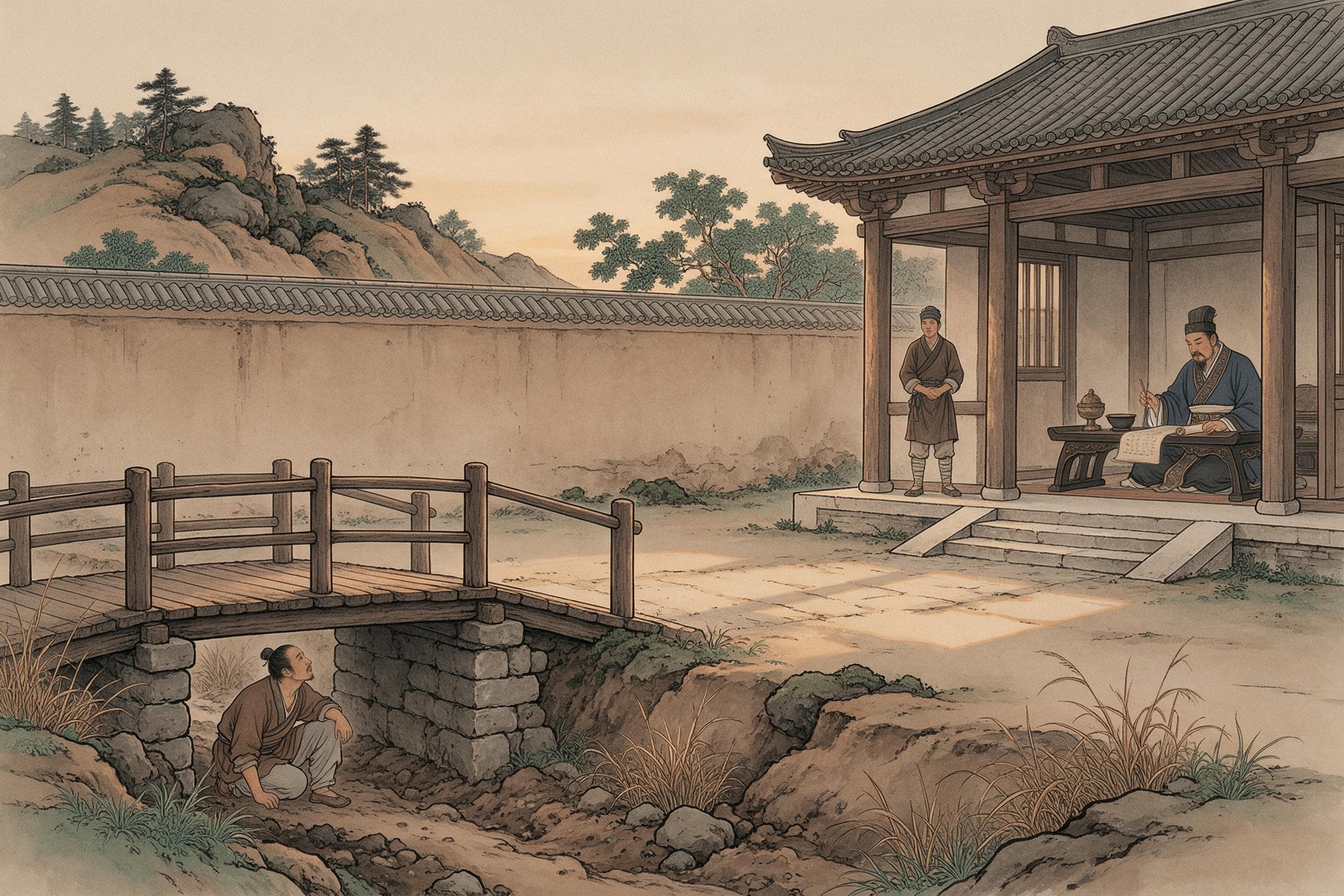
Three cases reached the commandant of justice, and each ends the same way: a sentence, an angry emperor, and a judge who does not change the sentence. In the first, a man stopped the carriages of the crown prince and the prince of Liang at a palace gate. In the second, a man from the counties startled the imperial horses on a bridge. In the third, someone stole a jade ring from the temple of the dynasty's founder. Two histories tell these cases, the Shiji's life of Zhang Shizhi and the Hanshu's, and the Hanshu follows the Shiji closely: one account written twice, not two independent witnesses.
The First Case: The Sima Gate
The entry is short: 太子與梁王共車入朝,不下司馬門,於是釋之追止太子、梁王無得入殿門。遂劾不下公門不敬,奏之 — the crown prince and the prince of Liang drove into court together and did not get down at the Sima Gate; Zhang Shizhi went after them, stopped them from entering the palace gate, and impeached them for 不敬, disrespect, and submitted it. The charge is two characters, and the man charged was the heir. What follows is not the emperor's anger at the judge: 薄太后聞之,文帝免冠謝曰:「教兒子不謹。」 — the empress dowager heard of it, and the emperor took off his cap and apologised for not having taught his son. Then 薄太后乃使使承詔赦太子、梁王,然後得入。文帝由是奇釋之,拜爲中大夫 — her envoy brought a pardon, the two entered, and the emperor, impressed, made Zhang a 中大夫. The Hanshu has 毌入殿門 for 無得入殿門 and 繇是 for 由是; the case ends with a promotion, not with a ruler giving way. The charge is brought against the heir, and the emperor's response is to apologise upward, to his mother, and then to promote the man who brought it.
The Second Case: The Middle Wei Bridge
上行,出中渭橋,有一人從橋下走出,乘輿馬驚。於是使騎捕,屬之廷尉。釋之治問。曰:「縣人來,聞蹕,匿橋下。久之,以爲行已過,即出,見乘輿車騎即走耳。」 — the emperor went out over the Middle Wei Bridge, a man came out from under it, the imperial horses shied, riders caught him and handed him to the commandant. The confession is four clauses: a man from the counties; he heard the clearing of the road and hid under the bridge; he waited so long that he thought the procession had passed; he came out, saw the carriages and ran. That is the whole of his conduct and the whole of his motive. The Hanshu differs in small words: 從橋下走 for 走出, 久,以為行過 for 久之,以爲行已過, 既出,見車騎 for 即出,見乘輿車騎. The confession is the only place in the three cases where the accused speaks, and it is four short clauses.
The sentence is one line: 廷尉奏當,一人犯蹕,當罰金 — the commandant submitted the sentence: one man violated the clearance, 蹕, punishable by fine, 罰金. The Hanshu has 此人 for 一人, 'this man' rather than 'one man', and puts the line in quotation marks as Zhang's own submission. Neither page gives the amount of the fine. The emperor's anger follows: 此人親驚吾馬,吾馬賴柔和,令他馬,固不敗傷我乎?而廷尉乃當之罰金! — this man startled my horses himself; my team was gentle, but with another, would he not have hurt me? and the commandant fines him! The Hanshu has 馬賴和柔,令它馬 for 吾馬賴柔和,令他馬.
Zhang answers in three layers. 法者,天子所與天下公共也。今法如此而更重之,是法不信於民也 — law is what the son of heaven holds in common with the realm; to make it heavier than it is would be to make the law untrusted among the people. 且方其時,上使立誅之則已 — and at the time, had Your Majesty had him killed on the spot, it would have ended there. 今既下廷尉,廷尉,天下之平也,一傾而天下用法皆爲輕重,民安所錯其手足? — but now that he has been handed to the commandant, the commandant is the balance of the realm; once it tips, the whole realm's use of law shifts with it, and where will the people put their hands and feet? The Hanshu has 上使使誅之 for 立誅之, 今已下廷尉 for 今既下廷尉, and 壹傾 for 一傾. The case ends 良久,上曰:「廷尉當是也。」 — after a long while the emperor said the commandant's sentence was right.
The Third Case: The Jade Ring
其後有人盜高廟坐前玉環,捕得,文帝怒,下廷尉治。釋之案律盜宗廟服御物者爲奏,奏當棄市 — someone stole the jade ring from before the throne in the founder's temple, was caught, and the angry emperor sent him to the commandant. Zhang 案律, checked the law, on stealing temple furnishings, and submitted the sentence of 棄市, execution at the marketplace. 案律 is the only mention of a law in the three cases, and the page does not name the statute, quote it, or give the value of the ring. The Hanshu writes 座 for 坐 and drops 釋之 and 律. The word 案律 is the only legal citation in the three cases, and it cites nothing.
The emperor's anger is larger here: 人之無道,乃盜先帝廟器,吾屬廷尉者,欲致之族,而君以法奏之,非吾所以共承宗廟意也 — the man is without principle, he stole a vessel of the former emperors; I handed him to the commandant wanting the clan exterminated, 族, and you submit him under the law, which is not how I meant to serve the ancestral temple. Zhang answers 法如是足也。且罪等,然以逆順爲差 — the law is enough as it stands; and where crimes are equal, the difference is made by obedience and rebellion. Then the hardest question: 今盜宗廟器而族之,有如萬分之一,假令愚民取長陵一抔土,陛下何以加其法乎? — if stealing a temple vessel brings clan extermination, then in the ten-thousandth part of a chance that a foolish commoner takes a handful of earth from the Changling tomb, what more could Your Majesty add? The Hanshu has 以逆順爲基 for 爲差, basis instead of gradation, and the sentence's meaning changes with the character. The case ends 久之,文帝與太后言之,乃許廷尉當 — after a long while the emperor spoke with the empress dowager and consented; the Hanshu drops 久之.
After it, 是時,中尉條侯周亞夫與梁相山都侯王恬開見釋之持議平,乃結爲親友。張廷尉由此天下稱之 — Zhou Yafu and the marquis of Shandu, seeing that Zhang held his opinions levelly, became his friends, and from this the commandant was known through the realm. The Hanshu names the marquis 王恬咸 and writes 繇此 for 由此. The Shiji's closing couplet on him, 驚馬罰金,盜環悟上, a startled horse fined and a stolen ring that woke the emperor, is not part of the biography: it is the 索隱述贊, a Tang commentary, and is marked as such here.
The Sentences, and What Came After
The sentences people remember are in one speech. 法者,天子所與天下公共也 — the law is held in common. 廷尉,天下之平也 — the commandant is the balance of the realm; 平 is a scale-beam, and the next clause, 一傾, once it tips, shows it. 一傾而天下用法皆爲輕重,民安所錯其手足 — once it tips, the realm's use of law shifts with it and the people have nowhere to put their hands and feet. The third case adds 法如是足也, the law is enough as it stands. These are the page's words, and this article keeps them as words: it does not translate them into any modern principle of law.
The aftermath is colder than the cases. 後文帝崩,景帝立,釋之恐,稱病 — after Emperor Wen died and Emperor Jing came in, Zhang was afraid and pleaded illness. He kept his place by a device of an old man, 王生, who at court said 吾韤解, my garters are loose, and had the commandant kneel and tie them, 欲以重之, to make him weightier. The Hanshu has 稱疾 for 稱病 and ends 年老病卒.
What This Article Leaves Out
It does not write a life of Zhang Shizhi or a history of Han law: the pages give three cases, a few words of procedure and no statutes. The name of the statute, the amount of the fine, the manner of execution, the value of the ring and the years of the cases are absent from both pages, and none is supplied here. The two books are one account written twice; where they differ, the article says which is which and does not merge them. The emperor's reasons for giving way are given only as 良久 and 與太后言之, and this article does not supply the rest. The article on the growing statute book, the one on the edict abolishing mutilation and the one on market enforcement take other subjects; this one stays at the commandant's court. What the pages give is a procedure in a few words, 奏當, 奏之, 下廷尉, 許廷尉當, and three sentences that do not move.
Related reading:Dog-Killing, Cloth-Selling, Flute at Funerals: What the Han Founders Did Before · From Zhaoyi to Yezhe: Fourteen Ranks of the Han Palace and Their Stipends · Three Hundred and Fifty Hu a Month: Two Han Salary Tables That Don't Match
Sources & further reading
- 《史記》卷一百二·張釋之馮唐列傳(西漢司馬遷撰;維基文庫本,頁面白文,未與中華書局點校本複核) — The three cases and the speeches: 太子與梁王共車入朝,不下司馬門…遂劾不下公門不敬; 上行,出中渭橋…縣人來,聞蹕,匿橋下…廷尉奏當,一人犯蹕,當罰金…法者,天子所與天下公共也…廷尉,天下之平也,一傾而天下用法皆爲輕重…良久,上曰:廷尉當是也; 其後有人盜高廟坐前玉環…釋之案律盜宗廟服御物者爲奏,奏當棄市…以逆順爲差…取長陵一抔土,陛下何以加其法乎…久之,文帝與太后言之,乃許廷尉當; 張廷尉由此天下稱之; 後文帝崩,景帝立,釋之恐,稱病. The page closes with a 索隱述贊 驚馬罰金,盜環悟上, which is Tang commentary, not biography.
- 《漢書》卷五十·張馮汲鄭傳(東漢班固撰;維基文庫本,頁面白文,頁頭標 textquality 25%,未與中華書局點校本複核) — The same three cases, largely following the Shiji with wording differences: 南陽堵陽人也, 爰盎, 毌入殿門, 此人犯蹕, 上使使誅之, 今已下廷尉, 壹傾, 座前玉環, 以逆順爲基, 王恬咸, 繇此, 稱疾, 年老病卒. The chapter ends with a 贊曰 rather than a 太史公曰.