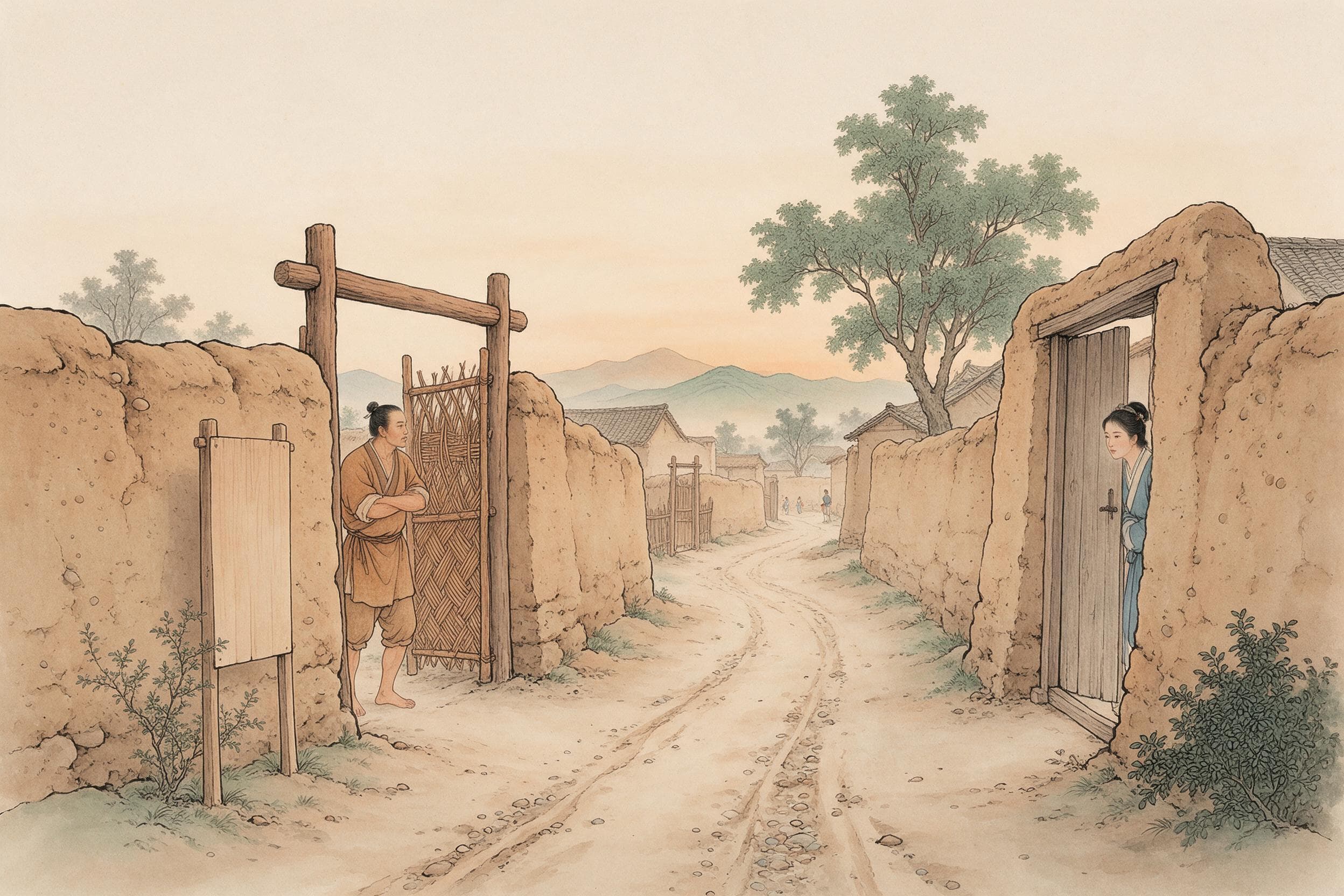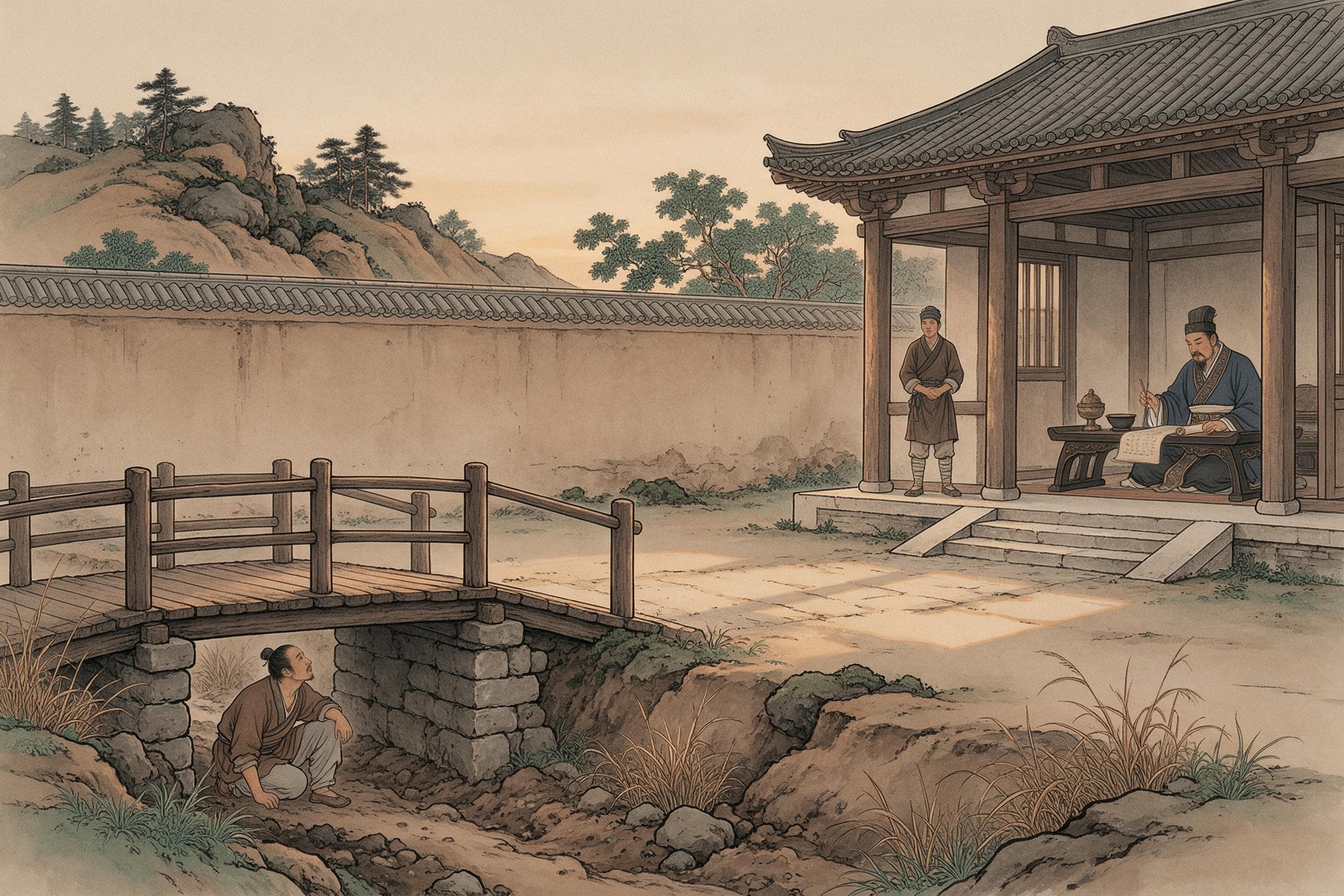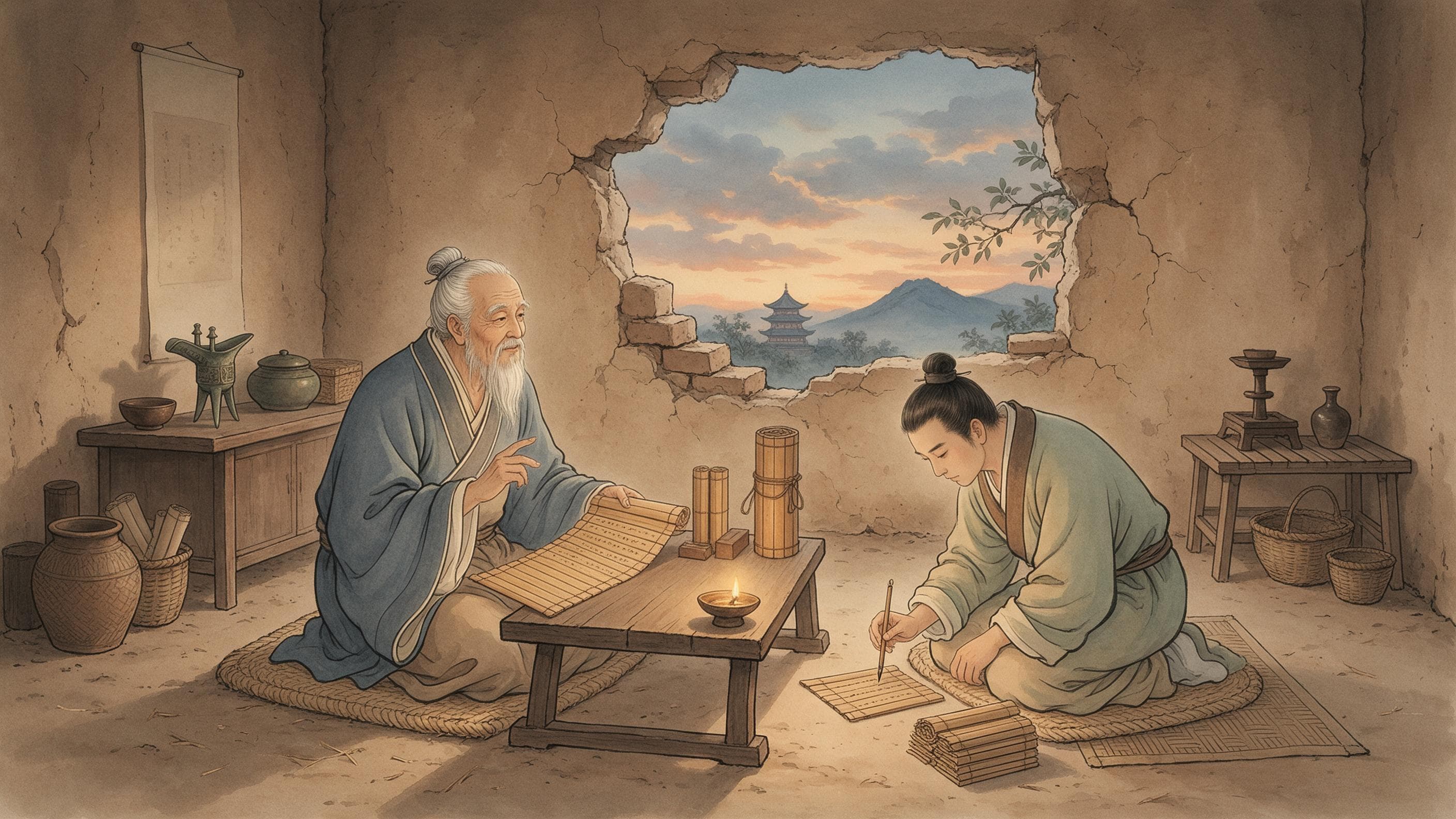
Qin burned the books, and Fu Sheng hid his copy in a wall. When the fighting ended he went back for it: 亡數十篇,獨得二十九篇 — several tens of chapters gone, twenty-nine recovered. He was over ninety and could not travel, so an official was sent to take the text down from him: 詔太常使掌故晁錯往受之. One character separates the two accounts of that visit: the Shiji has 晁錯, the Hanshu has 朝錯. That is the whole furniture of the story — a wall, an old man, a messenger, twenty-nine chapters — and it is the first link in the chain this article follows.
One: twenty-nine chapters in a wall
Below the twenty-nine chapters comes the line of teachers, and the Shiji gives it one sentence at a time: 伏生教濟南張生及歐陽生,歐陽生教千乘兒寬 — Fu Sheng taught Zhang Sheng of Jinan and Ouyang Sheng, and Ouyang Sheng taught Ni Kuan of Qiancheng. Ni Kuan's poverty — cooking for the other students, the classic carried on the road — belongs to the article on the Han academy, Fifty Disciples; here the Hanshu verdict is what counts: 歐陽、大小夏侯氏學皆出於寬, the three schools of the Shangshu all come out of him. The other line is on the same pages: 孔氏有古文尚書,安國以今文讀之……逸書得十餘篇, and it did not stand among the established teachings (遭巫蠱,未立於學官); 司馬遷亦從安國問故.
Two: five classics, five names
Both books open with the same short list of who spoke for which classic at the start of Han. The Shiji: 言詩於魯則申培公,於齊則轅固生,於燕則韓太傅。言尚書自濟南伏生。言禮自魯高堂生。言易自菑川田生。言春秋於齊魯自胡毋生,於趙自董仲舒. The Hanshu names the same men with some characters changed: 胡毋生 is 胡母生 there, 田生 is 田何, and the Yan master is named 韓嬰. The Changes have the longest pedigree: the Shiji counts 六世 to 田何, and the Hanshu writes the six names out — 商瞿, 橋庇, 馯臂, 周丑, 孫虞, 田何 — then 田何 to 王同, 王同 to 楊何, closing 要言易者本於楊何之家.
The Poetry has three houses: Shen Gong in Lu, Yuan Gu in Qi, Han Ying in Yan. What the page records of Yuan Gu is an argument, not a pedigree: 與黃生爭論景帝前 over whether Tang and Wu received the mandate or killed their kings. Yuan Gu said the hearts of the realm went over to them; Huang Sheng said a cap may be worn out but it still goes on the head, a shoe may be new but it still goes on the foot — that is the difference of above and below. The emperor ended it: 食肉不食馬肝,不為不知味;言學者無言湯武受命,不為愚. Later, at ninety-odd, Yuan Gu told Gongsun Hong: 務正學以言,無曲學以阿世.
Three: how many disciples
The numbers are where the two books part. One sentence is almost the same in both, and it differs in the middle: 弟子自遠方至受業者百餘人 in the Shiji, 千餘人 in the Hanshu. Both then count his 博士 disciples: 弟子為博士者十餘人, and name their posts — 孔安國至臨淮太守,周霸至膠西內史,夏寬至城陽內史,碭魯賜至東海太守,蘭陵繆生長沙內史,徐偃為膠西中尉,闕門慶忌膠東內史 — before closing with 學官弟子……至於大夫、郎中、掌故以百數 and 言詩雖殊,多本於申公. The man himself gets one scene: 天子問治亂之事,申公時已八十餘,老,對曰:「為治者不在多言,顧力行何如耳。」
Teaching itself is described only twice. Dong Zhongshu: 下帷講誦,弟子傳以久次相受業,或莫見其面 — the curtain down, the lecture given, the students passing it on by seniority, some of them never seeing his face; 蓋三年董仲舒不觀於舍園. Wang Shi, teaching the king of Changyi, had no written remonstrance, because he had the 三百五篇: 臣以《詩》三百五篇朝夕授王……臣以三百五篇諫,是以亡諫書.
Four: the house method
The page calls a school a 學 and names them one after another: 繇是《易》有施、孟、梁丘之學; 由是《尚書》世有歐陽氏學; 由是《尚書》有大小夏侯之學; 由是《禮》有大戴、小戴、慶氏之學; 由是《公羊春秋》有顏、嚴之學. What holds a school together is 師法. Meng Xi 得《易》家候陰陽災變書,詐言師田生且死時枕喜膝,獨傳喜, and the court heard of it: 上聞喜改師法,遂不用喜 — he changed the master's method, and the office was not given. In the other direction Qin Gong 增師法至百萬言.
Five: the road of salary
Gongsun Hong, himself raised from plain cloth to the Three Excellencies on the strength of the Spring and Autumn, asked for a statute for the school of officials. The statute itself — fifty disciples to each chair, the exemption from labour, the yearly test that sends a man into office or out of the school — is the subject of Fifty Disciples; on these two pages it does one thing only: from this point the chain of teachers has a register, and the Hanshu can begin to count it.
The Hanshu then counts the establishment up. 昭帝……增博士弟子員滿百人,宣帝末增倍之. Under Yuan Di 能通一經者皆復, and after some years, 以用度不足,更為設員千人, plus 郡國置《五經》百石卒史. At the end of Cheng Di 增弟子員三千人,歲餘,復如故. Under Ping Di, with Wang Mang in charge, the yearly test gave 甲科四十人為郎中,乙科二十人為太子舍人,丙科四十人補文學掌故. The page also begins the list of when each classic was established: 初,《書》唯有歐陽,《禮》後,《易》楊,《春秋》公羊而已 — at the start, only these four; the rest came in later reigns, down to the 古文尚書 under Ping Di.
Only at the end does the Hanshu say what the numbers mean: 贊曰:自武帝立五經博士,開弟子員,設科射策,勸以官祿,訖於元始,百有餘年,傳業者浸盛,支葉蕃滋,一經說至百餘萬言,大師眾至千餘人,蓋祿利之路然也. That is the verdict in Ban Gu's 贊, not a statement about the classics and not a clause of the statute; it describes a road, and says nothing about why any one man walked it. The Shiji has its own comment at the other end, on a different object: 太史公曰:余讀功令,至於廣厲學官之路,未嘗不廢書而嘆也 — Sima Qian read the 功令, the statute, and sighed over it. Two remarks, one at each end of the material, both kept outside the record.
- One tradition, two books: the Hanshu follows the Shiji and expands it, so they are not independent witnesses. The same sentence differs in number and in characters — 百餘人 / 千餘人 disciples, 晁錯 / 朝錯, 兒寬 / 倪寬, 胡毋生 / 胡母生, and the third-dynasty school names 殷曰序,周曰庠 / 殷曰庠,周曰序. Both are quoted; neither is chosen.
- The 祿利之路 is Ban Gu's 贊, marked as such: not a statement about the classics, not a clause of the statute, and not an account of anyone's reasons. And no history of scholarship: no general talk of classical learning growing or Confucianism becoming state doctrine, only the teachers, house methods and registers on the pages.
- Numbers are copied as written: fifty, a hundred or a thousand, twenty-nine chapters, ten-odd chapters, ten-odd doctors, a hundred or more, doubled, a thousand, three thousand, the forty and twenty and forty of the three grades, a million words of commentary, a thousand masters — no adding up and no conversion.
- Two page layers: the subheads on the Hanshu page (序, 丁寬, 施讎 and so on) were added by the Wikisource editors and are not Ban Gu's text; the 索隱述贊 at the end of the Shiji page is a Tang commentary by Sima Zhen, not part of the Shiji. Both pages are plain text without notes.
- Lines kept apart: the Nine Chapters, Han statutes, the Seven Epitomes and the medical lines of Bian Que and Cang Gong are other articles; this one is the transmission of the five classics and the register of the school of officials.
From a wall to a statute: twenty-nine chapters out of a hidden copy; a student who carried a classic and recited at every stop; five name-lists; a hundred disciples or a thousand, depending which book; schools counted out as 施, 孟, 梁丘; a statute fixing the number at fifty; and a closing 贊 telling what the road became. Nowhere on the two pages is a single lesson written down.
Related reading:Five Households, One Crime: How Qin Law Reached the Lane · Three Cases: How Zhang Shizhi Passed Sentence · Dog-Killing, Cloth-Selling, Flute at Funerals: What the Han Founders Did Before
Sources & further reading
- 《史记》卷一百二十一〈儒林列传〉(西汉司马迁撰;维基文库本,白文,无注;页末另收「索隱述贊」,为唐人司马贞所作,非《史记》正文) — 太史公曰:余讀功令,至於廣厲學官之路,未嘗不廢書而嘆也. The five name-list lines: 言詩於魯則申培公,於齊則轅固生,於燕則韓太傅。言尚書自濟南伏生。言禮自魯高堂生。言易自菑川田生。言春秋於齊魯自胡毋生,於趙自董仲舒. Fu Sheng: 秦時焚書,伏生壁藏之……亡數十篇,獨得二十九篇; 詔太常使掌故晁錯往受之. Shangshu chain: 伏生教濟南張生及歐陽生,歐陽生教千乘兒寬; 兒寬 行常帶經,止息則誦習之. Shen Gong: 弟子自遠方至受業者百餘人; 弟子為博士者十餘人. Gongsun Hong's memorial: 為博士官置弟子五十人,復其身。太常擇民年十八已上,儀狀端正者,補博士弟子……一歲皆輒試,能通一藝以上,補文學掌故缺. Dong Zhongshu: 下帷講誦,弟子傳以久次相受業,或莫見其面,蓋三年董仲舒不觀於舍園. Sang Hong's 易 chain: 六世至齊人田何; 要言易者本於楊何之家.
- 《汉书》卷八十八〈儒林传〉(东汉班固撰;维基文库本,白文,无注;页面小标题如「丁寬」「施讎」为维基文库编者所加段落名,非班固原文) — The opening: 《六藝》者,王教之典籍,先聖所以明天道,正人倫,致至治之成法也. Same name-list with variants: 於齊則胡母生 (Shiji: 胡毋生); the messenger is 掌故朝錯 (Shiji: 晁錯); Shen Gong's school has 弟子自遠方至受業者千餘人 (Shiji: 百餘人). The statute and its growth: 為博士官置弟子五十人……昭帝時……增博士弟子員滿百人,宣帝末增倍之……更為設員千人……增弟子員三千人……歲課甲科四十人為郎中,乙科二十人為太子舍人,丙科四十人補文學掌故. House methods: 繇是《易》有施、孟、梁丘之學; 上聞喜改師法,遂不用喜; 恭增師法至百萬言. The verdict: 贊曰:自武帝立《五經》博士,開弟子員,設科射策,勸以官祿……蓋祿利之路然也. The establishment sequence: 初,《書》唯有歐陽,《禮》後,《易》楊,《春秋》公羊而已; 至孝宣世……至元帝世……平帝時,又立《左氏春秋》、《毛詩》、逸《禮》、古文《尚書》.