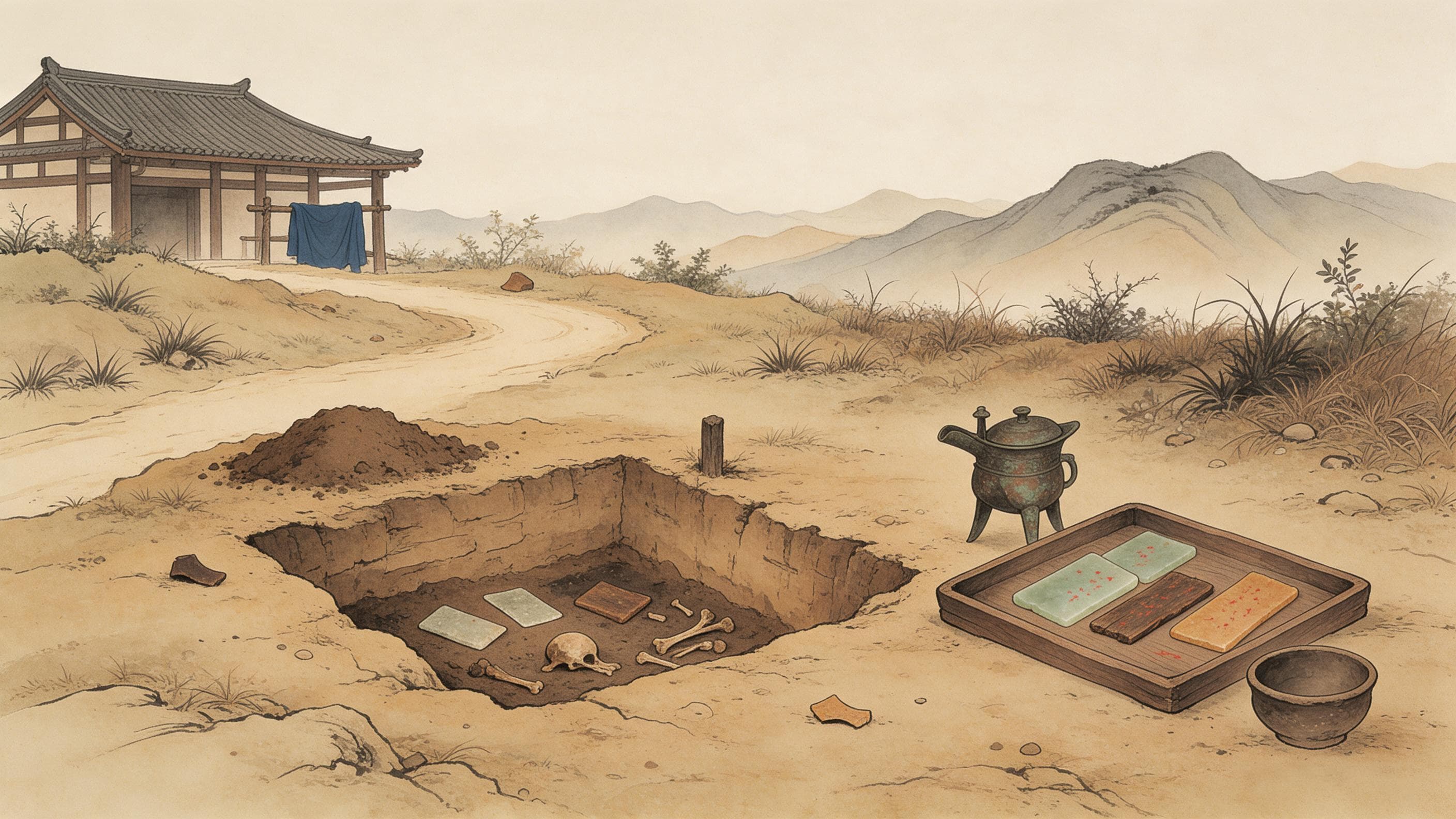
Shortly before noon on 9 December 1965, on a building site at Houma, schoolboys helping with the excavation were taking earth from a rectangular pit when they struck flat stone slips with faint red writing on them. The slips were picked up, one here, one there, and scattered; the archaeologists on site had them handed back, and 60 pieces came together again. They turned out to be an important specimen of the general preface to the Houma covenants, and the pit was a sacrificial pit. The site lies about 2.5 kilometres south-east of the Houma Eastern Zhou city complex; survey found more than 400 rectangular pits in an area roughly 70 by 55 metres.
Writing on jade
The dig ran from November 1965 to May 1966: 326 rectangular pits in all, 42 of them containing more than 1,500 covenant texts written on jade and stone slips. The pits vary in depth from 5.7 metres to 0.2; their mouths vary too, the largest 1.6 by 0.6 metres, the smallest 0.4 by 0.28. Most held a single animal victim — cattle, horses, sheep. The excavators' record notes that the victims lay face down, face up or on their side with no fixed rule, and that some seem to have been buried alive.
Each slip carries one complete text, at most 98 characters, usually 92, the same in substance, with a different name at the head. The writing is brushwork, almost all in red, a few in black; some characters are as small as 0.4 centimetres. The sizes are recorded: the largest slip 32 by 3.8 by 0.9 centimetres, the ordinary small ones about 18 by under 2 by 0.2. The hands differ — some fine and close, some free — so more than one scribe wrote them.
One oath, two destinations
The covenant had a procedure. The principal convener called the participants to the place; the covenant officer wrote the text on jade and stone slips, one copy for each party; the ground was levelled and rectangular pits dug; cattle, horses and sheep were killed, the convener took the ox by the ear, the blood was smeared, the oath read out. Then the victim and one copy were buried together for the gods to see and watch over; the other copy went into the covenant archive (mengfu) for consultation. If the archive copy was lost, the buried one was dug up again — the rite called 'seeking the covenant'. Each party had a copy, and the archive was the state's record; 'seeking' shows the record could be restored from the ground.
The texts fall into classes. Three are written in red: the 'clan covenant' among men of the same surname and lineage; the 'clientage' in which a man pledges himself to another and swears never to betray him; and the 'inner household' oath not to seize others' people or property and to denounce any kinsman who does. A few are in black: curses calling down divine punishment on offenders, and divination records. The red texts are the covenant proper; the black ones stand at its edge. 251 participants can be identified, and 26 names of targets; the most targets in one group reach nine lineages and twenty-one houses.
The formula in the Zuo zhuan
The Zuo zhuan, under the ninth year of Duke Xi, records the covenant of Kuiqiu: the lord of Qi swore the lords, saying, 'All we who are of this covenant, after this covenant, return to good relations.' That is a formula, preserved in a Lu text. It is dated to 651 BCE in the Zuo zhuan's own chronology. It shows that Spring and Autumn covenants had a fixed phrasing, but it is not the text of the Houma slips; the two can be set side by side, nothing more.
By Zhang Han's count of the Zuo zhuan's covenant tables, the text records 196 covenants, 57 of them involving Jin. The Houma slips turn that kind of formula into particular names, clauses and curses: who is with whom, what is forbidden, what happens to the oath-breaker and his descendants. Zhang Han's tally counts covenants in the text, not in the ground. But the two are different orders of text; the Zuo zhuan cannot be used to fill in the slips, and the slips cannot be used to rewrite the Zuo zhuan.
Whose oath, which year
The date is disputed. Guo Moruo, after seeing the specimens, placed the texts in the early Warring States, the sixteenth year of King An of Zhou, 386 BCE, under Zhao Jinghou Zhang; Zhang Han, Wang Kelin and Tao Zhenggang put them after the death of Duke Ding of Jin in 475 BCE; others argue for 424 BCE, when Zhao Huanzi drove out Zhao Xianzi. Zhang Shouzhong says the commonly accepted date is the late Spring and Autumn, following Zhang Han; the report itself notes that the beginning and end dates, the classification and the Jin history reflected in the slips are all still disputed.
In October 1995 the Houma slips were named one of the ten great archaeological discoveries of New China. The Houma Mengshu volume first appeared in 1976, with new editions in 2006 and 2016; of more than a thousand texts, 656 were traced and published. The report notes that three editions of one excavation report are without precedent in Shanxi's archaeological history. Those are the numbers of the archive and the book, not of the dig — the dig's numbers are 42 pits and more than 1,500 pieces.
What can and cannot be said
The limits. The material used here is a news feature, not an excavation report; the date, the batches and the principal convener are disputed and are not fixed here; the count of slips is quoted as the report gives it, '42 pits, more than 1,500 pieces', and not raised; the Kuiqiu formula is used only as a parallel, never as the Houma text; Guo Moruo's dating is given as his view, not as a finding; and no full covenant text is quoted, because its transcription was not read here. The Kuiqiu covenant gives no number of participants; the Houma slips are where numbers begin.
What this article can give is one tangible scene: the pit dug, the victim killed, one written oath buried for the gods to see, the other filed for men to consult; and more than two thousand years later, the buried copy dug up and read — a list of names, a few prohibitions, and a clause on what happens to those who break faith. The Zuo zhuan's 'return to good relations' is the formula of the same kind of document. The archive is gone; only the buried copies survived. The distance between the object and the formula is the distance of this article.
Sources & further reading
- 新华社〈侯马盟书:玉片上的朱书文带你「穿越」到东周〉2021-07-23(网易转载页,非《新华每日电讯》原刊版面)(Xinhua, 'Houma covenant texts: red brush writing on jade slips', 23 July 2021; NetEase repost, not the original print layout) — News feature, not an excavation report, quoting archaeologists of the Shanxi Provincial Institute of Archaeology: the Houma covenant site was dug from November 1965 to May 1966, 326 rectangular pits, 42 of them containing more than 1,500 covenant texts on jade and stone slips; pits from 5.7 m to 0.2 m deep, one animal victim in most; each slip carries one complete text, at most 98 characters, usually 92, with a different name at the head; brush writing, mostly red, a few black, characters as small as 0.4 cm; the largest slip 32 by 3.8 by 0.9 cm, the smallest about 18 by under 2 by 0.2 cm; classes of covenant (clan, clientage, inner-household in red; curses and divination records in black); 251 participants and 26 targets identifiable; the procedure of writing in duplicate, burying one copy and keeping one in the covenant archive, with 'seeking the covenant' when the archive copy was lost. Dates are disputed: Guo Moruo proposed 386 BCE, Zhang Han and others the late Spring and Autumn period.
- 《春秋左氏传·僖公九年》葵丘之盟 (Zuo zhuan, Duke Xi year 9, the covenant of Kuiqiu) — The covenant formula of 651 BCE: 'All we who are of this covenant, after this covenant, return to good relations.' Used only as an example of covenant phrasing, not as the text of the Houma slips.