A bronze coin lies on a wooden table: round, with a square hole at the centre and two characters on the face, 半兩 (ban liang), 'half a liang'. No reign title, no mint mark, no date. Coins of later dynasties often carry the name of the sovereign who issued them; this one carries a statement about metal. It tells you what the piece is supposed to weigh.
Two Characters, One Promise
The Han shu's treatise on food and money settles the Qin coinage in a sentence: 'Qin united the world and made coinage in two classes: gold, named by the yi, was upper money; the bronze coin, of the same substance as the Zhou coin, bore the legend 半兩 and weighed according to the legend' (秦兼天下,幣為二等……銅錢質如周錢,文曰「半兩」,重如其文). Sima Qian's closing judgment in the Shiji says the same thing: 'the bronze coin was inscribed 半兩 and weighed according to the inscription' (銅錢識曰半兩,重如其文).
To turn that into a figure you need one more line, from the Han shu's treatise on the calendar and the pitch pipes. A standard vessel held twelve hundred millet grains and weighed twelve zhu; 'two of these made a liang; twenty-four zhu to the liang' (一龠容千二百黍,重十二銖,兩之為兩。二十四銖為兩). Half a liang is therefore twelve zhu, and the two characters are a specification: twelve zhu of bronze. Money had been reckoned that way for a long time — the same chapter describes the old Zhou coinage as 'round and enclosing a square, its light and heavy reckoned in zhu' (錢圜函方,輕重以銖). But all of this is Han writing about Qin — one treatise compiled under Emperor Wu, another in the Eastern Han — and none of it reports weighing a single coin.
Too Heavy to Use
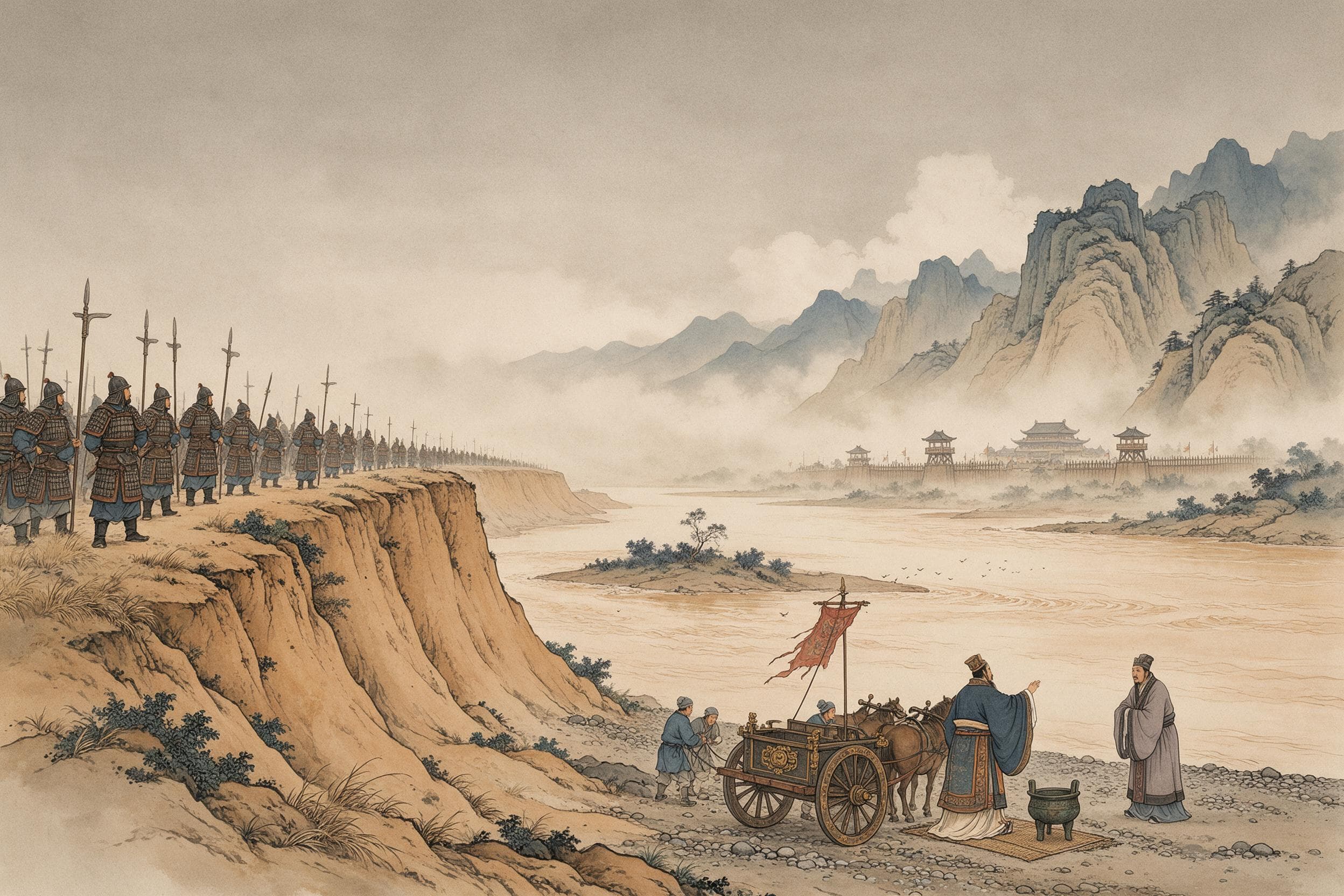
The first Han government judged the Qin coin too heavy to be useful. 'When Han arose, it held the Qin coin heavy and hard to use, and ordered the people to cast the jia qian' (漢興,以為秦錢重難用,更令民鑄莢錢). The Shiji tells it more briefly — 'and ordered the people to cast coins' — but agrees on the motive. How heavy the jia qian was, neither history says.
What they do give is what followed. 'Lawless men seeking profit hoarded their surplus and held goods back from the market, and prices leapt: rice reached ten thousand cash a shi, a horse a hundred jin of gold' (米至石萬錢,馬至匹百金). The Han shu puts the founder's answer immediately after: merchants were forbidden silk and carriages and taxed heavily to humiliate them. The two passages sit side by side, and the text does not say that one caused the other. What it does show is a market in disorder after a lighter coin and free casting — and a state answering with rules about who might dress well, not with a standard for the mint.
Four Zhu, Still Called Half a Liang
In the fifth year of Emperor Wen the state tried again: because the coins were 'ever more numerous and light', it cast a four-zhu coin 'whose legend was 半兩' (更鑄四銖錢,其文為「半兩」), and lifted the ban on private casting — 'the people were allowed to cast freely' (令民縱得自鑄錢). The arithmetic is the story. Four zhu is one third of the twelve that the two characters promise. The legend did not change; the metal did.
Jia Yi, arguing against free casting, describes the result in the language of the market rather than the treasury: 'the people's use of coins differs from commandery to county: where light coins are used, a hundred is increased by some number; where heavy coins are used, they are weighed and refused' (或用錢輕,百加若干;或用重錢,平稱不受). So 'no fixed legal coin is established', and 'the markets use different money, and the coin legends are in great confusion' (市肆異用,錢文大亂). This is the clearest sentence either page offers about daily use: coins were counted, but they were also weighed. It is also an argument, not a survey; Jia Yi is asking the emperor to take the mint back.
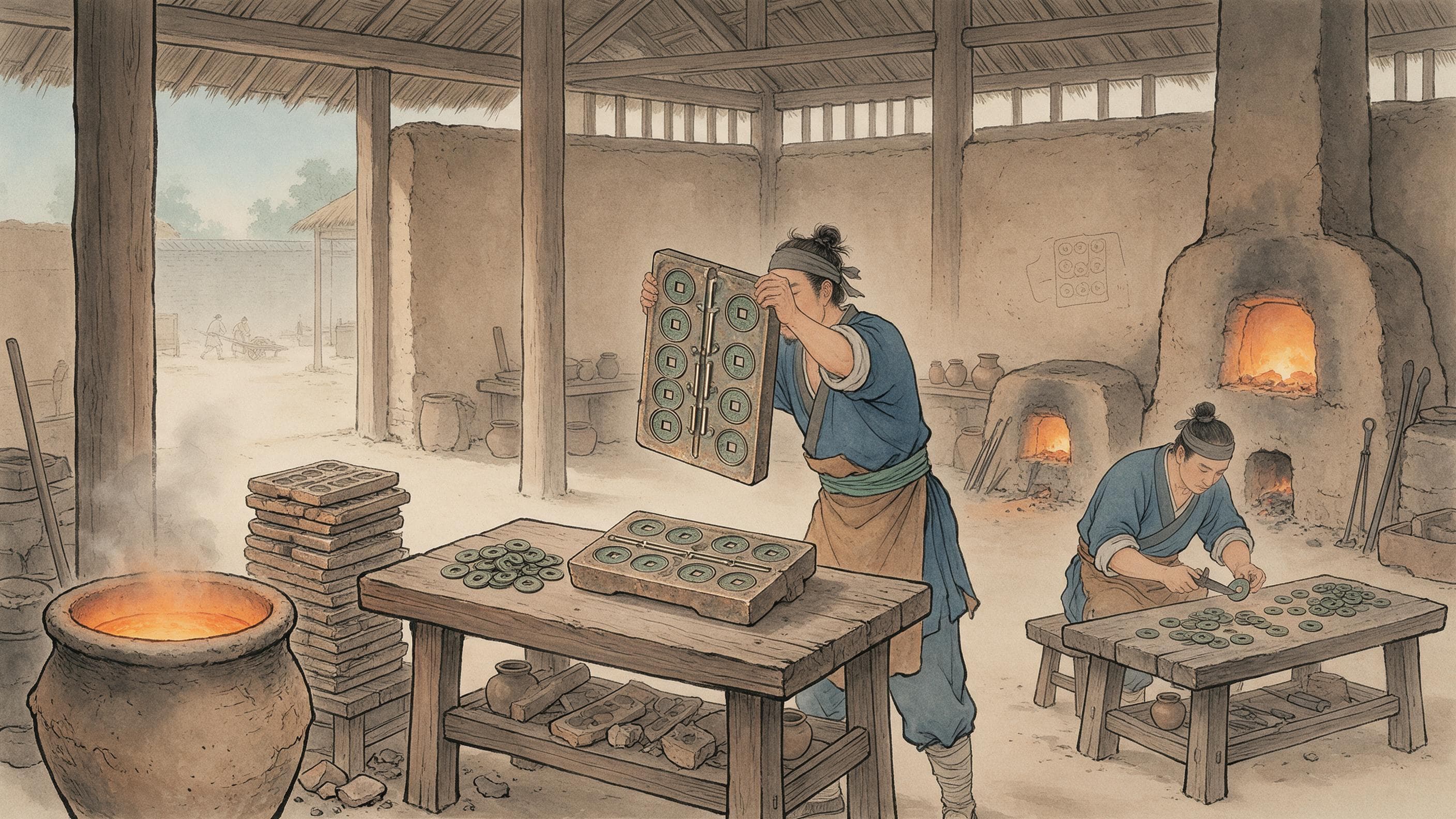
Free casting produced a very concrete confusion. When the ban was lifted, the largest private mints belonged to the king of Wu, who 'cast coins at the mountains, grew as rich as the Son of Heaven and in the end rebelled', and to Deng Tong, a favourite whose coin wealth 'surpassed a king's'; 'the coins of Wu and Deng were spread throughout the world' (故吳、鄧錢布天下). An inscription can be enforced by a mint; it cannot be enforced by its own two characters.
When the Name Could No Longer Hold
By Emperor Wu's reign the legal 半兩 had been four zhu for more than forty years — the Han shu notes that 'from Emperor Wen's recasting of the four-zhu coin to this year was over forty years' — and the coins were being shaved. Officials reported: 'the 半兩 coin is legally four zhu, but the wicked file the metal of the coin and take the shavings, so the coins grow ever lighter and thinner and goods ever dearer' (今半兩錢法重四銖,而姦或盜摩錢質而取鋊,錢益輕薄而物貴). A legend that had already broken its promise could not protect the metal either.
The remedy was to stop defending the old words. The state 'melted the 半兩 coins and cast three-zhu coins, the legend according to the weight' (文如其重). When the three-zhu proved too light to be safe, it went to five zhu and gave the coin a rim all round, 'so that the metal could not be filed away' (周郭其質,令不可得摩取鋊). The Han shu even dates the beginning: 'from the fifth year of Yuanshou under Emperor Wu, when the three offices first cast the five-zhu coin' (自孝武元狩五年三官初鑄五銖錢). The circle closed — but by changing the inscription, not the coin. The words had outlived their number; the state gave up the words.
What the Two Histories Do Not Record
Neither history records the weight of any single coin, the output of any mint, the price of a coin, or whether a light one was actually refused at a stall. 'Weighed according to the inscription' is a Han description of a rule, not a measurement of surviving metal. What they do give is a run of decisions with their stated reasons: two classes of money, a coin too heavy, a lighter coin cast by anyone, four zhu under the old name, shaving, three zhu, five zhu with a rim. How many coins a craftsman held at the end of a month, or how many bought a dou of millet, is not in them.
The two characters are a small contract written in bronze. What broke it was not a new decree about names but a thinner planchet slipped under the same words, and then a file at the edge. The repair, when it came, was modest and technical: say what the coin weighs, and raise a rim so that it keeps saying it. There is nothing grand about the object. But held in the hand, with the units known, it still reads as what it was meant to be.
Related reading:Three Clauses and Nine Chapters: From a Promise to a Code · Ending the Wine Monopoly: Four Coins a Sheng and a Thousand Brewings · Inspect, Do Not Levy: The Pass and the Market in Warring States Thought
Sources & further reading
- 班固《汉书》卷二十四下·食货志下(东汉;维基文库本,未与点校本复核) — The main narrative: Qin money in two classes, the bronze coin 'inscribed 半兩, weighing according to the inscription' (文曰「半兩」,重如其文); Han finding Qin coin heavy and having the people cast the jia qian; Emperor Wen's four-zhu coin 'whose legend was 半兩'; Jia Yi's warning that light coins are counted with a surcharge and heavy ones weighed and refused; Wu and Deng's private coins; officials reporting that the legal four-zhu 半兩 is being filed and shaved; the melting of 半兩 coins for three-zhu coins 'legend according to the weight' (文如其重); the five-zhu coin with a rim 'so the metal cannot be filed away' (周郭其質,令不可得摩取鋊).
- 司马迁《史记》卷三十·平准书(西汉;维基文库本,未与点校本复核) — The second witness: 'Qin coin was heavy and hard to use, so the people were ordered to cast coins'; under Emperor Wen 'the jia qian grew ever more numerous and light, so the four-zhu coin was cast, its legend 半兩, and the people were allowed to cast freely'; Sima Qian's closing judgment repeats that the Qin bronze coin was 'inscribed 半兩 and weighed according to the inscription'; the three-zhu coin is 'according to the weight in its legend' (文如其重) and the five-zhu is given a rim below 'so it cannot be filed' (周郭其下,令不可磨取鋊焉).
- 班固《汉书》卷二十一上·律历志上(东汉;维基文库本,未与点校本复核) — The unit relation without which 'half a liang' cannot be turned into a figure: 'a standard vessel held twelve hundred millet grains, weighed twelve zhu; two of these made a liang; twenty-four zhu to the liang' (重十二銖,兩之為兩。二十四銖為兩). Hence half a liang = twelve zhu. The same chapter gives the old formula for coinage, 'round and enclosing a square, light and heavy reckoned in zhu' (錢圜函方,輕重以銖).