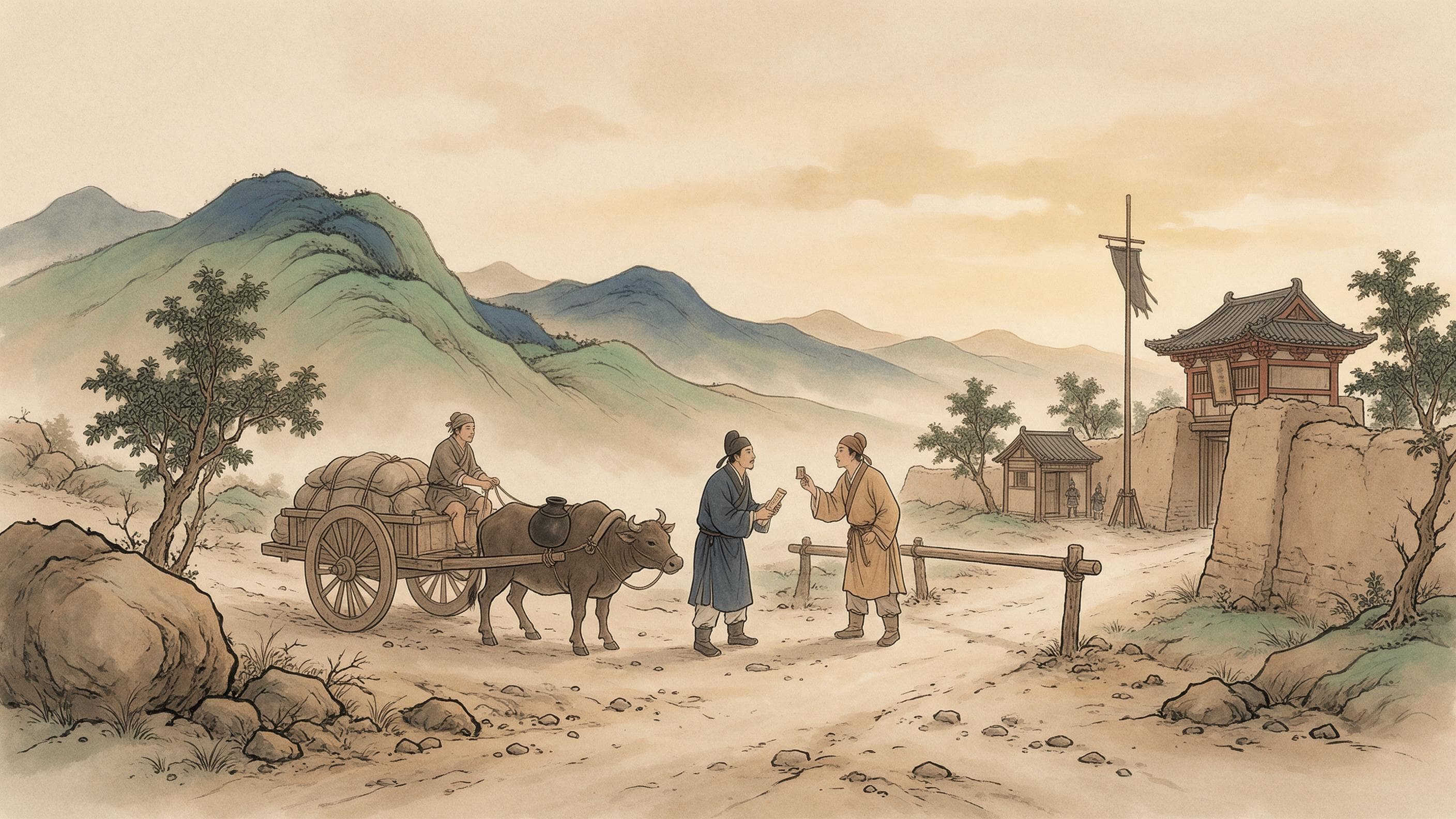
Qin corvée began with an account. The Statutes on Corvée from the Shuihudi tomb open with a tariff of penalties: 'When a levy is issued from the centre and a man fails to go, fine him two suits of armour. If he is late by three to five days, reprimand him; by six days to ten, fine him a shield; beyond ten days, fine him a suit of armour. If rain makes the work impossible, cancel the levy.'
The levy and the latecomer
Read the passage one grade at a time: the offence is not a single lump called 'not coming', but a graded scale of lateness, from a spoken reprimand up to a suit of armour. The units are armour and shields, not cash and not grain — no conversion into modern money is attempted here. The four characters on rain matter more: if weather blocks the work, the levy is cancelled and the man is not treated as a fugitive. The scale also fixes what kind of thing a penalty was: armour and shields, goods a man might own or have to buy, not extra days of labour.
But this is a statute, not an enforcement record. How many men were levied in a year, how many were actually late, how many suits of armour were collected — the slips do not say; nor do they give a national total of labourers or of work-days. What can be read is a rule for how to punish, not a ledger of how much was punished.
The works and their guarantee
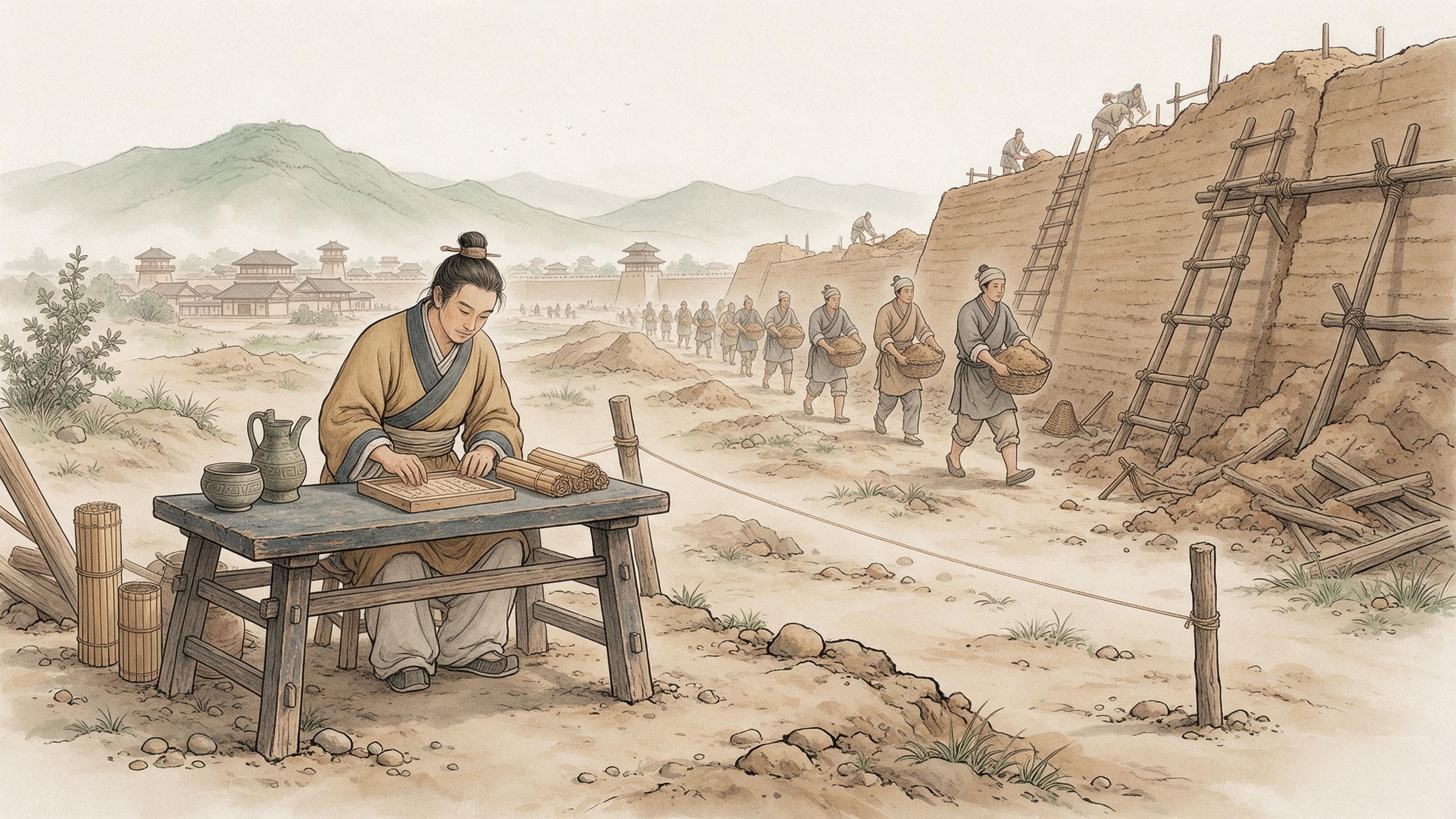
The same statute then handles quality: 'When labourers are raised to build the walls of a town, make them guarantee the wall for one year. If it fails before the year is out, the superintendent of works who directed the job and the men in charge of the wall are guilty; make the same labourers rebuild it, and do not count that as corvée.' A year's guarantee, a liability fixed on officials as well as workers, and rebuilding that does not consume the worker's service time. The rule shifts the risk of bad work onto the officials and onto the same gang, but not onto the worker's term of service: the wall is rebuilt, and the calendar of his corvée does not grow.
The chapter applies the same logic to the walls of parks and of the state's horse-and-cattle enclosures: if a repaired wall fails within the year, the county raises labourers again and 'it is not counted as corvée'; if it fails after the year, a stretch over three du is repaired by the county, a shorter stretch by the park itself. Liability is divided by the warranty period, and rework is kept off the labourer's tally — an administration keeping books on people.
How the work was measured
What follows is the language of audit: 'For the county's routine works and for works approved on report, the clerk estimates the work; if the estimate is over or short by as much as two days, it is a failure of inspection. The same applies when a higher authority estimates a work incorrectly. The measurement of work must be made by the superintendent of works together with the craftsman; the craftsman alone may not do it. If the measurement is inaccurate, the measurer is dealt with according to statute, and the actual amount of work is counted against the labourers.' Over- or under-estimating by two days is already a fault: the tolerance is measured in days of work, which means the estimate itself was a document with consequences.
So corvée was not simply 'men arrive and dig': the job was first converted into gong, units of work, then staffed, recorded and checked against the conversion. That is why the text has words for estimating work, measuring work, and being over or short. How much earth one man moved in a day, how many zhang of wall he built, the Statutes on Corvée does not say; those quotas belong to other chapters, and none is invented here.
A day at eight cash
The Statutes on Public Works contain another conversion: 'A man who owes a fine or a debt to the office, and cannot pay by the appointed day, works it off by the day: eight cash a day; if the office feeds him, six cash a day.' The same chapter prices the redemption of exile at eight cash a day. Read this carefully: it is labour used to pay what one owes, not a wage for corvée, and the men concerned are debtors and redeemers, not ordinary conscripts. The two cash between the fed and unfed rate is, in effect, the price the office set on feeding a labourer for a day.
Still, it shows how the administration thought: a day of labour was a convertible figure on a ledger. The same law also rules that convicts sent out on corvée may not enter the marketplace or linger at its gates, and must go round if their road crosses it; and that men working off a debt are sent home for the farming season, twenty days each at planting and at weeding. Sending a debtor home for planting and weeding lets the state have both the labour and the harvest.
The other face: the great works
Beyond the statutes lies the scale of the works themselves. The Shiji's annals of the First Emperor: 'Those of the hidden palace and the convict labourers, more than seven hundred thousand, were divided between the Epang palace and Mount Li. Stone was cut on the northern hills, and timber from Shu and Jing was brought in.' The figure is a Western Han writer's, not a Qin labour register; the term rendered 'hidden palace' is disputed, and the article quotes it without deciding it. Food rations, which belong to the granary statutes, are deliberately left out of this piece. The same passage adds that within the passes three hundred palaces were counted, and beyond them more than four hundred.
What can be stated here is therefore only the statutory layer: graded fines for lateness in armour and shields, cancellation for rain, a one-year guarantee on walls, rework excluded from corvée, work measured jointly by the works office and the craftsman, a day of labour priced at eight cash or six. What cannot: a national total of labourers or work-days, the actual burden on a household, a conversion of eight cash into purchasing power, or Dong Zhongshu's figure in the Han shu's 'Treatise on Food and Money' (食货志), that Qin service ran 'thirty times' the ancient norm. What Qin left behind is not a head-count but a language that turns people into days, units of work, and cash. A tariff of fines, a warranty, an audit rule and a day-rate: these are the instruments of a government that expected to count, and they are what survives.
Sources & further reading
- 《睡虎地秦墓竹简·徭律、司空》(秦;维基文库录文本,两篇同书合并为一条) — Qin statutes, not a record of how the levies fell: the 徭律 opens with penalties for failing to answer a central levy (two suits of armour), for lateness (a reprimand; then a shield; then a suit of armour), and exempts men when rain makes the work impossible. It requires walls built by conscript labour to be guaranteed for a year, with rebuilding not counted as corvée; it fixes who checks the work-quota ('the superintendent of works and the craftsman must measure together') and how miscounts are punished; and it orders that the real amount of work be counted against the labourers. The 司空 law prices labour used to redeem fines and debts at eight cash a day, or six when the office feeds the man, and bars convicts sent out on corvée from the marketplace. Food and grain rations are deliberately not used here (they belong to the 倉律 material). The 司空 law is on the same site at 睡虎地秦簡/司空.
- 司马迁《史记》卷六·秦始皇本纪(西汉;维基文库本) — A Western Han narrative of the Qin works: 'Those of the hidden palace and the convict labourers, more than seven hundred thousand, were divided between the Epang palace and Mount Li. Stone was cut on the northern hills, and timber from Shu and Jing was brought.' The figure is a Han writer's, not a Qin register; the reading of 隱宮 is disputed, and the article quotes the phrase without deciding it.
- 《汉书》卷二十四上·食货志上(东汉班固;董仲舒语) — Dong Zhongshu on Qin: 'in addition they made a month a turn of service, after which came the regular duty, one year of garrison, one year of labour service, thirty times antiquity; the land tax, the poll levy and the profits of salt and iron, twenty times antiquity.' Used only as a Han estimate of Qin service, not as a Qin register.