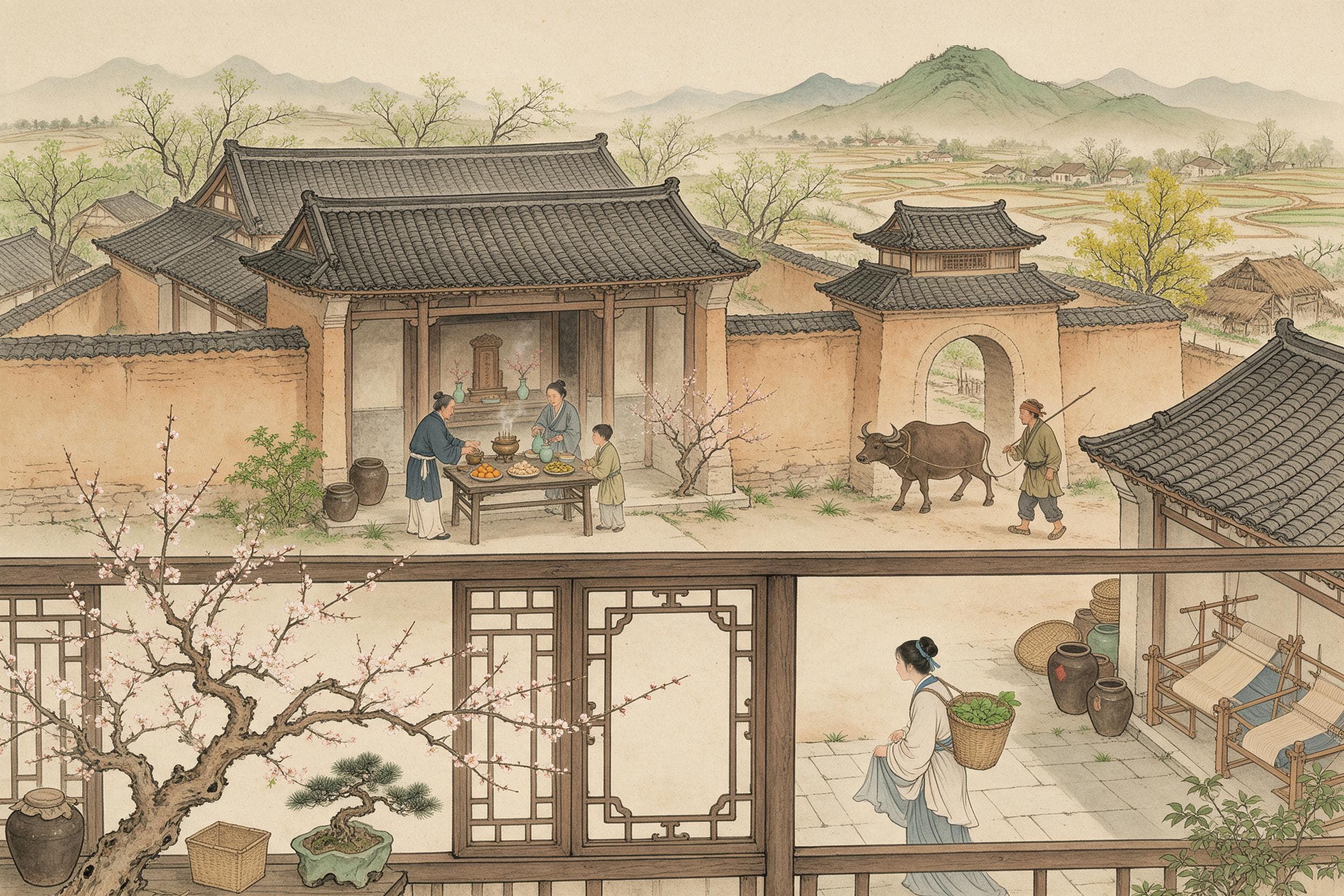
The year begins with an offering. 'The first day of the first month is called the true day. The household head, leading wife and children in person, purified himself and made offering to grandfather and father.' After the rite the family sat in order before the ancestors, the sons, wives, grandsons and great-grandsons each presenting pepper wine to the head of the house, 'raising the cup and wishing him long life, all joy'. That is the book's first scene and its most domestic page.
A ledger arranged by month
The book is by Cui Shi of the Eastern Han, and it sets out, month by month, what a landed estate should be doing: offerings, schooling, ploughing, silkworms, weaving, dyeing, brewing, sauce-making, medicine, buying and selling grain, repairs, guarding against thieves. The original is lost. What we read is a reconstruction: in 1921 Tang Hongxue rebuilt it chiefly from the Sui Jade Candle Precious Canon, adding what the Essential Techniques for the Common People, and other medieval encyclopaedias quote; an earlier reconstruction by Yan Kejun had gathered some two hundred fragments into twelve monthly chapters. It is a book pieced together from quotations, not the Han book entire — and that should be kept in view.
Its vantage point matters as much. The people who appear are the household head, the grown boys, the young children, the seamstress, the silkworm women, the kitchen steward, the women's weaving work; the business is fields, silkworms, looms, yeast, grain sales, kin and guests. This is an estate with land, mulberries, looms, granaries, hired hands and bondservants arranging its own year. It is not a record of the national peasantry. What it offers is an estate calendar, not 'a Han peasant's year'.
Spring: the silkworm room and the hungry gap
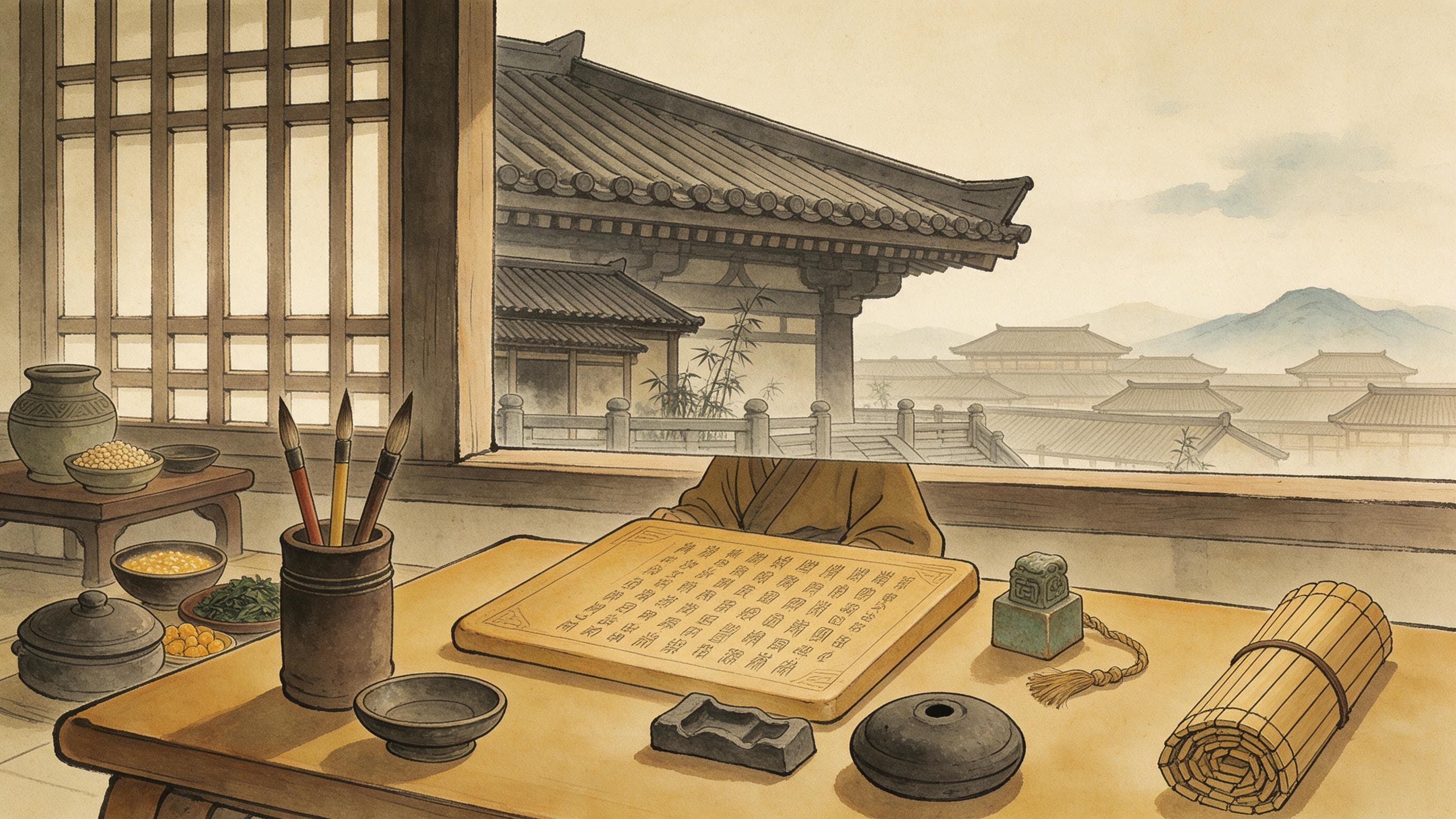
The first month is crowded: a day chosen for capping; offerings at the gate and to the first sower; 'before farm work begins, order the grown boys and above into the Great School to study the Five Classics'; 'when the ice on the inkstone thaws, order the young children into the elementary school to learn characters'; 'order the women's work to hurry the weaving'; 'order the kitchen steward to brew spring wine'; and with the rains, transplant trees and sow melons, gourds, mustard and mallows. Study, cloth, wine and vegetables all sit under the same month.
In the second month the earth altar is served and leeks and eggs offered to the ancestors; 'before the silkworm work begins, order the seamstress to wash the winter clothes and turn the lined garments into unlined ones'; sow millet, soybeans, seed hemp and sesame; gather elm pods for sauce; sell grain and lay in firewood and charcoal. In the third month, at Clear and Bright, 'order the silkworm women to prepare the silkworm room, plaster the cracks, and get out the mallets, stands, mats and baskets'; when the silkworms hatch at the Grain Rain, 'the whole household, women and children together, gives itself to the work. Let nothing else be undertaken, to confuse the principal business; those who do not obey are punished without question.' Two lines in the third month are not agricultural at all: 'relieve the needy, beginning with the nine branches of the clan, from the nearest outward' — the hungry gap is met by opening the stores; and 'make use of the ditches, repair the walls and houses against rain; repair the gates and set a watch, to guard against the thieves of the spring famine.' Relief and guard duty are written into the same month.
Summer: storing, airing, and rain
In the fourth month, 'when the cocoons are in the frames, hurry the reeling and the floss; get the loom and shuttle ready, and attend to the warp'. The fifth month is for storage and damp: 'store felt, furs, wool and feathers with ash'; 'hang oiled rain-cloaks on a pole; do not fold them away'; 'when heavy rain is coming, lay in grain, rice, firewood and charcoal, in case the roads are flooded'. Food too has its rule: 'until autumn, do not eat boiled or water-soaked cakes.' In the sixth month, at the first fu, offer wheat and melons to the ancestors; hurry the weeding; on the sixth day sow mallows, and after mid-fu the winter mallows.
Autumn: cloth, dye, a wedding, wheat
On the seventh day of the seventh month, 'make the yeast and grind the grain', and on the same day 'air the classics and the clothes' — custom and book-preservation in one. Once the heat breaks, 'wash the old and make the new, sew lined and thin garments against the first cold'. The eighth month is the busiest: a good day is chosen to sacrifice to the regular gods, with millet and pig for the ancestors; 'order the young children into the elementary school, as in the first month'; 'hurry the washing of silk and the dyeing of colours'; 'tear the floss and work the wadding, make new and wash old'; 'take a wife'; and the wheat must be sown to the day — 'at White Dew, sow the thin fields; at the autumn equinox, the middle fields; ten days later, the good fields.'
The ninth month turns to closing and self-defence: 'put the threshing floor in order, plaster the granaries, repair the drains and pits'; 'repair the five weapons and practise archery, against the robbers of cold and hunger'; 'inquire after the orphaned, widowed, aged and sick of the nine branches of the clan who cannot support themselves, and share out generously to save them from the cold.' Weapons and relief, on the same page of the estate's ledger.
Winter: grain in, wine brewed, school, rest
In the tenth month, 'bank up the walls, stop the north window and plaster the door' for winter; 'hurry the grain in; let none be left in the fields'; on the first xin day, 'order the kitchen steward to steep the yeast' and brew the winter wine for the winter solstice, the la sacrifice and the New Year; 'farm work done, order the grown boys into the Great School, as in the first month'; 'split the hemp, hurry the spinning of cloth thread; make white shoes and straw sandals.' In the eleventh month, at the winter solstice, offer millet and lamb; 'when the water on the inkstone freezes, order the young children to read the Classic of Filial Piety, the Analects and the chapters, and enter the elementary school.'
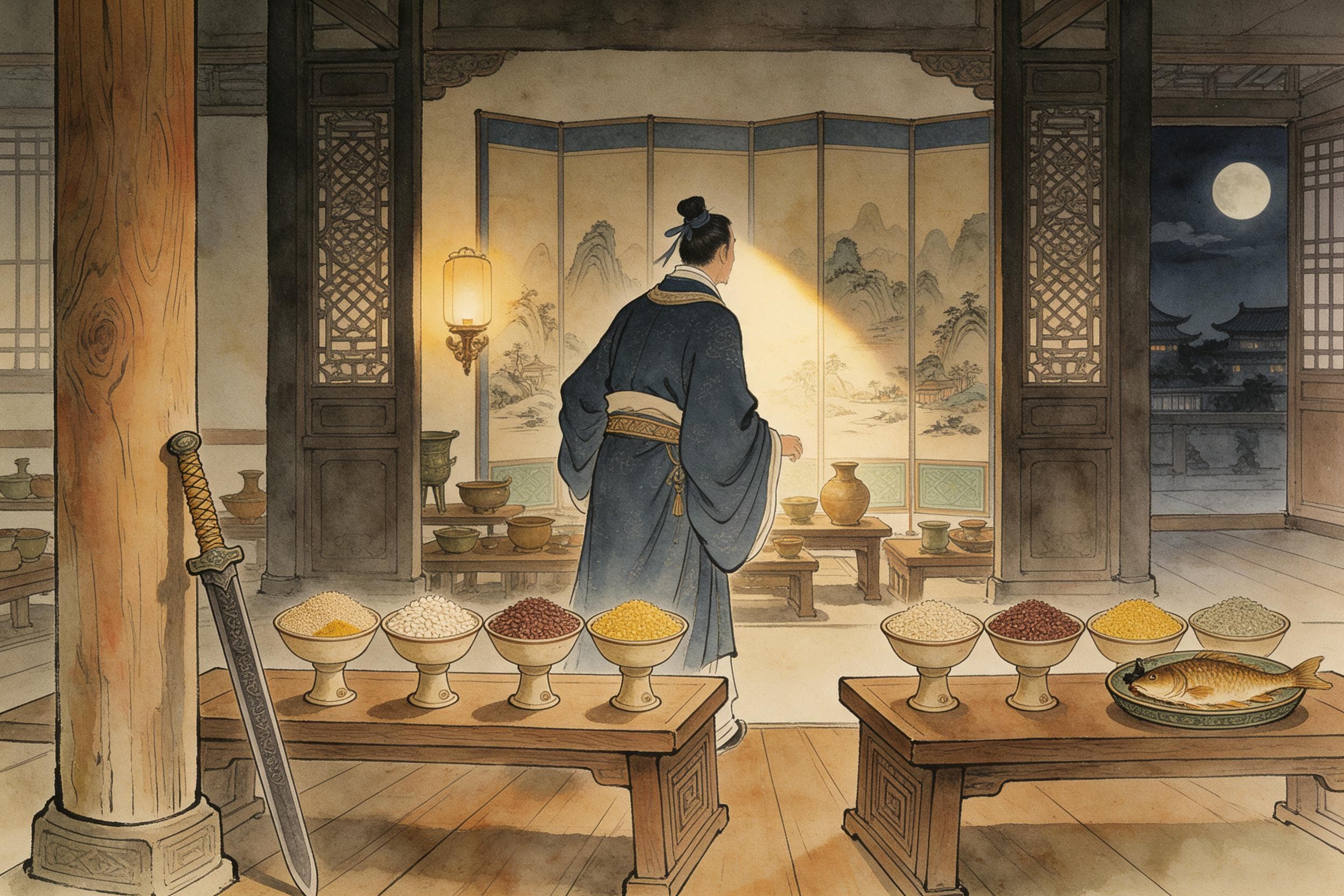
The twelfth month closes the year: five days before, a pig is killed; three days before, a sheep; two days before, the household purifies, cooks and sweeps, and 'then sacrifices to the ancestors and the five household gods'. Then 'the clan, the affines and the guests are invited, good relations and manners discussed, to make firm the bonds of kindness; farm work and labour service are stopped, and generosity reaches down to all'. Finally 'yoke the ploughs in pairs, feed the oxen, choose the men for the fields, and wait for the farming to begin'.
Limits last. First, this is an estate's annual round, not the year of the peasantry at large. Second, the text is a modern reconstruction, not the Han book entire. Third, even its geography is limited: a note in the reconstruction says 'this is the rule for the Zhou-Luo capital region; distant commanderies in Jizhou adjust to their own cold and warmth and are not bound by it'. Fourth, the two sources are one book and a book that quotes it: the Essential Techniques quotes the monthly ordinances month by month, and the reconstruction is built from such quotations — they are not two independent witnesses. So this piece can describe the shape of an estate calendar, not every Han farmer's year, and cannot give acre-yields, prices, or the size of the workforce.
Sources & further reading
- 《四民月令》(东汉崔寔撰;唐鸿学校辑,1921年;维基文库本,主据《玉烛宝典》,参取《齐民要术》等所引) — A reconstruction, not the Han book itself. The compiler states that the original was lost and that he rebuilt it mainly from the Sui 'Jade Candle Precious Canon', taking what other books (Jia Sixie's manual, the Bei Tang Shu Chao, the Yiwen Leiju, the Taiping Yulan) quote as notes; Yan Kejun's earlier reconstruction gathered some two hundred fragments into twelve monthly chapters. Text and commentary are kept separate, the commentary probably being the author's own. The entries describe the year of a landed estate, not of every Han peasant.
- 《齐民要术》卷第三·杂说第三十(后魏贾思勰;维基文库本) — One of the earliest surviving texts to quote the monthly ordinance at length, month by month (first month: the pepper wine and the toasts; third month: silkworm room and relief of the poor; eighth month: children to school and cloth to the dye pot; twelfth month: clan gathering and the suspension of labour). This is a source of the reconstruction, not an independent witness to Han practice; the two entries together are a text and its quotation, not two separate observations.