The Weishu's treatise on food and money disposes of Northern Wei salt in two short paragraphs: one on a pool in Hedong commandery, one on a row of stoves along the sea. The pool gets the politics; the stoves get the numbers. The treatise is a chapter on food and money, and salt is a small part of it: what the two paragraphs record is an administration, not a technique.
The Pool and the Stoves
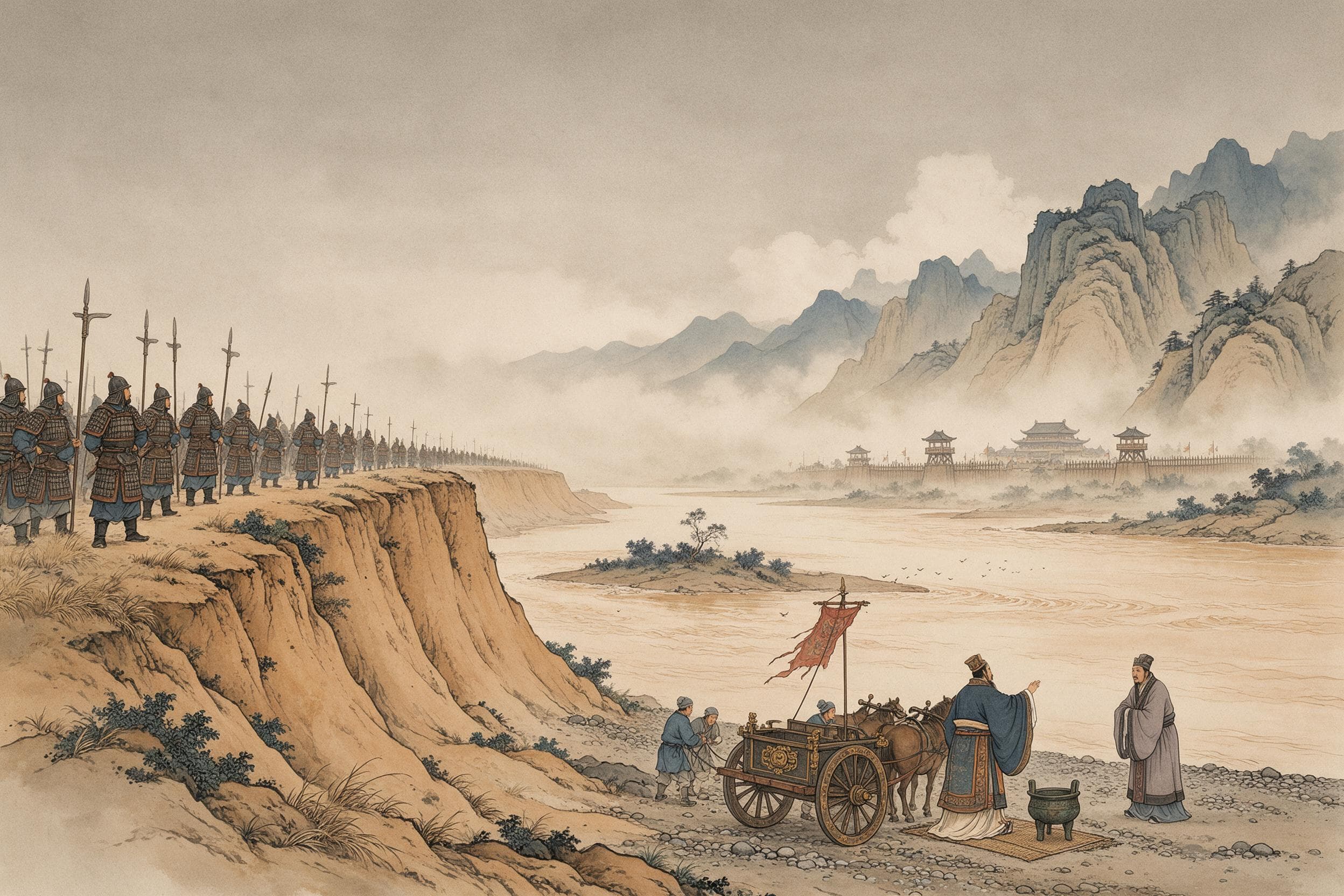
The pool first. 'In Hedong commandery there is a salt pool; formerly an office was set up to collect the tax on it' (河東郡有鹽池,舊立官司以收稅利). Then it was abolished, 'and among the people the rich and strong took the use of it for themselves, while the poor and weak had no share' (而民有富強者專擅其用,貧弱者不得資益). At the end of the Yanxing period an inspectorate was set up again, which 'measured the dearness and cheapness and moderated the tax, so that public and private both profited' (量其貴賤,節其賦入,於是公私兼利). The page's collation note says the 'at that time' of the first abolition cannot be dated: the Tongdian has 'previously' (先是), the Cefu yuangui has 'afterwards' (既而) — the base text itself is unstable here. Under Shizong (世宗) the ban was lifted once more, 'and it was shared with the common people' (與百姓共之); what the state needed was fixed by separate rules, 'enough and no more' (取足而已).
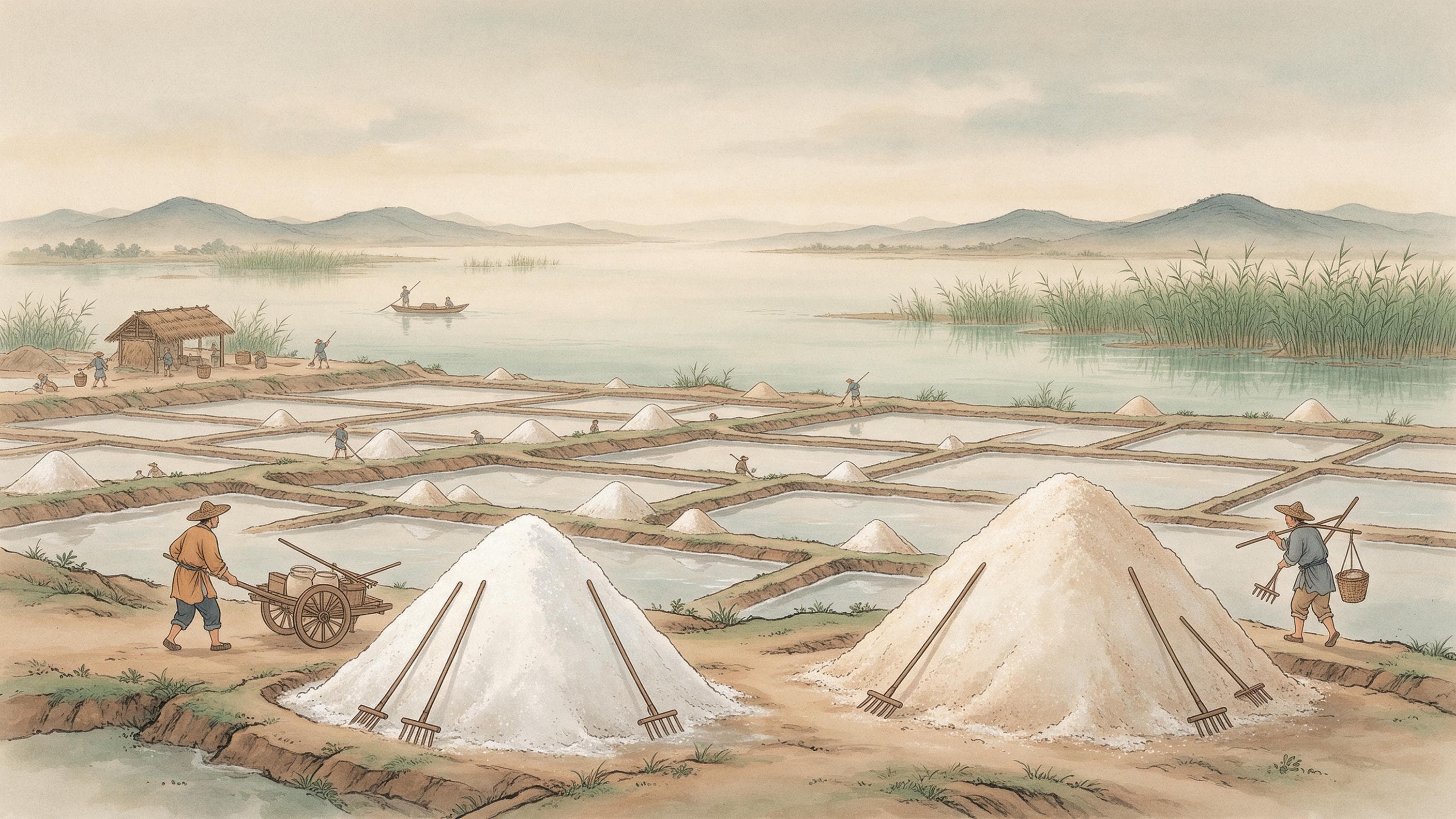
The stoves come after the move of the capital to Ye: 'in the four prefectures of Cang, Ying, You and Qing, by the sea, salt was boiled. Cang set up 1,484 stoves, Ying 452, You 180, Qing 546, and four more at Handan; the year's total came to 209,702 hu and 4 sheng' (滄州置竈一千四百八十四,瀛州置竈四百五十二,幽州置竈一百八十,青州置竈五百四十六,又於邯鄲置竈四,計終歲合收鹽二十萬九千七百二斛四升). With that, the treatise says, the army and the state were supplied. The treatise counts stoves, not salt-makers; it gives no output for a single stove, and the total is for all of them together.
Who Collected, Who Stopped
Read the two paragraphs as one, and what the treatise tracks is not salt-making but who takes the profit. The sequence is: an office, its abolition, an inspectorate, its abolition, then the rich and the well-placed taking the pool, and the people near the pool shutting others out. 'After this the powerful houses again used their position to seize it, and the people near the pool began to block others as well; strong and weak trampled each other, and the matter was heard far and near' (自後豪貴之家復乘勢占奪,近池之民,又輒障吝,強弱相陵,聞於遠近).
The remedy proposed was the old one: an office again. In the early Shenggui period the grand tutor, the prince of Gaoyang, Yuan Yong, and the grand guardian, the prince of Qinghe, Yuan Yi, memorialised. The pool is 'a treasury of heaven, feeding the living' (鹽池天藏,資育羣生); the court had never meant to compete with small people for the gain, but without a rule 'the powerful fence it and the near ones guard it, and the poor who come from far are left with nothing' (或豪貴封護,或近者吝守,卑賤遠來,超然絕望). The memorial is quoted at length; the emperor's answer is a single sentence of policy. So officers should be set again, and the state should take 'the tax of one in ten, which from ancient times to now has been taken in order and has helped widely' (十一之稅…所濟為廣).
A Memorial and a Counter-Memorial
The memorial answers two things. The smaller: a clerk, Wang Houxing, had asked that, besides the 20,000 hu of salt for the officials' kitchens, the pool send every year a thousand horses and five hundred head of cattle (請供百官食鹽二萬斛之外,歲求輸馬千匹、牛五百頭) — which the princes take as proof that such requests cannot be reckoned in advance; a demand for horses and cattle from a salt pool is treated as a symptom. The larger: the censor Zhen Chen had asked to abolish the ban altogether, and the memorial quotes the objection to him: 'Zhen Chen's proposal, talked about, is lofty in principle; put into practice, it fails in the doing' (坐談則理高,行之則事闕).
The emperor followed Zhen Chen anyway. What followed, the treatise says, was worse than the office: 'the people round the pool, Wei Baoguang and others, kept it for themselves; their blocking was twice that of the office, they gave and took at will, and set the price by their own mouths' (乃為繞池之民尉保光等擅自固護,語其障禁,倍於官司,取與自由,貴賤任口). The treatise does not say who these 'people round the pool' were, or by what right they held it. So the princes ask for the ban back, and the office with it; 'and an inspecting officer was set up again to supervise it. After that it was abolished and set up again, down to the Yongxi period' (於是復置監官以監檢焉。其後更罷更立,以至於永熙).
The Same Paragraph, Twice
The Tongdian, a Tang compendium, retells this passage in its chapter on salt and iron, and the two texts do not agree everywhere. The Weishu has the ban lifted 'when Shizong came to the throne' (世宗即位); the Tongdian has 'when Xiaoming came to the throne' (孝明即位). The Weishu's year total for the sea salt is 209,702 hu and 4 sheng; the Tongdian's is 209,708 hu and 4 dou. The rest is close enough to be the same story. The Tongdian also opens the passage 'in the time of Xuanwu of the Later Wei' (後魏宣武時), so that its own account names Xuanwu at the start and Xiaoming at the change.
Both versions are printed here; neither is corrected against the other. One is the Northern Wei history, the other a Tang retelling — and the retelling is marked as such: the 'Later Wei' of the Tongdian is the Northern Wei, and its account is a Tang scholar's summary. Which emperor, and which figure, the pages do not settle.
What the Pages Do Not Give
Neither page gives the pool's size, the number of salt households, the price of salt, the output of a single stove, or how the tax of one in ten was assessed. The stoves are counted and the total is given; the people who boiled the salt are not. Nor is there a record of the office's staff, its costs or its takings, and the dates are reigns and periods, not years. No figure is given for the Hedong pool's own output: the only annual total on either page is the sea salt's.
What remains is a pool and a row of stoves, and a phrase that recurs every time the pool changes hands: 'shared with the people' (與百姓共之) — after which, the treatise says, the powerful take it. That is the whole of what these two pages offer on Northern Wei salt: a tax, an office and a see-saw; not the salt, and not the salt-makers. The see-saw has no ending in the text: it runs 'down to the Yongxi period' and stops.
Related reading:The Price of Doubt: Five Punishments in the 'Lü Xing' · Half a Liang: The Weight Written on a Coin · Seventy Mu 'Occupied': A Ceiling, Not an Allocation
Sources & further reading
- 《魏书》卷一百一十·食货志(北齐魏收撰;维基文库本,未与点校本复核) — Two paragraphs on Northern Wei salt: the Hedong pool, where an office collected the tax, was abolished, was restored as an inspectorate at the end of Yanxing, was lifted again under Shizong, and was seized by powerful houses — with the Shenggui memorial of the princes of Gaoyang and Qinghe asking for the ban and the inspectorate back, the tax of one in ten, and the counter-argument against Zhen Chen; then the sea-salt stoves of Cang, Ying, You and Qing after the move to Ye, 1,484, 452, 180 and 546 stoves plus four at Handan, a year's total of 209,702 hu 4 sheng.
- 杜佑《通典》卷十·食货十·盐铁(唐;维基文库本,未与点校本复核) — The same Northern Wei passage retold in a Tang compendium: the same Hedong pool, offices, abolitions and memorial, but with the ban lifted 'when Xiaoming came to the throne' where the Weishu has Shizong, and a year total of 209,708 hu 4 dou where the Weishu has 209,702 hu 4 sheng. A Tang summary, marked as such.