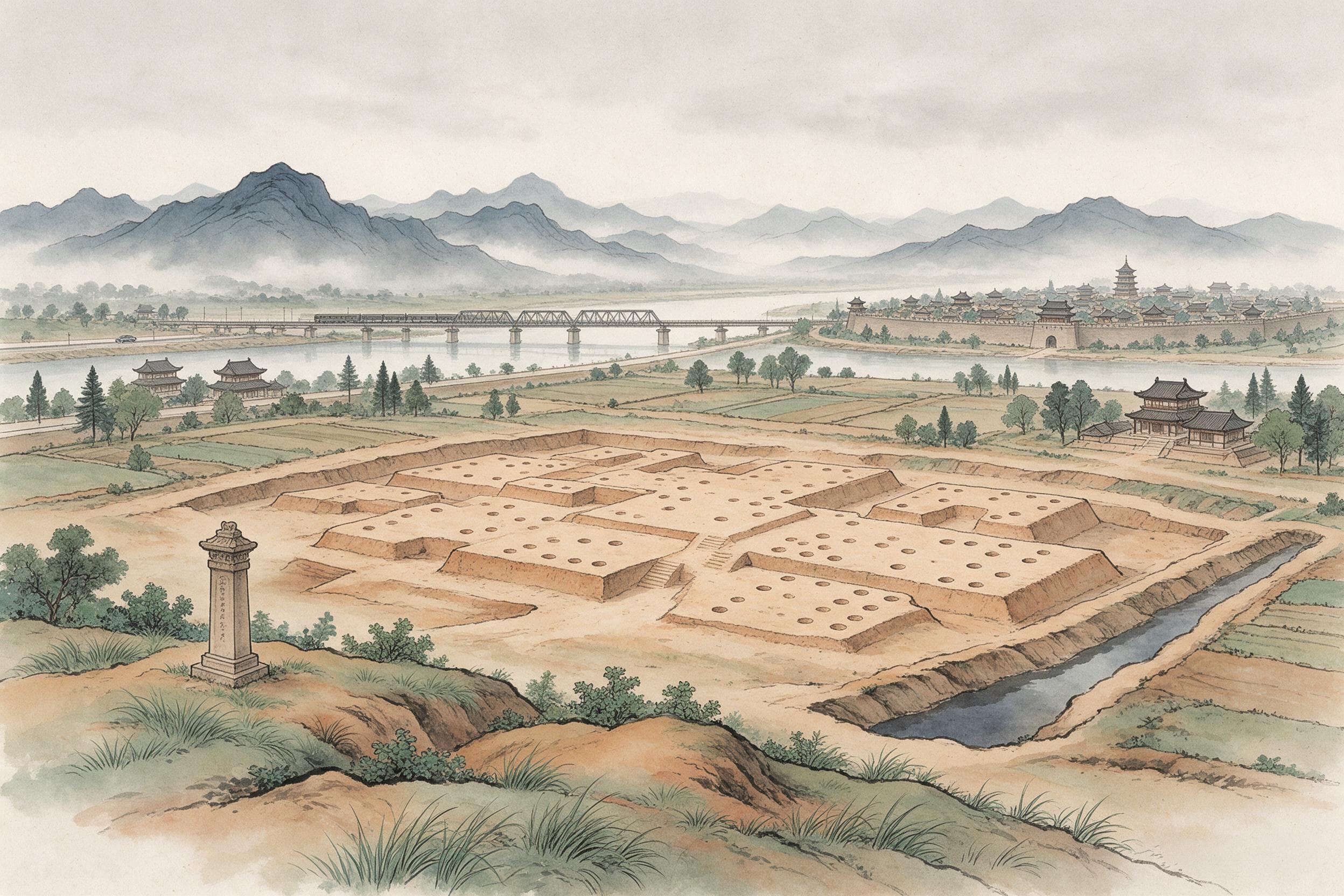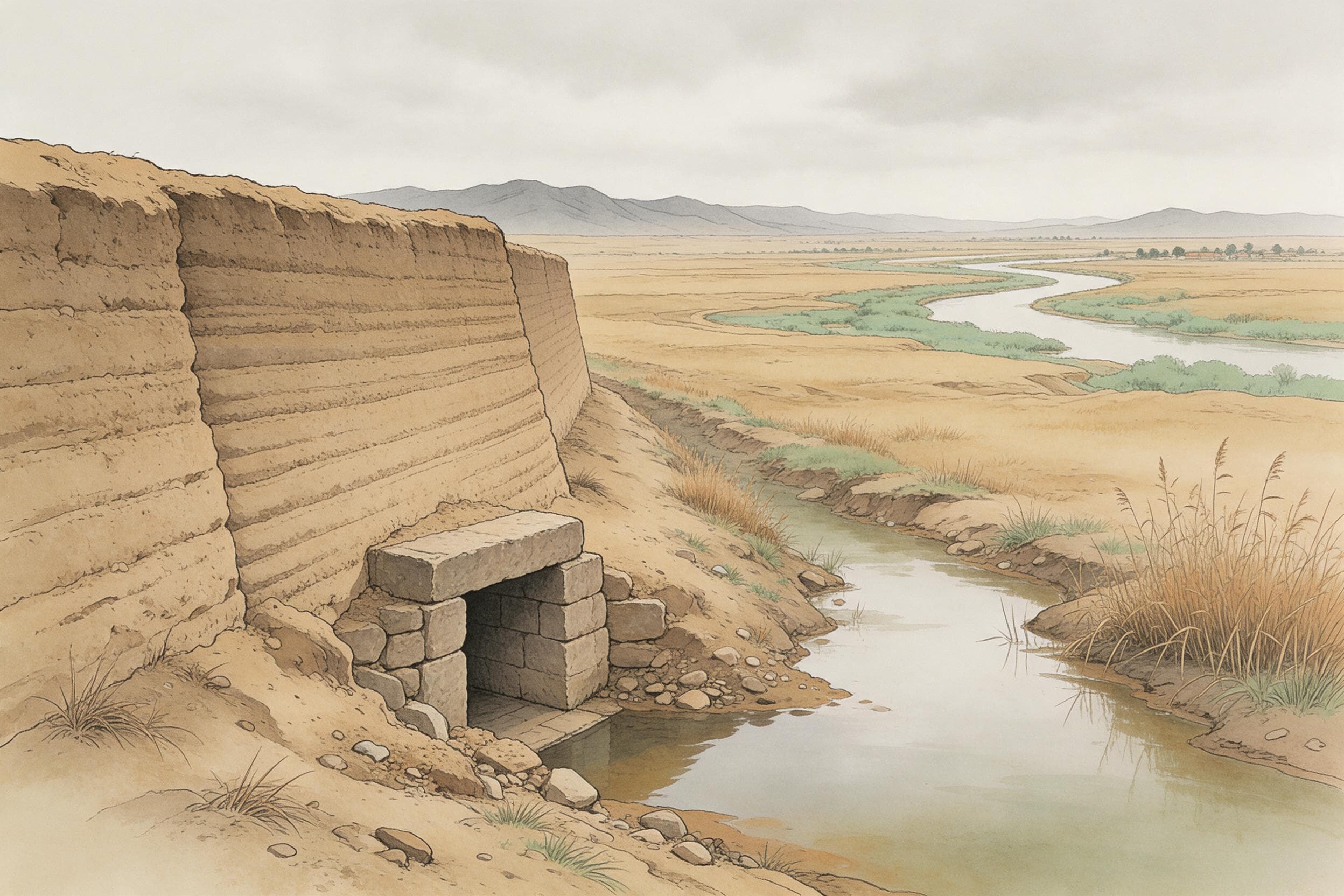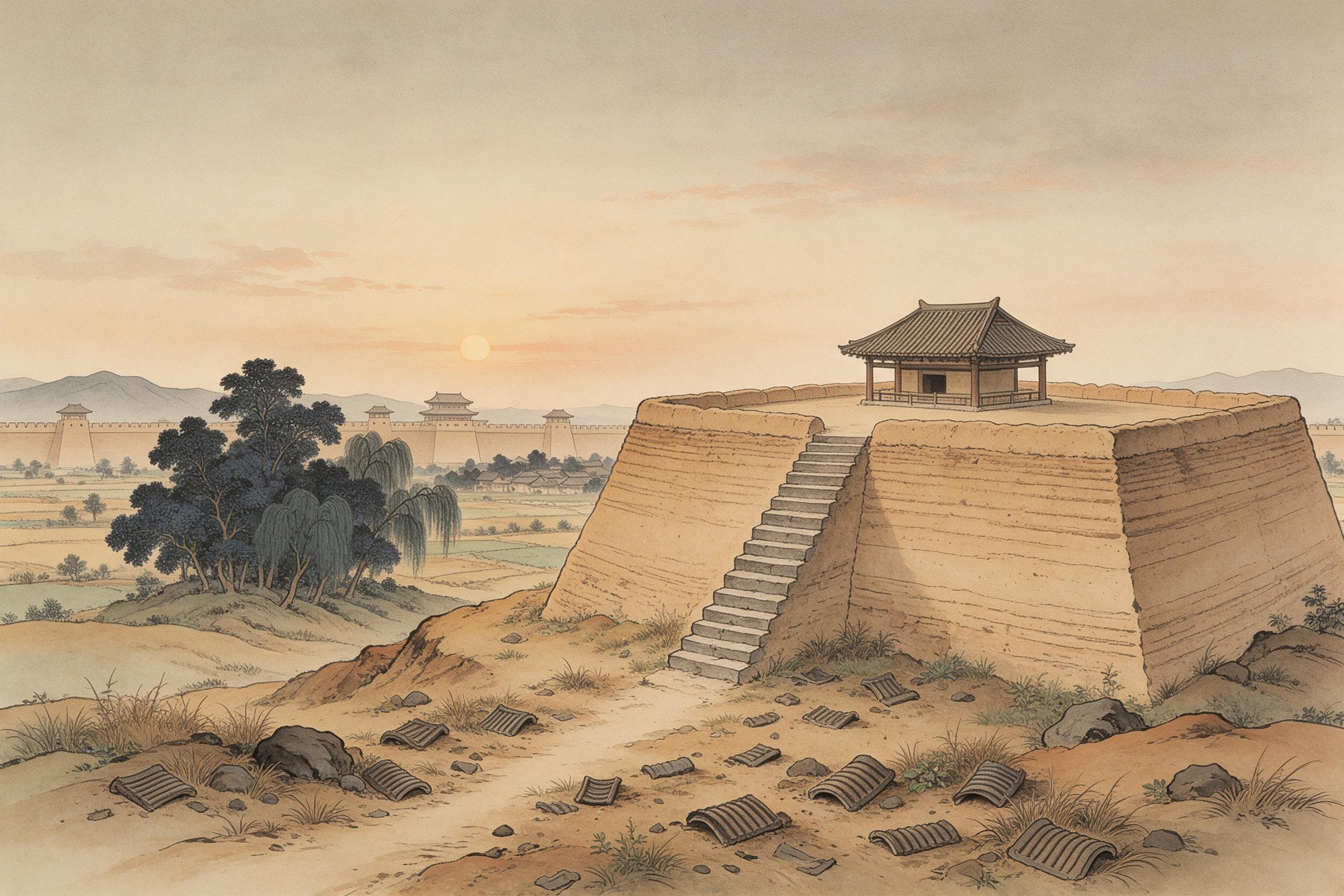
At the Weiyang palace site in the north-west of Xi'an, the front hall survives as a mound of rammed earth: about fifteen metres high, 350 metres from north to south, roughly 200 metres from east to west. The section shows the layers of rammed earth, and the top is flat. It is a platform, not a building; the hall it carried is gone. The palace was begun in 200 BC, and its wall, 8,800 metres in circuit, still runs across the fields. Weiyang was the palace inside the Han capital; the site today is fields, wall lines and mounds.
The mound first
The platform is read as having carried three halls, front, middle and rear, with the middle one the principal; it rises from south to north, and the highest point is the fifteen metres that remain. That reading, and the rise, come from the site's presentation and the press, not from an excavation report, which this article did not have. What is visible is earth; the three halls are an interpretation laid over it. The pages used here give no depth or bay width for any one hall. The presentation gives the platform's high point as the fifteen metres at its north end.
The measurements are not single either. One newspaper article gives the platform as about 350 metres north to south in one place and 400 metres in another, with a rammed-earth base of 80,000 square metres in the second; the site introduction says 350. The two figures are set side by side here, neither averaged nor rounded into one. Fifty metres is not a slip of the pen; it is what the reporting contains. The report also describes the platform as 'like a small earthen hill' — a description, not a measurement.
The book measures a hall
Then there is the book. The Sanfu huangtu, a topography of Chang'an in the Siku edition, opens its Weiyang entry with the Han shu: in the seventh year of Gaozu, Xiao He built Weiyang palace, setting up its eastern and northern gate-towers, front hall, armory and granary. It then says: 'The palace is twenty-eight li in circuit; the front hall is fifty zhang east to west, fifteen zhang deep, thirty-five zhang high', and calls the hall the luqin, 'where the lords and ministers were received'. The Siku text reads tong ('the same as') before luqin; another edition reads yue ('is called'). The book is not a Han archive — the Siku editors place its author after the Tang emperor Suzong — and its figures come from old maps and tradition, not from measurement.
So the two sets of numbers do not meet. Fifty zhang is the width of a hall; 200 metres is the width of a rammed-earth platform carrying three halls. Thirty-five zhang is a recorded height of a building; fifteen metres is what survives of the platform. This article does not convert one into the other: the Han foot was not verified for this piece, and 'fifty zhang, about 115 metres' is the sentence not to write. Nor is the gap an error to be corrected: a text describing a building and a survey measuring a ruin are talking about different things. Nor does the text say which of the three halls its fifty zhang describes; it may be the middle one, though that is inference.
How the terrace was made
The book also says how the platform was made: 'In building Weiyang palace, the front hall was made to follow the Longshou ridge', and 'the hill was cut to make a terrace and hall, without rammed-earth construction, rising above Chang'an city'. Its note quotes the Western Metropolis Rhapsody: 'spread Longshou to raise the front hall.' The same note describes the ridge as sixty li long, its head in the Wei river, its tail at Fanchuan. The terrace was a ridge cut down, not earth piled up; part of its height above the city may therefore be geology rather than construction, and how much earth was moved is not recorded.
That is why literature and site describe different objects. The hall stood on the terrace and is gone; the terrace remains, and its fifteen metres are a survival, not the original height. The sources used here give no original height for the platform either, no depth or bay width for any of the three halls. What is left is a shape and a sentence. The book's thirty-five zhang cannot be checked against anything on the ground; it is a number carried in a text.
A city gate as a ruler
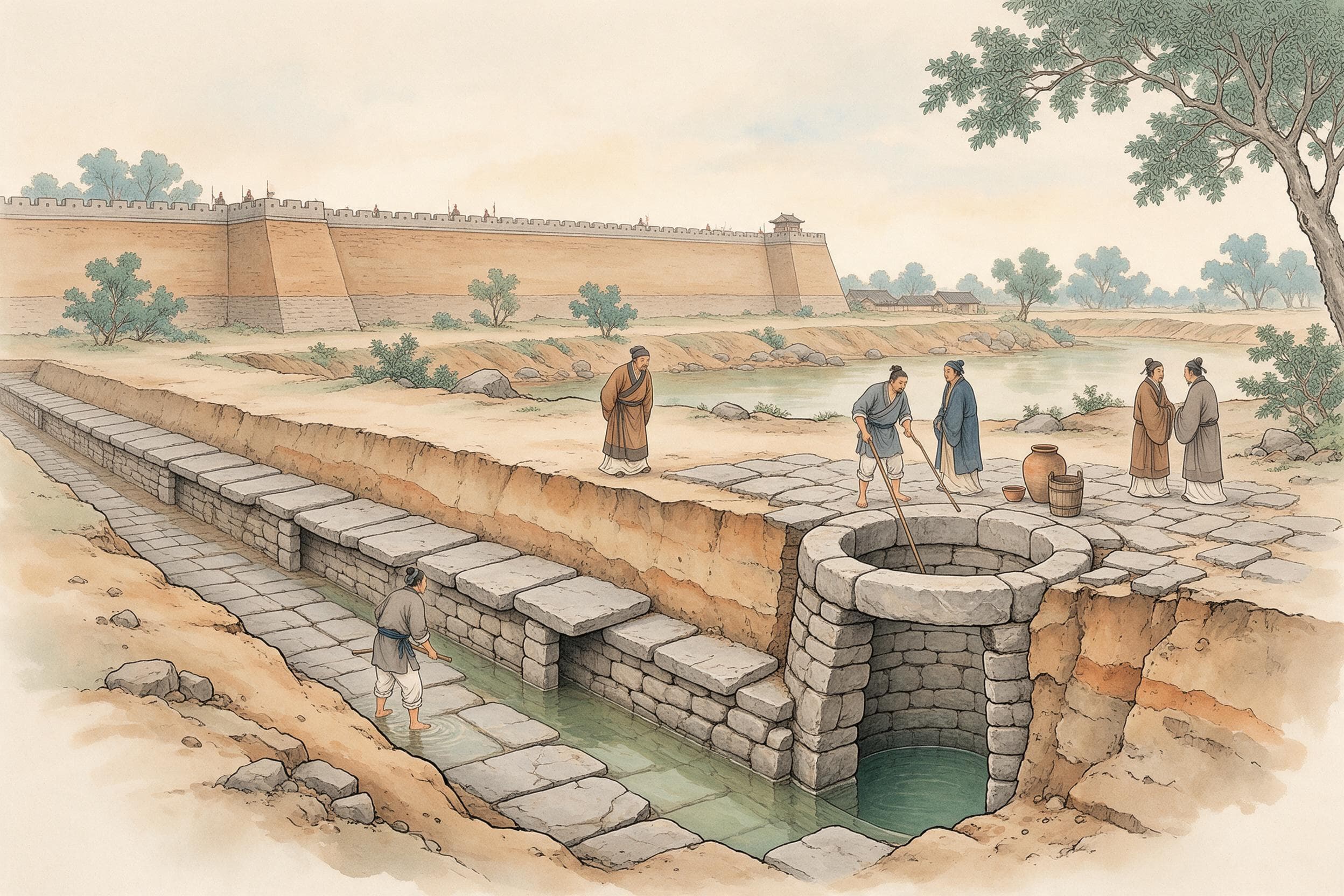
A city gate gives a scale. The Zhicheng gate of Chang'an's wall was 32 metres wide and 20 metres deep, with three passages and rammed-earth partitions about four metres thick between them. The front-hall platform is about 200 metres across — more than six times a gate-width. A gate wide enough for a road was, in width, about a sixth of the platform the emperor's hall stood on. The comparison is not a claim about grandeur; it is the only building-scale measurement on the same pages. The gate's figures are measurements; the hall's are a text.
Other figures from those pages, each with its own status: the palace wall is 8,800 metres in circuit, while the book's 'twenty-eight li' is another unit from another source, and the two are not converted. The palace area is given as 4.8 square kilometres in one account and about five in another; its east and west walls as 2,150 metres, the north and south as 2,250, marked in the report as 'according to records'. Tianlu Pavilion stood 730 metres south of the front hall; Shiqu Pavilion 520 metres west of Tianlu. These are distances and areas, not heights. One area looks measured, the other looks approximate; the pages do not reconcile them.
Two things called the front hall
The limits, listed. The book's dimensions are not measurements; no conversion between zhang and metres is attempted; the surviving fifteen metres are not the original height; 350 and 400 metres are not merged; the palace's full plan is not drawn, since the sources give only the wall, four gates, three halls and the front hall's position; reconstruction drawings and models are not used as dimensions; no ranking claims are made here; and no wage, work-day or cost of the terrace is invented, because none is recorded.
So the article ends with two things that share a name. On the ground: a flat-topped mound of rammed earth, 350 metres one way and 200 the other, fifteen metres high where it has not eroded. On the page: a hall fifty zhang wide, fifteen deep, thirty-five high, 'where the lords and ministers were received', cut into the Longshou ridge. The mound and the sentence are both evidence; they are not the same measurement, and the distance between them is the subject. A reader can stand on the mound; the sentence can only be read.
Sources & further reading
- 《三辅黄图》卷二(四库全书本)·汉宫·未央宫条(撰人不详,四库提要考为唐肃宗以后人作)(Sanfu huangtu, juan 2, Siku edition: Weiyang palace) — Old topography of Chang'an, not a Han archive. Opens with a quotation from the Han shu: in the seventh year of Gaozu, Xiao He built Weiyang palace with its eastern and northern gate-towers, front hall, armory and granary. Gives the palace as twenty-eight li in circuit, the front hall as fifty zhang east-west, fifteen deep and thirty-five high, called the luqin where lords and ministers were received; and says the front hall was made to follow the Longshou ridge, the hill cut into a terrace 'without rammed-earth construction'. The Siku text reads 'tong' before luqin where another edition reads 'yue'.
- 央视网〈汉长安城未央宫遗址保护展示区各点简介〉2013-11-01 (CCTV.com, introduction to the Weiyang palace site display area) — Site display introduction, reporting rather than an excavation report: surviving rammed-earth platform of the front hall 15 m high, 350 m north-south and about 200 m east-west; palace begun in 200 BC, wall 8,800 m in circuit, area 4.8 sq km; Zhicheng gate 32 m wide and 20 m deep with three passages and partitions about 4 m thick; Tianlu Pavilion 730 m south of the front hall, Shiqu Pavilion 520 m west of Tianlu.
- 陕西日报〈丝绸之路的东方起点 汉长安城未央宫遗址〉2014-08-01(华商网转载页)(Shaanxi Daily, 'The eastern starting point of the Silk Road', 1 Aug 2014; repost page) — Newspaper report, repost page, not an excavation report: the same article gives the front-hall platform as about 350 by 200 m in one place and 400 by 200 m with a base of 80,000 sq m in another; three halls rising from south to north; palace area about 5 sq km; east and west walls 2,150 m and north and south 2,250 m, marked as 'according to records'.