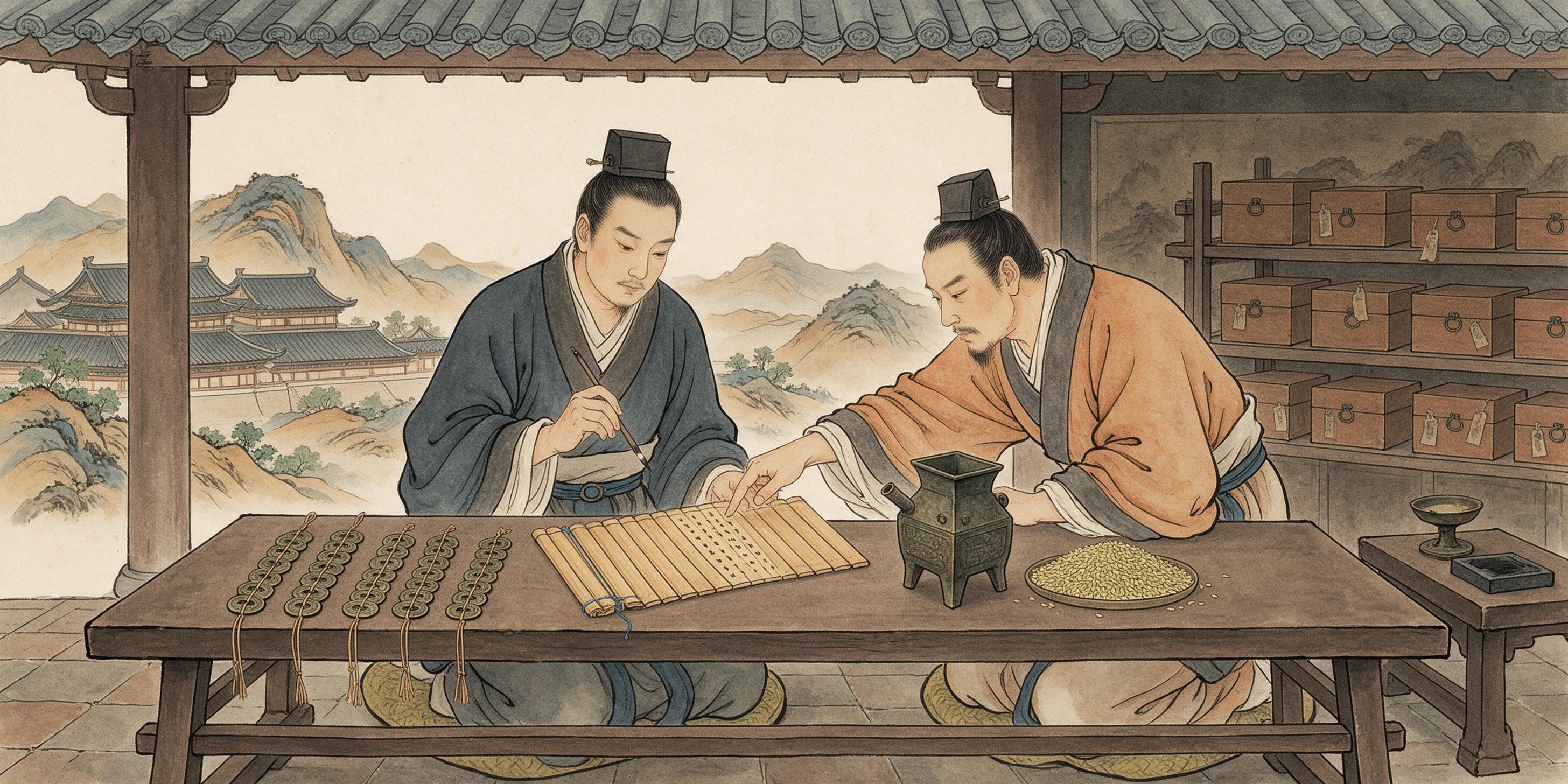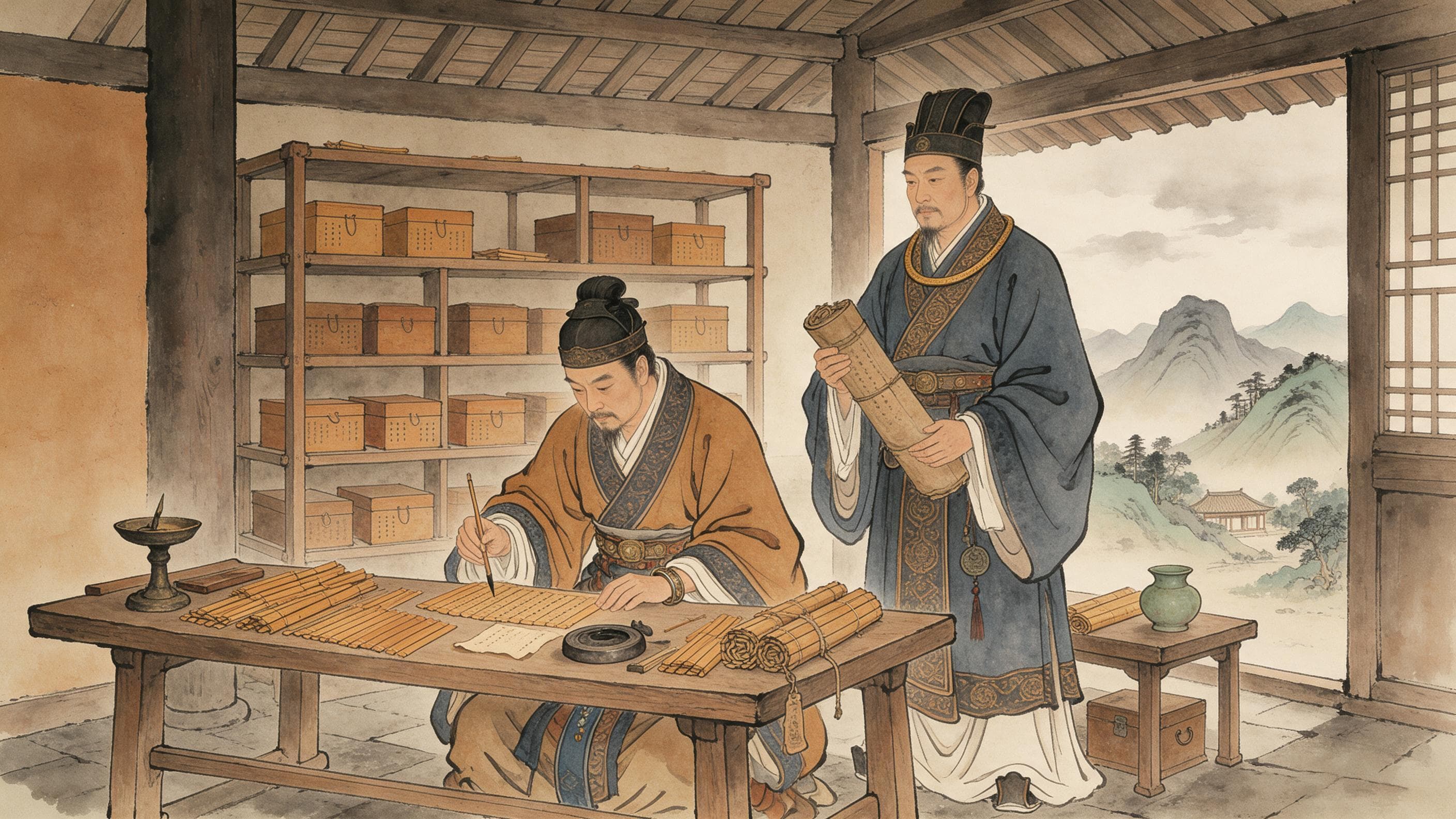
The Book of Han's treatise on geography contains a census table: the first part lists, commandery by commandery, households, persons and counties; the end of the second part gives one national total. The table is dated at its first entry — 京兆尹,元始二年, the metropolitan district, in the second year of Yuanshi — and the later commanderies are not dated again. This article only reads the table: figures as written, names as written, no growth rates, no averages, no estimate of real population, and no comparison with today. The treatise runs in two parts: the table of commanderies is in the first, the national total closes the second. It is the largest set of numbers in the treatise, and the quietest of all.
Two Kinds of Number in One Treatise
The first part runs: commandery, households, persons, number of counties, then the county names. The first entry: 京兆尹,元始二年戶十九萬五千七百二,口六十八萬二千四百六十八。縣十二 — 195,702 households, 682,468 persons, twelve counties, followed by the twelve names from Chang'an and Xinfeng onward. Every later entry follows the same form with different figures and names; the counties are listed only here, in the first part, not in the closing survey.
The end of the second part gives another kind of number: 訖於孝平,凡郡國一百三,縣邑千三百一十四,道三十二,侯國二百四十一。地東西九千三百二里,南北萬三千三百六十八里。提封田一萬萬四千五百一十三萬六千四百五頃,其一萬萬二百五十二萬八千八百八十九頃,邑居道路,山川林澤,群不可墾,其三千二百二十九萬九百四十七頃,可墾不可墾,定墾田八百二十七萬五百三十六頃。民戶千二百二十三萬三千六十二,口五千九百五十九萬四千九百七十八。漢極盛矣 — the count of commanderies and kingdoms, counties and towns, dao and marquisates; the extent of the realm east to west and north to south; three classes of land; and finally households and persons, with the verdict 'the Han at its height'. In figures: 103 commanderies and kingdoms, 1,314 counties and towns, 32 dao and 241 marquisates; 9,302 li from east to west and 13,368 li from north to south; 145,136,405 qing of enclosed land, of which 102,528,889 qing of settlements, roads, hills, rivers and marshes could not be farmed and 32,290,947 qing were of mixed quality, with 8,270,536 qing of registered cultivated land; and 12,233,062 households with 59,594,978 persons. The survey mixes counts, lengths and areas, and they are kept apart as the book keeps them.
The dates must be kept apart. In the commandery table only the first entry, Jingzhao, is dated 元始二年; the rest carry no year. The closing survey says only 訖於孝平, down to the reign of Emperor Ping, and adds 漢極盛矣, again without a year. Neither page says which year the individual commandery figures belong to, and this article does not supply one, nor treat the total as belonging to another year. The two parts are one treatise, but their numbers are not dated alike.
What the Table Counts
There are only three things in it: households, persons, counties. How a household or a person was counted, neither page defines: not who was included in a person, not what made a household, not how the figures came up from the counties. No definition is supplied here, and no later household registration system is used to fill the gap. The table has three columns and no footnotes on method; nothing in them says who was counted.
It must also be remembered that these are registered numbers. Nothing on the pages says they equal the actual population of the time; nothing discusses concealment, unregistered persons or flight. This article reads them as registrations only: no estimate of real population, no growth rate, and no division of persons by households. The figures are what the clerks wrote down, and nothing more is claimed for them. Three columns, no notes.
A Few Commanderies
The three metropolitan districts side by side, as written: 左馮翊,戶二十三萬五千一百一,口九十一萬七千八百二十二。縣二十四; 右扶風,戶二十一萬六千三百七十七,口八十三萬六千七十。縣二十一; Jingzhao as quoted above. Set together, they show only the registered size of each district; this article does not rank them or average them. Read in order they are 235,101, 216,377 and 195,702 households, and 917,822, 836,070 and 682,468 persons — figures, not standings, printed in the order the table gives them.
Two large commanderies: 河南郡,戶二十七萬六千四百四十四,口一百七十四萬二百七十九。縣二十二; 東郡,戶四十萬一千二百九十七,口百六十五萬九千二十八。縣二十二. A commandery with more households does not always have more persons, and one with more persons does not always have more households — that is a fact of the table — Henan has 276,444 households and 1,740,279 persons, Dong 401,297 households and 1,659,028 persons — it is pointed out and not turned into a conclusion; the two entries stand in the table's own order.
Rules for Reading the Table
First, no addition or subtraction. The commandery figures and the closing total are two kinds of number; this article does not add the commanderies up against the total, does not compute a difference or a ratio; the book gives none of these, and none are supplied. Second, no division: persons per household, households per county, persons per qing of land are all left uncalculated — any such figure would be mine, not the book's. If a reader wants a check, the only way back is the commandery entries themselves; no check is offered here, and the total is a separate sentence with its own wording.
Third, units as written. Land is in 頃 qing, distance in 里 li, households and persons are counts; all are printed as they stand, not converted to hectares or kilometres, and not turned into modern values. The three classes of land stand side by side, and the article says only that the book divides them so, not deriving one from another. The three land classes are 145,136,405 / 102,528,889 / 32,290,947 qing, with 8,270,536 qing of registered cultivated land beside them.
What the Two Pages Do Not Give
Neither page gives the definition of a household or a person, the method or the process of the count, the year of the individual commandery figures, the breakdown by sex or age, the split between town and countryside, the question of concealment and unregistered persons, or any comparison with earlier or later ages. None of it is there, and none is added here. The pages are a table and a survey, not a treatise on method. A table answers the questions it was built to answer, and no others. That is the limit of the reading.
Other subjects are kept out: the reporting of accounts, the poll and capitation levies, and the one-in-thirty land tax each belong to another article; the pieces on the Chang'an wall and on the tomb towns have already used the Jingzhao figures as a boundary (a commandery is not a county, nor the population inside a wall), and Jingzhao appears here only as an example. No general history of ancient population is offered — what is read here is a table, not an age. Two parts, one total, and no arithmetic beyond what is written. The table is what the book gives; the rest would be commentary.
Related reading:Heqin: A Letter, a Princess, and an Annual Tribute of Silk and Grain · The He Family Jade: Three Appearances of One Stone · The Music Bureau: A Staff List of 829, and 441 Dismissals
Sources & further reading
- 《汉书》卷二十八上·地理志上(东汉班固撰;维基文库本,页面白文无注,未与中华书局点校本复核) — The commandery-by-commandery table: each entry gives the name of the commandery or kingdom, households, persons, the number of counties and their names. The first entry, 京兆尹, is dated 元始二年 — 'in the second year of Yuanshi, 195,702 households, 682,468 persons, twelve counties'; 左馮翊 235,101 households, 917,822 persons, twenty-four counties; 右扶風 216,377 households, 836,070 persons, twenty-one counties; 河南郡 276,444 households, 1,740,279 persons, twenty-two counties; 東郡 401,297 households, 1,659,028 persons, twenty-two counties. The date is written only at the first entry; the rest of the table carries no year.
- 《汉书》卷二十八下·地理志下(东汉班固撰;维基文库本,页面白文无注,未与中华书局点校本复核) — The closing survey: by the end of Emperor Ping's reign there were 103 commanderies and kingdoms, 1,314 counties and towns, 32 dao and 241 marquisates; the land measured 9,302 li east to west and 13,368 li north to south; the 提封田 (total enclosed land) 145,136,405 qing, of which 102,528,889 qing were occupied by settlements, roads, mountains, rivers and marshes and could not be farmed, and 32,290,947 qing were of mixed quality, with 定墾田 (registered cultivated land) 8,270,536 qing; 民戶千二百二十三萬三千六十二,口五千九百五十九萬四千九百七十八。漢極盛矣 — 12,233,062 households and 59,594,978 persons, 'the Han at its height'. No year is repeated in this closing passage.