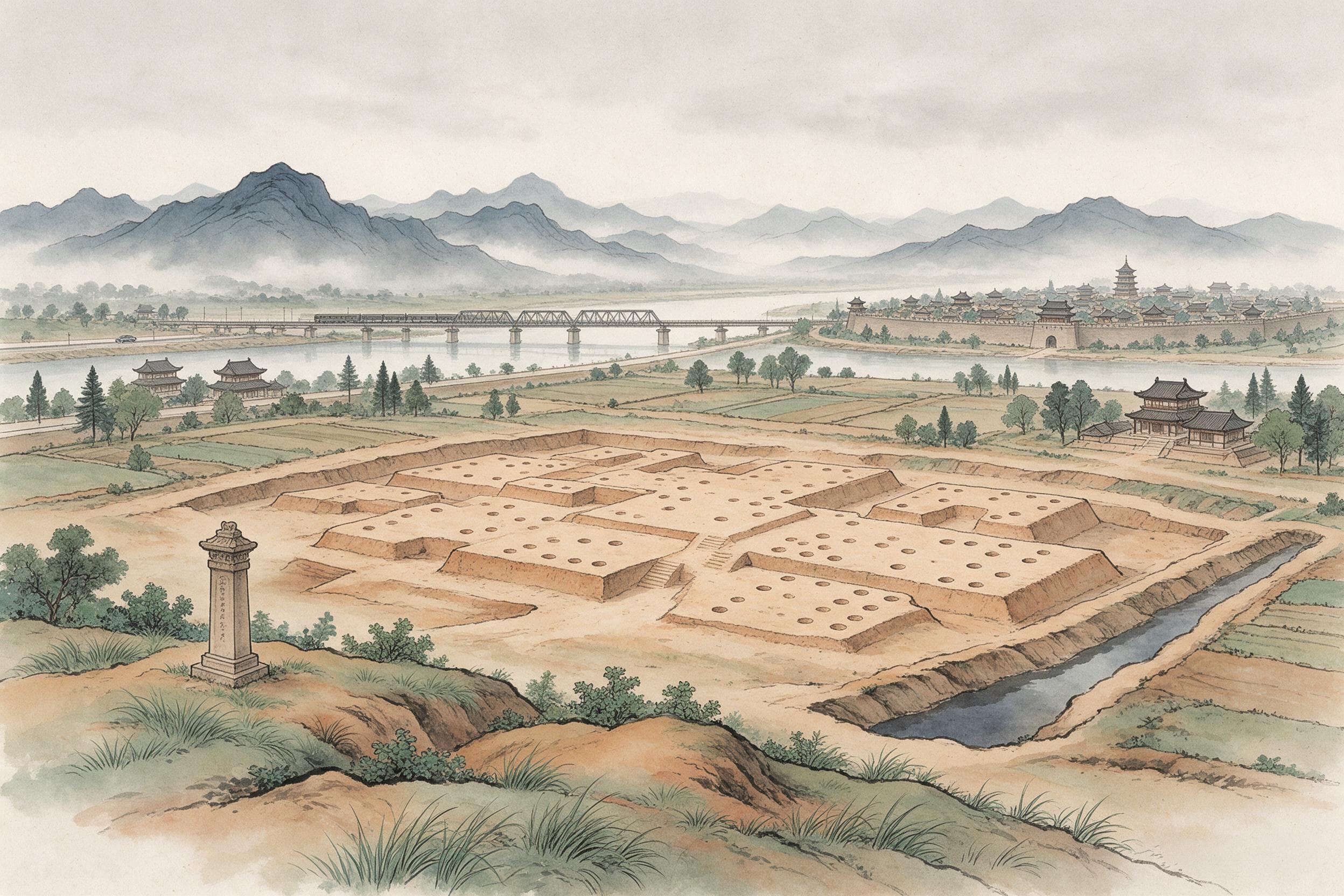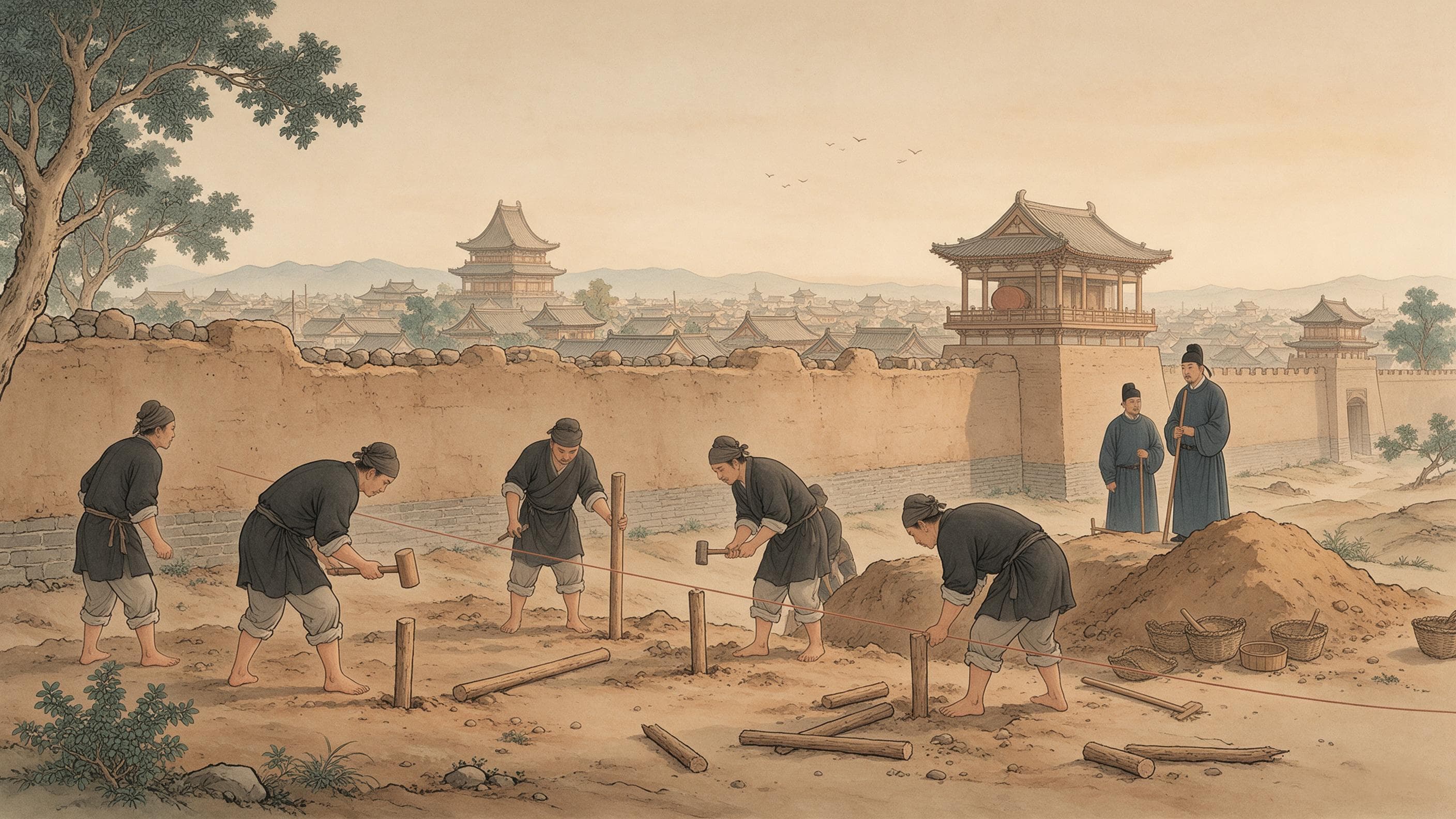
In the fourth month of 955 a line of markers went up around the walls of Kaifeng, the capital of the Later Zhou. The order was not to build; it was to mark. 'Let the office concerned build another outer wall (luocheng) on all four sides of the capital,' the edict said, 'and first set up markers (biaoshi).' Only after the line was fixed were labourers to be called, and only in the slack season of the farming year. The first act of the new city was a row of marks in the ground, with the old city still standing inside it.
Marking the ground
The edict gives its reasons in the flat language of administration. Kaifeng was where 'the Chinese and the foreign converge, where water and land routes meet', and it was growing. But 'the city follows its old plan and its scale has not been enlarged': the barracks of the guard were cramped, and the offices of the departments had nowhere to be built. In the markets 'inns and shops are limited', while merchants kept arriving, so rents 'rose without any fixed limit' and poor households 'found it hard to manage'. Houses stood wall to wall; the streets were low and narrow; summer brought damp heat, and ordinary days the fear of fire.
The timetable was as carefully set as the line. Labour was to be raised 'when winter ends and spring begins, in the slack time of farm work', and brought in 'gradually'; as soon as spring ploughing began, the men were to be sent home. If the earthworks were unfinished, they would be taken up again 'the following year'. The wall was to be built in the gaps between harvests, by men who had to be back in their fields.
Fifty-five thousand, then more than a hundred thousand
This was not the first wall work of the decade. In the first month of 952 the court ordered the prefecture of Kaifeng to 'repair the outer wall of the capital', and the prefecture 'led 55,000 conscripted labourers (dingfu) from the metropolitan counties; the rammed-earth work was finished and the men dismissed in ten days' (xunri). The word is repair, not expansion: the wall was already there, and the job was to put it back in order.
The new wall was a different undertaking. In the first month of 956 an order raised 'more than 100,000 labourers from the metropolitan counties and from the prefectures of Hua, Cao and Zheng' to build the new outer city, with the military governor of Caozhou, Han Tong, 'in overall charge of the labour'. The Comprehensive Mirror records the same figure a little differently: 'more than 100,000 people of Kaifeng prefecture, and of Cao, Hua and Zheng, were sent to build the outer city of Daliang.' The two accounts agree on the number and differ only in how the recruiting districts are named. Nine months after the markers went in, the wall was begun.
How wide a street
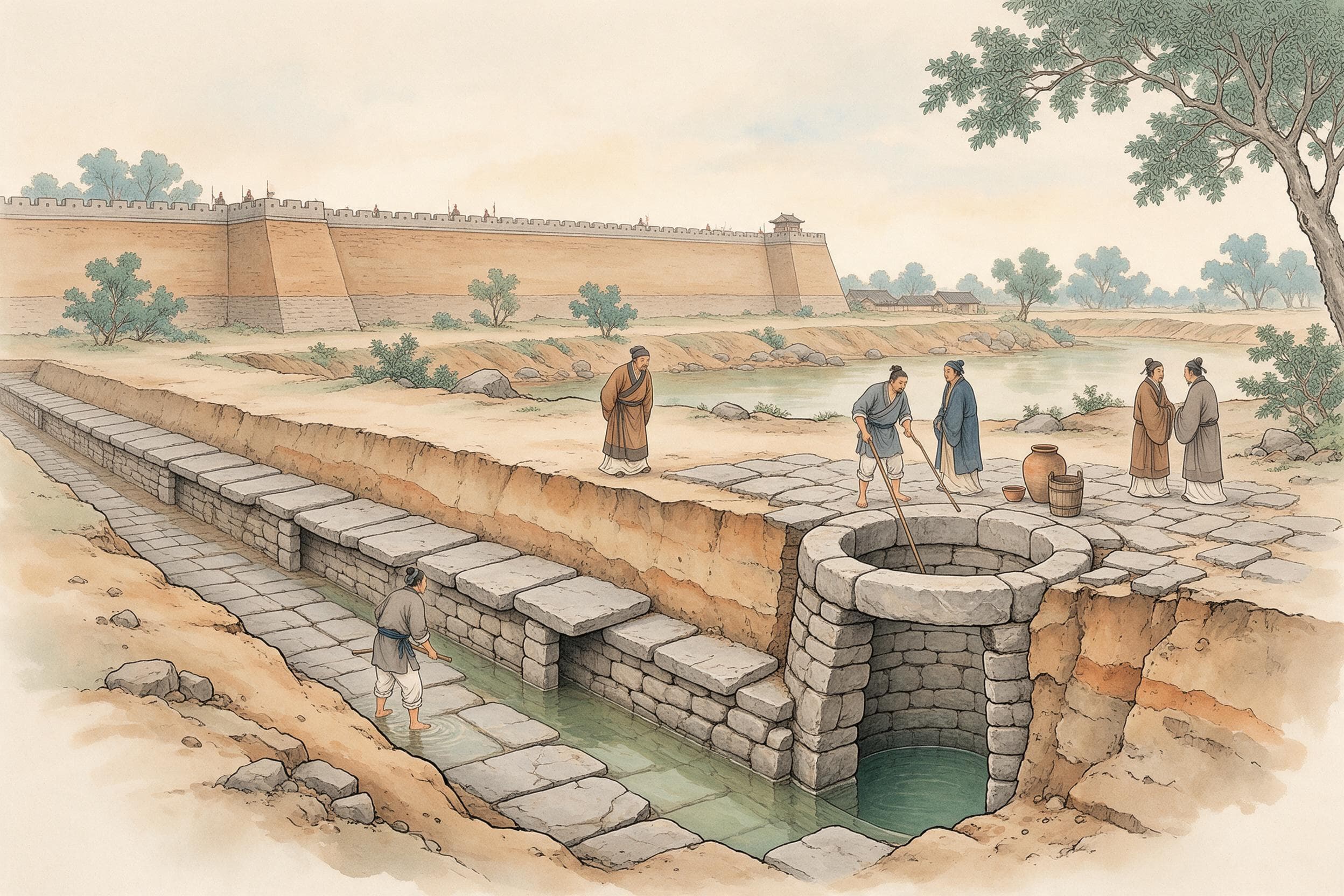
In the sixth month of 956, the year the wall was begun, an edict turned to the streets. The emperor had just come back from the Huai region and, he says, 'looked over the great avenues and thought again about how to make them serve'. The rule was graded by width: on a street fifty paces (bu) wide, the households on either side 'may each use five paces for planting trees, digging wells and putting up shade awnings'; on streets of thirty down to twenty-five paces, 'three paces each, and less in proportion'. The state fixed the roadway; the household got a strip at its edge for trees, water and shade.
A second record measures the same problem from the other end. In the eleventh month of 955 the Comprehensive Mirror notes that in Daliang 'people had encroached on the streets with buildings, and few carts could get through'; the emperor 'ordered them straightened and widened, some to thirty paces'. The fifty paces of the 956 edict and the thirty paces of the 955 entry come from two books and two moments; they are set side by side here and not averaged. What both describe is a city whose streets had been built over and were being cut back to a plan.
Seven li of cleared ground
The hardest clause is about ground, not stone. 'From now on,' the 955 edict says, 'any burial, any kiln, and any rural market (caoshi) must be seven li outside the markers.' Within the marked area the government was to divide the land first, fixing the sites of barracks, streets, granaries and departmental offices, and 'when that was done, the people were free to build'. The Mirror adds that graves were moved 'outside the markers' — which means families were told to take up their dead and bury them again further out. Neither text says who paid for the move, or what became of those who could not pay.
The cost in goodwill is recorded in one sentence. 'In widening the capital,' the emperor said, 'I have disturbed the living and the dead a great deal. The complaints will be mine to bear; in time it will profit people.' It is an admission that the work was unpopular and that he took the blame for it himself. In the record the order to move the graves stands immediately before this remark.
The state draws the grid, households build
Inside the markers the government did not put up the houses. The 955 edict reserves the laying out: the sites of barracks, streets, granaries and offices were to be marked first, and after that 'the people were free to build'. The Mirror says the same in its own words: 'within the markers, apart from the streets, granaries and offices that the county officers laid out, people were allowed to build houses wherever they liked.' The state drew the grid, and households built on their own lots. A city made by order, but not by the state's own hands.
What the sources do not give matters as much as what they do. There is no perimeter, no area, no count of households; no figure for houses pulled down or land taken, no compensation, no wage, no total of work-days. The two books count labourers by the ten thousand and time in days or in 'the following year', not the size of the finished city. Nor do they say when it was finished: the 955 edict allowed the work to run into the next year, and the record stops there. What remains is a sequence of orders: a wall repaired in ten days in 952; a line of markers in 955; in 956 more than a hundred thousand people building a new wall, with streets measured out and strips left at their edges for trees, wells and awnings. The city was made in that order — marked, cleared, built, and divided.
Sources & further reading
- 王溥《五代会要》卷二十六·城郭(附街巷条)(Wang Pu, Wudai huiyao, juan 26: city walls, with the streets and lanes section) — Song compendium of Five Dynasties institutions. Used for: the first month of 952, when Kaifeng prefecture was ordered to repair the outer wall and led 55,000 metropolitan labourers, the rammed-earth work dismissed in ten days; the full text of the fourth-month 955 edict (markers first, seven li cleared of burials, kilns and rural markets, land divided before households build); the first month of 956, when more than 100,000 labourers from the metropolitan counties and Hua, Cao and Zheng were called up under Han Tong; and the sixth-month 956 street edict (fifty-pace streets, five paces each side for trees, wells and awnings).
- 司馬光《資治通鑑》卷二百九十二·後周紀三 (Sima Guang, Zizhi tongjian, juan 292, Later Zhou 3) — Chronicle covering 954 to early 956. Used for: the 955 edict to extend the outer city, mark it out first and build in the winter slack season; the 956 call-up of more than 100,000 people of Kaifeng prefecture and Cao, Hua and Zheng; and the eleventh-month 955 entry that houses had encroached on the streets so that few carts could pass, that the streets were straightened and widened 'some to thirty paces', that graves were moved outside the markers, and the emperor's remark that the complaints would be his to bear.