In the eighth month of 204 the east gate of Ye was opened from inside, and the besiegers walked in. The city changed hands, and the new master was Cao Cao. The date needs care: the Han emperor still reigned and the state of Wei did not yet exist. Cao Cao was governor of Ji province under the Han; only in 213 was he made Duke of Wei, with ten commanderies of Ji as his state, and only then did Wei have its seat at Ye. Cao Pi took the throne in 220, moved to Luoyang and left Ye one of five capitals. What follows is the northern city as it was rearranged in the decade after 204.
First the siege, then the plan
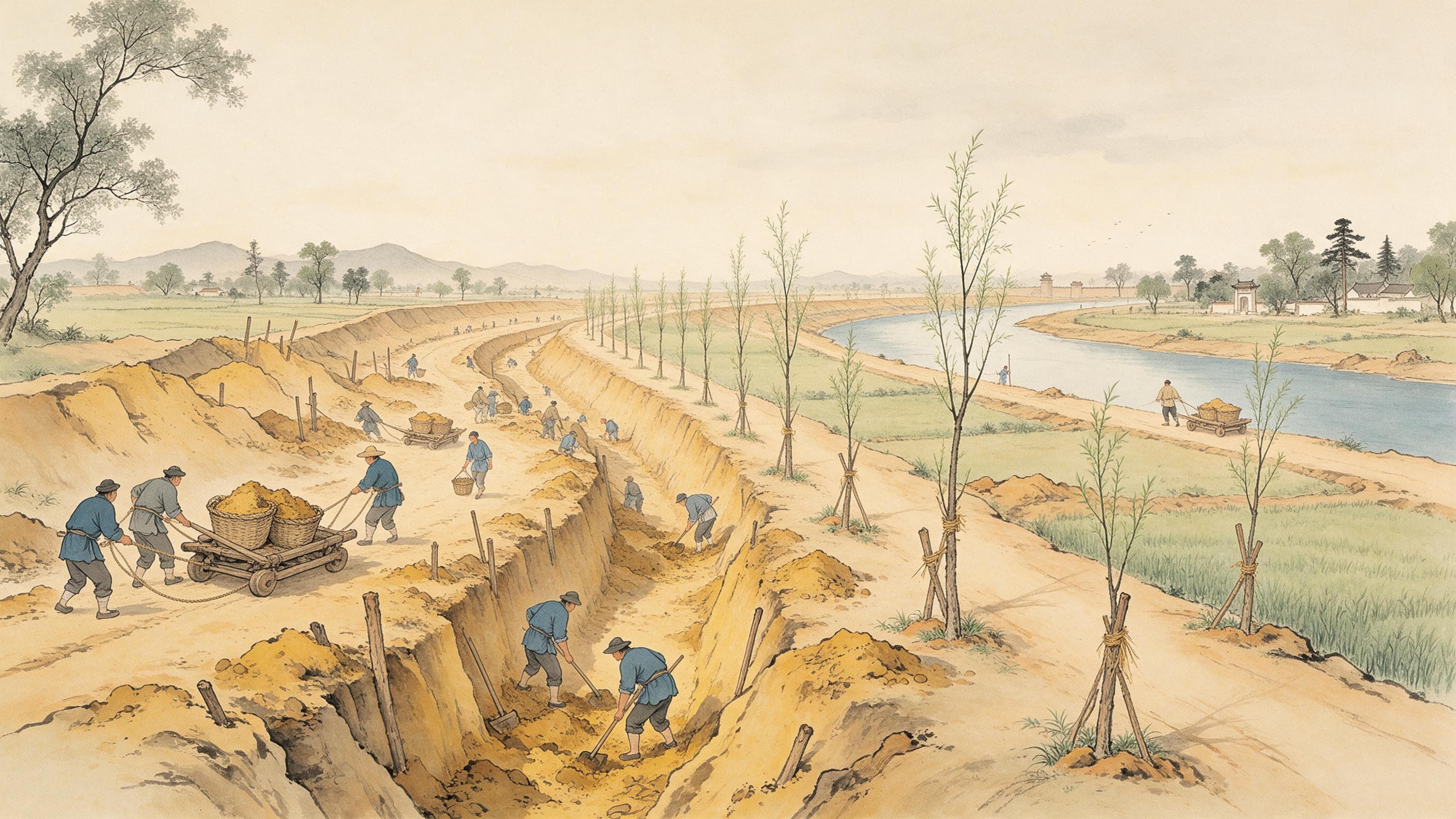
The siege was hard. The Wei shu records that in the fifth month the Zhang river was let into the city and 'more than half the people inside starved'; in the eighth month a nephew of the defender opened the east gate. That autumn the year's land tax was remitted and the law against great households tightened. The Shui jing zhu, quoting an older account, adds that the besiegers' earthwork was 'forty li around' and that Cao Cao raised it 'overnight, two zhang wide and deep, and turned the Zhang into it'. The city was rebuilt out of the old Yuan city, not laid out on empty ground. In 208 he was back, digging a pond 'to drill his marines'; the report suggests the spoil went into the platforms.
The terrace dates are plain: the Bronze Sparrow in the winter of 210; the Golden Tiger and the channel to the Bai canal in the ninth month of 213, after the dukedom. The Shui jing zhu says all three were 'built on the wall itself as their base', raised by 'Wei Wu' — Cao Cao's posthumous title. They were not garden follies outside the walls.
One avenue, seventeen metres wide
The excavators measured the street. In the south they found three north-south avenues; the central one is 'seventeen metres wide' and does not stop at the cross street but runs north into the palace enclosure, linking the Zhongyang gate, the Zhiche gate, the Duan gate and the Wenchang hall. Ten rammed-earth platforms in the north were identified as the palace zone, laid out symmetrically on that axis. The city has only one east-west avenue, about thirteen metres wide, cutting Ye in two; the east and west gates face each other 'essentially on one straight line'.
The order of work is the point: road first, city after. The Zhongyang gate opens onto the seventeen-metre avenue, which runs to the palace gate and on to the hall. He Liqun, who leads the Ye excavation, calls this 'the first large capital in China laid out on a central axis' — a judgement quoted as such, not a settled fact; nor does this piece claim Cao Cao was copying the Kaogong ji.
Seven gates: names from a text, widths from a trench
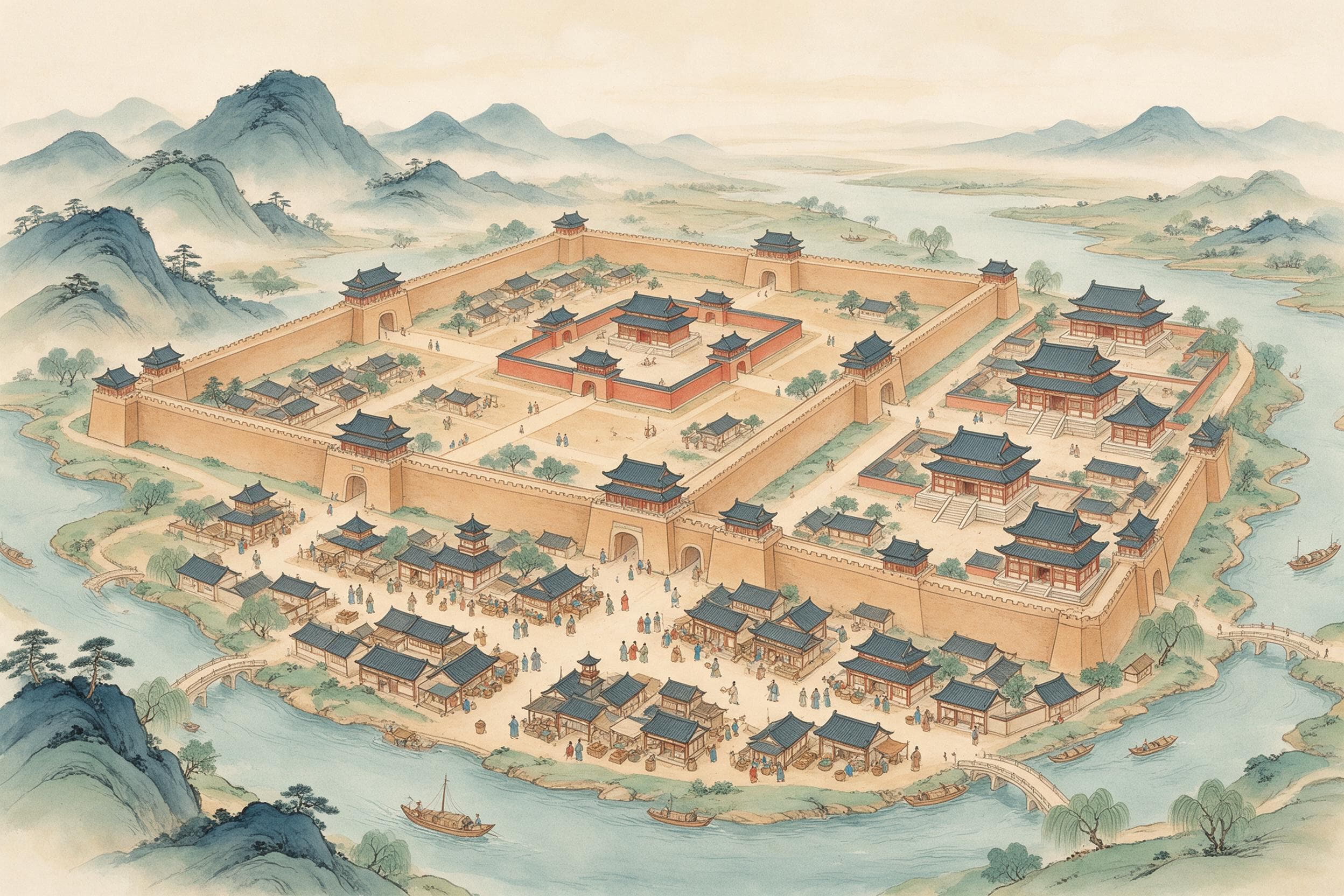
The Shui jing zhu says seven gates: Fengyang, Zhongyang and Guangyang on the south; Jianchun on the east; Guangde and Jiu on the north; Jinming, the White Gate, on the west. The spades measured widths: a gate site 800 metres south of the south-east corner has a passage 'twenty-two metres wide' with a barbican; one gate in the north wall and one in the south each have a passage 'twenty metres wide'. A stretch of wall still stands 800 metres long, three to five wide and two to three high; elsewhere only the foundation trench survives. How high the wall originally stood is nowhere recorded.
Two sets of dimensions. The survey gives 2,620 metres east-west and just over 1,700 north-south. The text gives 'seven li east-west and five li north-south', faced with brick, 'a tower every hundred paces'. The report's 'about seventeen li' circumference is computed from the sides, not measured, and is not used here as a measurement. The palace enclosure, the wards, the population, the building time, the labour, the cost and the gate depths are all absent.
The three terraces in the north-west corner
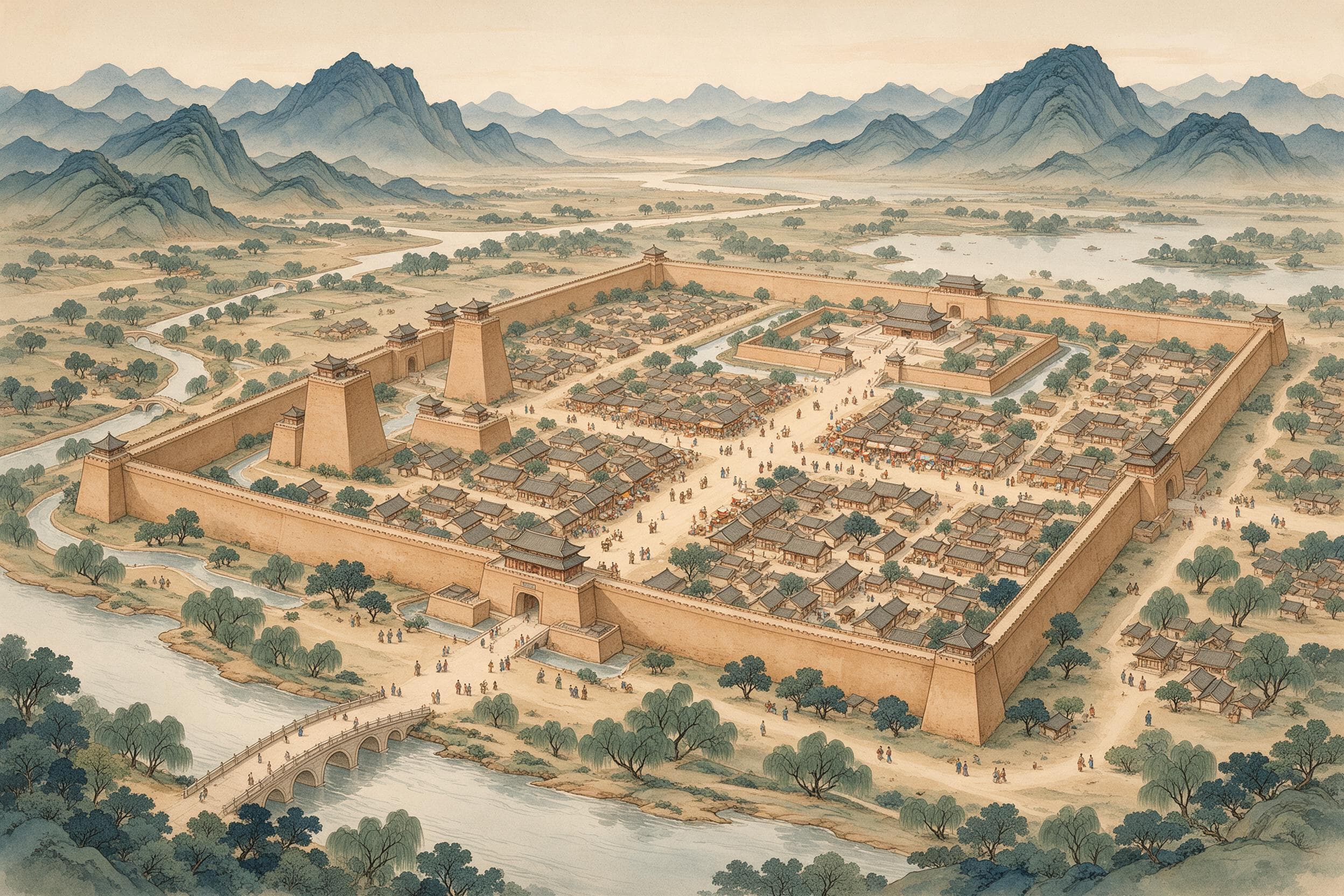
The terraces stand in a row inside the north-west wall: Golden Tiger on the south, later Jin Feng; Bronze Sparrow in the middle; Ice Well on the north. The excavated Jin Feng platform is 122 metres north-south, 78 wide, 12.5 high, all rammed earth — and that is only the base. The terrace keeps 'twelve metres above ground and an eight-metre foundation trench below', in layers eleven to thirteen centimetres thick. Of the Bronze Sparrow only the south-east corner is left; the Ice Well was washed away by the Zhang. So the heights survive only in the text: ten zhang and a hundred and one rooms for the Bronze Sparrow; eight zhang and a hundred and nine for the Golden Tiger; eight zhang and a hundred and forty-five for the Ice Well, with an ice chamber, wells 'fifteen zhang deep', graphite, and grain and salt cellars. When the Bronze Sparrow was finished, the story went, Cao Cao had his sons climb it and write poems about it.
Water came in from the west: 'Cao Cao led the Zhang current in from the west, past the Bronze Sparrow, and it flowed hidden into the city and eastward, and was called the Changming channel', with roads on both banks; his own terrace poem says 'lead the Changming and water the streets'. West of the city lay the Tianjing weir: 'twelve drops, three hundred paces apart', one source into twelve streams, each with a sluice. The west wall has never been traced — five metres down west of Jin Feng is running sand, and the Zhang may have destroyed it. Not traced, not absent.
What became of the city
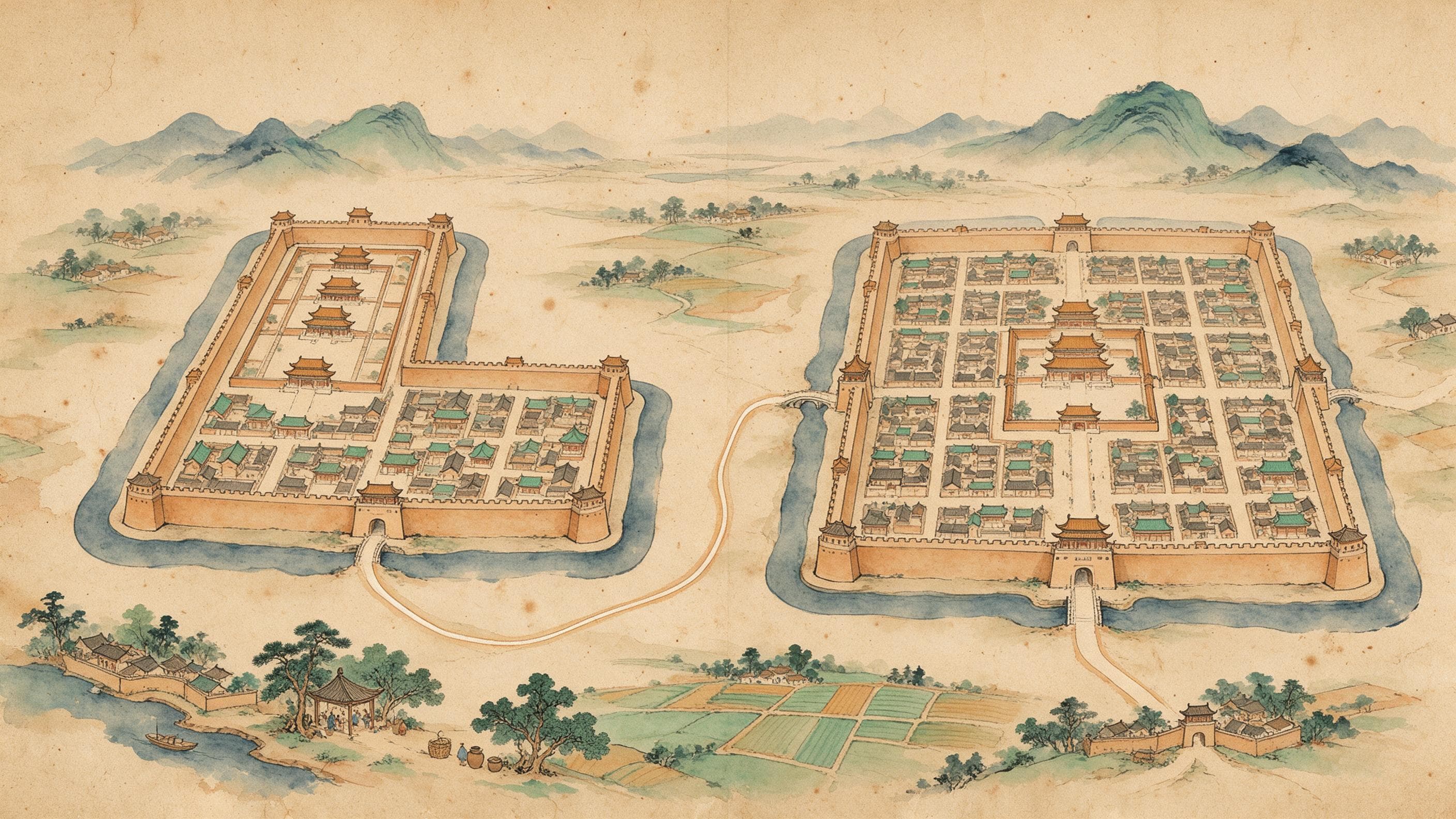
After 220 the capital moved to Luoyang. The Shui jing zhu calls Ye 'the foundation of the dynastic enterprise', one of five capitals. The Eastern Wei and Northern Qi later built a southern city across the south wall; it shares that wall and belongs to another story. This piece is the northern city only. The 'ten zhang' heights are a Northern Wei writer's, not what survives; of the Bronze Sparrow only the corner stands, and a trench there yielded a limestone dragon-head beam-end two metres long.
What can be read out of the city is a set of concrete things: a seventeen-metre avenue ending at the palace gates and halls; a thirteen-metre street dividing the city; seven gates and two widths, twenty-two metres and twenty; three platforms in the north-west with rammed layers eleven to thirteen centimetres thick. How long the siege lasted, how many years the wall took, how many men were levied — none of it is in the record. The city was broken into first, and only then laid out.
Sources & further reading
- 《三国志》卷一·魏书·武帝纪(西晋陈寿撰;维基文库本,页标 textquality 75%,部分人名地名已校中华书局 1982 年 2 版) — The dates: Ye taken in the eighth month of 204 after the Zhang river was let into the city; tax remitted and the law against great households tightened the same autumn; appointed governor of Ji province; the naval pond of 208; the Bronze Sparrow Terrace built in the winter of 210; made Duke of Wei in 213 with the ten commanderies of Ji as his state, the Golden Tiger Terrace and the channel to the Bai canal in the ninth month of that year.
- 《水经注》卷十·浊漳水(北魏郦道元注;维基文库本) — The literary side, written some three centuries after the events: the city seven li east-west and five li north-south, faced with brick, a tower every hundred paces; the seven gate names; the three terraces built on the wall itself, the Bronze Sparrow a hundred and one rooms, the Golden Tiger a hundred and nine, the Ice Well a hundred and forty-five with wells fifteen zhang deep; the Changming channel led in from the west under the terrace; the Tianjing weir of twelve drops; Ye as one of the five capitals.
- 张小英〈邺城肇始——考古揭示埋藏千年的中国都城秘密〉(《北京日报》2023-12-12,访谈徐光冀、何利群) — Survey report, not a final excavation report: the walled city 2,620 m east-west by just over 1,700 m north-south; gate passages 22 m and 20 m wide; the single east-west avenue about 13 m, the central north-south avenue 17 m running from the Zhongyang gate to the Zhiche gate, Duan gate and Wenchang hall; ten rammed-earth building platforms in the palace zone; the Jin Feng terrace platform 122 by 78 m and 12.5 m high, rammed layers 11-13 cm; the circumference of about seventeen li is computed from the sides.