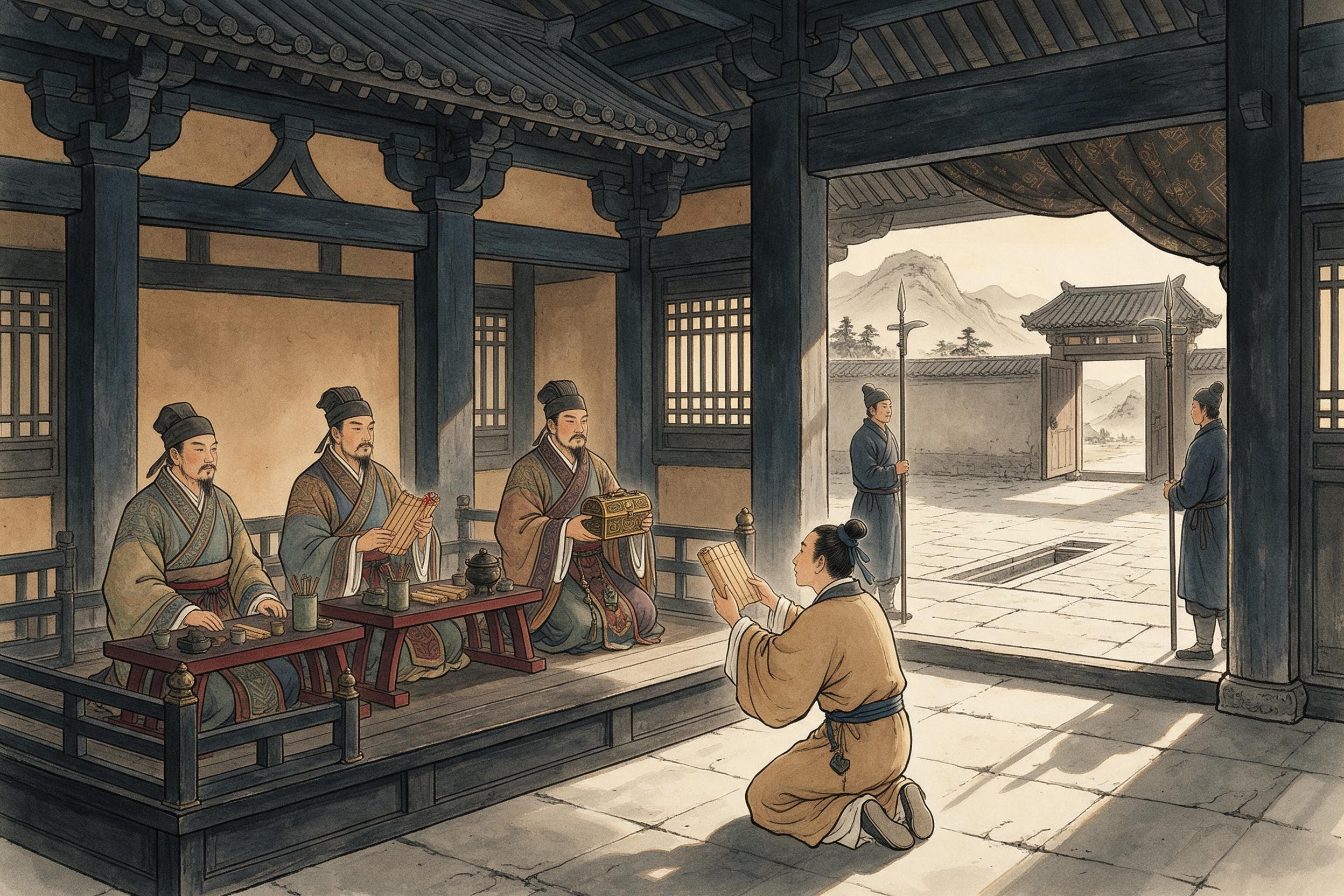
The skeleton of the Qin system is one sentence: 'the realm was divided into thirty-six commanderies, and each commandery set up a governor, a commandant and an inspector' (分天下以為三十六郡,郡置守、尉、監). Three office names in one line, with no duties and no ranks. Duties and ranks are in another book, where the Book of Han's table of officials works through them one by one: 'such-and-such office, a Qin office, in charge of such-and-such, rank so much'. This article follows the two pages for the three offices and the county level; the number and list of commanderies belong to another piece, no organisation chart is drawn, and no establishment figures are inferred.
Thirty-Six Commanderies, Three Offices
The Shiji in the twenty-sixth year: 'the realm was divided into thirty-six commanderies; each commandery set up a governor, a commandant and an inspector; the people were renamed the black-headed' (更名民曰黔首). The number is given, the names are not; the three offices stand side by side with no precedence and no statement of who answered to whom. Only the three names are followed here; the list of commanderies is a separate subject.
The Book of Han's entry for the commandery governor: 'The commandery governor is a Qin office, governs his commandery, rank two thousand shi. There is a deputy; in frontier commanderies there is also a chief of staff, who controls troops and horses, both at six hundred shi. In the second year of the middle era of Emperor Jing the title was changed to taishou' (郡守,秦官,掌治其郡,秩二千石。有丞,邊郡又有長史,掌兵馬,秩皆六百石。景帝中二年更名太守). Four things at once: it is a Qin office; its charge is 'to govern the commandery'; the rank is two thousand shi; the deputy and the frontier chief of staff are at six hundred; and under Jing the name became taishou. All printed, with no translation into later official titles.
The Commandant: Assisting the Governor
The commandant's entry: 'The commandery commandant is a Qin office; he assists the governor and controls the military offices and armoured troops; rank equivalent to two thousand shi. There is a deputy, also at six hundred shi. In the second year of Jing's middle era the title was changed to duwei' (郡尉,秦官,掌佐守典武職甲卒,秩比二千石。有丞,秩皆六百石。景帝中二年更名都尉). 'Assists the governor' states the relation; 'controls the military offices and armoured troops' the charge; the rank is 'equivalent to two thousand shi', one step below the governor; there is a deputy at six hundred; the name later became duwei. The table adds: 'the pass commandant was a Qin office; the agricultural commandant and the commandant for dependent states were both first set up under Emperor Wu' (關都尉,秦官。農都尉、屬國都尉,皆武帝初置) — three items side by side, of different dates.
Between governor and commandant the pages give only this: one 'governs the commandery', the other 'assists the governor and controls the military offices and armoured troops'; one is two thousand shi, the other equivalent to two thousand. Who raised troops, who held judicial power, how the two divided the work — the table does not say, and nothing is supplied here.
The Inspector: Supervising the Commanderies
The 'inspector' of the Shiji's sentence appears in the Book of Han as the supervising censor: 'The supervising censor is a Qin office; he supervises the commanderies. The Han abolished it; the chancellor sent secretaries to inspect the provinces separately, not as a standing post' (監御史,秦官,掌監郡。漢省,丞相遣史分刺州,不常置). The charge is three characters: 'supervise the commanderies'. The Han abolished it, and later, in the fifth year of Yuanding, Emperor Wu 'first set up regional inspectors, to inspect the provinces under the clauses of an edict', at six hundred shi, thirteen of them; under Emperor Cheng the title became shepherd at two thousand shi, and under Emperor Ai it changed back and forth. That sequence is Han business, marked as such; what rank the Qin inspector held, the table does not give.
The County: Magistrate and Head
At the county level the table divides by households: 'The county magistrate and the county head are both Qin offices, governing their counties. Above ten thousand households there is a magistrate, rank one thousand to six hundred shi. Below ten thousand there is a head, rank five hundred to three hundred shi. Both have deputies and commandants, rank four hundred to two hundred shi, and these are the long officials. Below a hundred shi are the dou-shi and zuo-shi ranks, and these are the minor officials' (縣令、長,皆秦官……是為少吏). The line is drawn at ten thousand households, and nowhere else.
Below the county are the ting and the xiang: 'roughly every ten li there is a ting, with a ting head; every ten ting a xiang, with the three elders, the salaried headman, the sefu and the patrol officer. The three elders have charge of teaching; the sefu hear lawsuits and collect taxes; the patrol officer goes the rounds to stop thieves. A county is roughly a hundred li square; where people are dense it is reduced, where sparse enlarged, and the xiang and ting likewise — all Qin institutions' (皆秦制也). The table then gives late-Han totals: counties, marches, fiefs and towns 1,587; xiang 6,622; ting 29,635. Those are statistics at the table's end, after the Han system; they are recorded here in one sentence and not taken as Qin figures.
What Neither Page Gives
Neither page gives the establishment of a commandery, the numbers or appointments of governors, commandants and inspectors, the rank of the commandery inspector, the detailed relation between commandery and county, or the division of powers between governor and commandant. At the table's end there is one more line: 'the officials from zuo-shi to chancellor, 130,285 men' — that is a Han total, not a Qin one, recorded here in a sentence and not used to infer Qin numbers. Qin administrative documents and appointment cases belong to another piece and are not in this one.
Nor is any general account of a mature bureaucracy offered, nor any comparison with later offices (governor equals prefect equals provincial chief), nor an organisation chart. Names and renamings (Jing's second year of the middle era, and the rest) are printed as they stand; what the pages lack is not supplied.
What can be written is this: one sentence with three office names; the governor 'governs his commandery' at two thousand shi; the commandant 'assists the governor and controls the military offices and armoured troops' at the equivalent of two thousand; the supervising censor 'supervises the commanderies', abolished under the Han; counties divided into magistrates and heads at ten thousand households; and ting and xiang with their three elders, sefu and patrol officer. Who reported to whom, how they were assessed, what went into the annual accounts — neither page says.
Related reading:When Coins Ran Short: Small Coins and a Proposal to Abolish Money · The State's Bookshelf: Four Editors, Six Divisions, and a Grand Total · Royal Fields and Private Dependants: Slaves and Two Edicts in Han China
Sources & further reading
- 《史记》卷六·秦始皇本纪(西汉司马迁撰;维基文库本,页面白文无注,未与中华书局点校本复核) — The twenty-sixth year: 'the realm was divided into thirty-six commanderies, and each commandery set up a governor, a commandant and an inspector' (分天下以為三十六郡,郡置守、尉、監); the people were renamed 'the black-headed'. One sentence gives the three offices and nothing more — no duties, no ranks, no numbers.
- 《汉书》卷十九上·百官公卿表上(东汉班固撰;维基文库本,页面白文,〈〉内为录文夹注,未与中华书局点校本复核) — The table's entries, each opening 'a Qin office': the commandery governor 'governs his commandery, rank two thousand shi', with a deputy and, in frontier commanderies, a chief of staff for troops at six hundred shi, renamed governor (taishou) under Emperor Jing; the commandery commandant 'assists the governor and controls the military offices and armoured troops, rank equivalent to two thousand shi', renamed commandant (duwei) under Jing; the supervising censor 'a Qin office, supervises the commanderies, abolished under the Han', later replaced by the regional inspectors; and the county magistrate and head, 'both Qin offices, governing their counties', with counties above ten thousand households under a magistrate at one thousand to six hundred shi and smaller ones under a head at five hundred to three hundred shi, both with deputies and commandants, down to the minor staff; then the ting and xiang officers and the Han totals for counties, xiang and ting, 'all Qin institutions'.