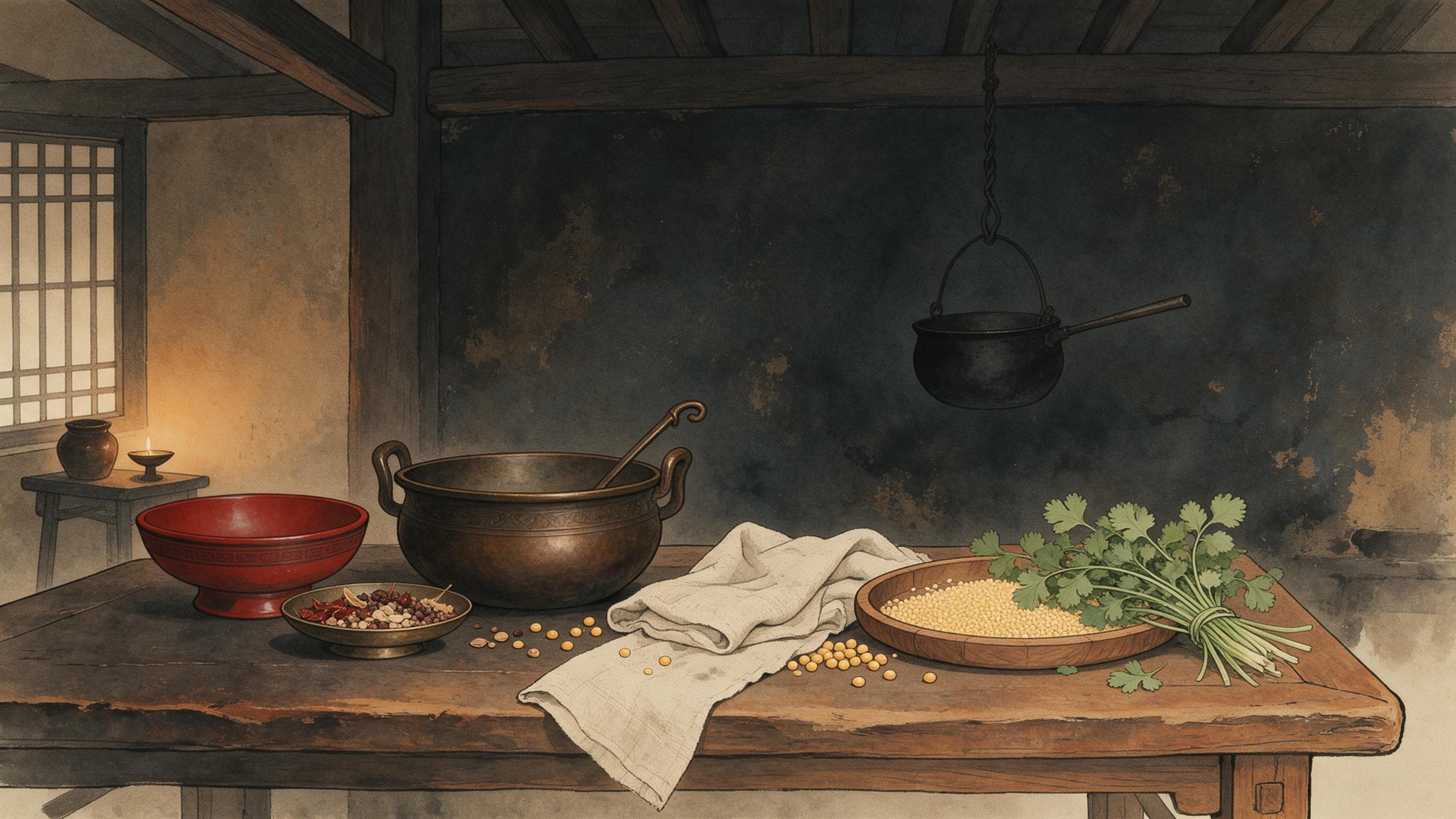
The first entry in the 'Precious and Strange Dishes' section of the Yinshan zhengyao is a soup. Mutton, one leg, cut into pieces; tsaoko, five; cassia bark, two mace; hui-hui beans, half a sheng, crushed and peeled. Boil them together into a broth, strain it, then add cooked hui-hui beans, two ge; fragrant rice, one sheng; ma-si-da-ji, one mace; a little salt, mixed smooth; then the pieces of meat and coriander leaves. Above the recipe, four characters give the purpose: 'tonifies, warms the middle, settles the qi.' The dishes further down the list run through venison, bear, wolf, wild goose, duck, carp, turtle and quail.
How a recipe is written
The section is uniform. Each entry states its effect, then its ingredients with quantities, then its method. 'Barley soup', for instance: 'warms the middle and lowers the qi, strengthens spleen and stomach, stops restlessness and thirst, breaks cold qi, removes bloating'; one leg of mutton, five tsaoko, two sheng of barley kernels; boil to a broth, strain, add the barley, cook until done, a little salt. The measures are a fixed set — leg, piece, jin, liang, mace, sheng, ge — and the verbs are a fixed set too: boil, strain, add, stir-fry, deep-fry, steam. The venison soup shows how far the pattern can travel: deer head and feet, one set, washed and cut into pieces; ha-xi-ni pounded to a paste the size of a bean and mixed in; four liang of hui-hui oil to fry it; then boiling water, pepper, ha-xi-ni, bi-bo, a cup of cow's milk, a ge of ginger juice and salt.
Many entries begin the same way: one leg of mutton, five tsaoko, half a sheng of hui-hui beans. The ma-si-da-ji soup does; so do the ba-er-bu soup, the sha-qi-mou-er soup, the quince soup, the pine-yellow soup, the chao soup. It looks like a base broth with variations built on it — but the book never uses the word 'base broth'. That reading is this article's inference, not the text's. The venison soup drops the beans; the pine-yellow soup keeps them and adds a cooked sheep's breast, pine-pollen juice and ginger juice.
Names that say where they come from
Some dish names explain themselves. Under the ba-er-bu soup the text notes: 'a Western-Heaven tea-rice name.' The sa-su soup carries the same note; the shuo-luo-tuo-yin is marked 'a Uyghur tea-rice'; the tu-tu-ma-shi is 'hand-pulled noodles'; the ma-qi is 'hand-rolled noodles'. Elsewhere the names carry 'Hexi', the region west of the Yellow River. These notes are the book's own, not a later editor's. The sa-su soup is also marked 'Western Heaven'; its base is two legs of mutton, a head and feet, four tsaoko and three liang of cassia, with ginger and ha-xi-ni. Hexi returns in 'Hexi lung': a sheep's lung stuffed with chive juice, a flour paste, butter, pepper and ginger juice, boiled and served with its own juice.
The ingredients include a group of transliterations: ma-si-da-ji, za-fu-lan, ha-xi-ni, hui-hui beans. For some of them the book supplies a Chinese name of its own — sha-qi-mou-er is glossed 'turnip', ku-dou as 'fenugreek' — but for ma-si-da-ji, za-fu-lan, ha-xi-ni and the hui-hui beans it gives no gloss. This article does not fill the gap: what the book does not identify, it does not identify. The glosses it does give are small and practical — turnip, fenugreek, hand-pulled noodles: a court kitchen explaining itself to itself.
Who the book was for
The Qing catalogue is clear about the office behind it. Hu Sihui — rendered 'He-shi-hui' in the Siku edition — was an imperial diet physician. The founder of the dynasty established four such physicians; their task was to select from the materia medica those flavours that are 'non-toxic, not mutually antagonistic, safe for long use and beneficial', to harmonise them with food and drink, and to blend the five flavours. For each day's dishes, 'who cooked it and what was used' was to be 'noted in a register, so that the results could be checked'. Hu Sihui was appointed to the post in the Yanyou period.
The book opens with a submission memorial dated the third year of Tianli, 1330, and runs to three juan. The first is the dish list; the others cover health taboos, pregnancy and nursing, and drinking. This article stays with the first juan: it is a recipe collection, not a day-by-day menu of the Yuan court. The three juan are not one genre: the first is recipes; the others are rules about what not to eat, and when.
The numbers on the list
The numbers are kitchen numbers: one leg of mutton; five tsaoko; two mace of cassia; half a sheng of beans; one sheng of fragrant rice; one mace of ma-si-da-ji; one or two mace of za-fu-lan; half a mace of ha-xi-ni; one or two liang of pepper; three jin of bean flour; six jin of wheat flour. Weight in jin, liang and mace; volume in sheng and ge; count in pieces and legs. The figures say how much goes into a pot; they do not say how many people eat from it. In 'grilled sheep's heart', za-fu-lan is steeped in rose water and brushed over the heart as it turns above the fire, with a little salt; the dish is prescribed for palpitations and low spirits.
The limits: weights are not converted into grams; no serving number is given, because the book gives none; no judgement is made about how the food tasted; these are not presented as the emperor's daily meals, because the book is a collection of recipes, not a kitchen ledger; the transliterations are not forced into botanical identifications; modern dishes are not matched to them; no diner or occasion is named in the list; and no edition not read here is quoted. No entry gives a cooking time or a fire temperature; the verbs assume a cook who does not need them.
What it can and cannot tell
What it can tell: in the Yuan there was a book compiled by an imperial diet physician and submitted in 1330; its first juan lists some eighty dishes, each with an effect, ingredients and method; the names and notes preserve origins — 'Western Heaven', 'Uyghur', 'Hexi'; and the physicians were required to record, day by day, who cooked each dish, what went into it and how it was made, for later checking.
What it cannot tell: what ordinary people in the Yuan ate, what the court actually ate each day, whether the dishes were good, or what ma-si-da-ji was. The material is a recipe list and a catalogue entry. It offers the grammar of one kitchen, not the table of a whole age. The register is the missing link: the recipes say what went in, and the catalogue says a register recorded who made each dish, but no such register survives. That is where this article stops.
Sources & further reading
- 忽思慧《饮膳正要》卷一·聚珍异馔(维基文库本,四部丛刊系统)(Hu Sihui, Yinshan zhengyao, juan 1, 'Precious and Strange Dishes') — The recipe section of a Yuan court dietary manual. Some eighty dishes, each headed by its stated effect and then its ingredients and method. The first is 'Ma-si-da-ji soup': one leg of mutton cut into pieces, five tsaoko, two mace of cassia, half a sheng of hui-hui beans, boiled and strained, then cooked beans, fragrant rice, mastic and coriander. Several dishes name their origin: 'a Western-Heaven tea-rice name', 'a Uyghur tea-rice', 'hand-pulled noodles'; the text itself glosses some transliterations (sha-qi-mou-er is turnip; ku-dou is fenugreek) but leaves others unexplained.
- 《四库全书总目提要》卷一百十六·子部·谱录类存目·饮膳正要条(清纪昀等)(Siku quanshu zongmu tiyao, juan 116, entry on Yinshan zhengyao) — Qing catalogue entry: He-shi-hui (the Siku rendering of Hu Sihui) was an imperial diet physician; the founder of the dynasty established four such physicians; they were to choose from the materia medica flavours that are non-toxic, not mutually antagonistic, safe for long use and beneficial, and to harmonise the five flavours with food and drink; for each day's dishes the cook, the ingredients and the preparation were to be noted in a register so that results could be checked. The book has a submission memorial dated the third year of Tianli and runs to three juan.