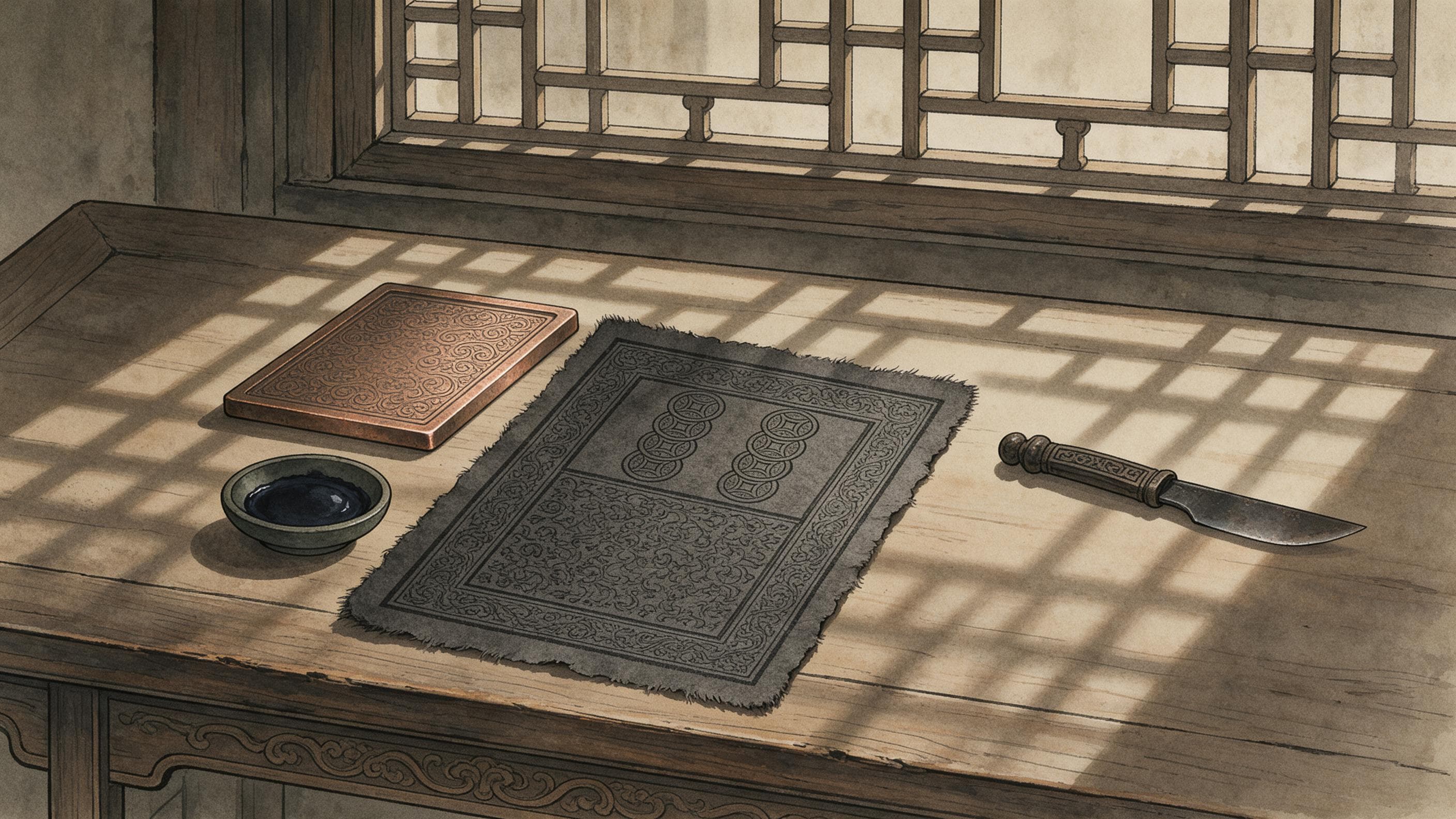
The note in the National Museum of China is a dark, dusty grey — grey enough that people called this money chu bi, 'paper-bark currency', after the mulberry tree it was made from. In the middle of the upper panel the denomination reads two guan, two thousand cash, with two strings of coins printed beneath it. Across the top runs Zhiyuan tongxing bao chao, the Zhiyuan treasure note 'current in all circuits'. Down either side the same words appear in the Phags-pa script. Further down come the two sentences that did the guarding: five ingots of silver to whoever informs, death to the forger.
From mulberry bark to a copper plate
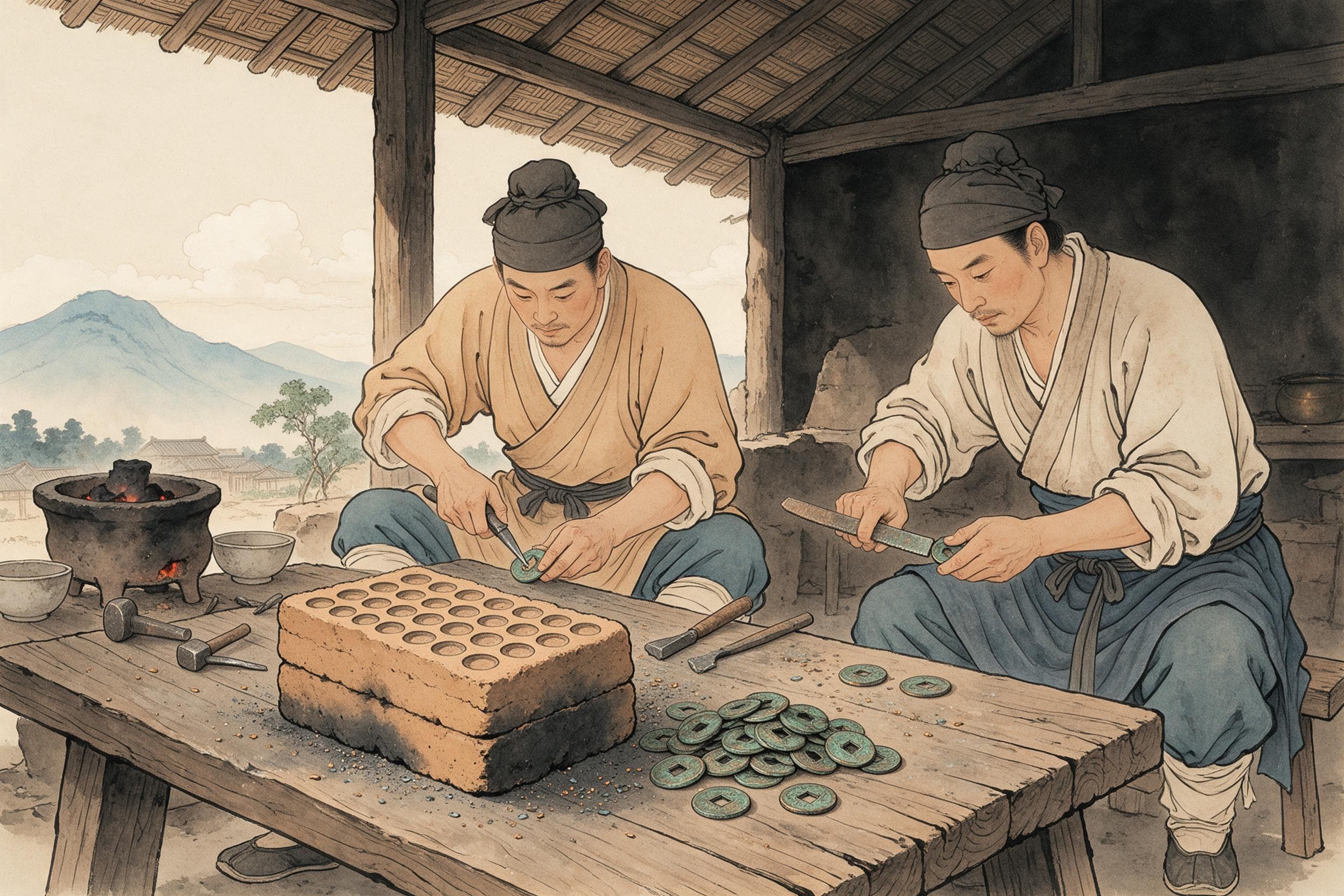
According to the Yuan shi, the history compiled in the early Ming, the Yuan's first paper money was issued in 1260, the first year of Kublai's Zhongtong reign. The jiao chao was declared 'based on silk': fifty liang of silver bought a thousand liang of silk notes — the note being a unit of account, not a weight of raw silk. In the tenth month came the Zhongtong yuanbao note in nine denominations — 10, 20, 30 and 50 cash, 100, 200 and 500 cash, one and two guan — with one guan equal to one liang of the earlier note and two guan to one liang of silver. The plates were wood at first; in 1276 the government cast copper ones.
Printing and price-keeping were separate offices. In 1264 every circuit got a pingzhun ku, an equalising treasury, ordered to hold prices steady — 'so that goods answer to one another and do not swing high and low' — and funded with twelve thousand ingots of notes. In 1275 a small denomination, the li chao, was added and dropped three years later. Paper was the last link in the chain: bark, a grey sheet, a copper plate, an official treasury.
A death sentence printed on the money
The lower half of a Zhiyuan note is ten lines of Chinese that read like a government order. The Secretariat has memorialised and been permitted to print Zhiyuan notes, to be taken alongside tax and service payments, without limit of years, current in all circuits; then the clerks of the note treasury and the printing treasury; then the sentence — whoever informs first shall have five ingots of silver, the forger shall be put to death, and his household property shall go to the informer; then the year, the month and the deputies. The first defence against forgery was not a hidden mark. It was printing the reward and the death sentence where every holder would see them.
Behind the paper stood a penal chain that reached past the forger. The Yuan shi chapter on law lists it: for forging notes, everyone in the plot — ringleader, plate-cutter, the man who buys the paper, the man who buys the pigment, the man who fills in the serial numbers — 'all shall be put to death, and their household property confiscated'. Two neighbours who knew and said nothing: seventy-seven strokes. The ward head, the street chief, the village head who failed to notice: forty-seven strokes each. The arresting officer: thirty-seven. Passing a forged note: 107 strokes on the first offence, a year of penal labour on the second, exile on the third. A captor got five ingots of silver, paid 'in silver, not in notes'. Father and son forging together both died; a father who forged while his son merely carried things did not drag the son down; a wife was not punished for her husband. This is a list of statutes, not a case file: no date, no place, no names.
What one note was worth
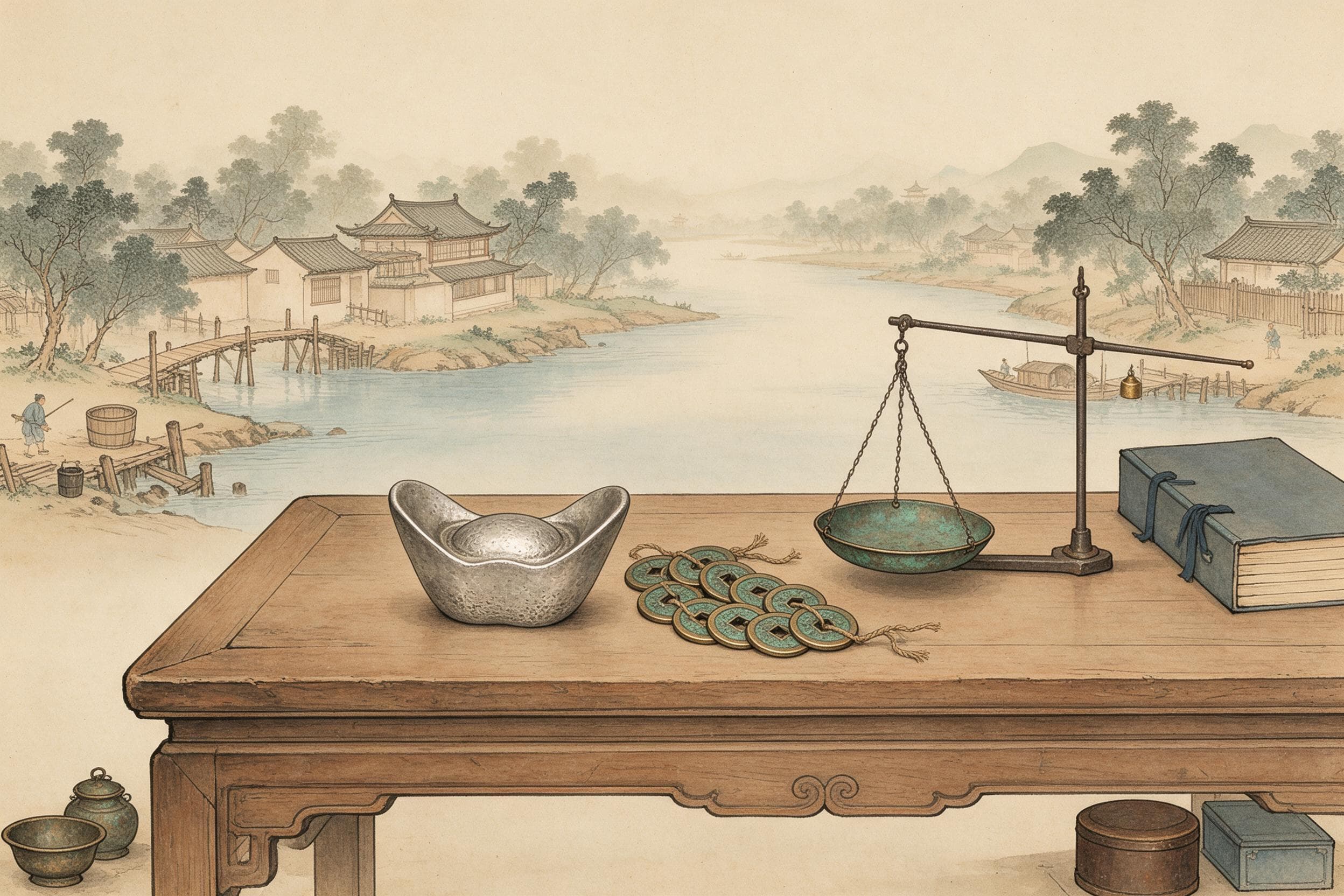
Three issues, three conversions. Two guan of Zhongtong notes made one liang of silver. In 1287 the Zhiyuan note took over in eleven denominations from two guan down to five cash, one guan of new money to five of the old. In 1309 came the Zhida silver note in thirteen denominations: one liang to five guan of Zhiyuan notes, to one liang of silver, to one tenth of a liang of gold. 'The note law changed three times,' the history says. By 1350, when Zhizheng notes replaced it, more than thirty-six million ingots had been issued.
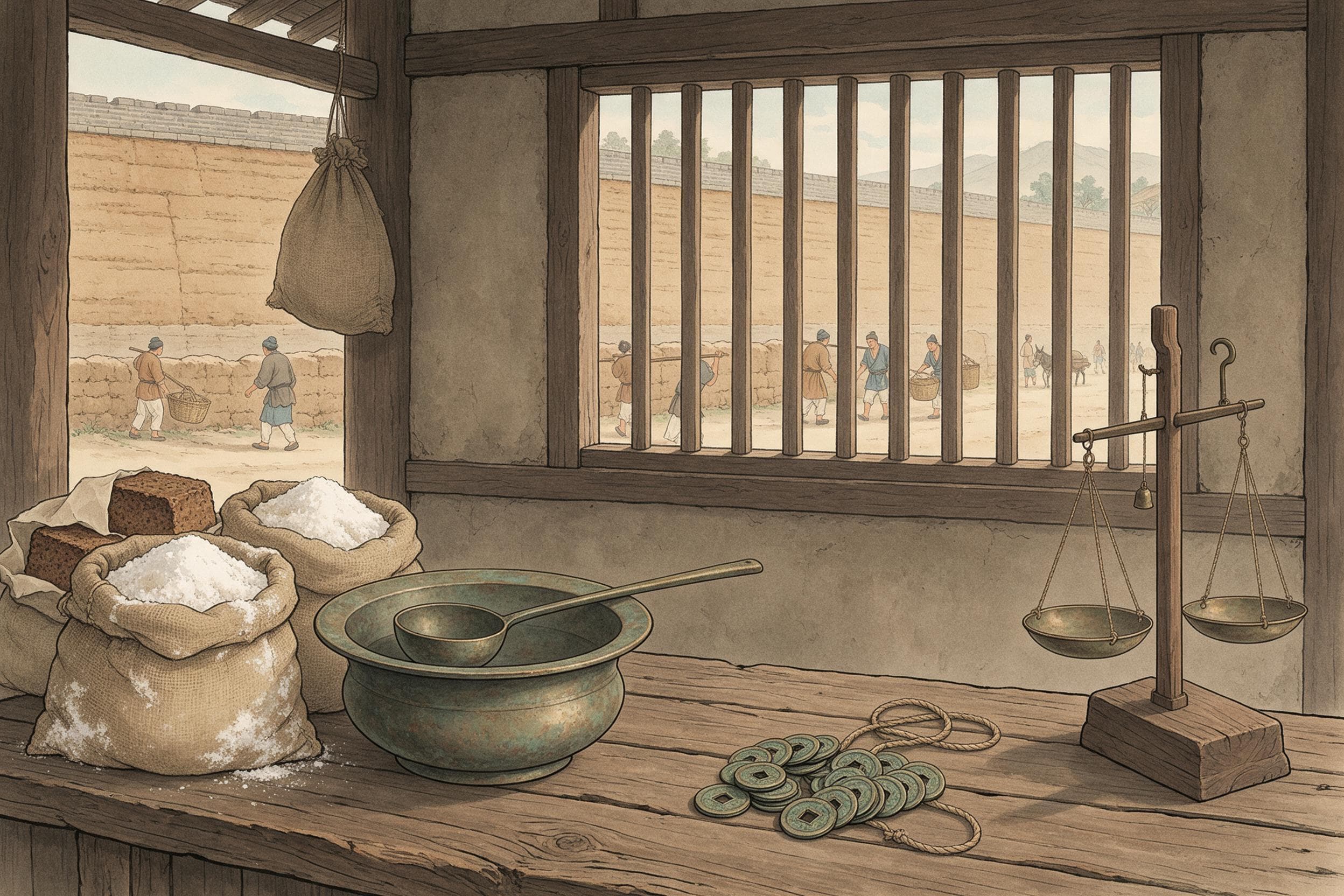
The treasuries also posted two-way prices. In 1287: 'For each liang of flower silver, the price on deposit is two guan of Zhiyuan notes, the price on withdrawal two guan and five fen; for each liang of red gold, twenty guan on deposit, twenty guan five hundred cash on withdrawal.' The same liang of silver is worth one amount going in and another coming out, with a margin between them. Who took that margin, and how it was booked, the source does not say. It gives the prices and stops there.
What to do with a worn-out note
Notes wore out. In 1265 officials were sent to the note treasury to exchange worn ones for new, deducting thirty cash for ink and labour; in 1266 the fee fell to twenty; in 1285 it went back up. A note whose strings and hundreds were still legible, merely a little damaged, had to be accepted, and refusing one was an offence. The old notes could not simply be kept: each quarter the tax officials of every circuit carried them to the provincial ministry to be burned. In 1298 the Board of Revenue sorted worn notes into twenty-five grades; in 1327 the burning places were fixed, with a surveillance commissioner in attendance.
What those twenty-five grades were, this piece has no source for, and says so rather than inventing them. Nor does it convert the thirty-cash fee into modern money: there is no reliable price series in these sources. What can be said is that the system had an after-sales department. Printing the note was the easy part; the note had to be exchangeable, burnable, and burned under supervision.
Why the paper stopped being worth what it said
Three conversions, one reason, recorded in four characters: wu zhong chao qing, goods heavy and notes light. By 1287 a Zhiyuan guan was set at five Zhongtong guan; by 1309 a Zhida liang at five Zhiyuan guan — and that, the history says, was 'too many multiples, weight and lightness out of balance', so the silver note was abolished within a year of the next emperor's accession. The printing totals jumped from 73,352 ingots in 1260 to 2,181,600 in 1286; by 1302 they stood at 2,000,000. These are ingots printed each year, not the stock in circulation: nothing is subtracted for the worn notes called in and burned.
'Goods heavy, notes light' is description, not a price. This piece therefore gives no figure for a dou of rice, because there is none in the sources. Coins were tried once, in 1310, and dropped the next year; gold and silver could still be bought and sold at the treasuries. The Yuan shi opens its chapter on the note law by saying that paper money began with the Tang flying money, the Song jiaozi and the Jin notes — the dynasty that printed the most did not claim to have invented it. What remains is a gap. The penalties for forgery reached into the neighbours' houses; what emptied the note was the press. The law could police private plates. It could not police the government's own.
Sources & further reading
- 《元史》卷九十三·食货一·钞法(明初宋濂等修;维基文库本,未与中华书局点校本复核) — Zhongtong notes of 1260 in nine denominations, two guan to a liang of silver; equalising treasuries funded with 12,000 ingots in 1264; wooden plates replaced by copper in 1276; Zhiyuan notes from 1287 in eleven denominations at five to one; treasury buying and selling prices for silver and gold; worn-note exchange fee and quarterly burning; the annual printing totals. Ming compilation, not a Yuan primary text.
- 《元史》卷一百五·刑法四·诈伪(明初修;维基文库本,未与中华书局点校本复核) — The penal chain for forged notes: conspirators put to death and property confiscated, neighbours who keep silent beaten, ward heads and village chiefs punished, users of forged notes in escalating grades; five ingots of silver reward, paid in silver and not in notes. Statute text, not a case record.
- 中国国家博物馆藏品页〈至元通行宝钞〉(馆方撰文:陈煜) — Object description of a Zhiyuan note: mulberry-bark paper, dark grey, hence the name 'paper-bark currency'; denomination two guan; Phags-pa and Chinese inscriptions; the ten lines of text including the informer's reward and the death penalty; 36.18 million ingots issued to 1350. Museum description; its evaluative remarks are not used.