The coin cast in 1653 carries two characters on its back: li, one thousandth. A li was a thousandth of a liang of silver, so one coin was worth a thousandth of a liang, and a thousand coins made one exactly. That was not a market quotation but a rate the state had fixed and stamped on the metal, so that anyone holding the coin could read it without asking a money-changer. The rate held, broadly, from the 1640s to the 1850s; what the market actually gave over the same years is the other half of the story.
The official rate: a thousand cash to the liang
According to the Huangchao wenxian tongkao, the Shunzhi coinage of 1645 was set at 1.2 qian in weight, seven coins to a fen of silver; in 1647 the rate was changed because the coins were heavy and small transactions awkward, to ten coins to a fen, 'to be the standing rule'; in 1651 a hundred cash counted as a tenth of a liang; in 1653 the li-marked coin fixed a thousand to one liang. It was the wording of 1647 — to be the standing rule — that let the figure outlast the reign which set it. The Qingshi gao puts the change to ten coins inside 1645; the tongkao dates it to 1647, and the two are cited separately here. Seven cash to a fen works out at 700 to a liang, ten at 1,000; the change of 1647 took the figure from 700 to 1,000.
The weight kept changing too: one qian in 1644, 1.2 in 1645, 1.25 in 1651, 1.4 in 1657, back to 1.2 in 1747. The Da Qing huidian gives the Qianlong standard as 'two zhu eighty-eight shu, eight fen across', and the alloy was fixed at seven parts red copper to three of white in the Qingshi gao. Qian and fen here are weights, not values: the coin weighed a qian, it was not worth a qian. A heavier coin held more metal, which is what made the next problem.
The market: three points
What the market gave was another matter. Late in Kangxi's reign, a liang bought 880 down to 770 cash; in 1748 the capital's coin was so dear that 'a liang bought only 800', and the treasury released coin from a store to steady it; in 1837 'a liang often fetched 2,000'. Three years, three figures — one late in Kangxi, one in 1748, one in 1837 — with no year recorded in between. The Kangxi entry is a range, not a single figure.
The points belong in their own column. The official rate did not move; the market went from 770-880, to 800, to 2,000. They are three separate records from different years, not a continuous series and not a statistic. Why it moved, the sources do not say. 'Silver dear, cash cheap' describes the price, it does not explain it; the reasons usually offered for the run to 2,000 — silver leaving the country, the opium trade — are not in these sources, and this piece does not supply them. Nor is it a national average: records like these are capital prices kept by officials.
Where the cash came from: sixty-one mao a year
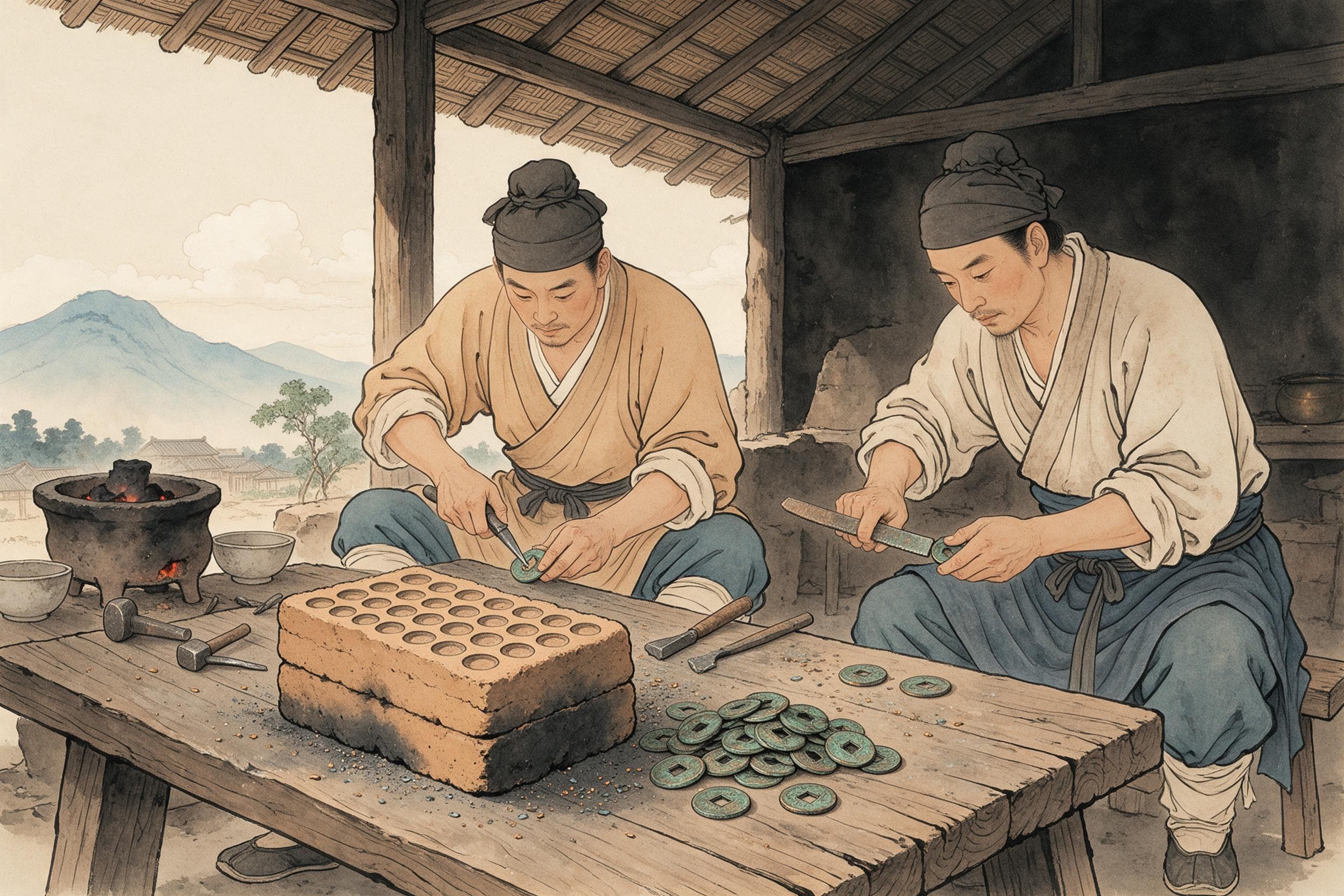
According to the Da Qing huidian, the Baoquan mint in the capital cast 'sixty-one mao a year', each mao 12,480 strings, making 761,280 strings; in a leap year four more mao were added, 49,920 strings. A mao is a batch, the mint's production quota, not a denomination. The books count it differently: the Qingshi gao has 2,000 strings to a mao and thirty mao a year, the huidian 12,480 strings and sixty-one, so the two totals cannot be compared at all. Only the huidian is used for output here. Fourteen provinces were licensed to cast as well, though their output is unknown.
The copper came from Yunnan: 5,704,000-odd catties a year, in six shipments, fourteen months from despatch to the capital; white lead 3,841,914 catties, black lead 700,571, tin a little over 211,000. The lead and tin went into the alloy, the copper into the body of the coin, and the six shipments and fourteen months are a schedule on which the mint's year depended. These are the capital mint's requirements, not national output: no province's output is recorded, and neither is any national total. The supply began not with the mint's will but with whether Yunnan's copper arrived on time.
Why the weight kept being changed
The Qingshi gao states the logic: 'heavy coins get melted down, light ones get counterfeited.' The restoration of the 1.2-qian standard in 1747 and the dear coin of 1748 are that see-saw working. The penalties were severe: ringleader and craftsmen sentenced to beheading (immediate in the gao, deferred in the tongkao), accomplices and knowing buyers to deferred strangling, an informer fifty liang of silver. The huidian ranks the prohibitions in five grades: destroying coin, private casting, clipping the edges for metal, using old demonetised coin, and small private coin — each naming a way of turning a coin back into metal or into more coins. Statutes, not cases: no date, place or name. Clipping the edges needed no furnace, only shears.
In 1853 a separate set of rates appeared: a note for one liang of silver against 2,000 cash, notes of 2,000 against a liang; big coins from 1,000 down to 10 in five grades, weighing from two liang down to 4.4 qian. These were official rates for notes and big coins, not a new rate for the standard cash, which still stood at a thousand to the liang. What the market gave that year is not recorded. The heaviest of the five was marked a thousand.
Two lines, two centuries
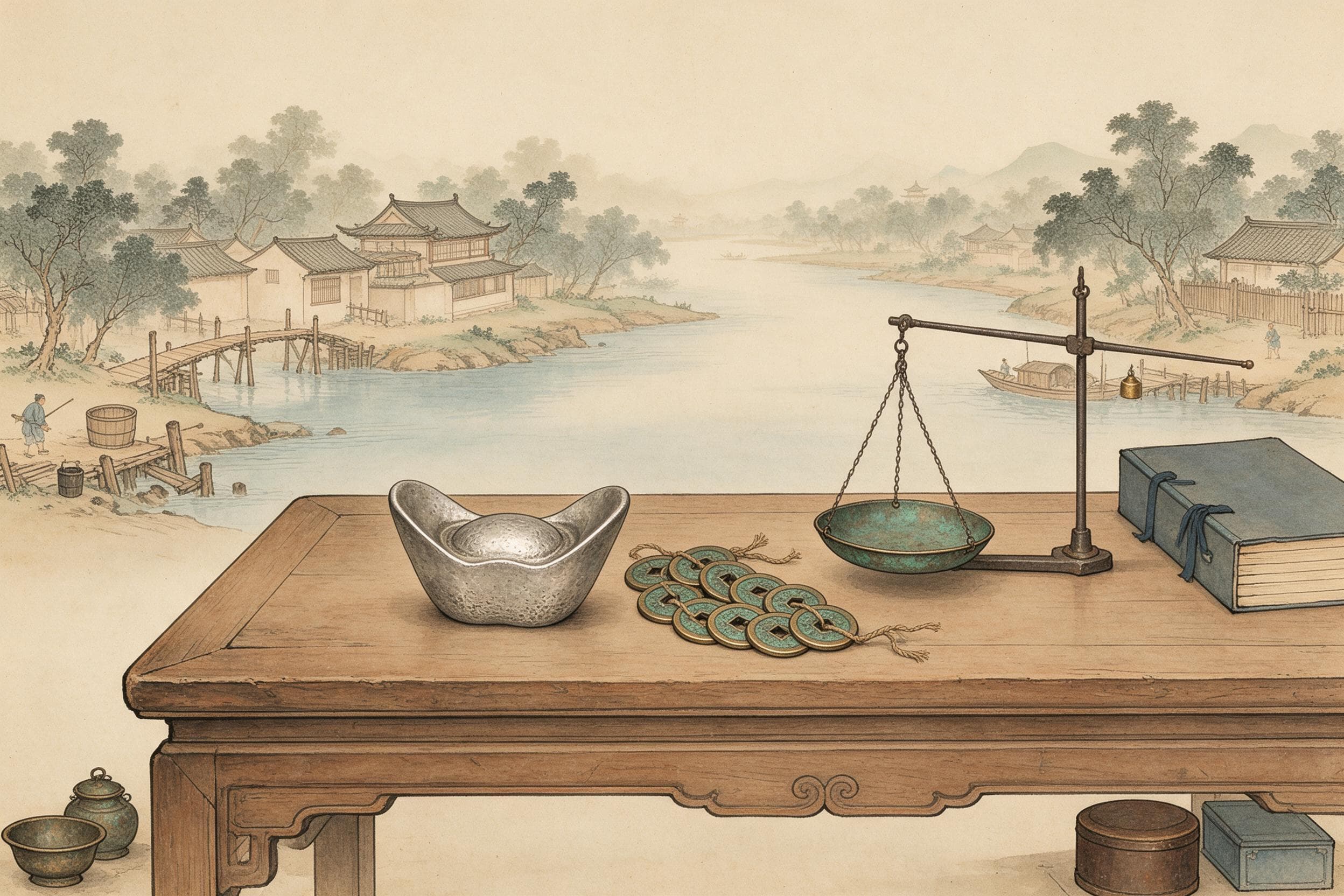
Set the columns side by side. The standard cash's 1,000 to the liang was set in 1647 and stamped on a coin in 1653, and stood for two centuries; in 1853 a separate official rate set one liang of notes at 2,000 cash, which was a rate for paper, not a change in the coin's. The market went 770-880 under Kangxi, 800 in 1748, 2,000 in 1837. Two centuries is not a trend line but two records: what the state decreed, and what the market took. The official rate lived on a character on the back of a coin, the market rate in the year's accounts.
What the sources cannot give is stated too: no national mint output, no provincial figures, no continuous price series, no regional spread, no price of copper or silver itself — only one mint's mao and three years of market prices, which are not enough to draw a curve through. Nothing here is turned into modern purchasing power, no law of inflation is drawn, and no Ming or Republican comparison is borrowed to fill the gaps. One line official, one line market; each went its own way.
Sources & further reading
- 《清史稿》卷一百二十四·食货五·钱法(民国赵尔巽等修;维基文库本,未与中华书局点校本复核) — Republican-era compilation, not a Qing primary text. Shunzhi coin weights and the rate of seven coins to a fen; late Kangxi 880 to 770 cash to the liang; 1748 'only 800' in the capital; 1837 often 2,000; the Xianfeng notes at 2,000 cash to the liang and the five grades of big coins; the private-coining statutes and the fifty-liang reward.
- 《皇朝文献通考》卷十三·钱币考一(清乾隆官修;四库全书本,未与点校本复核) — Qing official compilation, Siku edition. The official rate year by year: 1644 the coin at one qian; 1645 1.2 qian and seven to a fen; 1647 ten to a fen 'to be the standing rule'; 1651 1.25 qian and a hundred cash to a tenth of a liang; 1653 the li-marked coin at a thousand to the liang; 1657 1.4 qian; the private-coining statutes.
- 《钦定大清会典》卷十四·户部·钱法(清乾隆官修;四库全书本,未与点校本复核) — Qing official statutes, Siku edition. The Qianlong coin standard of two zhu eighty-eight shu and eight fen; the Baoquan mint's 61 mao a year at 12,480 strings each, 761,280 strings, plus four mao in a leap year; the annual Yunnan copper, white lead, black lead and tin; the fourteen provinces licensed to cast; the five grades of coin prohibition. The Huidian text for tin reads 「二十一萬千七百十有二斤」, apparently with a character missing; the article gives it as a little over 211,000 catties.