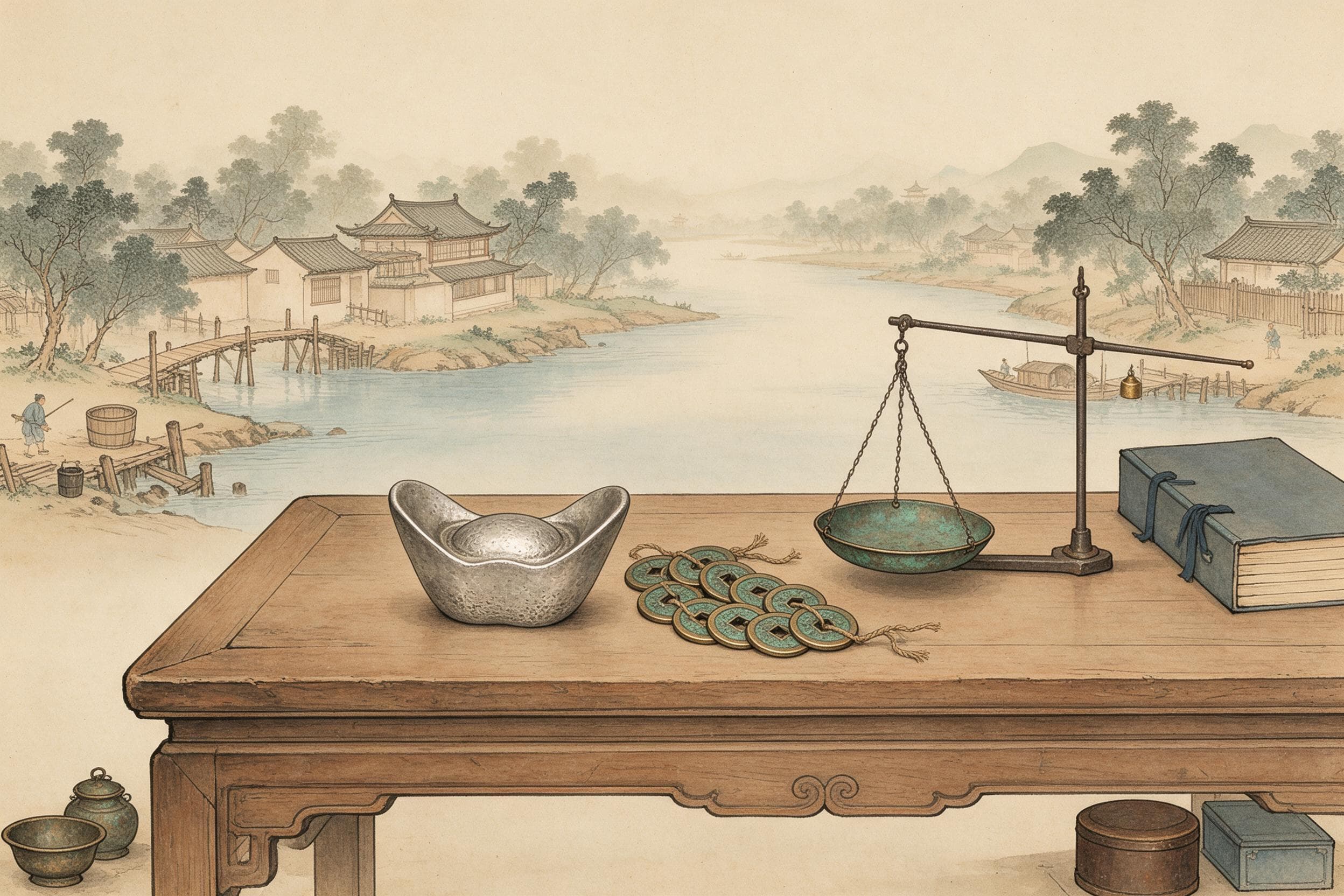
In 924 the Bureau of Revenue put up a notice in every prefecture, county and garrison town: for all buying and selling by soldiers, civilians and merchants, 'eighty to the hundred' — eighty cash were to count as a hundred. The notice did not say why eighty. It said that from now on this was the reckoning. A hundred coins strung together was the unit everyone reckoned in, so eighty to the hundred meant the string was to be counted short. It was a rule about counting, not about how much a coin should weigh.
The rule, and the street
The Jiu Wudai shi records that notice. A decree of the same second month added orders: officials were to keep checking that rich households did not hoard cash, that craftsmen did not melt coins into bronze vessels, and that frontier garrisons let no merchant cart money out of the country. Short of money, the state began with hoarding, melting and export, in that order of complaint.
The street had its own arithmetic. In 927 the Bureau of Revenue complained again: in the three capitals, at Ye and in the provincial towns the rule is eighty to the hundred, yet lately the shops and markets 'disregard the rule and convert short hundreds into long money' — passing off short strings at the long rate. The order was repeated: eighty to the hundred; offenders were to be seized, caged and interrogated, and their money confiscated in full. A string short of its hundred, passed off as a hundred, was exactly what the notice was meant to stop.
The coins went into the melting pot
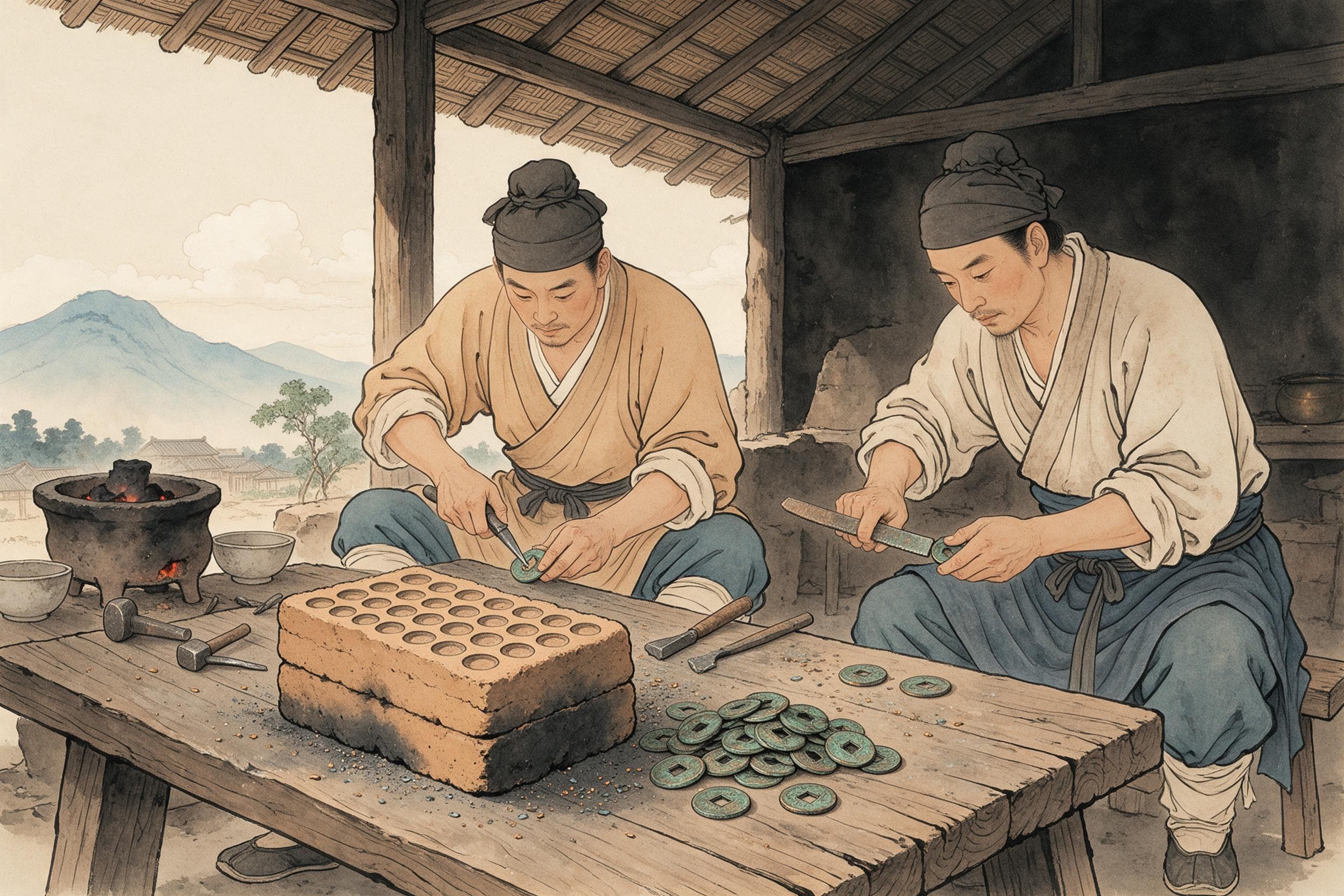
The government recorded the first reason itself: coins were being melted into bronze vessels. In 926 the secretariat reported that bronze vessels were dear 'mostly because cash is being melted down', and a decree fixed the prices: raw bronze vessels at 200 cash a catty, worked bronze at 400, and anyone charging more 'shall be judged under the law on illegal coining'. That November no more than five hundred cash could be carried out through a city gate; that December iron and lead coins were to be destroyed. Bans on base coin followed: iron and lead together in 929, lead alone in 935.
Coining went back and forth. In 938 private and official minting of a 'Tianfu yuanbao' coin was permitted, each coin to weigh two zhu four lei and ten coins to the liang — a standard set by decree, not by the scales of excavated coins; the next year private minting was banned again. In 951 the bronze law let anyone trade in copper but forbade melting cash into vessels on pain of death; the local officer took a year of penal labour, the neighbours' guarantors seventy strokes, and an informer a hundred strings of cash. The state could not stop the melting, so it went after the price of what the metal became.
Buying copper: two official prices
In the ninth month of 955 bronze vessels were banned and the state began buying copper: 150 cash a catty for worked copper, 100 for raw. Mirrors were to be cast officially and sold from a depot in the eastern capital. In 957 the prices rose to 200 and 150 — and the same order changed the catty used for copper from twenty liang to sixteen. In two years the official price of worked copper had risen by a third.
These are official prices, not market ones: each order carries the clause that anyone charging outside them is to be judged under the law on illegal coining. What a catty of bronze actually fetched is not recorded, nor is how the prices were enforced; and nothing here is converted into modern money, because the sources give no price of grain or cloth to convert against.
Salt: taxed by the catty, assessed by the shi
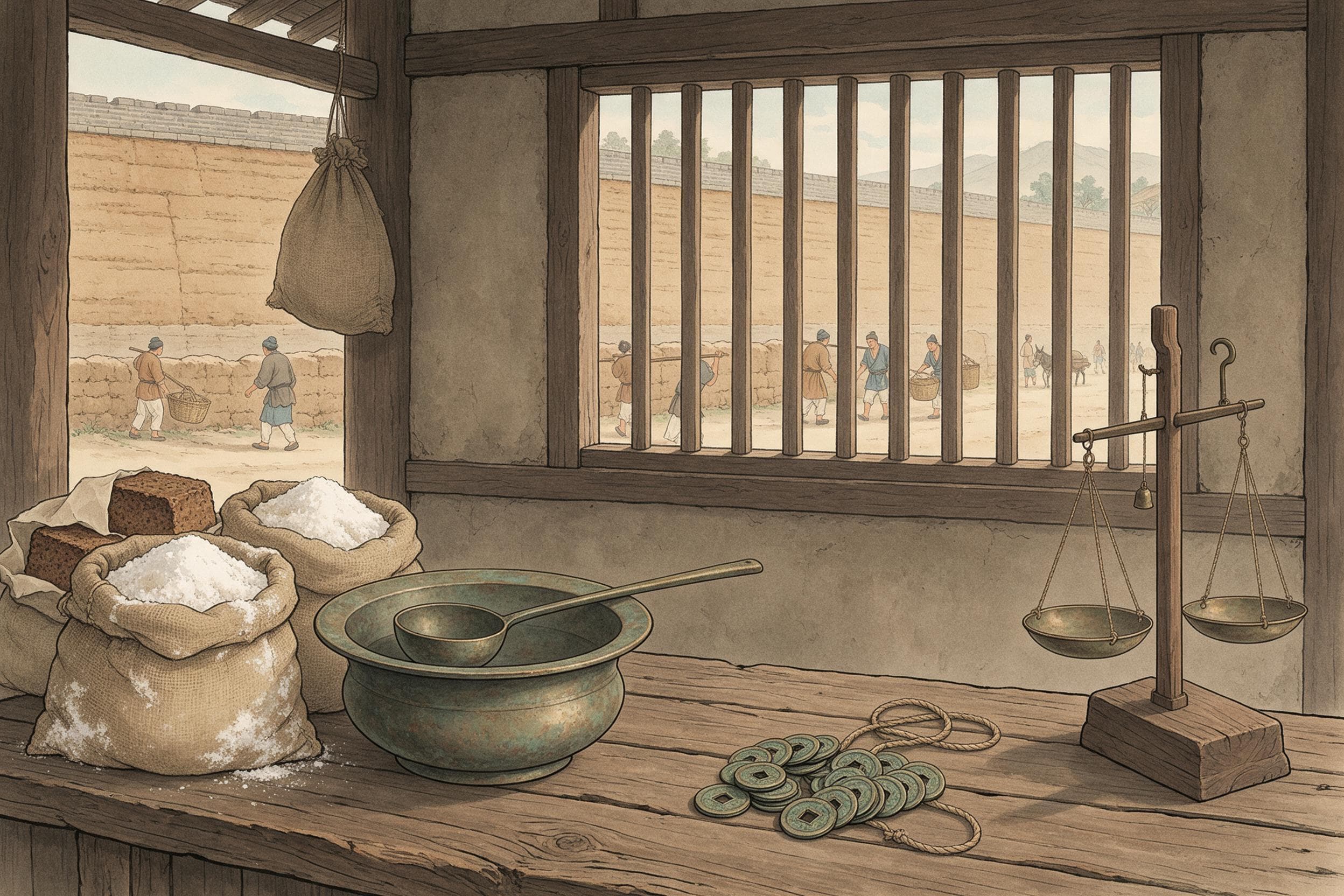
Salt ran on another ledger. In 942 an order taxed all salt in transit: seven cash a catty for goods passing through, ten for goods sold where they stood. The Jiu Wudai shi also gives the trade in Henan and Hebei around the middle of the Tianfu era: the salt offices took in about 170,000 strings a year, and once salt grew cheap it sold for 'no more than twenty cash a catty far from the works, no more than ten near them'. Price and tax sit in the same range — ten to twenty cash a catty against a tax of seven to ten — though the figures come from different years and one region. The 170,000 strings are what the salt offices took in, not a national total, and the price is given as a ceiling — 'no more than' — not as a rate. That is as far as the comparison can be pushed.
Some salt was assessed by the shi. Under Guangshun a shi of green salt paid 800 cash, 'reckoned at eighty-five to the hundred', plus a dou of salt; a shi of white salt paid 500 plus five sheng. The two sources date this differently — the Jiu Wudai shi under the third year of Guangshun, the Wudai huiyao under the second — and each is cited on its own here.
Wine-curd money and farm-tool money, assessed on the acre
The last link is the household's acreage. In 928 an order laid 'five cash an acre for wine-curd money, full hundreds' on the summer and autumn grain land; in 930 two cash were remitted and only three collected; in 931 it was abolished altogether. That same year raw iron was sold 'ten cash a catty less' than before, and villagers paid 'one and a half cash an acre' as farm-tool money on the summer and autumn land. Small sums, both, but assessed on land and on households. The wine-curd levy lasted three years and was abolished; the farm-tool money outlasted it.
Where the money came from, the record never says in full. Following Tang precedent, mints were set up in the south — Yongping at Raozhou, Yongning at Chizhou, Yongfeng at Jianzhou, Baoxing at Hangzhou — each to 'coin money every year', with no figure given for any of them. Men were levied: 55,000 labourers from the capital district rebuilt the outer wall of Kaifeng in 952, 'rammed and finished within ten days'; in 956 more than a hundred thousand built the new outer wall. Households were counted: in 959 the registers came to 2,309,812. Those are the numbers that exist — official prices for copper, so much a catty on salt, so much an acre for wine-curd and tools. Every figure is quoted in its own unit — cash, strings, catties, shi, acres. The mint output and the total revenue do not exist, and the notice of 924 stands in front of that missing ledger — a rule for counting what was not there.
Sources & further reading
- 《旧五代史》卷一百四十六·食货志(宋初薛居正等修;维基文库本,未与中华书局点校本复核) — Order of 924 that all buying and selling use eighty cash to the hundred, with the ban on melting coins into bronze vessels; the 926 decree fixing raw bronze vessels at 200 and worked at 400 a catty; the southern mints named with no output figures; salt prices and the 942 transit and shop taxes; the 800 and 500 cash per shi salt taxes; wine-curd money at five cash an acre; 2,309,812 households counted in 959. Song compilation; the page is marked textquality 50%.
- 《五代会要》卷二十六·盐麴铁城郭、卷二十七·泉货(北宋王溥编;维基文库本) — Two juan of one Northern Song compilation by Wang Pu, not a Five Dynasties archive. Juan 27, on currency: the 927 complaint that the market converts short hundreds into long money, with caging and confiscation; the 938 Tianfu yuanbao coin standard; the 951 bronze law with death for melting cash; the 955 and 957 official copper prices. Juan 26, on salt, wine-curd, iron and walls (https://zh.wikisource.org/wiki/五代會要/卷二十六): the 942 transit and shop salt taxes; salt assessed per shi at eighty-five to the hundred; wine-curd money from 928 to 931; farm-tool money; the 55,000 and hundred-thousand labour levies at Kaifeng.