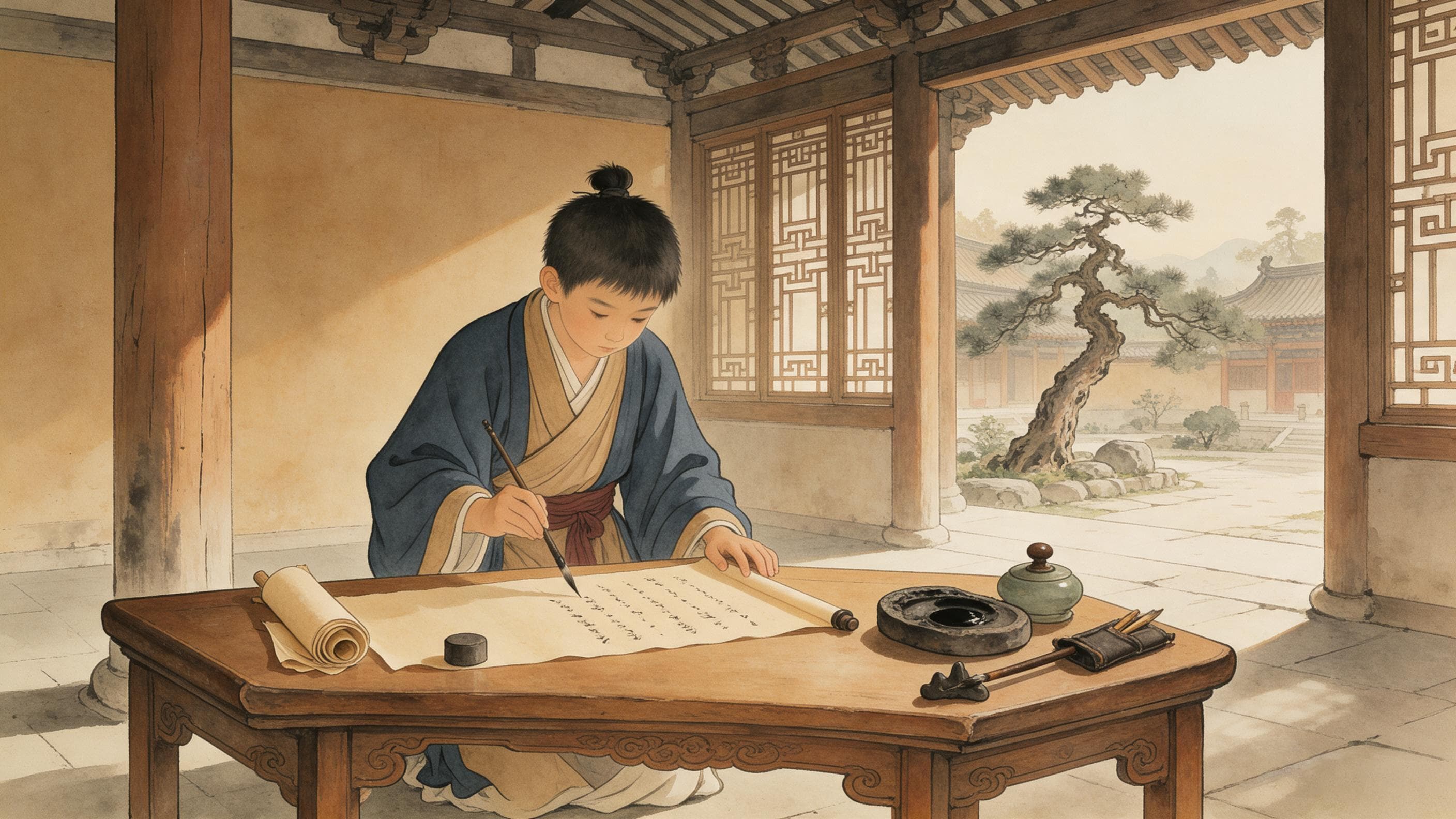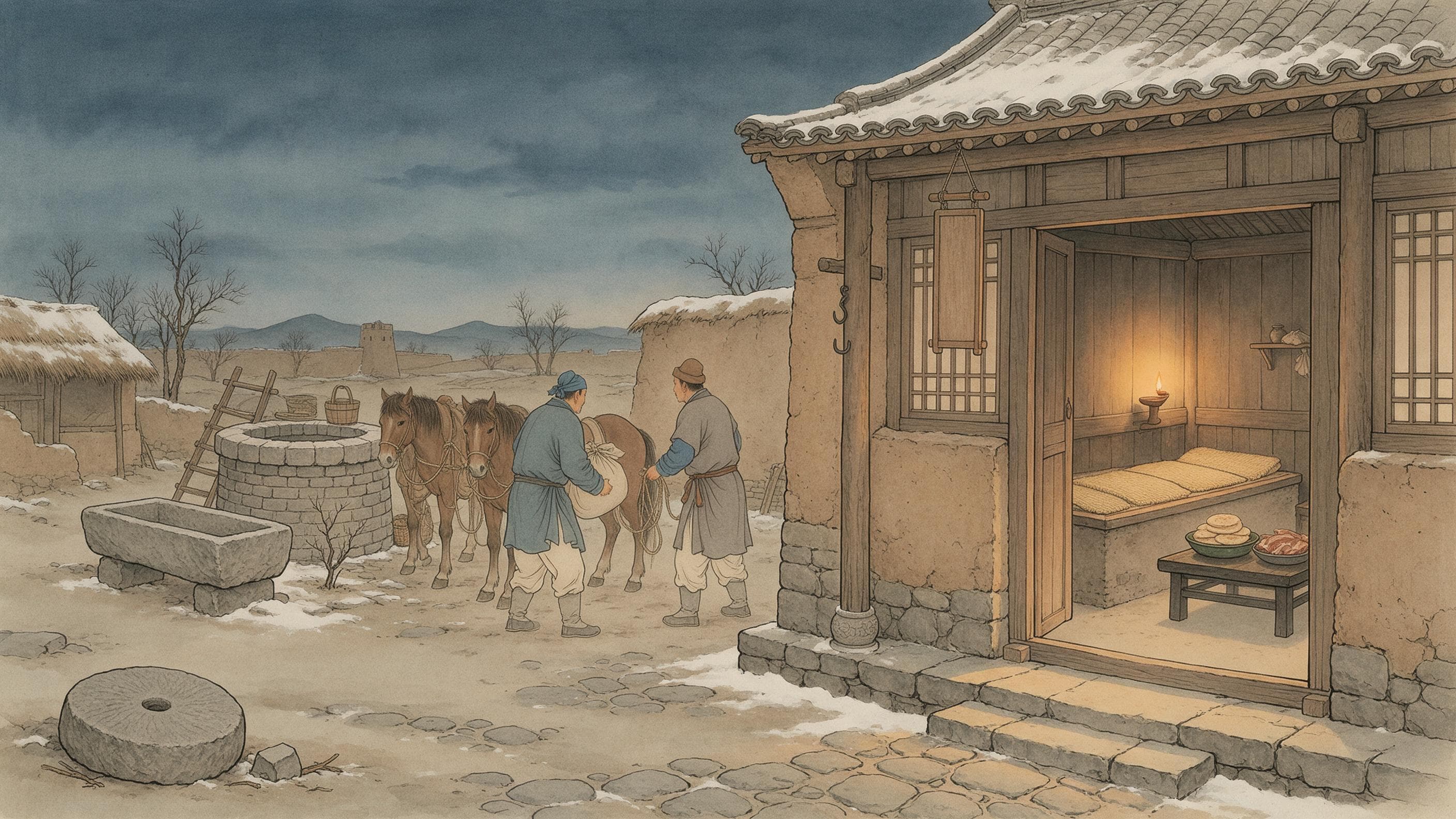
Before daylight the merchant calls the innkeeper over to settle. The innkeeper recites the bill line by line: three jin of wheat flour at ten cash a jin, thirty cash; one jin of pork, twenty; fire and sleeping space for four men at ten cash each, forty; six dou of black beans at fifty a dou, three hundred; eleven bundles of hay at ten a bundle, one hundred and ten. Total, five hundred cash. The guest, who has bought his flour and fodder from the house itself, asks for something off, and the host gives way: “Very well, very well, bring four hundred and fifty.”
None of those figures is a statistic. The scene is a lesson from Lao Qida (老乞大), a textbook for Koreans learning Chinese: 108 dialogues that follow a merchant from Kaesong to the capital and home again. Qida transliterates the Mongol word for Cathay. The Wikisource text is headed with the name of the Korean scholar Choe Sejin and a note that the book was compiled in the late Yuan or early Ming; what survives is a later Korean edition with Korean glosses, revised more than once. That is why one version has 北京 where another, cited in the Guangming Daily, has 大都; 顺城门 against 顺承门; “sesame oil” against “clear oil”. This article therefore reports what the book's speakers say, not a table of Yuan prices: the bill above is an exercise to recite aloud, not a receipt.
The night's bill, item by item
Read as a lesson, the bill teaches three things at once. First, cost: eleven horses, six dou of beans and eleven bundles of hay — five sheng of beans and one bundle a horse, the ration the book states elsewhere; when it prices fodder for six horses it reckons two qian of silver, then adds that where fodder was dear the same night came to three or four qian, and where it was cheap, two. A range inside one lesson means teaching, not counting. Second, the etiquette of haggling: five hundred down to four hundred and fifty, a tenth, allowed because the guest had bought from the house. Third, a seam: five men eat the three jin of flour, but only four are charged fire and sleeping money, and the text never says who the fifth was.
The room can be rebuilt almost object by object. The guest complains of the “fine earthen kang” — the heated brick platform — and asks for straw mats; three are brought. The lamp is hung on the wall. Behind the house is a shallow well drawn with a rope, a stone trough beside it for the horses. Later the traveller measures it against home: this well is brick-lined, at least two zhang deep; in Korea, he says, wells are built of stone, the deepest under one zhang, usually seven or eight chi, and it is the women who draw the water, carrying it on their heads in copper vessels. The comparison is his, not the author's: a Korean traveller taking China's measure.
Without a permit, no bed
Not every door opens. At the next house he is refused, and the refusal is an essay in liability: “I am not unwilling to let you stay. The authorities have posted notices on every door: no lodging unknown men. How do I know where you come from?” An official travel permit (yin xin wen yin, 印信文引) helps, but the host still recites a recent case — a household that took in a few guests who turned out to be Mongols on the run, and was dragged into the pursuit after the guests had gone. The innkeepers of this book are not local colour; they are men counting their distance from a lawsuit.
Capital prices, heard on the road
The prices come secondhand, as most prices did. “An acquaintance of mine said, when he came, two fen of silver bought a dou of husked rice, five fen a dou of millet, one qian of silver ten jin of flour, two fen a jin of mutton.” Horses: this grade sells at fifteen taels and up, that grade at ten and up. Ginseng: “In former years it was three qian a jin; now, since there is none for sale, you cannot find it at five.” The units stay as spoken — silver by weight, grain by dou, meat by jin — and nobody totals them. The lesson is in the asking; the answers are examples.
Six steps of a horse sale
The horse sale is the book's longest set piece, and it runs as procedure. A broker takes charge; the buyer is told to look at the teeth; the seller opens at one hundred and forty taels for fifteen animals. The broker does the arithmetic aloud — five good horses at eight taels, forty; ten poor ones at six, sixty; “one hundred in all, settle it” — and when the seller objects, five taels more, one hundred and five, closes the deal. The broker states his position plainly: “I am a broker. I lean neither to buyer nor seller; I say what is straight.”
Then the money. The seller asks for fine silver: “Low silver, do not give me; mine is all fine official silver.” The buyer, unable to assay it, asks for a mark and a guarantor: “I have looked at it, but true from false I cannot tell. Make your mark, and if later it will not pass, I shall ask the broker to exchange it.” The contract is then dictated as a model: a named seller in Liaodong, a middleman at the corner of the Sheep Market in the capital, a buyer from Jinan in Shandong, twelve taels for one horse, and five taels of official silver as the penalty on whoever backs out. Tax at three fen per tael on one hundred and five taels comes to three taels, one qian and five fen. Every figure is a specimen; the real content is the sequence — broker, teeth, price, silver, contract, tax.
The return cargo, and the limits of the book
What he buys to carry home is the other half of the lesson: a hundred jin of red tassels, five hundred strings of glass beads, needles and awls and combs, a hundred sets of knives, thirty government-made steelyards, coarse cotton and brocade — and books: the Four Books with Zhu Xi's commentary, the Odes, the Documents, the Changes, the Rites, Han Yu, Liu Zongyuan, Su Shi's poems, the Comprehensive Mirror, and a storyteller's Three Kingdoms. Off the road the book is just as concrete: in the twelfth month people pick up dung to warm their hands at the fire; a family feast drinks two taels of silver's worth of wine; for a disordered stomach, thirty pills of areca, taken with ginger decoction.
At the end the Korean has a fortune-teller choose his day and takes leave of his companions. Nowhere does the book give a total: no yearly income, no profit on the round trip, no sum for the road. It keeps its accounts in scenes, not in columns. That is the honest way to use it. Those five hundred cash cannot go into a price table for the Yuan dynasty, but the tenth asked off, the five taels that closed a bargaining gap, the mark scratched on silver a buyer could not assay — these are the sounds of a market, written down so that a student in Korea could learn to make them.
Sources & further reading
- 《老乞大》卷上(维基文库本,朝鲜谚解系统) — The road from Kaesong to the capital: the inn bill, fodder prices, wells, straw mats, cooking, and the travel permit demanded by a wary household.
- 《老乞大》卷下(维基文库本,朝鲜谚解系统) — Horse trading through a broker, silver testing, a model contract and its penalty, tax at three fen per tael, ginseng and hemp cloth, the return cargo, and thirty areca pills.
- 包学菊〈从商贸之旅到市民生活——两部海外汉语课本里的「中国故事」〉,《光明日报》2024-02-23 第 16 版 — Overview of the Lao Qida: compiled in the Yuan, a Korean primer of 108 dialogues, the route ending at the capital's gate; also the wording of another edition (大都, 顺承门, 清油) used here to show textual variation.
- 《老乞大》(维基文库书目页) — Bibliographic page: the text is headed with Choe Sejin's name and described as a primer compiled in the late Yuan or early Ming for Koreans learning Chinese.