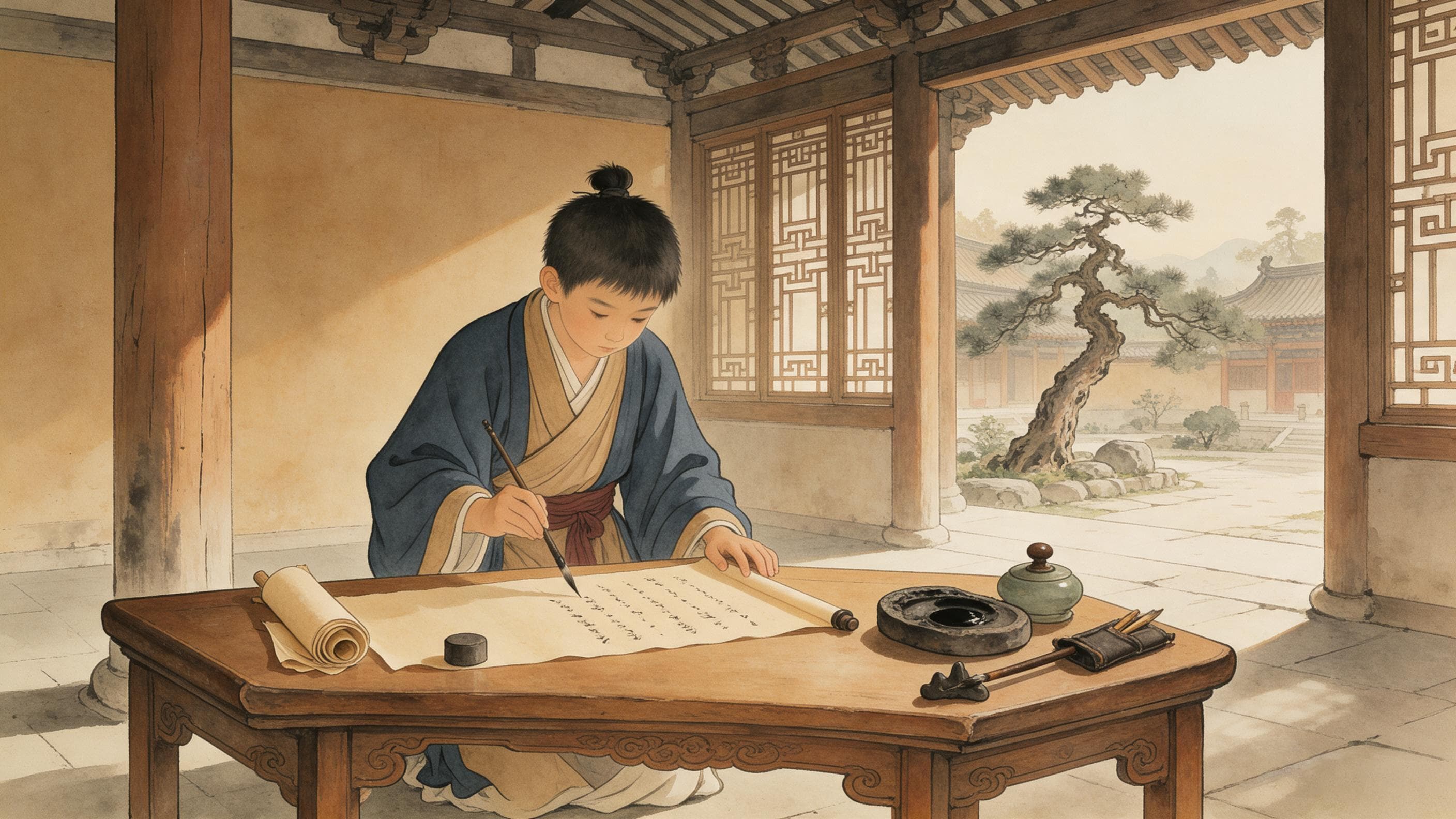
At the end of a copied scroll, someone added a line: “The fifteenth day of the twelfth month of the fifth year of Tianfu, the year yichou, 905, written by Zhang Gui, student-scribe of the Jinguangming monastery, Dunhuang commandery” — quoted here from Tian Weiwei's study, not from the original roll. The scroll is 26.7 centimetres high and 185.3 long, and what he had just finished copying was a long poem, The Lament of the Lady Qin. We do not know how old he was, how long he had been at the monastery school, or what he paid. We know the day he finished.
That is the kind of evidence this article has: colophons at the end of manuscripts, not statutes. Eleven copies of the poem survive from Dunhuang; six carry a student's note. The poem itself is Wei Zhuang's long narrative of the Huang Chao rebellion, lost for a thousand years and recovered only with the Dunhuang library; why it sat in a schoolroom is not hard to guess — a long poem with real events in it, widely admired, in a regular rhyme, good practice for a student who would one day have to answer policy questions and compose verse. The students called themselves xueshi, xueshilang, xueshi tong'er — “student boy” — or simply “temple novice” or “commoner”; by Tian's account they mostly said “student” early on and “student-scribe” later. The dated notes fall between 850 and 986, under the Guiyi Army that ruled Dunhuang. Two boundaries first: this is Dunhuang, not the Tang capital, and mostly the late Tang and Five Dynasties, not the high Tang; and the colophons are quoted from the article, not read off the scrolls.
What they copied
The copies are modest objects. Two are long rolls, 26.7 by 185.3 and 40.6 by 174.9 centimetres; among the eleven there are fragments under five centimetres square, and two small “pocket” copies written by the same student, Yin Nu'er. They copied more than poetry: manuscripts with student signatures also carry the Taigong Jiajiao, the Kaimeng Yaoxun, the Analects with collected commentary, the Classic of Filial Piety and the poems of Wang Fanzhi. Monastery, private and government schools used much the same texts, and even the sons and nephews of the Guiyi Army's rulers attended monastery schools. Three of the six colophons come from monastery schools, and those monasteries lay in different quarters — Jinguangming in the north-west of Shazhou, Jingtu inside the city wall, Sanjie at the Mogao caves — so the boys carrying these copies were not all in one corner of the town. As for the handwriting, Tian judges that “most of it is rather poor, and can basically be identified as the work of beginners” — a scholar's judgement, not a fact.
First layer: characters
The first layer was characters. The Thousand Character Classic was compiled by Zhou Xingsi under the Liang, a century and a half before the Tang, and it became standard in Tang times — not a Tang composition, and not a Tang official primer. “Heaven is dark, earth is yellow; the cosmos is a waste of waters. The sun and moon fill and wane; the stars are ranked in order.” Four characters to a line, a thousand characters, rhymed, running from the sky down to human affairs and ending on the particles: “what are called particles: yan, zai, hu, ye.” A child who finished it had met a thousand characters, and a line such as “a foot of jade is not treasure; an inch of time is what we race.”
Second layer: anecdotes
The second layer was memorised story. Li Han's Mengqiu runs four characters to a phrase, two phrases to a couplet, every phrase a person or an anecdote: “Wang Rong terse and essential; Pei Kai clear and penetrating”; “Kuang Heng bored through the wall; Sun Jing shut his door”; “Sun Kang read by snow; Che Yin by fireflies”; “Meng Tian made the brush; Cai Lun made paper”; “Wang Chong read in the market.” Then, at the end, it turns to the reader: “Vast are the ages past, not all can be sifted; cut the weeds and gather the flowers — er cao mian zhan, you children, do your best.” Er cao is not a flourish; it is the class being addressed.
Third layer: conduct
The third layer was conduct. The Taigong Jiajiao, “Family Instructions of the Grand Duke,” is all plain maxims, and its author is disputed — the old attribution to Jiang Gongfu is not secure. “A child who studies is like the light of the rising sun; to grow old without studying is to be dark as night.” “A disciple serving his teacher should respect him as a father, learn his way and his words. A disciple has the shuxiu bond; one day a teacher, a lifetime a father.” And: “Diligence is a treasure beyond price; learning is the bright pearl of the eyes. A thousand in stored wealth is not as good as understanding one classic; a thousand qing of good land is not as good as a thin skill you carry with you.” The shuxiu — the bundle of dried meat a pupil brought — is named, and never priced.
Primers copying primers
The primers borrow from each other. The Thousand Character Classic has the line “women admire chastity, men emulate the worthy.” The Taigong Jiajiao has the same line, with one character written differently. That is not a coincidence of feeling but a line copied from one schoolbook into another: these were not separate classics but a stack of popular texts, layered, each taking sentences from the one below. The point is made by reading the two texts side by side, not by any statement in the sources.
What is missing is as instructive. No tuition figure, no price for a book, a sheet of paper, a brush or an inkstone; no timetable, no term, no record of how many years a boy studied. The margins are said to hold schoolboy doggerel, but this round found no readable text of it, so none is quoted. The colophons give names and dates; they do not give accounts.
They do not even give a settled name. On one scroll the same boy signs twice: “the seventeenth day of the second month of the second year of Xiande” as Ma Fude, student-scribe, and two days later “the nineteenth day of the second month of the fourth year of Xiande of the Great Zhou, the year dingsi, 957,” as Ma Fude, student boy. Same hand, same year, two descriptions of himself — and one textual knot: the second year of Xiande does not match the cyclical year dingsi, which is 957, the fourth year. The manuscript says what it says.
Sources & further reading
- 李瀚《蒙求》(唐;维基文库) — The Tang primer of four-character phrases: “Wang Rong terse and essential, Pei Kai clear and penetrating”; “Kuang Heng bored through the wall, Sun Jing shut his door”; “Sun Kang read by snow, Che Yin by fireflies”; it ends by addressing the reader — “cut the weeds and gather the flowers; you children, do your best.”
- 周兴嗣《千字文》(南朝梁;维基文库) — Compiled under the Liang, standard in Tang times: four characters to a line, a thousand characters, ending on the particles. “Women admire chastity, men emulate the worthy”; “a foot of jade is not treasure, an inch of time is what we race.”
- 《太公家教》(旧题唐姜公辅,作者有争议;维基文库) — Plain maxims for children: “a child who studies is like the light of the rising sun”; “one day a teacher, a lifetime a father”; the *shuxiu* bond is named but never priced; the line on chastity and worth repeats the Thousand Character Classic almost verbatim.
- 田卫卫〈唐宋之交敦煌学童群体与社会文化传播〉,《光明日报》2025-01-25 第 11 版 — Eleven Dunhuang copies of the Lament of the Lady Qin, six with student colophons; dated notes 850–986; the 905 colophon of Zhang Gui at the Jinguangming monastery, the 919 note of An Yousheng, Ma Fude's two signatures of 957; the six self-descriptions; the school texts; scroll measurements; and the judgement that the handwriting is that of beginners. Colophons are quoted from this article, not from the original scrolls.