In the sixteenth year of Jiajing (1537) the minister of war, Zhang Zan, came to court in a python robe. The emperor saw it and asked his grand secretary Xia Yan: “A minister of war is of the second rank — why does he wear a python?” Xia Yan answered that what Zhang Zan wore was in fact a flying-fish robe bestowed by the throne, and that its brightness made it look like a python. The emperor's reply was exact: “Does a flying fish have two horns? Prohibit it strictly.” Two horns were the whole evidence. The court read a man by the pattern on his back.
The episode is recorded in the Ming Shi, juan 67, the third chapter on carriages and dress, which governs the clothing of officials, their wives and relatives, palace servants, commoners, musicians, soldiers, foreign envoys and monks. One boundary comes first: a chapter like this says what ought to be worn, not what was worn. The chapter complains repeatedly of extravagance and of dress in which “high and low cannot be told apart” — proof that the rules were being evaded. What follows, then, is how the regulations tried to pin a person down by his clothes, not a description of the street.
The badge: birds and beasts
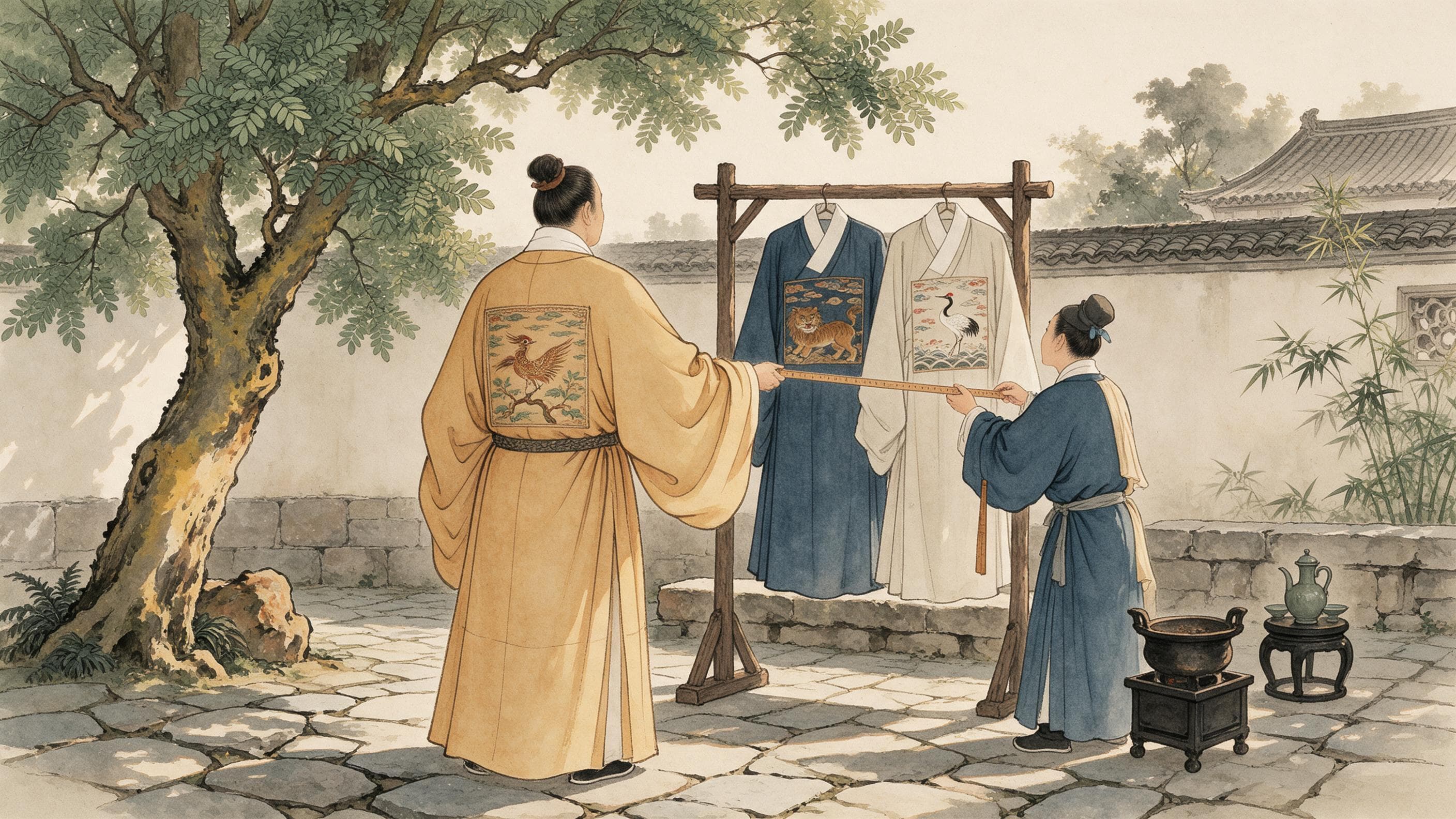
The plainest scale was the buzi, the square badge sewn on the chest and back of the everyday robe. In the twenty-fourth year of Hongwu (1391) it was fixed: dukes, marquises, earls and imperial sons-in-law to wear the qilin and the baize; civil officials to wear a bird each — first rank the crane, second the golden pheasant, third the peacock, fourth the wild goose, fifth the silver pheasant, sixth the egret, seventh the mandarin duck, eighth the oriole, ninth the quail; minor office the magpie; and the censors, whose business was accusation, the xiezhi, the one-horned goat that gores the guilty. Military officials wore beasts: lion for the first and second ranks, tiger and leopard for the third and fourth, bear for the fifth, a young tiger for the sixth and seventh, rhinoceros for the eighth, sea-horse for the ninth.
The badge was not alone. Court dress was graded by the ridges on the cap: eight for a duke, seven for a marquis, seven for an earl, seven for a first-rank official, six for the second, five for the third, four for the fourth, three for the fifth, two for the sixth and seventh, one for the eighth and ninth; only the censors wore the xiezhi cap. The tablet in the hand followed: ivory above, sophora wood below. The belt followed: jade for the first, flowered rhinoceros horn for the second, gold for the third, plain silver for the sixth and seventh, black horn for the eighth and ninth. From cap to waist, a man was a column of numbers.
Colour: crimson, blue, green
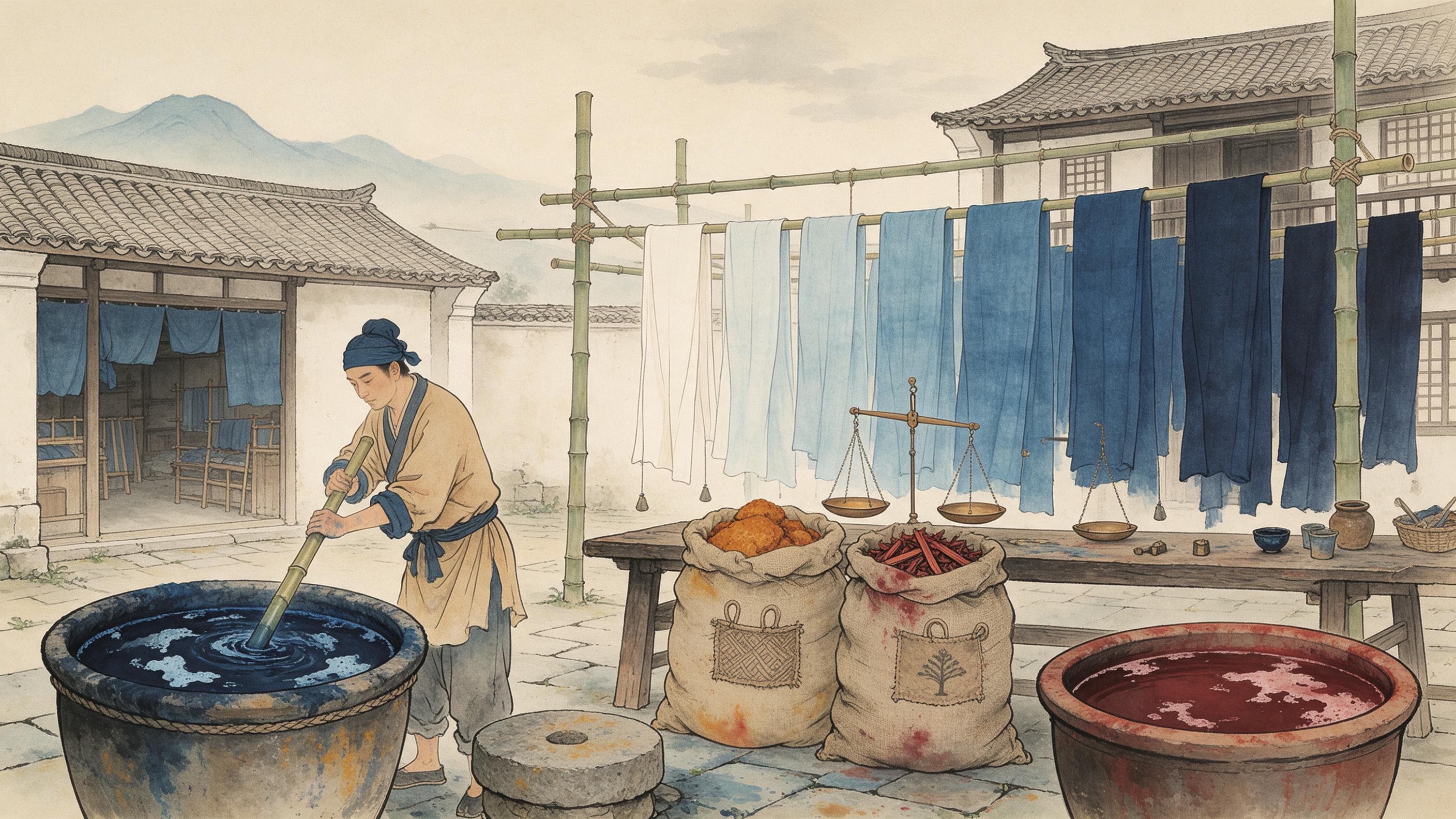
Colour was the coarser scale, and it was statutory. In the twenty-sixth year of Hongwu (1393) the public robe was fixed: round-collared, closing to the right, in silk gauze, damask or plain silk, the sleeve three chi wide. First to fourth rank: crimson. Fifth to seventh: blue. Eighth and ninth: green. The woven pattern was graded by size — a single flower five cun across for the first rank, three for the second, a scatter of petals two cun for the third, small mixed flowers one and a half for the fourth and fifth, one cun for the sixth and seventh, and no pattern at all below that. The belt was jade, horn, gold or black horn by rank. A man's salary was not written on him; his cloth was.
Then come the prohibitions, which are more interesting than the permissions. The 1391 clause forbids officials' clothes and bed-curtains the three colours dark-black, yellow and purple, and forbids woven or embroidered dragons and phoenixes: “those who disobey are punished, and the dyers who made it too.” In 1458 the ban widened to python, flying fish, striding bull, great peng, lion, “four-jewel” and “western lotus” patterns, and to black, green, willow-yellow, ginger-yellow and bright yellow. That the penalty reaches the dyer shows what colour was: licensed manufacture, not taste.
Commoners and merchants: a narrow corridor
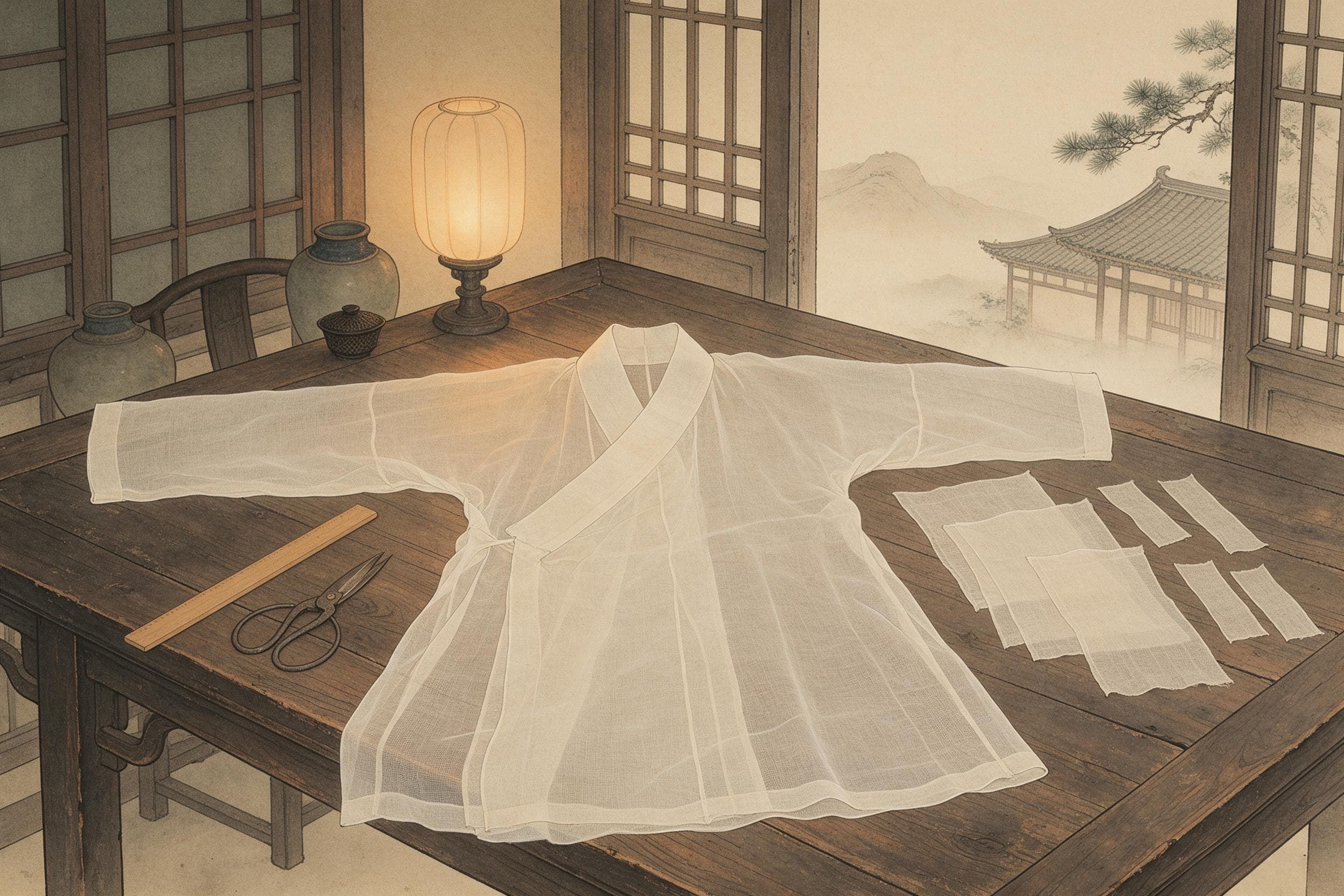
Below the officials the regulations narrowed to a corridor. Commoners in 1370 were to wear the four-cornered scarf, later the square “four directions pacified” scarf, a round-collared robe in mixed colours, never yellow; no gold embroidery, no brocade, no silk gauze or damask — only plain silk, coarse silk and undyed gauze; no gold or jade in hairpins and bracelets, silver only; no boots with cut patterns or gold thread, and from 1392 no boots at all except in the cold north.
The sharpest line is dated 1381: “Farmers may wear coarse silk, gauze, plain silk and hemp; merchants may wear only plain silk and hemp. If a farming household contains one man who is a merchant, it may not wear coarse silk or gauze either.” One trader in the family, and the whole household lost its silk. The rest was cut to the body: in 1390 a commoner's robe was fixed to end five cun above the ground, the sleeve six cun past the hand, the sleeve breadth one chi, the cuff five cun. The one generous opening is a wedding: at the beginning of the dynasty, commoners were allowed to borrow the dress of the ninth rank for the day.
How the rules were enforced
Penalties were not left vague. The Great Ming Code has a statute, “Dress and Buildings Contrary to Rank,” for officials and commoners whose houses, clothes, vehicles or vessels exceed their grade: an official is struck a hundred strokes and dismissed for good; a commoner gets fifty strokes, and the head of the household bears the penalty; the craftsman who made the thing gets fifty too. For forbidden dragon-and-phoenix patterns it is worse: a hundred strokes and three years of penal labour, the craftsman a hundred strokes, his whole household sent to the capital to work as government artisans, the goods confiscated; an informant gets fifty taels of silver, and a craftsman who turns himself in is pardoned and rewarded. The supplementary rules fold the banned dark-black, yellow and purple, and python, flying-fish and striding-bull patterns, into that same law. And the court kept reissuing: after the Zhang Zan affair the Ministry of Rites ruled that no official might wear python, flying fish or striding bull; in 1574 students were forbidden the “loyal and quiet” cap, brocade shoes and umbrellas. A rule reissued every generation is a rule being broken.
Outside the rules
The system also opened its own doors. The same chapter has a section on bestowals: grand secretaries began to receive python robes under Hongzhi, with Liu Jian and Li Dongyang; the qilin, which belonged to dukes and marquises, was bestowed on the grand secretaries Yan Song and Xu Jie under Jiajing; Zhang Juzheng received a seated python under Wanli. Bestowal is the exception that proves the rule, and also the hole in it: if the throne can dress a man above his rank, then “who may wear what” is not a hard boundary but a line that favour can redraw. How the street actually dressed we cannot see. The Ming Shi gives us the statute and the complaint, not a census of coats — a state counting its subjects in cun of flower, ridges of cap and feathers on a square of cloth.
Sources & further reading
- 张廷玉等《明史》卷六十七·志第四十三·舆服三(文武官、命妇、士庶、乐工、军隶、僧道冠服) — The badges fixed in 1391: qilin and baize for dukes and marquises, birds for civil officials from crane down to quail, beasts for military officials from lion to sea-horse, the xiezhi for censors. Court-dress ridge counts, public-robe colours crimson, blue and green with graded flower sizes, belts by rank, the ban on dark-black, yellow and purple, the 1381 rule that merchants may wear only plain silk and hemp, commoners' restrictions, and the bestowals that broke the system.
- 《大明律集解附例》卷十二·礼律·仪制「服舍违式」(维基文库) — The statute behind the regulations: officials and commoners whose houses, clothes, vehicles or vessels exceed their grade; official a hundred strokes and dismissal, commoner fifty strokes with the household head liable, craftsman fifty. Forbidden dragon-and-phoenix patterns: a hundred strokes and three years' labour, the craftsman's household sent to the capital as government artisans, goods confiscated, fifty taels to an informant. The supplementary rule folds dark-black, yellow and purple and python, flying-fish and striding-bull patterns into that law.