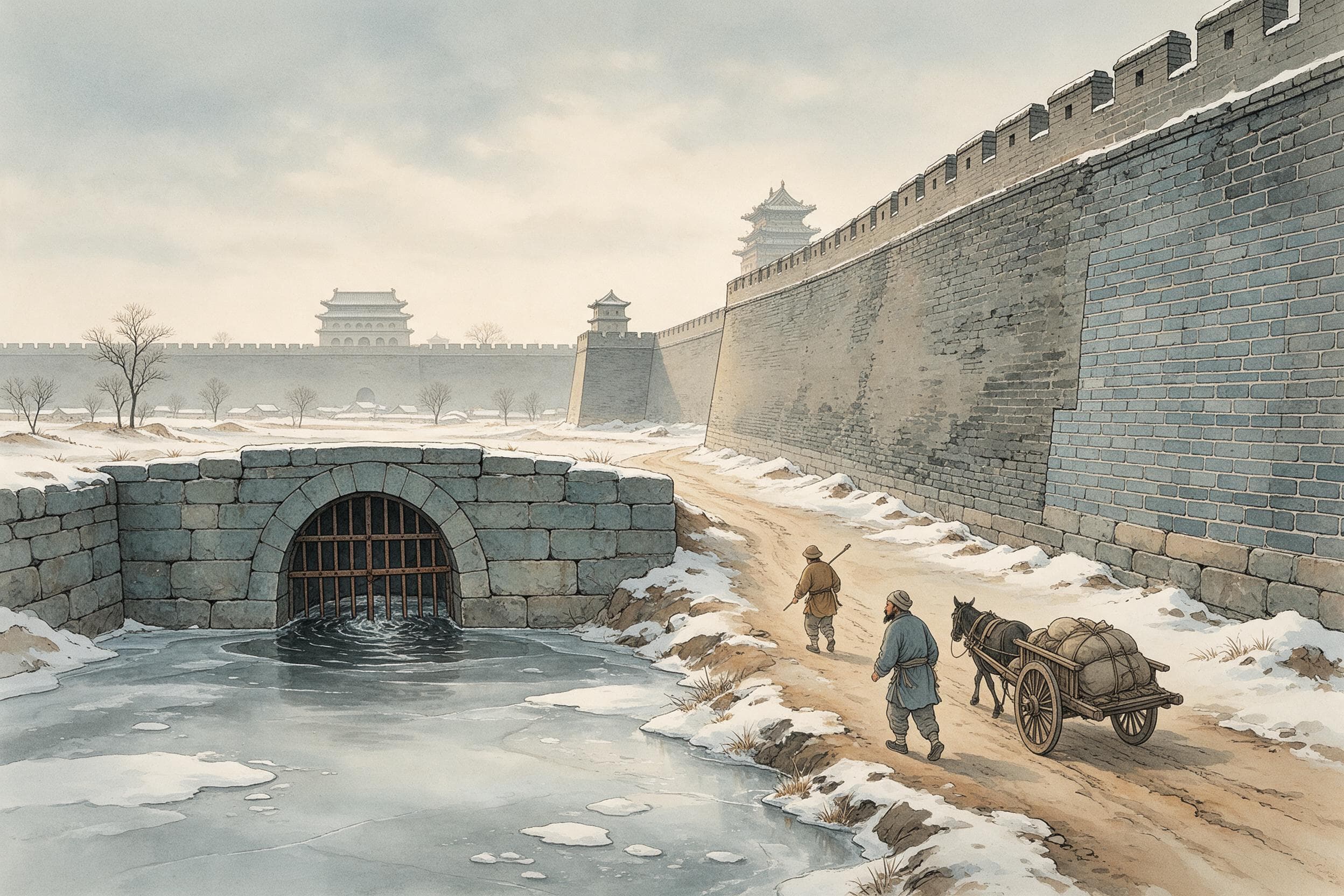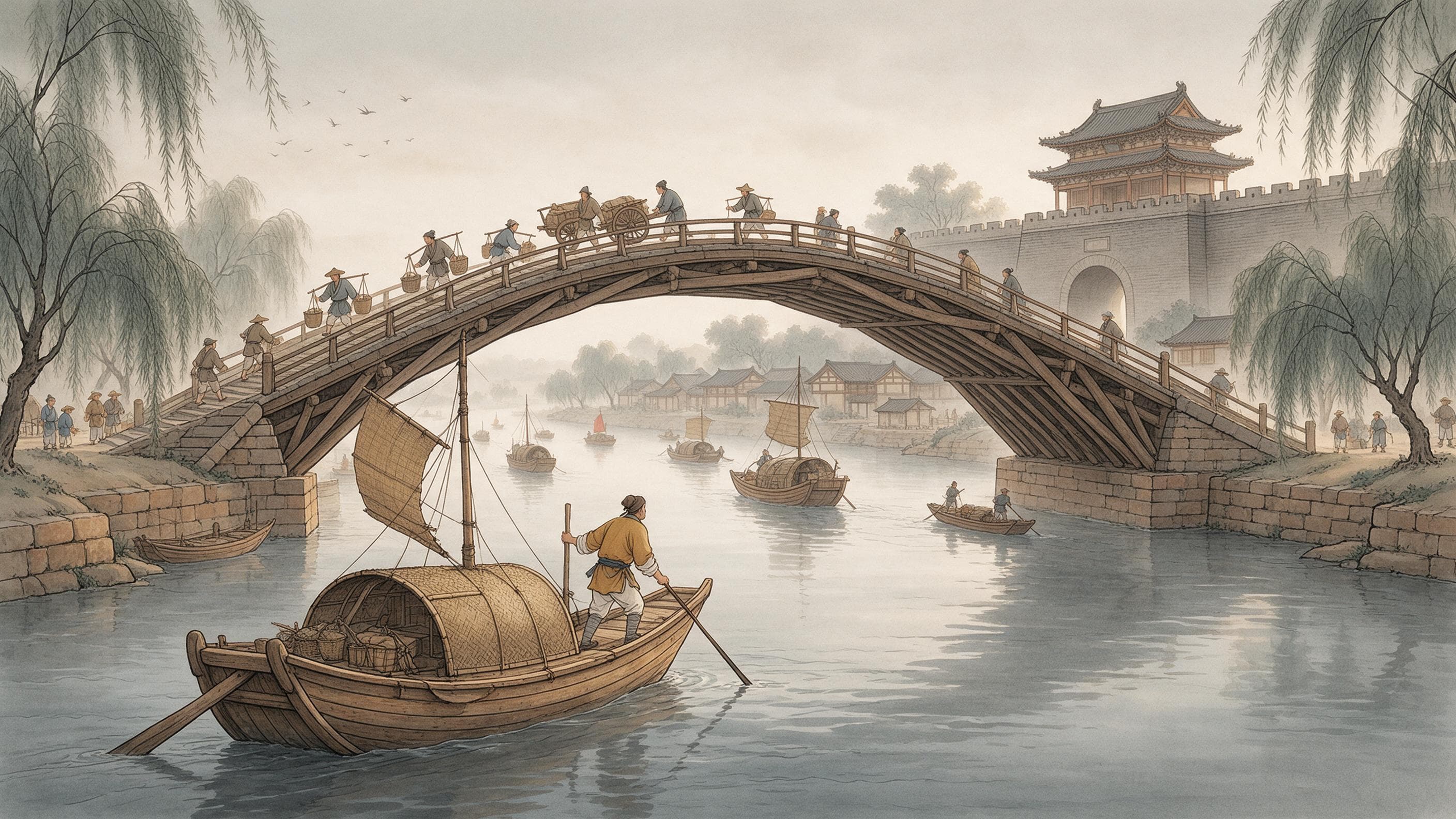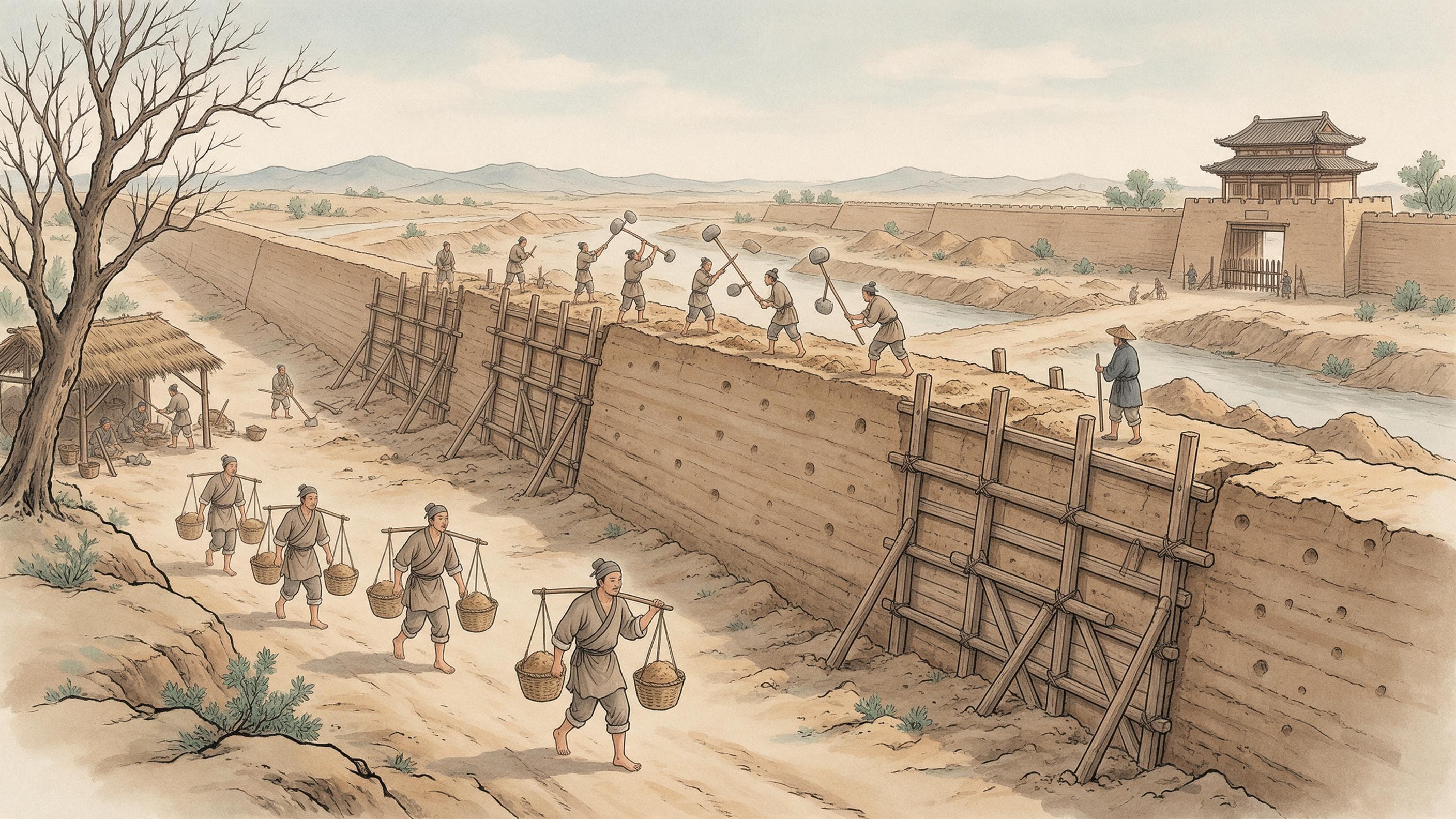
The Yuan History's geography chapter gives the capital in one sentence: 'the city sixty li square, with eleven gates.' Sixty li, eleven gates, every gate named. The archaeologists' survey gives an outer circuit of about 28,600 metres. The two sentences have to be set side by side: that is as much as can now be measured of this city.
Two sets of figures
According to the Yuan History, the old central capital was renamed in 1264; 'in the fourth year the present city was laid out north-east of the central capital and the capital moved there'. The Rixia jiuwen kao, quoting the Hongwu register of Beiping, says the seat was fixed three li north of the old capital in 1267 and 'the wall enclosed sixty li'; quoting the Yuan yitong zhi, it adds that in the second month of 1272 the name was changed to Dadu, residents were moved in to fill it, and bell and drum towers were built in the city. The gates the Yuan History lists in full: Lizheng due south; Shuncheng and Wenming to its right and left; Anzhen and Jiande on the north; Chongren due east with Qihua and Guangxi to its right and left; Heyi due west with Suqing and Pingze. The line that the Rixia jiuwen kao quotes also carries its unit: 'two hundred and forty paces to the li' — which is how the text arrives at sixty li at all. No plan and no architect's name appears in these four sources.
On the survey side, the archaeologist Sun Meng, in an interview with China News Service: the circuit is about 28,600 metres and the area over fifty square kilometres, which 'broadly tallies' with the textual sixty li. The word 'broadly' is kept here — not rewritten as 'that is, sixty li', still less as 'identical'. The same interview gives the comparison: the Jin capital's outer city was about twenty square kilometres. In 1270 the Dadu region counted 184,000-odd households and 635,000-odd people — the region, including dependent counties, not the population inside the walls. The unit matters when the two figures are compared.
The palace city: nine li thirty paces
The palace city's figures, in the Chuogeng lu, are dense: 'the palace city nine li and thirty paces round, four hundred and eighty paces east-west, six hundred and fifteen north-south, thirty-five feet high, faced with brick.' Then two dates: 'ground was broken at the hour of the monkey on the seventeenth day of the eighth month of the eighth year of Zhiyuan, and the work was finished on the fifteenth day of the third month of the next year.' That is 1271, and the following spring. It is the only walled city here with a start and a finish. 'Faced with brick' is worth pausing on: an earthen wall with a brick skin.
The palace city and the outer city are two different walls, and their figures cannot be swapped: nine li thirty paces is the palace, sixty li the outer city. Paces and feet are Yuan measures; they are quoted as written and not converted into exact metres (a conversion, if given, is marked 'about' and called a conventional one). And the outer city has no date of its own: only the palace city does, and its two dates cannot be moved onto the whole city.
The feet and bays of gates and halls
For the palace gates and halls the Chuogeng lu gives dimensions. The palace had six gates; the southern one, Chongtian, was 'twelve bays and five passages, one hundred and eighty-seven feet east-west, fifty-five deep, eighty-five high'. The main hall, Daming, was 'eleven bays, two hundred feet east-west, one hundred and twenty deep, ninety high'; the colonnade seven bays, 'two hundred and forty feet deep, forty-four wide, fifty high'; the bedchamber five bays. Bays and feet are given as written, with no conversion. The figures are precise to the foot, which is what makes them usable.
Which layer this is must be said: the Chuogeng lu is a late Yuan or early Ming account of palace regulations, not an architect's drawing. The sources used here do not name Liu Bingzhong or assign him a role, so this piece writes of 'building' and not of 'the planner'; to name him one would need the Yuan History's biography of Liu and its text checked separately. What the account does not give is a ground plan; it gives bays and feet.
The water inside the city
The Yuan History has a passage on the Haizi: 'north of the imperial city and on the north side of Mount Wanshou, formerly called the Jishui pool, it gathers the springs of the north-west, flows into the capital and collects here, so vast that people called it a sea. The people were free to fish and gather there without prohibition, and it was compared to King Wen's spirit pool.' Springs from the north-west, a sheet of water big enough to be called a sea, and no ban on fishing or gathering. The name is a comparison as much as a description.
That is the other face of the city: its centre was not only the palace. On the lake the people were allowed to fish and gather, and the text compares it to a king's park in the Book of Songs. Water gates, sources and drains are not in these sources, and this piece does not fill them in; it stops here. Water gets one paragraph in the geography, and it is about fish, not about drains.
A city measured two ways
The limits, stated: no 'largest city in the world' — the interview contains something like it, but it is not used as fact, only the comparison of fifty-odd square kilometres with the Jin capital's twenty; 'sixty li' and '28,600 metres' are never merged into one sentence, since one is a text and the other a survey, and the relation is 'broadly tallies'; palace figures are not used for the outer city; the outer city's measured height and thickness, gate depths, street widths, labour and building time are all absent; and the interview is an archaeologist's judgement, not an excavation report. The interview adds that the Yuan city did not reuse the Jin one, and that its southern half lies under Ming-Qing Beijing — one sentence, not a general claim about inheritance.
Once more, side by side: the outer city 'sixty li square, eleven gates', surveyed at about 28,600 metres round and over fifty square kilometres; the palace city 'nine li thirty paces round, four hundred and eighty paces east-west, six hundred and fifteen north-south', with a start and a finish dated to the day; the Chongtian gate twelve bays and five passages, the Daming hall eleven bays, each with its feet. The texts give the rule, the spades give the circuit — and between them, 'broadly tallies' is the highest verdict this city can currently be given. The documents and the survey each answer a question the other cannot.
Sources & further reading
- 《元史》卷五十八·地理志一·大都路(明初宋濂等修;维基文库) — Ming compilation. The years: the old capital renamed in 1260, the new city begun north-east of the old one in 1267, renamed Dadu in 1271; the city 'sixty li square, with eleven gates', all eleven named; the Haizi lake north of the imperial city, 'where the people were free to fish and gather without prohibition'.
- 《辍耕录》卷二十一·宫阙制度(元末明初陶宗仪;四库全书本,维基文库;四库本无标点,引文按文义加标点,未与点校本复核) — A late Yuan/early Ming account of the palace, written after the events and without punctuation in this edition: the palace city 'nine li thirty paces round, four hundred and eighty paces east-west, six hundred and fifteen north-south, thirty-five feet high, faced with brick'; ground broken at the hour of the monkey on the seventeenth day of the eighth month of 1271 and finished on the fifteenth day of the third month of the next year; the Chongtian gate twelve bays and five passages, 187 by 55 by 85 feet; the Daming hall eleven bays, 200 by 120 by 90 feet; the colonnade seven bays, 240 feet deep.
- 《日下旧闻考》卷三十八·京城总纪(清于敏中等;四库本,维基文库) — A Qing compilation quoting older books, each entry marked with its source: the city laid out three li north of the old capital in 1267, walled for sixty li; 'the capital sixty li square, two hundred and forty paces to the li, in eleven gates' (from the Chuogeng lu); in 1271 renamed Dadu, residents moved in to fill it, bell and drum towers built in the city (from the Yuan yitong zhi).
- 中新社〈东西问|孙勐:“世界城市”元大都怎样影响北京?〉(2026-10-02 专访北京市考古研究院研究馆员孙勐) — An interview with an archaeologist, not an excavation report: the city begun in 1267 and 'completed' in 1276; the measured circuit about 28,600 metres, which 'broadly tallies' with the textual sixty li; area over 50 square kilometres against about 20 for the Jin capital's outer city; 184,000-odd households and 635,000-odd people in the Dadu region in 1270; three nested walled cities; the Yuan city did not reuse the Jin one, and its southern half lies under Ming-Qing Beijing.