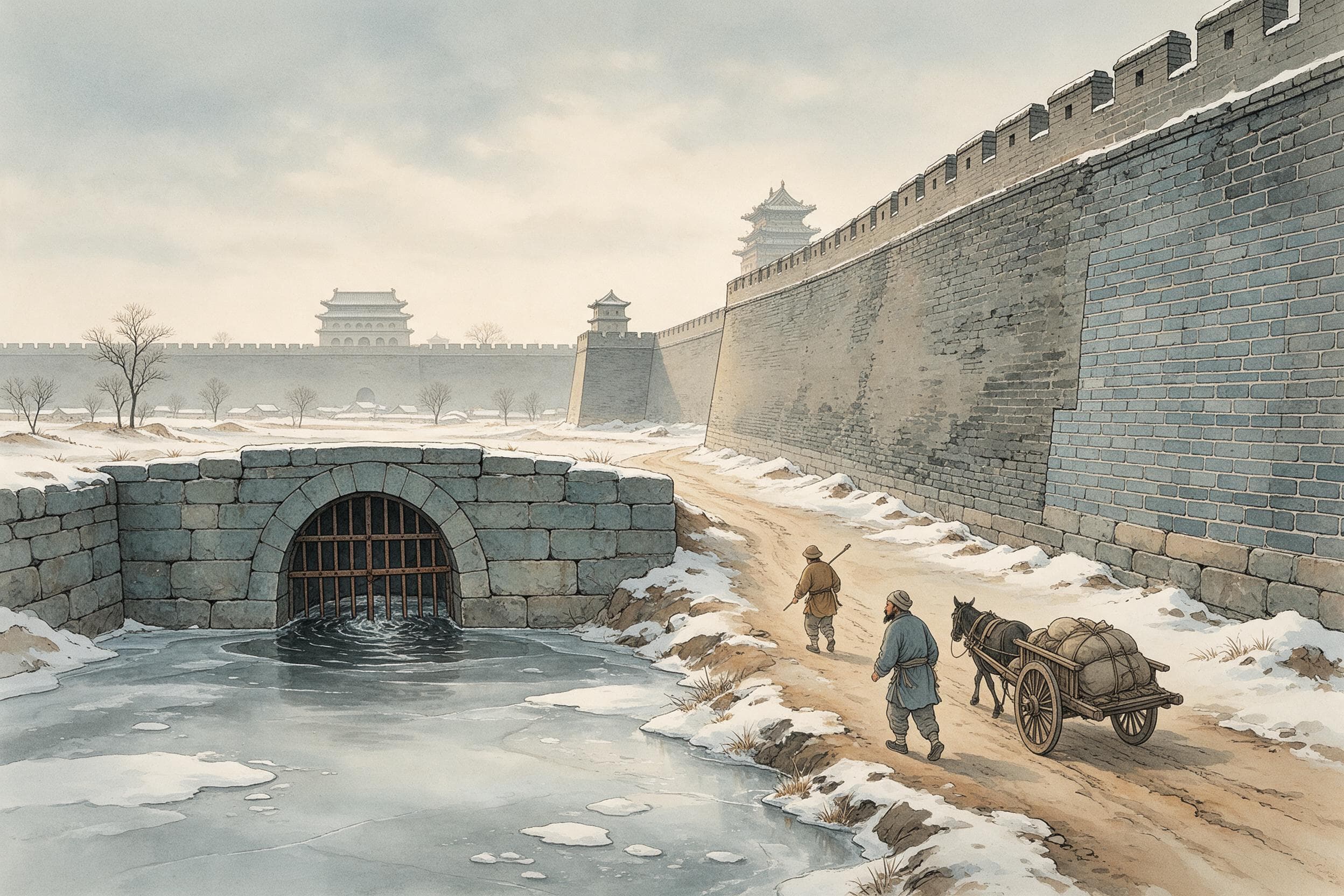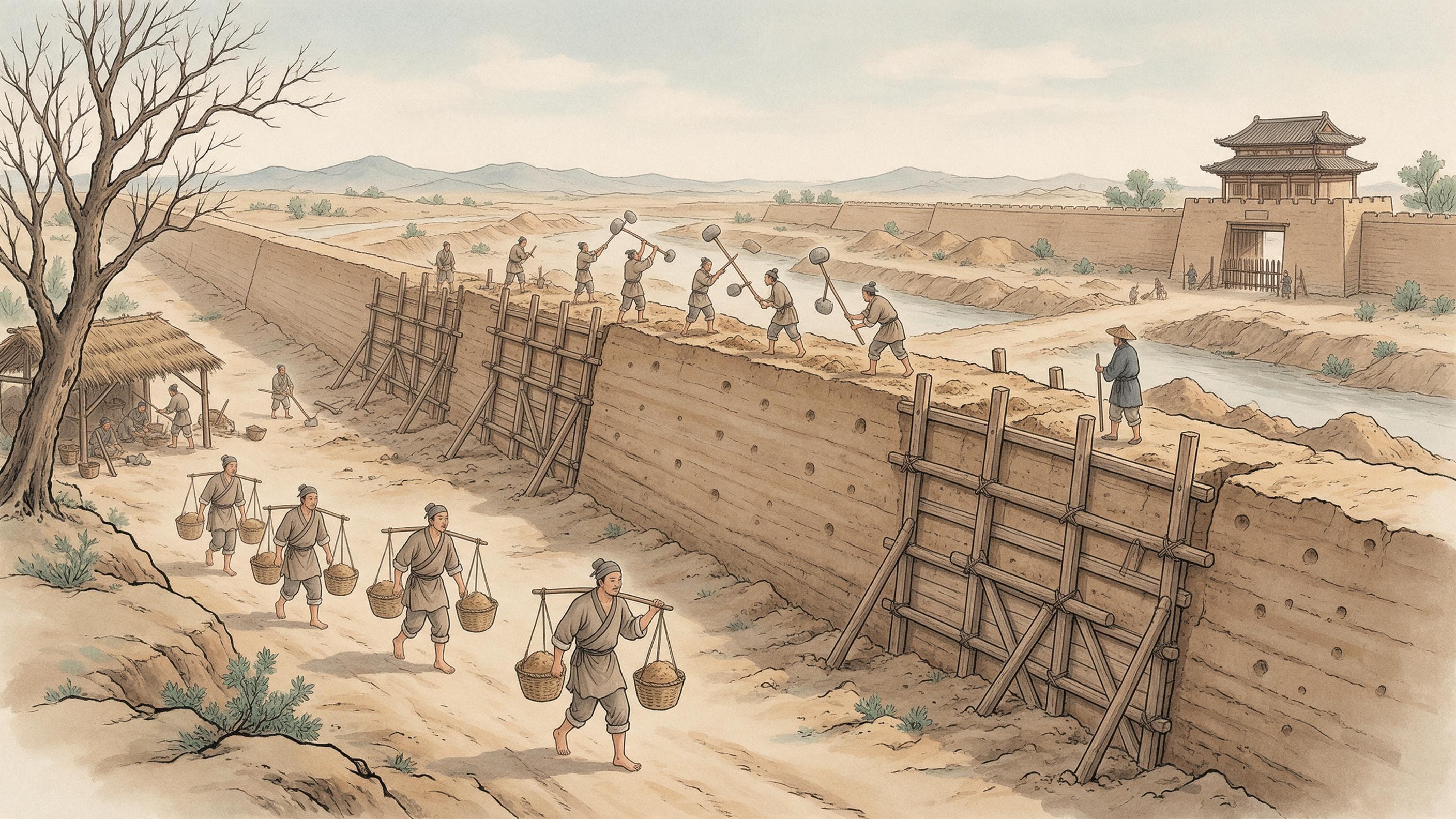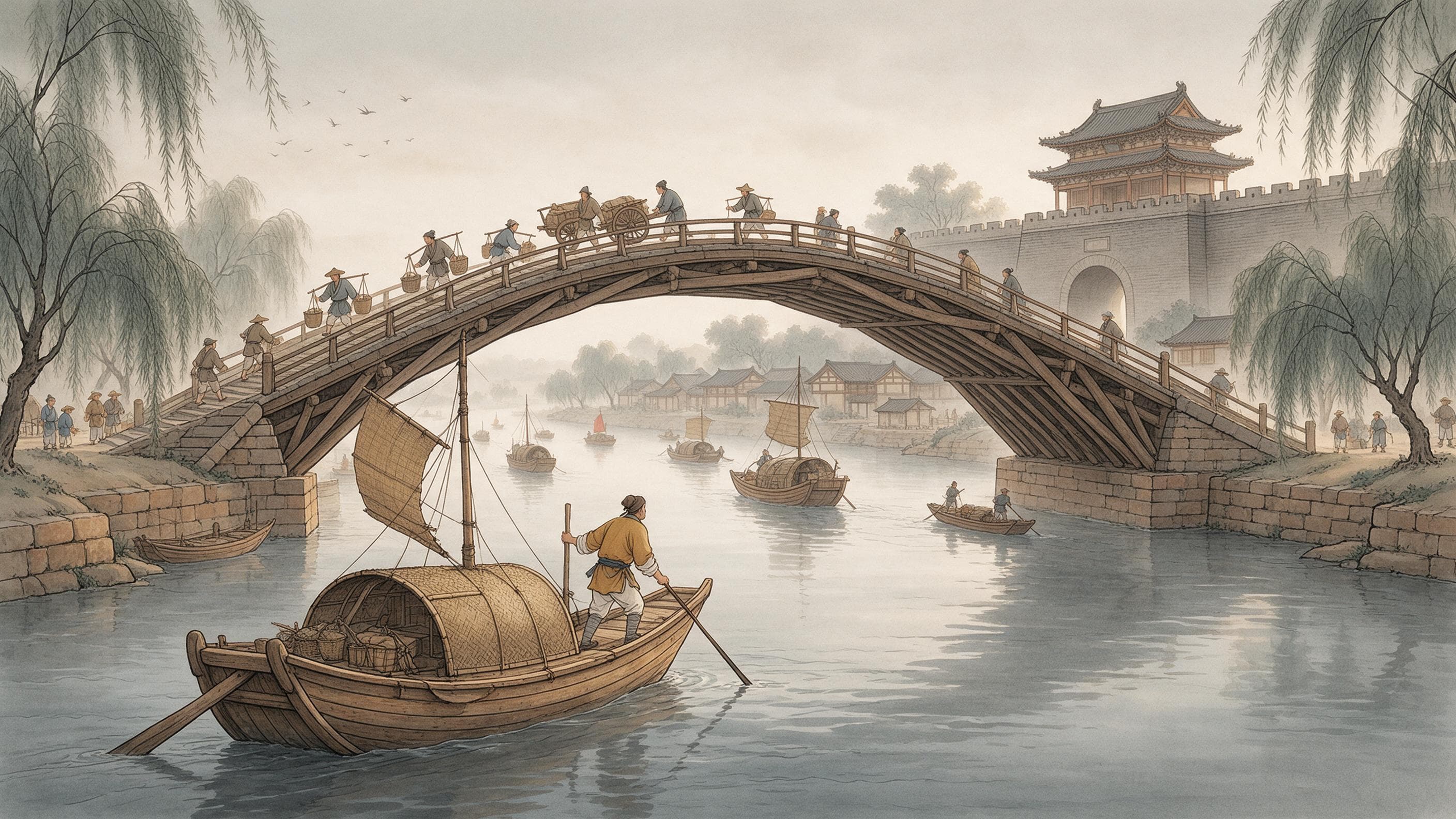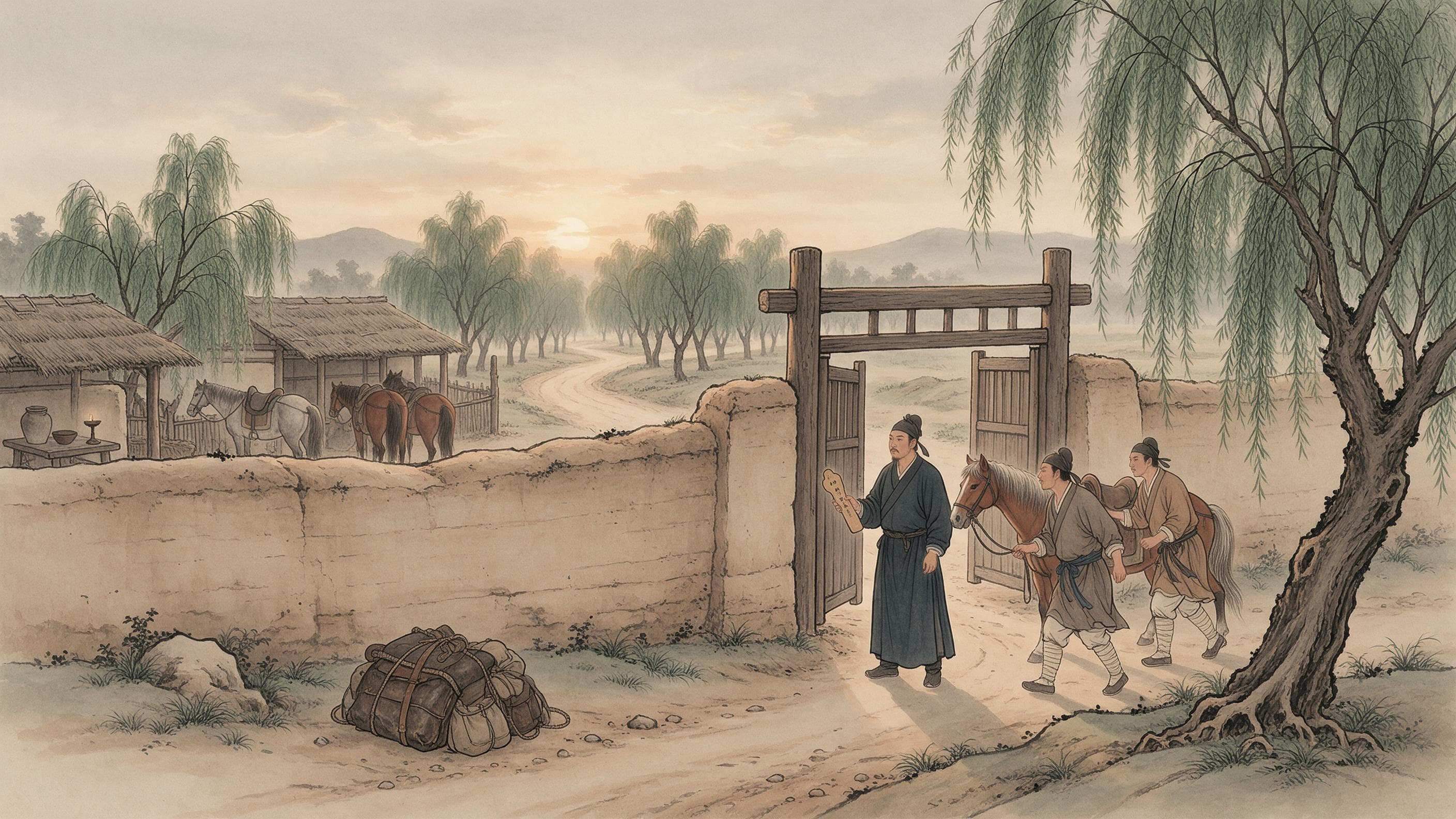
On a Tang highway there was a post station every thirty li. According to the Tang liu dian, juan 5, the realm had 'one thousand six hundred and thirty-nine' of them. Off the main roads, according to the Tongdian, a station every thirty li was not called a post station but a hostel. Each station had a master, horses, and boats where there was water; and a traveller arriving at the gate first had to produce a pass.
One station every thirty li: two totals
The code states it neatly: 'in general one station every thirty li, in all one thousand six hundred and thirty-nine in the realm.' It then gives the breakdown: 260 water stations, 1,297 land stations, 86 serving both. And it leaves a margin: 'where the terrain is steep or the station must sit by water and grass, it need not be thirty li' — in difficult country the rule bends. Thirty li was not only the station's unit: beacon towers too were set 'about thirty li apart', so that one could be seen from the next.
The accounts do not add up. First the breakdown: 260 plus 1,297 plus 86 makes 1,643, four more than the stated 1,639. Then the two books disagree: the Tongdian says 'there were one thousand five hundred and eighty-seven water and land stations in the realm', fifty-two fewer. The two books are some fifty years apart, so a change is possible, but neither explains the difference. Both totals are printed here; this piece does not reconcile them. The four-station gap may be a copying error in the text; this piece does not correct it.
How many horses to a station
Horses were allotted by grade. The code: 'each station has one master, who fixes the number of horses according to how busy the station is: the capital station seventy-five head; the first grade of the circuits fifteen fewer than the capital station; the second and third fifteen fewer at each step; the fourth twelve fewer; the fifth six fewer; the sixth four fewer; the horses supplied by the state.' Seventy-five is the top, and each grade below is reduced by a fixed step. Read by the text's own arithmetic, the six grades come to about 75, 60, 45, 30, 18, 12 and 8 — a calculation from the stated base and reductions, not a figure the text lists.
The rules reach into details. In steep country and in the damp heat of Jiangnan and Lingnan, where big horses did not suit, 'Sichuan horses were also kept'. Water stations got boats by how busy they were: 'four to a station where business is heavy, three where light, two where lighter still'. 'Three horses to one keeper, one boat to three men.' Each station 'was given money to fund it, and bought its own equipment'. The capital kept eighty 'duty horses' ready every day for miscellaneous errands. The same office counted the carts as well: the Court of Agriculture kept 1,021, the Palace Works 345, the imperial stables 100, the Palace Treasury 63, down to one or two carts for minor offices, with oxen at double the number.
Who was entitled to stay
A post station was not an inn; using one required a pass. The code: 'those who ride the post, in the capital receive their pass at the gate of the Chancellery; outside it, from the regent or from the military commands and prefectures. Anyone passing a regent's or a command's office has the pass countersigned by its chief; anyone not entitled is stopped on the spot.' The pass came from the central chancellery or from a provincial authority, and could be refused at the door. That is the hardest sentence in the whole system: the right to a station was written on a pass, not bought with money.
Who ran the stations, the Tongdian records as a change. 'Each station had a master, drawn from the wealthy households of the district, to receive travellers. After the Zhide era, when the people were too poor to bear it, officials took them over.' First the rich households supplied the man; after 756-758 the state did. The phrase 'to receive travellers' also fixes the purpose: the station served official travellers, those on government business.
Between the two capitals: where the sources stop
How many stations lay between the two capitals, how many stations a courier covered in a day, how many days a document took — none of this is in these two books. The code gives the thirty-li rule and the realm's total; the Tongdian gives a total and the change in management. Neither gives the station count, the distance or a daily schedule for the Chang'an-Luoyang road. This piece does not use the Yuanhe junxian tuzhi to reconstruct station sites — that is a geography, not a post-station register — and it does not invent an itinerary. Note where the Tongdian puts it: at the end of a chapter on prefectures and counties, among local officials. The station was filed under local government.
Nor is there anything on ordinary travellers. The stations served pass-holders on official business; private inns, hostels and roadside lodgings do not appear in these two passages at all. So this piece stops at 'the station was for official use' and does not describe the prices, beds or experience of a Tang inn. The sources are silent, and nothing is filled in. The phrase 'to receive travellers' is the only line in either book that says who used the stations, and it points to those on government business.
Rule and practice
Rule and practice must be kept apart. The Tang liu dian is the Kaiyuan statute: it says how things were supposed to be. The Tongdian is a compendium and adds a layer of change — the station master moving from rich households to officials. That 'three horses to one keeper' does not mean every station was fully staffed; that 'anyone not entitled is stopped' does not mean every master dared stop a powerful traveller. Of actual operation, these two books say very little. By the code's own ratio of three horses to one keeper, a capital station of seventy-five horses implies twenty-five keepers — the statute supplies a checkable workforce figure.
Back to the road: a station every thirty li, each with a master, several dozen horses, boats and boatmen, and a pass to be shown at the gate. The rules are as straight as a ruler; the accounts are not: the breakdown adds to 1,643, the total reads 1,639, and another book says 1,587. A regulation can be written in one sentence; the number of stations is always a few off. That is the ruler this piece can offer — accurate, and not quite true.
Sources & further reading
- 《唐六典》卷五·尚书兵部·驾部郎中(唐李林甫等撰;维基文库) — The Kaiyuan institutional code, a statute and not a travel diary: one station every thirty li, 1,639 stations in all, of which 260 water, 1,297 land and 86 mixed; where terrain or water and grass require it, not necessarily thirty li. Horse quotas by grade, from the capital station's 75 down by fixed steps; three horses to one keeper, one boat to three; each station funded with cash and buying its own equipment. Passes: issued at the gate of the Chancellery in the capital, by the regent or the military commands outside it; a station may refuse anyone not entitled.
- 《通典》卷三十三·职官十五·州郡下·乡官(唐杜佑撰;维基文库) — A Tang compendium of institutions, with a note on change: one station every thirty li, and where the road is not a main highway the station is called a hostel; each station had a master drawn from the wealthy households of the district, to receive travellers; after the Zhide era, when the people were too poor to bear it, officials took the stations over; the total given is 1,587 water and land stations, which does not match the 1,639 of the code.