Four rivers ran through the Northern Song capital. According to the Dongjing meng Hua lu, the Cai had eleven bridges; the Bian, from seven li outside the east water gate to the west water gate, had thirteen. The Zhou bridge — properly the Tianhan bridge, facing the imperial street — was 'low and flat, impassable to boats; only the flat boats of the western river could pass'. A bridge was a road for people and a gate against boats. The account is a memoir, written after the fall of the north: the city it describes is the one before 1127.
Four rivers, twenty-four bridges
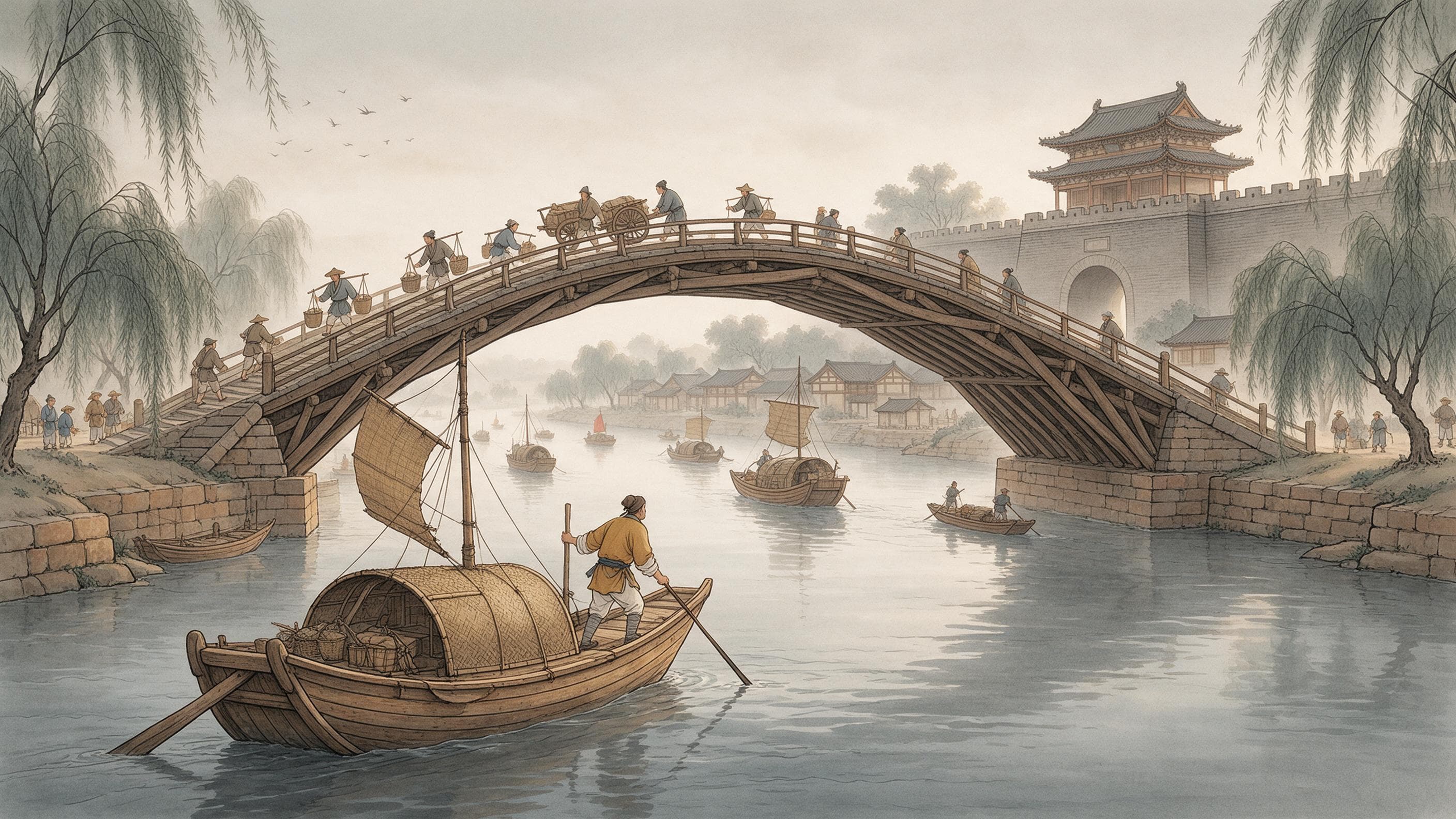
The four were the Cai, the Bian, the Wuzhang and the Jinshui. The Cai entered at the Dailou gate in the south-west and left at the Chenzhou gate in the south-east, with eleven bridges. The Bian came in from the Luo at the western capital and went east to Si prefecture to join the Huai: 'it carries the grain of the south-east, and all the goods of the south-east enter the capital by it; public and private alike depend on it.' Seven li outside the east water gate stood the Rainbow bridge, 'without piers, all of great timbers laid across, painted in vermilion, like a flying rainbow'. Eleven and thirteen make twenty-four. The Bian itself was an old canal: dug under the Sui as the Tongji, joining the Yellow river to the Huai, renamed Guangji under the Tang; the Song took its mouth at the south of Heyang county in Meng prefecture, and it ran to the Huai and the Si.
The Zhou bridge and the Xiangguo temple bridge were 'both low and flat, impassable to boats, only the flat boats of the western river could pass'; the Zhou bridge's piers were of bluestone, with stone beams, stone posts and balustrades. Height and material are not decoration here: a bridge a foot lower is a foot less boat. The same structure is a road on top and a gate below. The stone piers and balustrades are recorded; what mattered was the height of the deck.
Six chi and six million shi
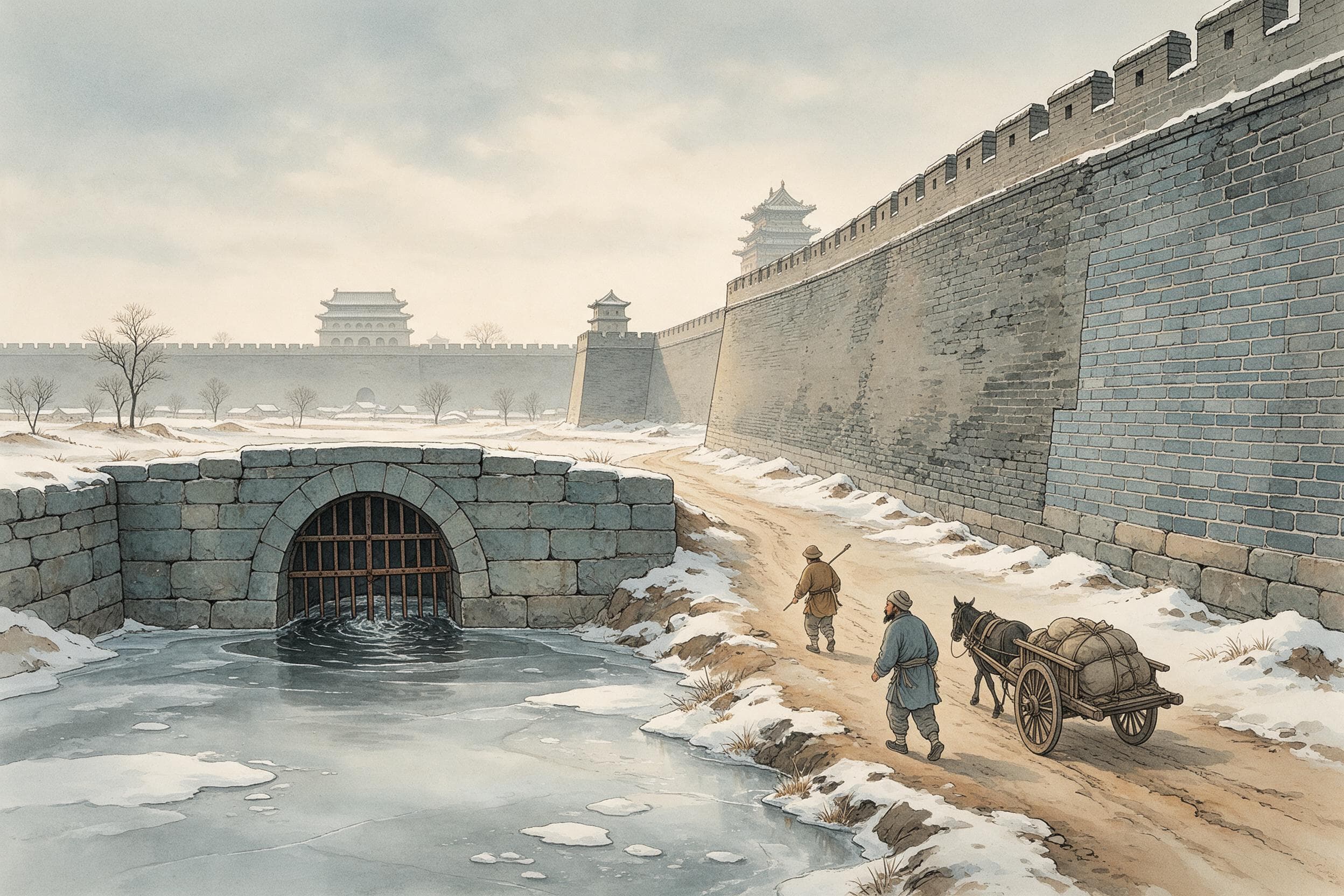
How large a boat the Bian could take was a question of water. The Song History's chapter on canals: 'every year from spring to winter the flow at the river mouth is regulated, kept to a depth of six chi, as the standard for heavy loads.' Six chi is the navigational standard at the mouth, not the depth of the whole river. The same chapter says 'several million shi of grain from Jianghuai, Huguang and Zhejiang are carried each year, with the produce of the south-east and countless goods besides'. The regulation was seasonal: from spring to winter the flow at the mouth was managed, not left to itself.
The annual quota is another set of figures. Zhang Fangping's memorial: 'at the founding three canals were dredged to bring grain to the capital, and annual quotas were fixed: the Bian 6,000,000 shi, the Guangji 620,000, the Hui min 600,000.' Six million shi is a quota written into the system, not what arrived each year; this piece does not treat the quota as traffic. One depth and one quota held up the whole grain route. The canals were the backbone of the system: Zhang Fangping's 'the state's grain transport rests on the canals' opens the same memorial, and of the three dredged at the founding the Bian carried the largest share.
The names of Lin'an's boats
In the Southern Song capital the boats had names. The Mengliang lu: 'the boats on Hangzhou's inner rivers are all luojiaotou boats, carrying scholars, merchants and all kinds of people, and moving incense, goods and miscellaneous things.' For people, the luojiaotou; for goods, the datan boat, 'which carries the rice of the shops from Huzhou market, firewood and charcoal from the Kuapu bridge, tiles, lime and mud from Xiatang, and the boats that move salt sacks'. The names are the classification: one kind for people, another for rice, fuel, tiles and salt. Water made everything easy: 'where the water route is convenient, boats are much used; where there is no water, men carry the loads.'
Leaving the city meant hiring: 'if scholars or commoners wish to go to Su, Hu, Chang, Xiu or the Jianghuai country, they mostly hire bijuan, fangchuan, hangchuan or feipeng boats.' For those destinations, those four types. And one telling line: 'great houses, mansions and estates also build boats of their own, to pole about as they please, with no fear of the government seizing them for service.' The sources give no fares, no hire prices, no journey times, and this piece does not supply them. The private boat is the only line in the three sources about who owned boats, and even that is about avoiding requisition.
Why boats at all
Why Lin'an used boats is written on its streets: 'formerly Bianjing used carts to move goods; but Hangzhou's streets are all stone slabs, not mud, and cart wheels cannot run on them, so boats and human labour are used.' Bianjing had earth underfoot and used carts; Hangzhou had stone and used boats and porters. The surface decides the transport — a more concrete sentence than any talk of a flourishing traffic. Stone streets are why Hangzhou's transport looks like a fleet rather than a cart yard.
The limits belong here too: Bianjing and Lin'an are kept separate, not merged into one city, with a single sentence of comparison; no boat price, hire price, fare or boatman's wage is given, because none of the three sources has one; no tonnage or capacity, since only names and uses are recorded; no bridge span, arch height or width, only 'without piers' and 'low and flat'. The boat names classify use, not technical specification. The four boat names are not explained in the text: what each looked like is not described, only where each was hired to go.
Two cities, two ways with water
Side by side: Bianjing was a gate for grain coming into the city — four rivers, twenty-four bridges, a bridge too low for boats, six chi at the river mouth, a quota of six million shi. Lin'an was a net of boats over stone streets — luojiaotou and datan boats on the inner rivers, hired boats for the country, private boats for great houses. One city used water as a highway for grain; the other as the cart of its streets. Both are descriptions of facilities, not of a market.
What can be written is this: four rivers, twenty-four bridges, six chi, six million shi, a handful of boat names, one sentence about wheels. No fares, no capacity, no journey times, no bridge spans; the sources stop at facilities and names. Writing the water route to that point is more solid than six words about a flourishing Song traffic. What is inside them is numbers, not adjectives.
Sources & further reading
- 《东京梦华录》卷一·河道(宋·孟元老;维基文库) — A Southern Song memoir of the Northern Song capital, not an archive: four rivers through the city — the Cai, the Bian, the Wuzhang and the Jinshui; eleven bridges on the Cai; thirteen on the Bian between seven li outside the east water gate and the west water gate; the Rainbow bridge without piers, of great timbers 'like a flying rainbow'; the Zhou bridge and the Xiangguo temple bridge 'low and flat, impassable to boats, only the flat western-river boats could pass'.
- 《宋史》卷九十三·河渠志三·汴河(元修;维基文库) — Yuan compilation, but it preserves the memorials: each year from spring to winter the water at the river mouth was regulated 'to a depth of six chi, as the standard for heavy loads'; several million shi of grain from Jianghuai, Huguang and Zhejiang were carried; Zhang Fangping's memorial gives the annual quotas — Bian 6,000,000 shi, Guangji 620,000, Huimin 600,000.
- 《梦粱录》卷十二·河舟(宋末元初·吴自牧;维基文库) — A late Song/early Yuan memoir of Lin'an: the inner-river boats are all luojiaotou boats for scholars, merchants and goods; the datan boats carry rice, firewood, charcoal, tiles, lime and salt sacks; for Suzhou, Huzhou, Changzhou, Xiuzhou and the Yangtze country people hire bijuan, fangchuan, hangchuan and feipeng boats; great houses built their own boats 'with no fear of the government seizing them for service'; the city's streets were stone-paved, so wheels could not run and boats and porters did the work.