The Qing code begins the walls of Beijing with a circuit: 'the inner city forty li round, with nine gates.' Forty li and nine gates, each named — Zhengyang, Chongwen, Xuanwu, Chaoyang, Dongzhi, Fucheng, Xizhi, Anding, Desheng. These are the figures of a statute, not of a survey; but of the numbers a circuit of wall can carry, this juan carries nearly all.
The account of one circuit
Inner city: 'a corner tower at each of the four corners; four sides repaired, 7,879 zhang 8 chi; three zhang five chi and more high; battlements five chi eight cun broad; base six zhang two chi thick; top five zhang wide; seven water gates below.' The circuit, the four corner towers, the length repaired, the height, the width of the battlements, the thickness at the base and at the top, the seven water gates. The code describes a profile — height, top width, base thickness, battlements — before it describes a line on a map. Battlements of five chi eight cun, a base of six zhang two chi and a top of five zhang: the profile of the inner wall, not just its length.
Outer city: 'the outer is a double wall, enclosing the south of the inner city, turning up to hold the two corner towers, and stopping northward; twenty-eight li round, with seven gates' — Yongding, Zuo'an, You'an, Guangqu, Dongbian, Guangning, Xibian; 'six corner towers; three sides repaired, 4,632 zhang 7 chi and more; two zhang high; battlements four chi; base two zhang thick; top one zhang four chi; three water gates below.' The outer city is not a full ring: it encloses the south and stops at the two corner towers.
Where the seven water gates were
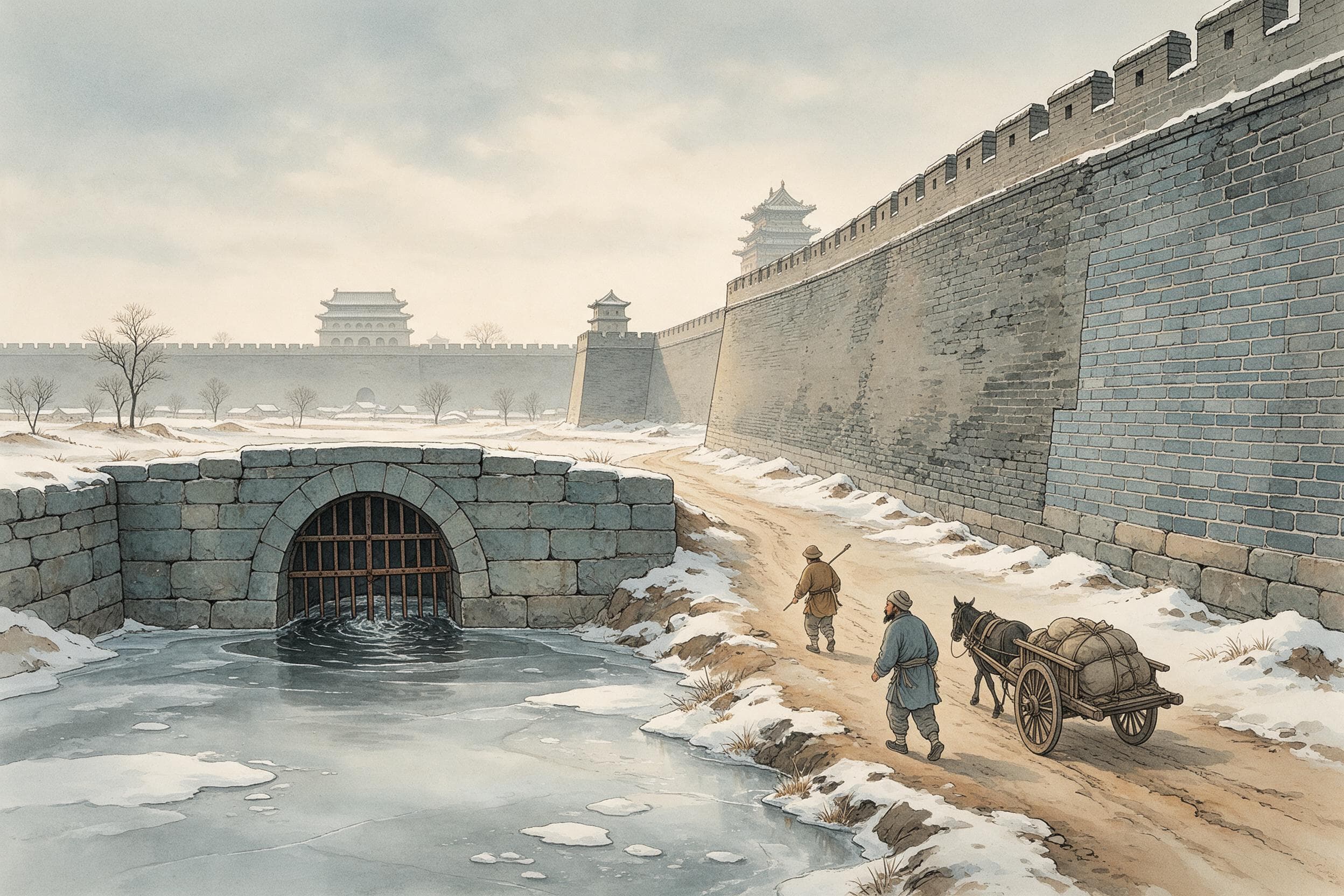
The code gives the positions in the text: one east and one west of the Zhengyang gate, one east of Chongwen, one west of Xuanwu, one south of Chaoyang, one south of Dongzhi, one west of Desheng — seven. The outer three: one east and one west of Dongbian, one east of Xibian. A water gate is a drain, not an ornament; seven and three, taken together, are the drainage plan of the two walls. Zhengyang, on the south, got two; every other gate got at most one.
One line must be held here: seven for the inner city and three for the outer are the counts of two different walls, and are not added into 'ten', nor written as 'ten water gates in all'. Where the water came from and where it went, none of these three books says, and this piece does not supply it.
How the wall changed
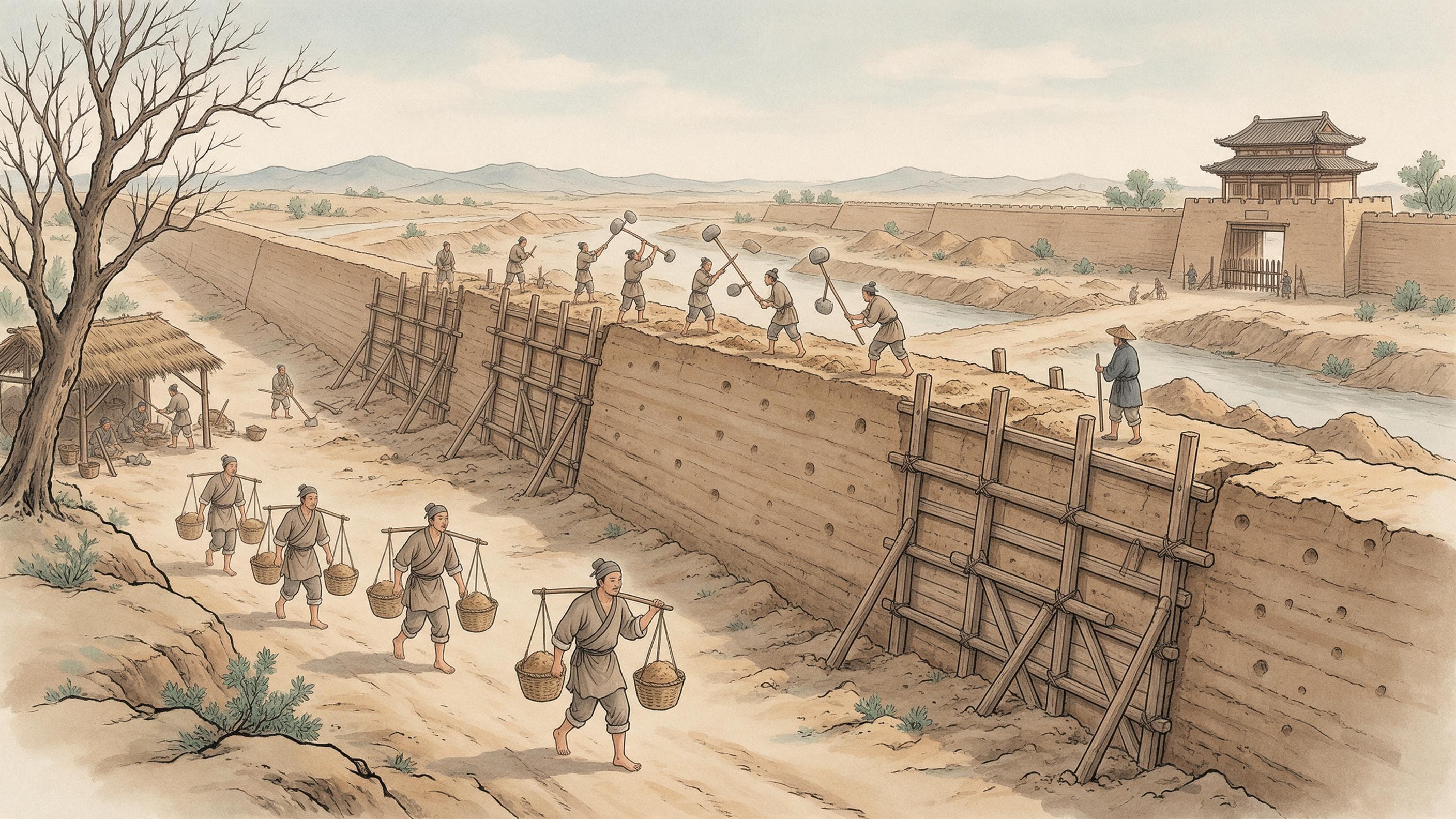
This circuit was not drawn once. The Rixia jiuwen kao, quoting the Hongwu register of Beiping: the old Yuan 'earth wall was sixty li round', and after the city was taken, 'because the enclosure was too wide, half of its east-west and northern extent was cut away, brick facing was added, and it came to forty li'. Quoting the Huanyu tongzhi: 'in the early Hongwu the Dadu circuit was renamed Beiping prefecture, the city was cut back five li at the north, the two northern gates Guangxi and Suqing were abolished, and the other nine remained.' The Tianzhi ouwen quotes the Ming veritable records: 'in the eleventh month of the seventeenth year of Yongle, the southern city of Beijing was extended by more than two thousand seven hundred zhang.' The two earliest statements describe one remodelling differently: the register has the wall cut back at the east, west and north, the gazetteer has five li taken off the north.
The same juan records the Ming measurements: Xu Da 'ordered the commander Hua Yunlong to manage the old Yuan capital and build the wall afresh, straight north to south, 1,890 zhang east-west'; Zhang Huan 'measured the old Yuan palace city, 1,206 zhang round'; Ye Guozhen 'measured the southern city, 5,328 zhang round'. The Ming wall's form: 'three zhang and more high on the east, south and west, two zhang wide at the top; on the north four zhang and more, five zhang wide; the moat one zhang and more deep, and more than eighteen zhang wide.' This was built in the early Ming and kept by the Qing. The 1,206 zhang of the old palace city is the smallest of the three circuits, and the only one measuring the ruler's enclosure rather than the city.
The granaries beyond the wall
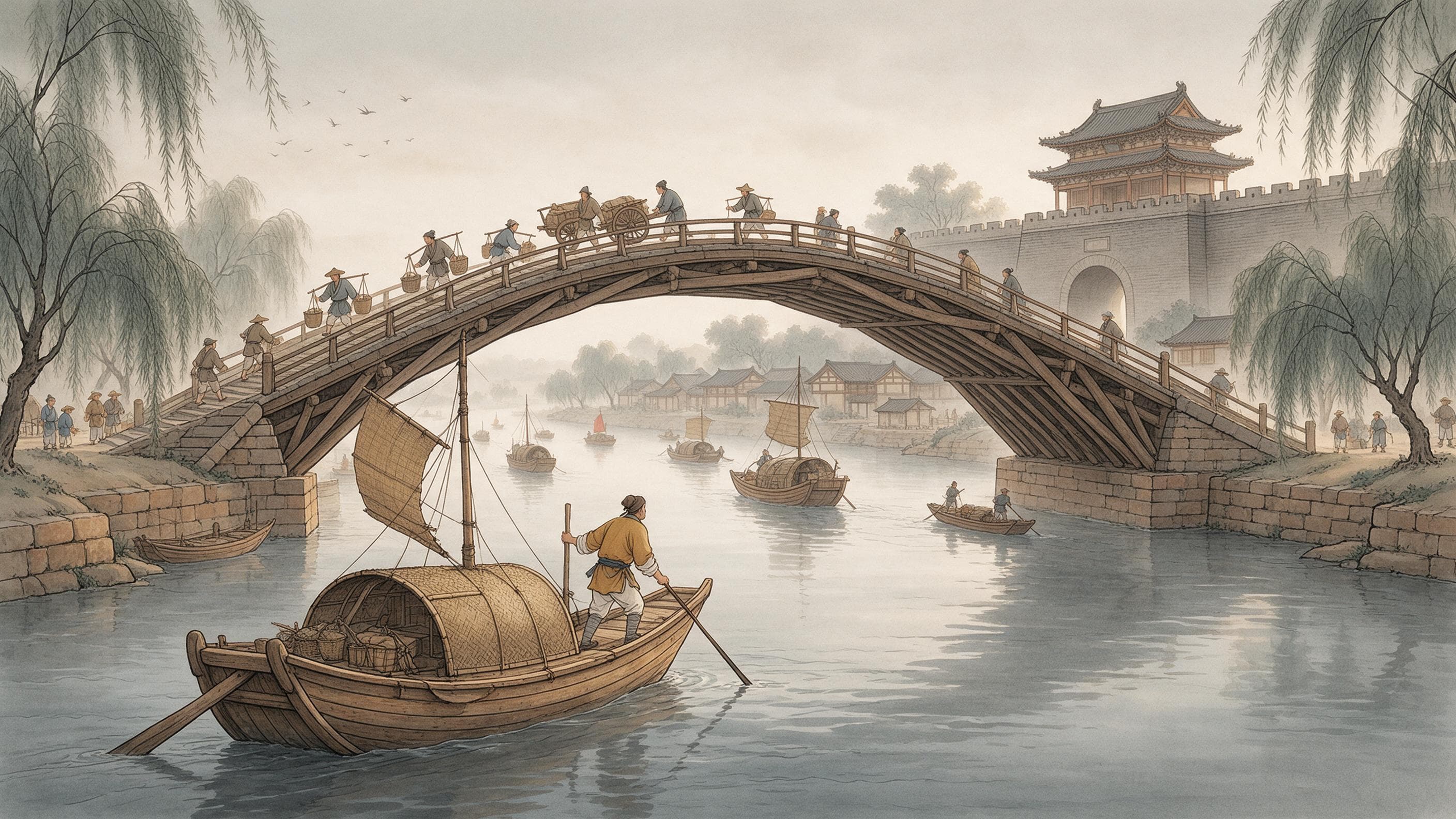
The account of a city is not one wall. The same juan goes on to the granaries: Chuji, outside Dongbian gate, '108 bays, five rooms to a bay, 540 rooms, three wells'; Benyu thirty bays and 150 rooms, Fengyi the same; the Tongzhou west granary '203 bays ... 1,016 rooms, nine wells'; the central granary '119 bays ... 596 rooms, five wells'. 'Outside every granary gate a water channel is cut and a bridge laid across it; in the second month of spring and autumn the supervising officer inspects and dredges it.' The standard for repairs was 'a hundred taels a granary a year'. Rooms are counted, not capacity: the code stops at rooms and wells.
The limits fall here too: the code gives bays and rooms, not the grain each granary held; it gives no total for repair silver, no labour force and no building time; and nothing on the population or the houses of the inner city. The sources are silent, and nothing is added.
One wall, one city
A few more lines: the code's zhang and chi are statute figures, not measurements, and are not written up as 'the measured height of the wall'; no comparison with the longest wall in the world is made; the Ming wall is not turned into a Qing foundation — the Qing kept the Ming city, and Ming figures are always marked as built in the early Ming and kept by the Qing; Beijing is not said to be the Yuan capital 'directly enlarged', since the Hongwu cut back and the Yongle extended — remodelling, not enlargement; and zhang and chi are not converted into metres, except as 'about' with the conventional conversion noted.
Side by side, to close: inner city forty li, nine gates, seven water gates, a height and a base and a top each with its figure; outer city twenty-eight li, seven gates, three water gates; two lengths of repair, 7,879 zhang 8 chi and 4,632 zhang 7 chi and more; and beyond the wall the granaries — Chuji 540 rooms, Tongzhou west 1,016, the central granary 596 — with a channel and bridge outside each gate, dredged twice a year, and a hundred taels a granary for repairs. The account of a city is not one wall. Every figure here is a statute, every shape a history. That is the whole of the account.
Sources & further reading
- 《钦定大清会典》卷七十二·工部·营缮清吏司·城垣(清官修;四库全书本,维基文库;四库本无标点,引文按文义加标点,未与点校本复核) — The statutes of the city wall: the inner city forty li round with nine gates, a corner tower at each of the four corners, 7,879 zhang 8 chi of repair, three zhang five chi and more high, battlements five chi eight cun broad, base six zhang two chi thick, top five zhang wide, seven water gates (positions given in the text); the outer city enclosing the south of the inner one and turning up at both corners, twenty-eight li round with seven gates, six corner towers, 4,632 zhang 7 chi of repair on three sides, two zhang high, three water gates; the granaries — Chuji 108 bays of five rooms each, 540 rooms, three wells; Tongzhou west granary 203 bays of 1,016 rooms and nine wells; the central granary 119 bays, 596 rooms, five wells; a water channel and bridge outside each gate, dredged each spring and autumn; repairs at a hundred taels a granary a year.
- 《日下旧闻考》卷三十八·京城总纪(清于敏中等;四库本,维基文库) — A Qing compilation with sources marked: the old Yuan earth wall sixty li round, then 'reduced by half of its north-east and west', faced with brick and brought to forty li (Hongwu register); in the early Hongwu the city was cut back five li at the north and the Guangxi and Suqing gates abolished, the other nine kept (Huanyu tongzhi); Xu Da's wall 1,890 zhang east-west, the old Yuan palace city 1,206 zhang round, the southern city 5,328 zhang (Ming Taizu shilu); the Ming wall three zhang and more high on three sides, four on the north, the moat over one zhang deep and eighteen zhang wide.
- 《天咫偶闻》卷十(清震钧;维基文库) — A late Qing notebook quoting older books: the Huanyu tongzhi on the early Hongwu cutting of the city by five li at the north and abolishing the two gates; the Ming shilu on the eleventh month of 1419, when the southern city of Beijing was extended by more than two thousand seven hundred zhang. A third witness to how Qing writers retold the Ming changes, not a Qing statute.