On a turtle plastron, on a bingzi day, a diviner named Wei asked two opposite questions: 我受年 — will we receive the harvest — and 我不其受年 — will we not. It was not idle curiosity. The harvest was where the offerings came from: no grain, no wine, no animals to present, and the ancestors would have nothing to eat. Before the Shang knelt to their ancestors, they first asked the bones whether the year would feed them.
The question, carved into bone
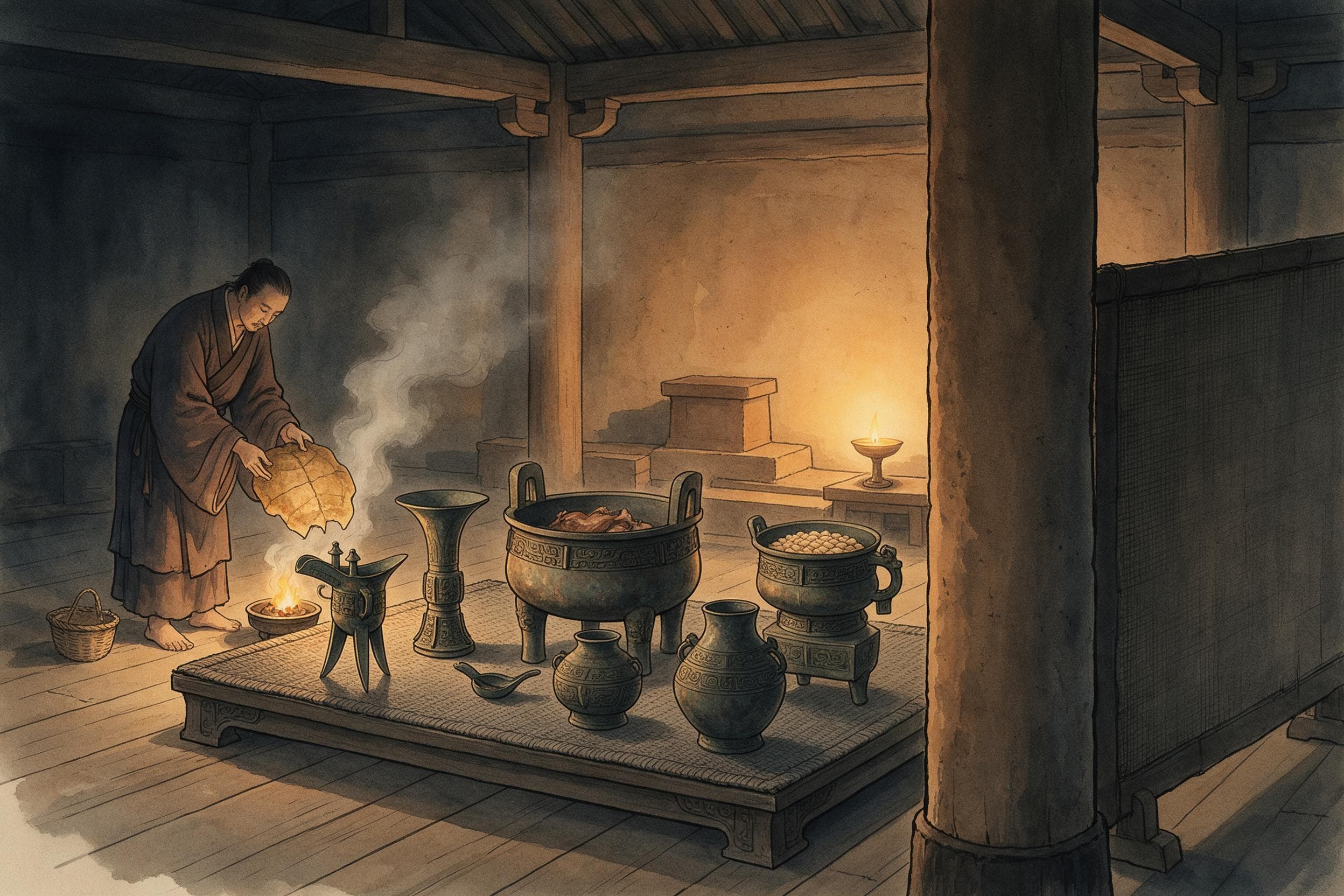
Divination was how the Shang king handled what mattered. The Academia Sinica museum's own description of its oracle-bone material says the king divined on everything from great matters of natural disaster and war down to illness and the meaning of dreams. The diviner (贞人) conducted the reading and wrote the royal record. The character for year, 年, is a person with grain on their head: 禾 above 人. A question was put to a heated turtle plastron or ox shoulder blade; the cracks that opened were read as the answer, and the question, the day and the diviner's name were carved beside them. The pairing is itself the method: the statement and its negation are both laid before the bone, and the cracks choose. Sacrifice in the oracle bones is therefore never a separate ceremony: it belongs to a sequence — ask first, offer afterwards. One caution about the material: these are royal archives, recording the king and his court. How commoners sacrificed to their ancestors is not recorded in either the bones or the graves. The diviner's own name is part of the record — Wei is the man who asked — which is what makes a royal archive readable.
Food as the bridge
The Shang believed that the dead became ancestors who could protect the living, and that the living, reverencing those ancestors, should offer them food and wine in return for protection and blessing. The researchers put it plainly: food was the most important medium connecting the living with the dead, and human beings with the gods. That sentence defines the rite. It is less a memorial than a continuing exchange — wine and food go one way, protection comes back the other. The bronze vessels were buried in sets because they were the instruments of that exchange. It follows that the king's question about the harvest was also a question about what he could afford to put on the table: a poor year meant fewer animals, less wine, a thinner offering for the dead.
One bronze set, three jobs
The ritual vessels have a division of labour. Food vessels — the ding, gui, li and yan — held meat and grain: a ding stewed meat, a gui held cooked millet, a yan steamed. Wine vessels — jue cups, gu beakers, gong, zun, you, hu, lei, jia — held and poured the drink, and water vessels, pan and he, were for washing at the feast. What stands out is the wine: many vessels, many shapes, so many that 'wine-heavy' is the standard description of Shang ritual bronze. Wine was not a side dish to the offering; it was one of its two main parts. The set worked like a grammar: to offer a thing properly you needed the vessel made for it.
What went up
Part of the offering list can be reconstructed. There was wine, hence the sets of wine vessels. There were animals, hence the meat cauldrons. There was also a fruit dish: several small earthenware jars from tomb M54 came out with their contents hardened into a single block, and when broken open the block held many small fruit stones, identified as plum, which 'may indicate that the jars held a fruit stew' when buried. The word is may: these are grave goods, and they do not prove that a fruit stew was always offered. The researchers also infer that cooks built broth from natural spices, or cracked animal bones and boiled them down to enrich a millet gruel — an inference from the research, not a line of oracle bone, and marked as such. None of this is written on bone; it is what the vessels and the residues suggest. Meat itself is the inference the cauldrons invite: a vessel built for stewing implies an animal to stew.
Retainers and victims are not the same
There were human costs. Tomb M54 contained fifteen human retainers and fifteen dogs. Two categories must be kept apart. The retainers (殉人) were probably close servants, guards or consorts who went with the tomb owner; the sacrificial victims (牲人) were offered, and their position and treatment differed — the victims on the ledge had a meat intake that 'dropped to barely above the level of herbivores', with a diet almost entirely plant. In the same tomb the owner's nutrition was the highest, the retainers' next, the victims' lowest: what you ate was who you were, and the ritual sorted the dead and the living into the same ranks. The two words matter: one accompanies the dead, the other is offered to them. This passage stays restrained: the material gives numbers and positions, not descriptions of any single ceremony, and the scale and origin of the victims rest on this one tomb, not on the whole kingdom.
The gaps need saying too. How often the sacrifices were held cannot be stated — the bones carry many divinations about sacrifice but no calendar, so 'frequently' is as far as the sources go, with no count. The number and grade of offerings at one rite are not recorded as a rule. The steps of a wine offering belong to divinations the brief did not check clause by clause, and are not attempted here. How commoners worshipped has left no material at all, and the later Rites of Zhou and Book of Rites cannot be read back into the Shang. What can be established is a chain: the Shang believed their dead became ancestors who could protect them, so they asked the bones about the harvest, poured wine and set meat in bronze, and sent retainers, victims and dogs into the ground — carrying one exchange through to the end. What is most telling is the plastron itself: it records the question and the date, and never the answer — how much that year actually yielded. The Shang left a ritual with its accounts missing: belief, gear and human cost, but no price list, no calendar and no rule of quantities. What came back is not on the bone either; the return was expected as harvest, weather, health and victory, not as a written answer.
Sources & further reading
- 吴梦洋〈亚长的餐桌:一位商代将军的饮食人生〉,《中国社会科学报》2026年7月28日A12版(中国社会科学院考古研究所网站转载) — 商人相信祖先能保佑生者、向祖先与神灵敬献食物美酒;青铜食器酒器水器之分与「重酒」;陶罍梅核(可能为果羹);香料与骨汤提鲜(研究者推断);亚长墓殉人15个个体、殉狗15条,牲人食肉水平极低;饮食等级与身份对应
- 中研院历史语言研究所历史文物陈列馆〈我受年──甲骨文「年」的故事〉 — 甲骨《乙》867 释文:「丙子卜,韦贞,我受年」「丙子卜,韦贞,我不其受年」;「年」字上禾下人
- 中研院历史语言研究所历史文物陈列馆〈通天神龟──商代占卜用具说明书〉 — 商王占卜范围:大至天灾、兵戎,小至治病、解梦