In the twelfth month a pig is killed. The meat cannot all be eaten before it turns, so the problem shifts from how to kill to how to keep. The sixth-century Qimin Yaoshu (齊民要術, Essential Techniques for the Common People) answers in two places. The chapter on pigs says when to kill and how to fatten. The ninth chapter, under a heading that bundles salt-cured, fat-cooked, lees-cured and mud-packed meat, says what to do afterwards. Set side by side, the methods are not three versions of one trick. They are three different ideas.
1. The twelfth month: season as an ingredient
Start with why the twelfth month. The pig chapter gives the year's rhythm: through the eighth, ninth and tenth months the pigs are turned out to feed themselves and are not fed at home, and the distillers' grains and chaff are kept back 'for the depth of winter and the first of spring'. A pig that has eaten well through the autumn lays on fat as the cold comes, and by the twelfth month it is at its fattest. The same chapter has piglets' tails nipped at three days and the boars castrated at sixty, noting that a barrow 'has fine bones and much meat'. Piglets born in the eleventh or twelfth month had to be steamed overnight in a steamer, or they died of cold within ten days.
That rhythm fixes the timing of everything that follows. The first of the four methods opens with a rule: 'Made in the twelfth month it is good and keeps through the summer without worms; made in other months it must be covered and guarded, for if the seal is not tight, worms breed.' One recipe, a different month, a different result. In this technology the season is an ingredient. The same chapter also has ao meat, simmered in fat, wine and salt until the fat covers the meat, and the lees-cured and mud-packed cuts — though the lees recipe is careful to say it can be made in any of the four seasons.
2. Zha: pack the pork in cooked rice and wait for the sourness
The first road is the shortest. The whole recipe runs to three sentences: 'Take good fat pork and cut it into pieces; salt it so that it is neither too salt nor too flat. Use cooked rice as the meal, as in making zha. When you can smell the sourness, it can be eaten.'
What matters is the test at the end: not a number of days, not a colour, but a smell. The cook decides with the nose when to open the jar. The phrase 'as in making zha' also tells us that zha-making was common knowledge, a method the reader already had; pork zha simply swaps the meat and follows the established method for fish.
A modern explanation: micro-organisms feed on the starch in the rice and produce acids, and as the acidity rises, the bacteria that spoil meat slow down; the salt draws water out at the same time. None of this is in the text, which offers only 'when you can smell the sourness'. The recipe records an operation and a judgement, not a principle.
3. Lees-cured pork: wine, salt and ten days
The second road uses the lees left from brewing. 'Method for lees-cured meat: mix wine lees with water and knead it to the thickness of gruel; add salt until it is salty. Put pengzhi meat into the lees. Keep the jar in a shaded place under the house. Eaten with wine or with rice, it is always grilled first.' Then the shelf life, in one line: 'In summer weather it goes ten days without stinking.'
Three things work at once: salt draws out water, the lees cut the meat off from the air, and the shade keeps it cool. Nor is the meat raw. In the roasting chapter, pengzhi is a large cut held close to the fire, one side at a time, sliced as it whitens. Meat treated that way has already met the fire. Buried in lees, it wears two coats.
The lees were not waste. In the pig chapter, grains and chaff are stored to feed pigs through the winter; in the ninth chapter, lees are a pickling medium. What comes out of a brewing jar has two uses in one household, depending on the season and the need. Ten days does not sound long, but these are ten days of summer — the worst ten days of the year for meat.
4. Bao: mud, straw and the north wall
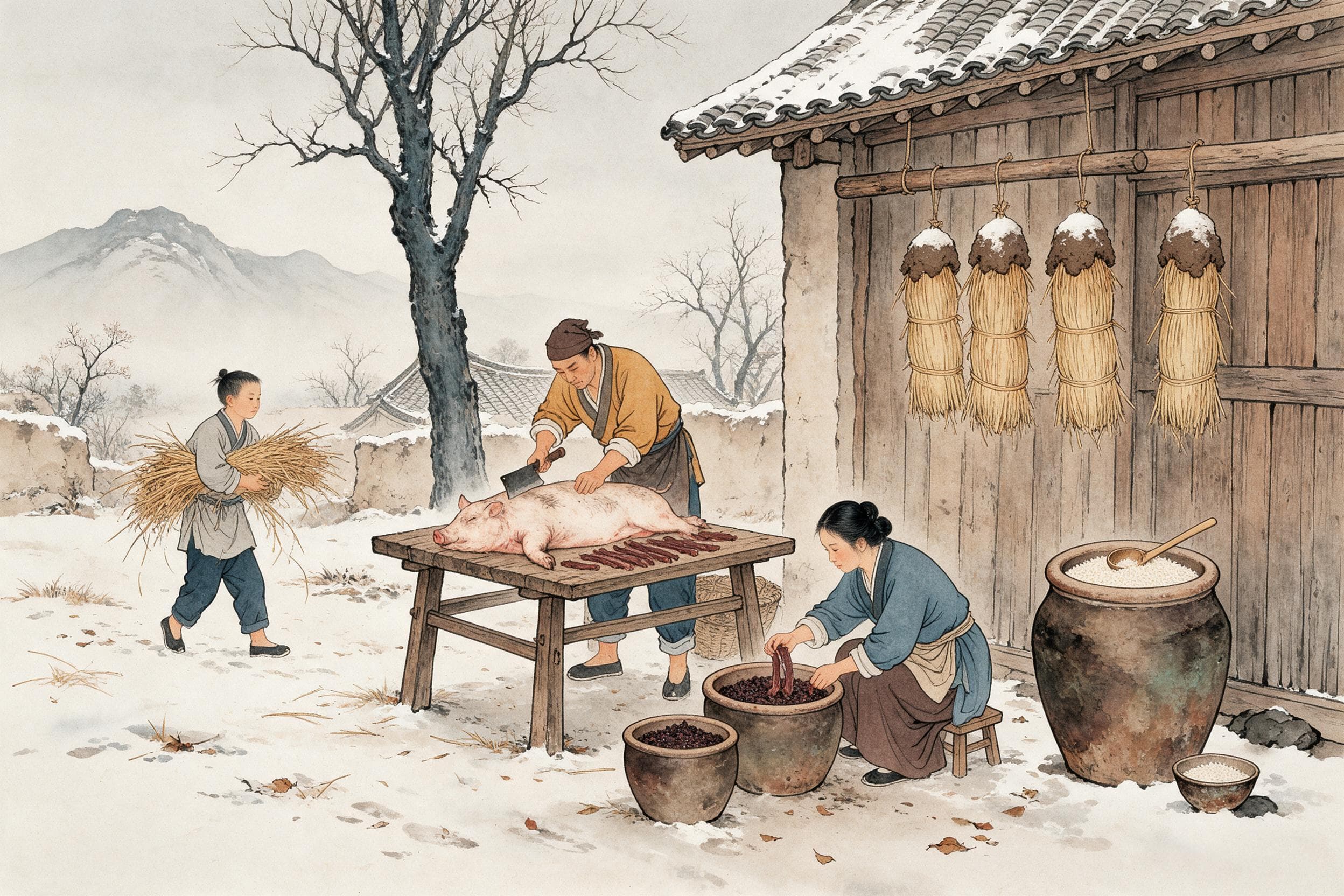
The third road uses the least material and demands the most timing: 'In the twelfth month kill the pig. After a night, when the liquid is gone and the meat is just dry, cut it into the shape for pengzhi and wrap it in cogongrass or sedge. If you have neither, rice straw will do. Seal it with thick mud and do not let it crack; if it cracks, mud it again. Hang it outside on the north side of the house, in the shade, and it will last to the seventh or eighth month, like newly killed meat.'
The timing is precise: a night after the killing, when 'the liquid is gone and the meat is just dry' — blood drained, the surface drying but not dried. Cut into strips, wrap in grass, plaster with mud, patch the cracks. Then it does not go into the house; it hangs outside on the north wall. From the twelfth month to the seventh or eighth, most of a year, and it comes down 'like newly killed meat'.
There is no salt in this recipe at all. It relies on a shell that air cannot pass, a place out of the sun, and the coldest weeks of the year. The mud stops insects and air; the north wall stops the sun. Why the meat inside does not change, the book never explains. It leaves only the four characters 'like newly killed meat'.
5. Three roads, three different levers
Set together, the three answer different questions. Zha makes the meat sour. Lees-curing surrounds it with salt and wine. Bao seals it and puts it in the coldest, darkest place available. One works by fermentation, one by salt and the exclusion of air, one by enclosure and cold. That three approaches sit side by side in one book suggests a household with a whole toolkit, not a single word like 'pickle'.
A modern explanation: salt lowers the water available in the meat, so spoilage organisms struggle; the rice fermentation produces acid, and at higher acidity other organisms stop; the mud seal and the north wall exclude air and keep the temperature down. All three change the environment so that the meat spoils more slowly. The text has none of this vocabulary. It is ours.
So it will not do to say the ancients understood the science of preservation. What they had was a set of operations and judgements worked out by trial: which month, how much salt, what smell means ready, patch the mud when it cracks. Those rules survived because they worked in a place with no refrigerator; why they worked was explained much later. What the book hands down is the hands, not the theory. A jar, a crock of lees and a north wall were the whole of the equipment.
Sources & further reading
- 贾思勰《齐民要术》卷第九「作𦞤奥糟苞第八十一」「炙法第八十」(猪肉鲊、作糟肉、苞肉、作𦞤肉、捧炙)(Jia Sixie, Qimin Yaoshu, juan 9: 'Pickled, Fat-cooked, Lees-cured and Mud-packed Meat', with the roasting chapter) — All three methods quoted here, plus the pengzhi cut of meat that both the lees and the mud methods start from.
- 贾思勰《齐民要术》卷第六「养猪第五十八」(Jia Sixie, Qimin Yaoshu, juan 6: 'Raising Pigs') — Why the twelfth month: the autumn feeding regime, grain and chaff stored for deep winter, castration, and winter piglets kept alive in a steamer.