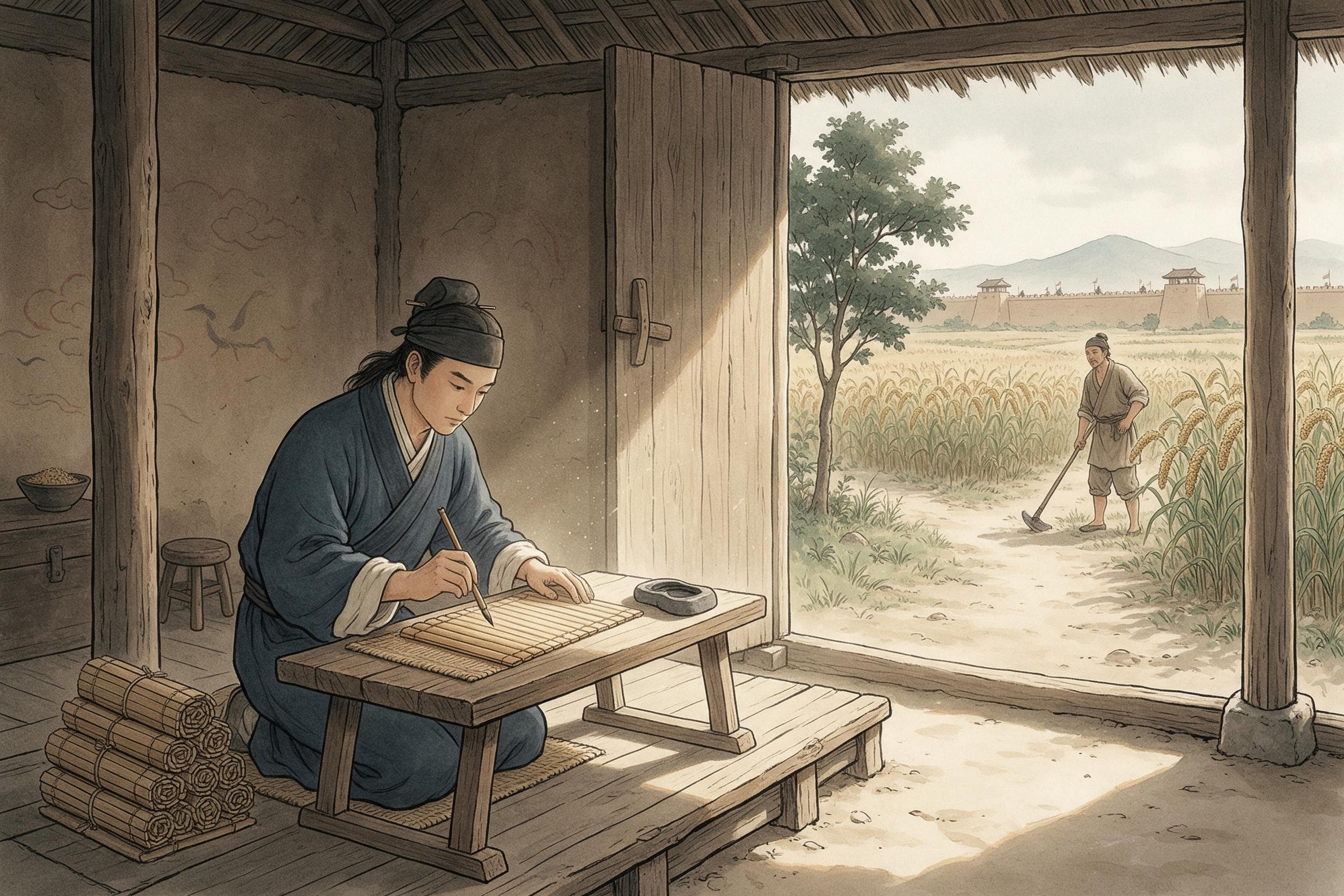
A clerk sits down in a county office in the late Warring States and writes a report about rain. Under the Field Statutes of Qin, every fall of rain, every field of millet coming into ear, every patch newly broken, every crop damaged, had to be reported in writing with the number of qing (顷, roughly a hundred mu) affected. Nearby counties sent a fast runner with the document; distant ones used the post; the deadline was the end of the eighth month. This is what being a 'registered household' looked like on paper: the state kept a written tally on the weather of every field. No actual report from the period survives; what survives is the statute demanding one, and in an archive that is itself the point. The statutes are known from a tomb at Shuihudi in Yunmeng, Hubei, buried in the third century BCE.
Rain, ears of millet, and a count of fields
The Field Statutes are detailed almost to the point of fussiness. When rain has fallen and the millet is in ear, a written report must give the number of qing of grain that received the rain, of millet in ear, and of land broken but not planted. If rain falls after the crop is up, the report must say how much fell and how many qing benefited. Drought, storms, floods, locusts and anything else that damages the crop must also be reported by qing. Even the delivery is specified: fast runners for near counties, the post for distant ones, everything in by the end of the eighth month. The unit that matters is the qing — not the household, not the person, but land the state had measured. The units are ordinary ones: a qing is a hundred mu, and a mu is not turned into square metres here, because the statute gives a ratio, not a modern area.
Fodder on the allocated acre
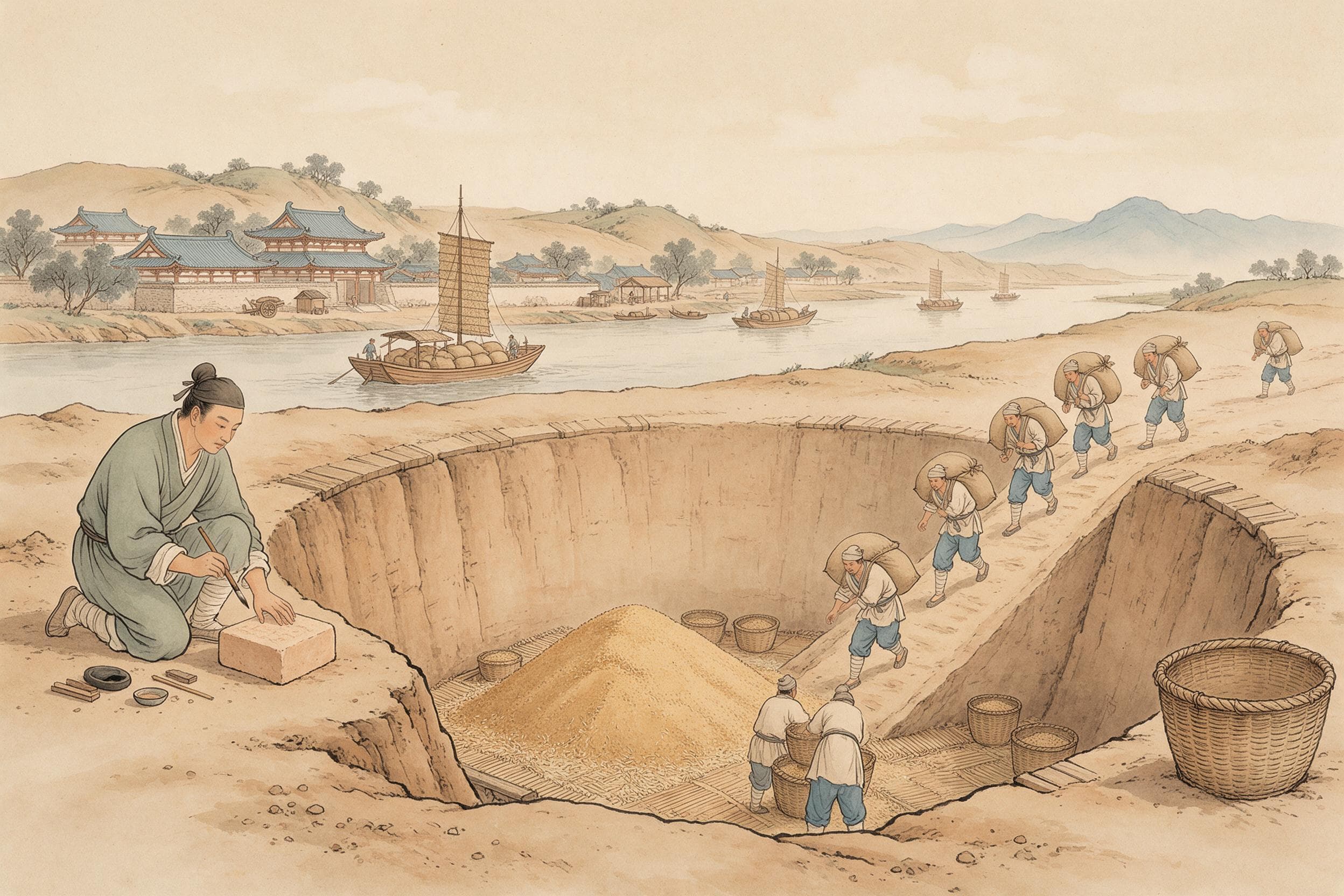
Once the land was on the books, the levy followed. The same statute sets the fodder: 入顷刍稾,以其受田之数,无垦不垦,顷入刍三石、稾二石 — for every qing, three shi of fodder and two shi of straw, assessed on the household's allocated land (受田之数) whether it had been broken or not. A qing was about a hundred mu; how much land each household actually received is not stated in this statute, and this article does not invent a figure — the 'hundred mu' of Mencius belongs to a different argument, below. The four characters 受田之数 are the hinge: they imply that the state held a register of what each household was owed and owed. The levy is in kind, fodder and straw, the sort of charge a state collects when it needs feed more than coin; the register therefore had two faces at once, what the land grew and what the household owed for it.
The bailiff watching the village
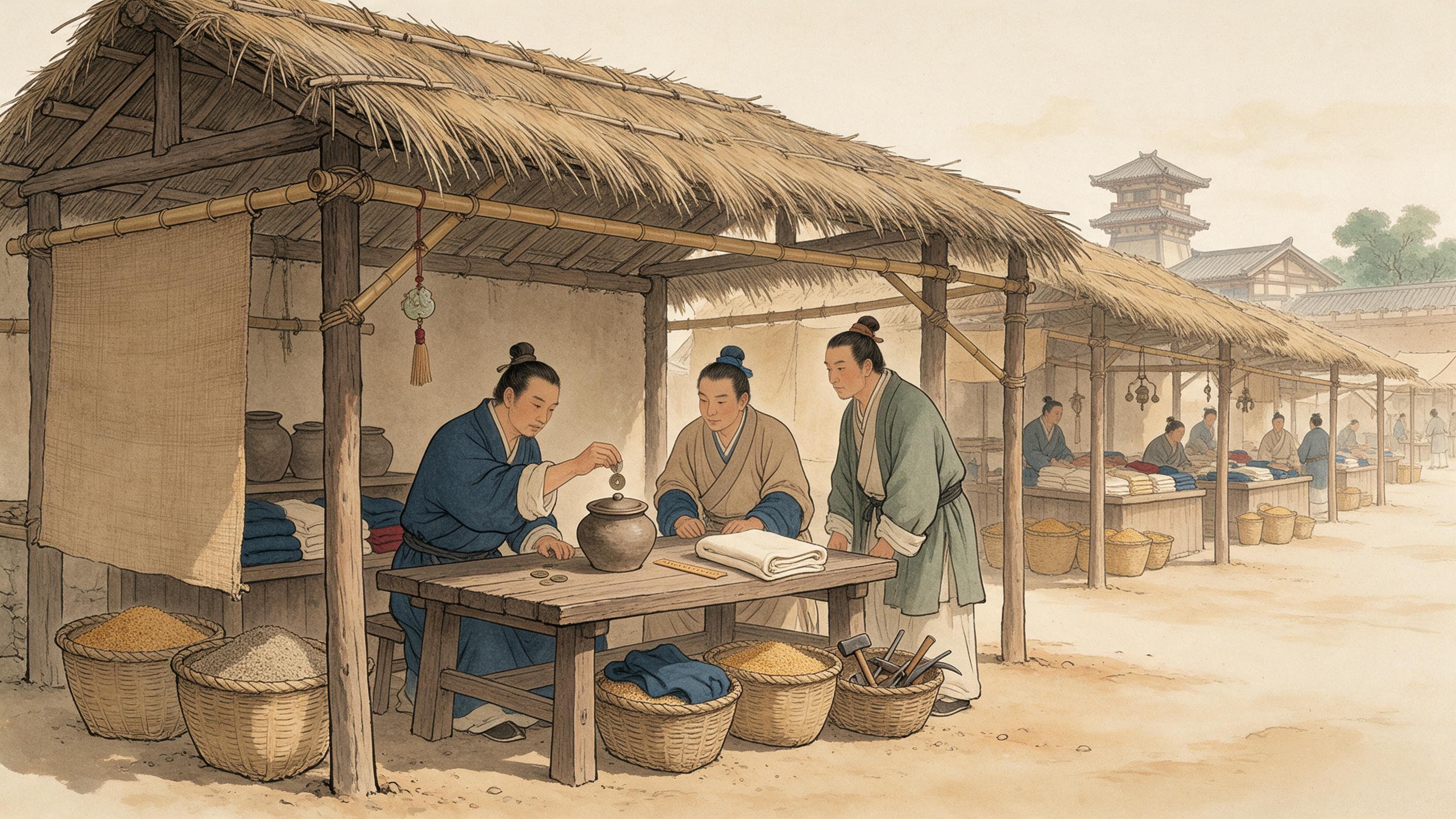
The men who enforced all this were village-level officers. Another clause of the Field Statutes reads: 百姓居田舍者毋敢酤酒,田啬夫、部佐谨禁御之,有不从令者有罪 — households living in the fields must not sell wine, and the field bailiff (田啬夫) and the sub-district assistant (部佐) must stop them; anyone who disobeys is liable. Wine-selling in a farming hamlet was a matter for the statutes, which tells you where the enforcement actually happened: not in the court, but in the village, in front of the people who were being counted. How many households a bailiff covered, and how the duty rotated, the material does not say. What the clause does show is the reach of the register: a state that counted fields also had an opinion about a village's wine jar.
Corvée on a clock
Beyond the fields there was labour. The Corvée Statutes set the penalties in steps: when the central government calls men up and a man fails to go, the fine is two suits of armour (二甲); three to five days late, a reprimand; six to ten days, one shield (一盾); over ten days, one suit of armour (一甲). Armour and shields are goods, and how they converted into money is not recorded — so no conversion is attempted here. Public works even had a warranty: men conscripted to build a town wall made it 嫴堵卒岁, guaranteed for a year; if it collapsed inside the year, the director of works and the gentlemen in charge were liable, the labourers rebuilt the wall, and the rebuilding did not count as corvée service. What the ladder of penalties shows is that the state had priced time: a few days late cost a reprimand, ten days cost a suit of armour, and the schedule was written down so that the price could be applied without argument.
Mencius drew a different countryside
In the same Warring States, Mencius offered another picture. In the state of Teng he described the well-field: 方里而井,井九百亩,其中为公田;八家皆私百亩,同养公田;公事毕,然后敢治私事 — a square li divided into nine hundred mu, a hundred of them public in the middle, eight households each holding a hundred mu privately and tilling the public field together; only when the public work was finished might a family do its own. He added that the people need constant property to have constant hearts (有恒产者有恒心), making land the ground of good government. The arithmetic is neat: eight households of a hundred mu make eight hundred, plus the hundred in the middle, exactly the nine hundred of the well — one field in nine is public. This is a proposal, a blueprint, argued in Teng — not what Qin did. Set the two side by side and the countryside has two imaginations: the statute asks how the state should keep its books; the philosopher asks what the state should give.
The line between the documented and the missing is clear. What is documented: in late Warring States Qin, rain, crop damage and newly broken land were reported by qing; fodder was levied on allocated land; missed corvée was fined in armour and shields; public walls carried a one-year guarantee. The medium was paperwork and the men were village bailiffs. What is missing is much larger: how the household registers were compiled, and how the five- and ten-household groups were organised, belong to statutes the brief could not check clause by clause and are marked unread; whether the reports were accurate, and who verified them, is not recorded; whether the other states did the same cannot be said, because the material is Qin's alone; and the real weight of a fine in armour cannot be turned into modern money. The registered farmer, in this archive, is not a person with a story: he is a number of qing, a quantity of fodder, a date on which he was due to arrive. One plain question remains: when the reports on rain and qing reached the county office, who read them?
Sources & further reading
- 睡虎地秦简《秦律十八种·田律》 — 雨、秀粟、垦田、灾伤按顷数书面上报,近县轻足送、远县邮行,尽八月;「入顷刍稾,以其受田之数」,顷入刍三石、稾二石;田舍百姓毋敢酤酒,田啬夫、部佐禁御
- 睡虎地秦简《秦律十八种·徭律》 — 御中发征乏弗行赀二甲;失期三日到五日谇,六日到旬赀一盾,过旬赀一甲;兴徒为邑中功者令嫴堵卒岁,未卒堵坏则主事者有罪、役徒复垣且不计为徭
- 《孟子·滕文公上》 — 井田「方里而井,井九百亩,其中为公田,八家皆私百亩,同养公田」;「有恒产者有恒心」;属主张与蓝图,非秦制实录