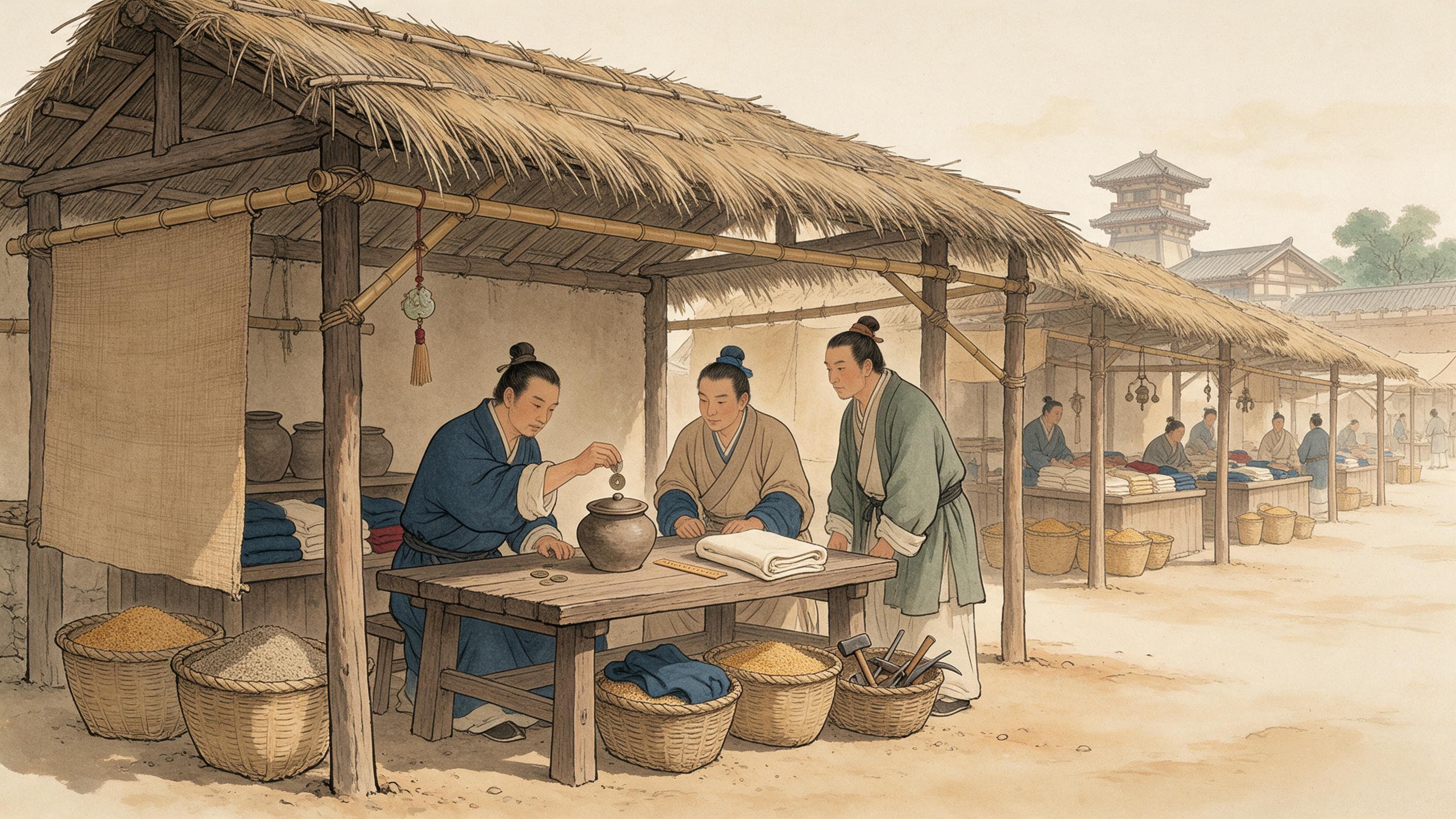
A row of market stalls, and a small action: a clerk of the market is receiving money — for craft work, or for a purchase the government is making — and the statute tells him exactly what to do with it. “When receiving money for craft work or for an official purchase, one must at once put it into the money jar (qian xiang, 钱缿), and have the payer see it go in. Whoever disobeys is fined one suit of armour.” The jar is not the point. The witness is: the payer must watch the coins enter, so that the money taken is the money recorded; and the penalty is a piece of military equipment, not a reprimand.
That sentence is all that survives under the heading Guan Shi (关市, “passes and markets”) in the Shuihudi bamboo slips, found in a tomb at Shuihudi, Yunmeng, in Hubei, and written in the late Warring States or Qin period. These are working statutes, not commentary. It follows that the sentence is one statute, not a code for the market, and that it never names the jar's material — clay, wood and bamboo are all absent. This article stays with what the slips say, plus a few clauses of the Jin Bu (金布) statutes that supply the assumptions the jar rests on. The online transcription used here gives no slip numbers, so the quotations are located by chapter, not by slip.
Why the jar had to be seen
Two phrases are easy to skim past. Zuo wu (作务) is craft work: the labour of workshops and artisans. Guan fu shi (官府市) is the government itself as a buyer. In both cases the state stands on the receiving side of the money, which is exactly where a receipt matters. The penalty, zi yi jia (赀一甲), is reckoned in armour, one suit, and the statute does not convert it into coin; this article does not convert it either. A market clerk who pocketed a payment had, in the arithmetic of this law, cost the state a suit of armour.
Eleven coins to a bolt of cloth
The jar governs how coin comes in; the Jin Bu statutes govern what coin is worth beside the other currencies in use. “Eleven coins make one bolt of cloth. Where coin is paid in or out against gold or cloth, it is done by statute.” That is a legal rate, not a market price: it governs official conversions and says nothing about what a bolt cost to buy, still less what eleven coins could buy. The bolt itself is specified like a manufactured good: “Cloth eight chi long and two chi five cun wide. Cloth that is poor, or whose width or length does not match the standard, does not circulate.” Cloth here is money with a legal size — and it is also cloth, the material clothes are cut from. A bolt that failed the measure was not money; it could still be cloth.
A thousand coins to the basket
The state's own intake has its own procedure. “Those who receive money for the government: a thousand coins to one basket (ben, 畚), sealed with the seal of the assistant and the magistrate. Less than a thousand is also sealed. Good and bad coin are packed in together. When money is paid out, the seals are presented to the assistant and the magistrate, and only then is it opened for use.” The same logic runs through the market: “When commoners use coin in the market, good and bad are mixed; they must not be sorted apart.” A further clause forbids picking and choosing outright: neither the traders in the market rows nor the government's own clerks may refuse this coin or that cloth; if the row leader fails to report it, or a clerk's inspection is careless, all are liable. Responsibility runs down the rows, stall by stall. The lie wu zhang (列伍长) is a row-level officer, which tells us what the jar clause does not: the market was laid out in rows, and each row had someone answerable for it.
The price on the goods
The clause closest to retail trade concerns the price tag: “Where there is selling and buying, each attaches its price; for small articles that cannot come to a coin apiece, no price need be attached.” The verb ying (婴) means to fasten or attach, so the image is a tag or a notice fixed to the goods rather than a price called out — an inference from the wording, since the slips nowhere describe a tag. The clause assumes two things: that goods in a market carried visible prices, and that the smallest goods were exempt because a single coin could not buy them. It does not say who checked the tags, or where the exemption stopped. The exemption itself is evidence of a sort: the law troubles to exempt goods cheaper than a single coin, which means such goods existed and that a coin was a coarse unit in everyday trade.
Which coin? The slips do not say
The Shiji supplies the familiar picture: “When it came to Qin, the coins of the whole realm were made into two grades: gold, reckoned by the yi, as the upper coin; copper coin inscribed ‘half liang’, its weight matching its inscription, as the lower. Pearls, jade, tortoise shell, cowrie, silver and tin were treasure for ornament, not coin.” That is a Han historian's retrospect, written well over a century later. It tells us what the Qin currency system was remembered as; it does not license us to read “half liang” back into the statute, which says only qian, coin. Nor does the cloth clause mean that Qin used cloth instead of coin: the two circulated together at a statutory rate, and the government collected both. Note also how the passage grades them — gold by the yi, a unit of weight, copper by the coin — without giving a rate between the two; the clauses used here supply none.
Add up what these clauses do and do not contain. They do: a witnessed payment into a jar, and a fine in armour for failing it; a cloth standard with a legal length and width; a rate of eleven coins to the bolt; sealed baskets of a thousand; a ban on sorting good coin from bad; visible prices on goods. They do not: the jar's material, the size of the market, the number of its clerks, the price of anything, or any record of how often the fine was imposed. The whole scene is one sentence long, but it is a scene — a man with a jar, a payer watching, and a law that assumes both will remember who saw what.
Sources & further reading
- 睡虎地秦简《金布律》(维基文库录文) — Cloth eight chi by two chi five cun and substandard cloth not circulating; eleven coins to one bolt; official receipts sealed a thousand coins to a basket; good and bad coin packed together; no picking and choosing among coin or cloth; prices attached to goods.
- 睡虎地秦简《关市》(维基文库录文) — The single surviving statute under this heading: money received must go at once into the money jar, with the payer watching; failure is fined one suit of armour.
- 司马迁《史记》卷三十·平准书(秦代币制) — The Han historian's retrospect: Qin coinage in two grades, gold reckoned by the yi and copper half-liang coin; pearls, jade, shell, silver and tin as treasure rather than coin.