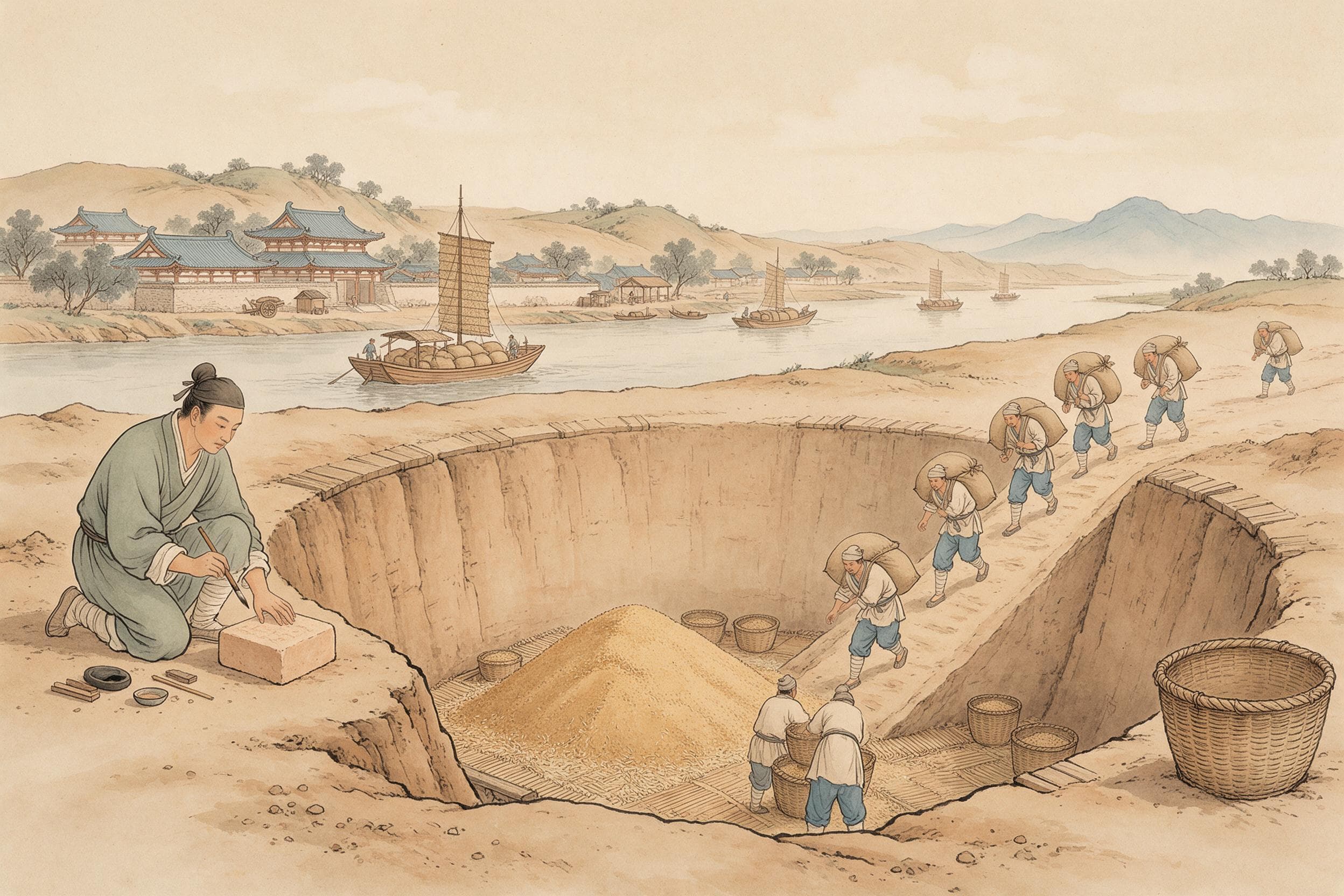
A brick, thirty-three centimetres square, with ten lines and a little over a hundred and ten characters cut into it. It records that the pit stood at the eastern gate of the Hanjia Granary, twenty-third row from the south and fifth pit from the west; that the grain was brown rice from Suzhou; that there were 13,000 shi of it; that collection began in the Tongtian era of Empress Wu and the pit was filled on the eighth day of the eleventh month of the Shengli era; and that eight officials handled it, among them the granary scribe Wang Liang and the supervisor Zhang Wei. The brick was unearthed in 1970 from pit 19 at Jiajigou in Luoyang and is now in the Luoyang Sui-Tang Grand Canal Museum. How the Sui and Tang state collected, moved, stored and signed for grain can almost all be inferred from this one object.
A receipt buried with the grain
What the brick is, the reports say plainly: an 入库凭证, a certificate of entry into the store, confirming the archive system recorded in the Old Tang History. It is not a monument but an account. The location is given down to row and pit because a granary is a field of pits and without precision the grain cannot be found; the source is given down to the prefecture because responsibility must run back to where the tax was collected; quantity, date and officials are all listed. Eight signatures divide one pit's accountability among eight men. This one-brick-per-pit practice lets us reconstruct the intake procedure a thousand years later — but it records only entry. Removal, losses and issues are not on the brick.
From Suzhou to Luoyang
13,000 shi of Suzhou rice had to reach Luoyang, and that meant the canal system: grain loaded on boats, carried north, then by land or water into the city. The canal was the empire's answer to geography: move grain by water wherever possible, and put the great granary where the route met the capital. The scale of the Hanjia Granary shows what it had to swallow: the site runs 710 metres north to south and 612 east to west, about 430,000 square metres, with more than 300 pits found so far; the largest pit mouth is eighteen metres across and the deepest twelve metres down. In pit 160 the excavators found millet that, though carbonised, 依然存有50%的有机物 — still contained fifty per cent organic matter. That means carbonised grain retaining organic material, not edible grain and certainly not 'unchanged for a thousand years'; it shows that underground pit storage, with a wide mouth, a deep shaft and grain heaped below the lip, sealed by rammed earth, kept the contents dry and airless.
The Sui side: four granaries and a village store
The surviving Hanjia pits and this brick belong to the Tang and Wu Zhou, so the Sui story has to come from the Sui History's chapter on the economy. In 583 the court set up the Liyang Granary in Wei prefecture, the Heyang in Luo, the Changping in Shan and the Guangtong in Hua, 转相灌注, feeding one into another, to carry grain from east of the passes and from Fen and Jin to the capital. It recruited grain-transport men in thirteen riverine prefectures and offered exemption from garrison duty to anyone who could move forty shi from Luoyang through the Dizhu rapids to Changping — one reward notice that measures how hard the canal was. In 585 the official Zhangsun Ping proposed community granaries (义仓): households and soldiers were to set up a store in each community, put in grain and wheat according to their harvest, 于当社造仓窖贮之, build pits in the community, with the community office keeping the books, and in a bad year the store fed that community's hungry. In 596 a decree graded the levy: top households no more than one shi, middle households seven dou, bottom households four dou. That is Sui law, not Tang, and the community granary is not an official state store — the two should not be mixed. The Daye era added the Xingluo and Huiluo granaries, and by the Sui collapse the eastern capital 粮尽,布帛山积,乃以绢为汲绠,然布以爨 — grain gone, cloth piled like a mountain, silk used for well ropes and cloth for firewood. The stores remained; the grain did not.
The men who signed
The names on the brick are the scribe Wang Liang, the supervisor Zhang Wei and six others. A 仓史 kept the documents and a 监事 supervised; eight men signing one pit shows that the Tang granary ran on a system of signatures. But that is as far as it goes: their rank, salary and duties are not in the material, nor how often a filled pit was inspected. One more caution: 'first built in the Sui' is the common phrase (the CCTV report uses it), but the surviving pits and the brick are Tang and Wu Zhou, and the date and extent of the granary are still debated by archaeologists — that material could not be read for this article, so it is marked as pending and no judgement is offered.
How far the numbers go
The figures need their sources. The 430,000 square metres, 300-odd pits, eighteen-metre mouths, twelve-metre depths and the fifty per cent organic matter all come from the CCTV report; so does the claim that in the eighth year of Tianbao the granary held nearly half the empire's grain — the original figures in the Comprehensive Canon and the Old Tang History were not checked here, so the claim is given as 'according to CCTV', not as settled fact. Another count gives 400-odd pits; this article uses 300-odd, the figure with an accessible source. The shi is a capacity unit that varied with grain, period and measure, so it is left standing and not converted to tonnes. And no 'world's earliest' or 'most advanced' ranking is attempted: a brick cannot carry that.
What the brick reconstructs is a chain: collection in the prefectures, transport north by canal, storage in a Luoyang pit, eight signatures, the brick buried with the grain. It shows that the Tang state registered location, origin, quantity and responsible officials for its grain, and registered them precisely enough for us to retell one pit's life. What it cannot answer is equally clear: how that 13,000 shi left the pit, how much was lost, where it was spent; what the taxpaying households of Jiangnan paid in transport and labour; and whether the eight signatories still held their posts afterwards. The question stays open: there was a certificate for entry — where was the certificate for issue? The brick's silence is itself informative: a state records what it needs to control, and intake was what this one needed to prove.
Sources & further reading
- 魏征等《隋书》卷二十四·食货志(隋代仓场与义仓制度) — 开皇三年置黎阳、河阳、常平、广通四仓,「转相灌注」;十三州募运米丁;韦瓒募人洛阳运米四十石经砥柱免征戍;开皇五年长孙平奏立义仓,当社造仓窖、社司执帐;开皇十六年诏社仓分上中下三等税(一石/七斗/四斗);大业置兴洛、回洛仓;东都粮尽以绢为汲绠、然布以爨
- 央视网《「春种一粒粟,秋收万颗籽」》2024-09-13 — 含嘉仓南北710米、东西612米、遗址约43万平方米、已发现粮窖300余座;仓窖口径最大18米、最深12米;160号窖碳化粟仍存50%有机物;1970年驾鸡沟19号仓窖出土刻铭砖,藏洛阳隋唐大运河博物馆;「始建于隋」「天宝八年贮全国近一半粮食」均为该报道表述
- 光明网《「文物会说话」有声海报|一块砖,记录下仓廪有多「实」》2025-10-31 — 刻铭砖长宽各33厘米、阴刻10行110余字:含嘉仓东门从南第二十三行从西第五窖、苏州糙米、一万三千石、武则天通天二年征收圣历二年十一月八日入窖、仓史王亮与监事张威等八位职官;作为仓窖「入库凭证」;2014年随大运河列入世界遗产名录