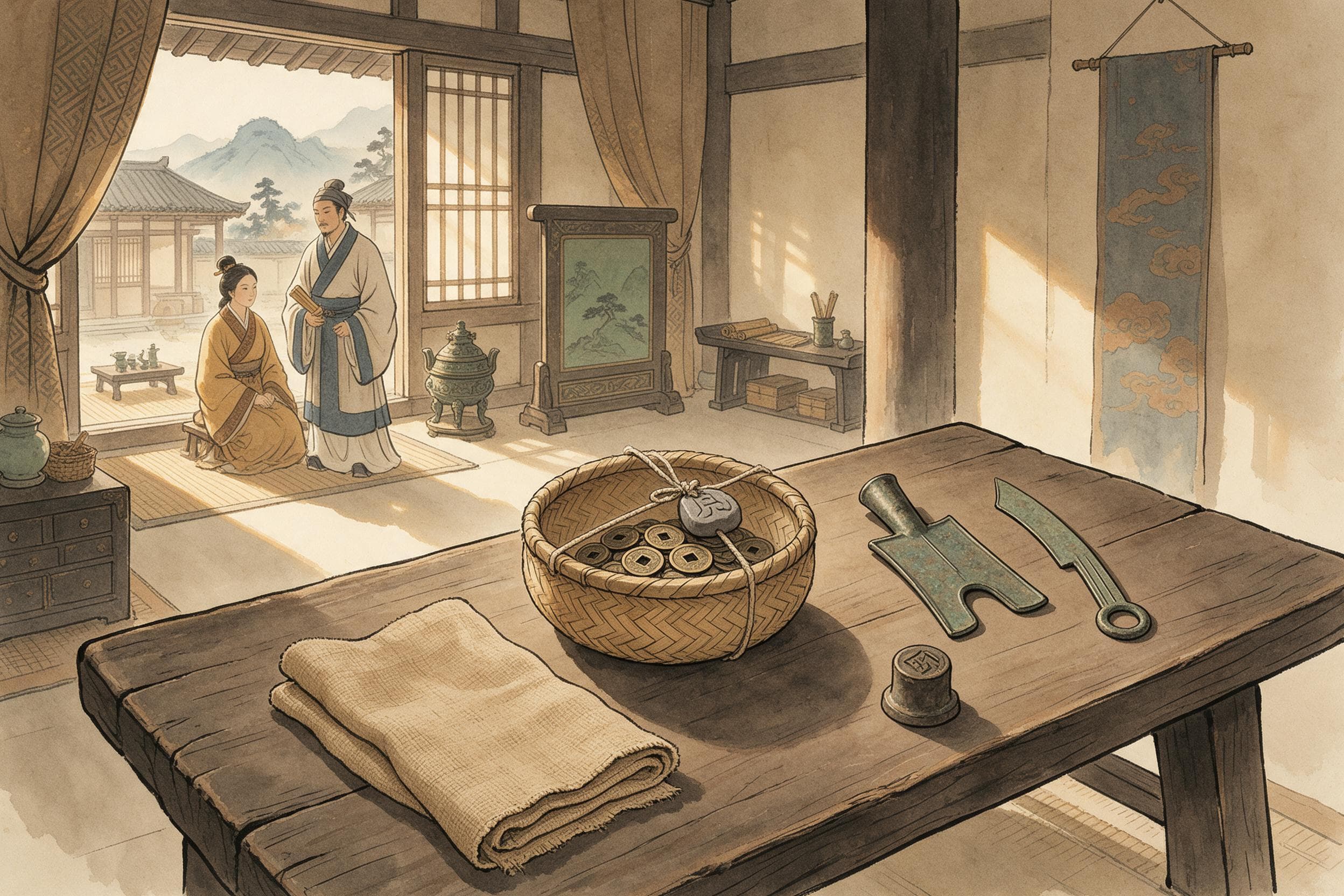
The object in the display case is about the length of a hand and shaped like a shovel: a hollow socket at the top where a handle would fit, shoulders sloping away on either side, two feet curving outward at the bottom. It is cast bronze, thin, and could never have dug anything. This is a spade coin (布币, bubi), one of the currencies of the Warring States, and it is a tool turned into money — more exactly, a tool's outline turned into money. Next to it in most collections sits a coin shaped like a curved knife with a ring at the end of the handle, and a third family: a disc of bronze with a hole through the middle. In the centuries before Qin swallowed the other states in 221 BCE, what a person pulled out to pay with depended on where he stood, and it usually looked like the tool his neighbours knew best.
Money in the shape of the tools people knew
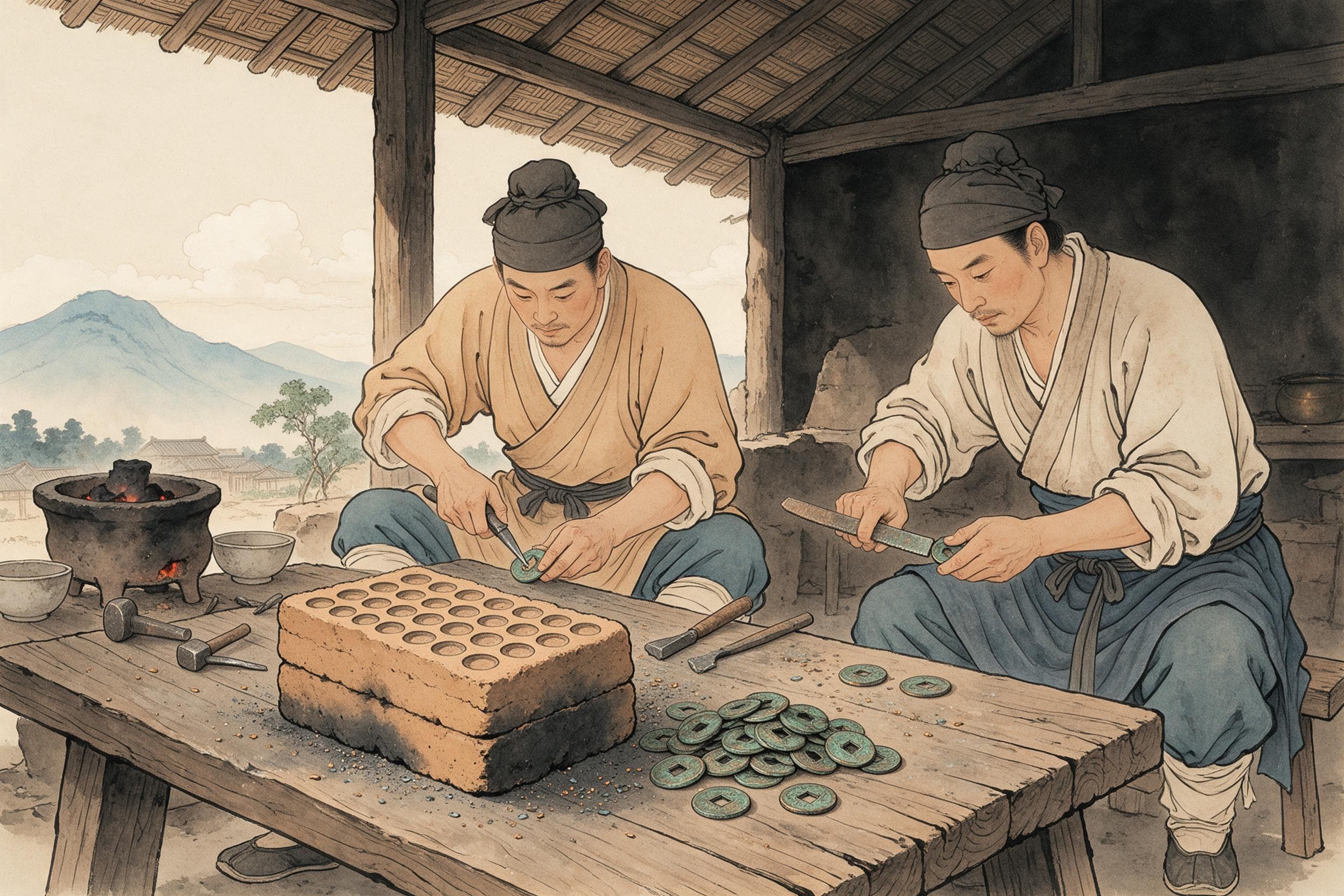
The China Numismatic Museum's own account of its collection says it directly: spade money was born from the shovel-shaped farming implement, which suits the agriculture of the Central Plains; in the fishing and hunting regions people knew the whittling knife, so knife money flourished in Qi and Lu; ring coins (圜钱, huanqian) came in square-holed and round-holed forms, and after unification were developed into the square-holed banliang (半两, "half liang") pushed out across the new empire. That genealogy is a museum explanation, not an excavation report: useful as a good popular account, not a settled argument about every type. The objects themselves are unambiguous enough. A Qi "great knife" carries the character da (大, "great") cast on the blade, and the spade series has its own archaeological names, among them the hollow-handled spade with slanted shoulders and curved feet.
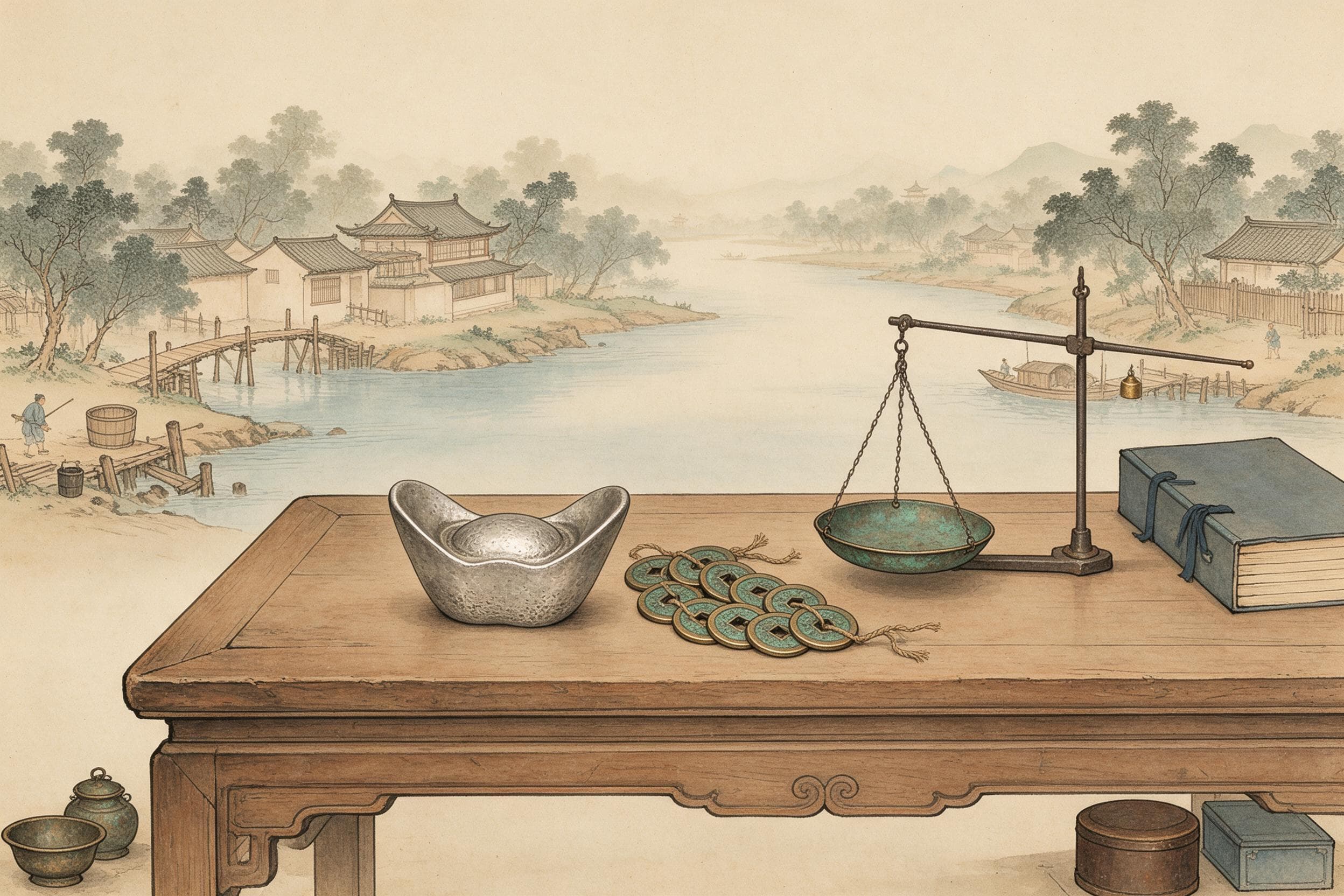
Why cast money in the shape of a tool? The answer usually given is recognition: a farmer who had never handled a coin could still see that this was an object of familiar outline and solid metal. The sources state no reason. What they do show is that the value sat in the metal rather than in a promise. The coins were reckoned by count and by weight, and the banliang was named for what it weighed — half a liang — not for what it would buy.
A bolt of cloth was also money
The most detailed rules about money in the whole period are not about coins at all. They are about cloth. A statute in the Qin legal corpus, the Jinbu lü (金布律, "statute of gold and cloth"), opens with a specification: 布袤八尺,幅廣二尺五寸 — a bolt of cloth eight chi long and two and a half chi wide. It then provides that cloth whose width or length falls short of the standard 不行, does not circulate. One line later comes the rate between the two kinds of money: 錢十一當一布, eleven coins to one bolt. And a further clause sets the frame: 其出入錢以當金、布,以律 — cash paid out and taken in is reckoned against gold and cloth, according to statute.
Two different things are hiding under the same character. 布币, the spade coin, is a piece of cast bronze; 布 in this statute is cloth, a bolt with a legal length and a legal width, and it was money. A payment could be settled in it, which is why the law bothers to define the selvedge. Gold appears in the same sentence as another unit of account, though the text gives no ratio for it. What eleven to one actually meant — a fixed official rate, or an accounting convention for valuing payments in kind — the statute does not explain, and no other text from the period settles the question.
No one was allowed to pick the coins
One clause tells you what a buyer could not do: 百姓市用錢,美惡雜之,勿敢異 — in the market, good coin and bad coin are mixed together, and no one may treat them differently. Another extends the ban upward, to sellers and to the state's own clerks: 賈市居列者及官府之吏,毋敢擇行錢、布 — those who keep stalls in the rows, and the clerks of the government, may not pick and choose among coins and cloth. The penalties reach the bystanders: if a row warden (列伍長, the head of a group of stalls) fails to report an offender, or if a clerk's inspection is careless, all of them are guilty.
Why a state would insist that worn, light or debased coin pass at the same value is not stated. The likeliest reason — and this is inference, not text — is that the coin was the state's own issue and had to keep moving for taxes, fines and purchases to work; if buyers could weigh and refuse, the lighter pieces would stop circulating. The same principle of mixing is written into the receiving end. 官府受錢者,千錢一畚,以丞、令印印 — an office taking cash puts a thousand coins into one ben (畚, a shallow basket or container) and seals it with the seal of the commandant or the magistrate; even a sum under a thousand is sealed. 錢善不善,雜實之: good and bad alike go in together. To spend it, 出錢,獻封丞、令,乃發用之 — the sealed container is presented to the commandant or magistrate, and only then is it opened.
A price on everything, one coin at the bottom
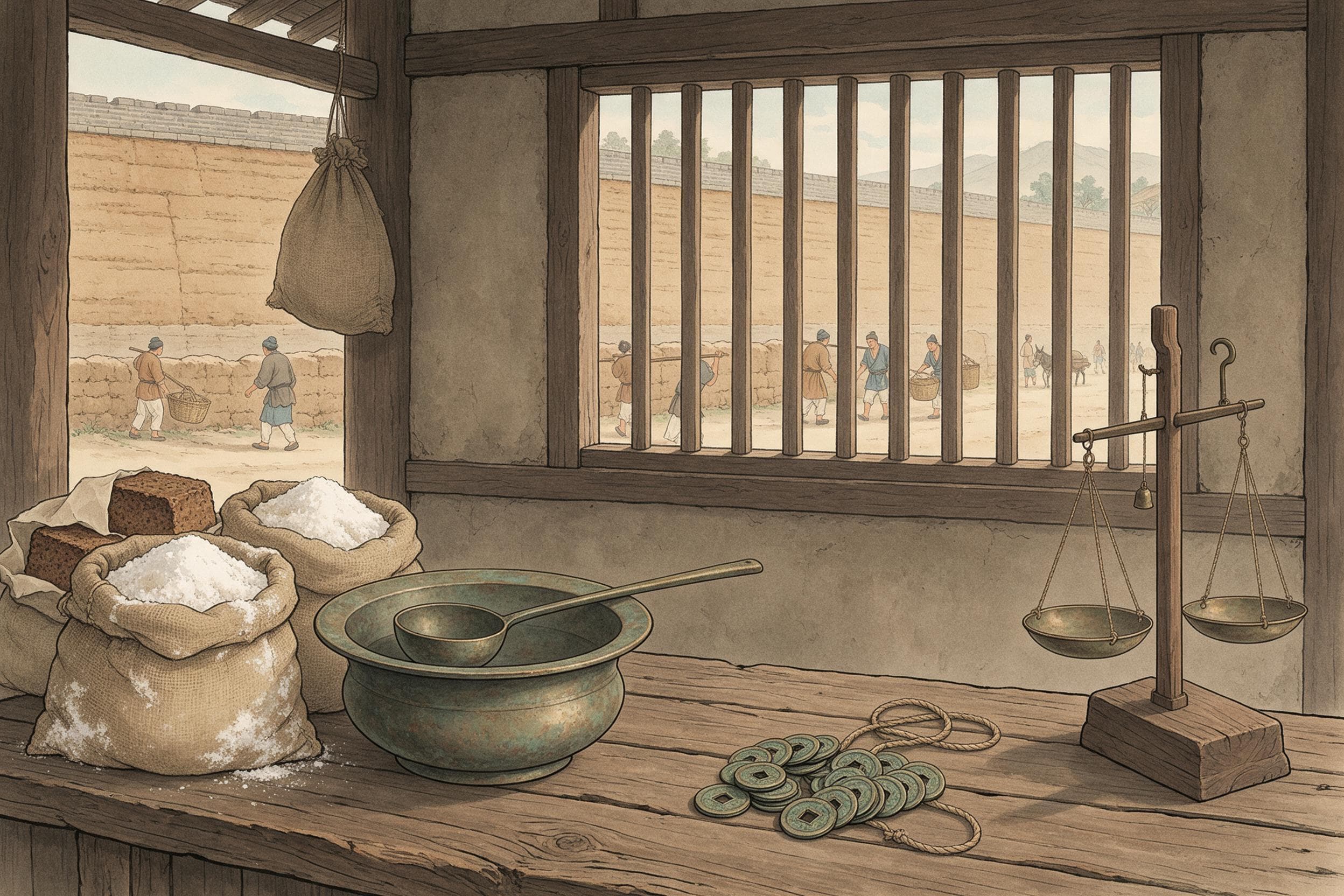
Every sale had to show its price: 有買賣殹,各嬰其賈 — in buying and selling, each marks up its price. Then comes the exception, which is more revealing than the rule: 小物不能各一錢者,勿嬰 — small articles that cannot reach one coin apiece need no tag. A single coin was evidently the smallest unit anyone had; goods cheaper than that were not priced one by one. It is a rare glimpse of the floor of the monetary system.
What the clause does not give is a single price. No reliable table of Warring States prices survives, and a statute is not a shopping list: it tells us that prices had to be posted and that a coin was the smallest unit, not what a coin bought. Guesses about the purchasing power of a spade or a knife should be left alone.
One state's law, not six states' practice
All of this is Qin's law, and it has to stop there. The Shuihudi manuscripts were buried in the late Warring States in the tomb of a Qin official; the statutes are Qin's, from the decades before unification. They cannot be stretched over the other states: nothing in them describes the spade coins of Wei or the knife money of Qi. Nor do they supply what modern readers most want — an exchange rate between the different coinages, a purchasing-power figure, or a value stamped on a coin. The coins passed by weight and by count. And the statutes cannot prove that everyone used them: a law forbidding the refusal of bad coin is evidence that coin circulated, not that coin was the only way to pay.
Set the objects and the statute side by side and the money of the period looks like two things at once. It is the spade in the display case, a farmer's tool in bronze, made to be recognised across a market; and it is the sealed basket in the ledger, a thousand coins with an official's stamp on the cord, opened only by permission. Between those two images stands the buyer at the stall, who had to accept whatever mixture of coin and cloth was handed to him, and had to be able to read the price marked on the goods. That is about as close as the sources come to the inside of a Warring States purse.
Sources & further reading
- 睡虎地秦简《秦律十八种·金布律》(Shuihudi Qin bamboo slips, "Statute of Gold and Cloth") — Cloth of legal size, eleven coins to one bolt, cash reckoned against gold and cloth, bad coin not to be refused, price tags, and a thousand coins sealed in a ben.
- 经济日报〈这里「钱」味儿十足〉(China Economic Daily, report on the China Numismatic Museum, 2025-10-12) — Popular museum account of spade, knife and ring coins and of the banliang; used for the shape genealogy, which is explanation rather than excavation report.