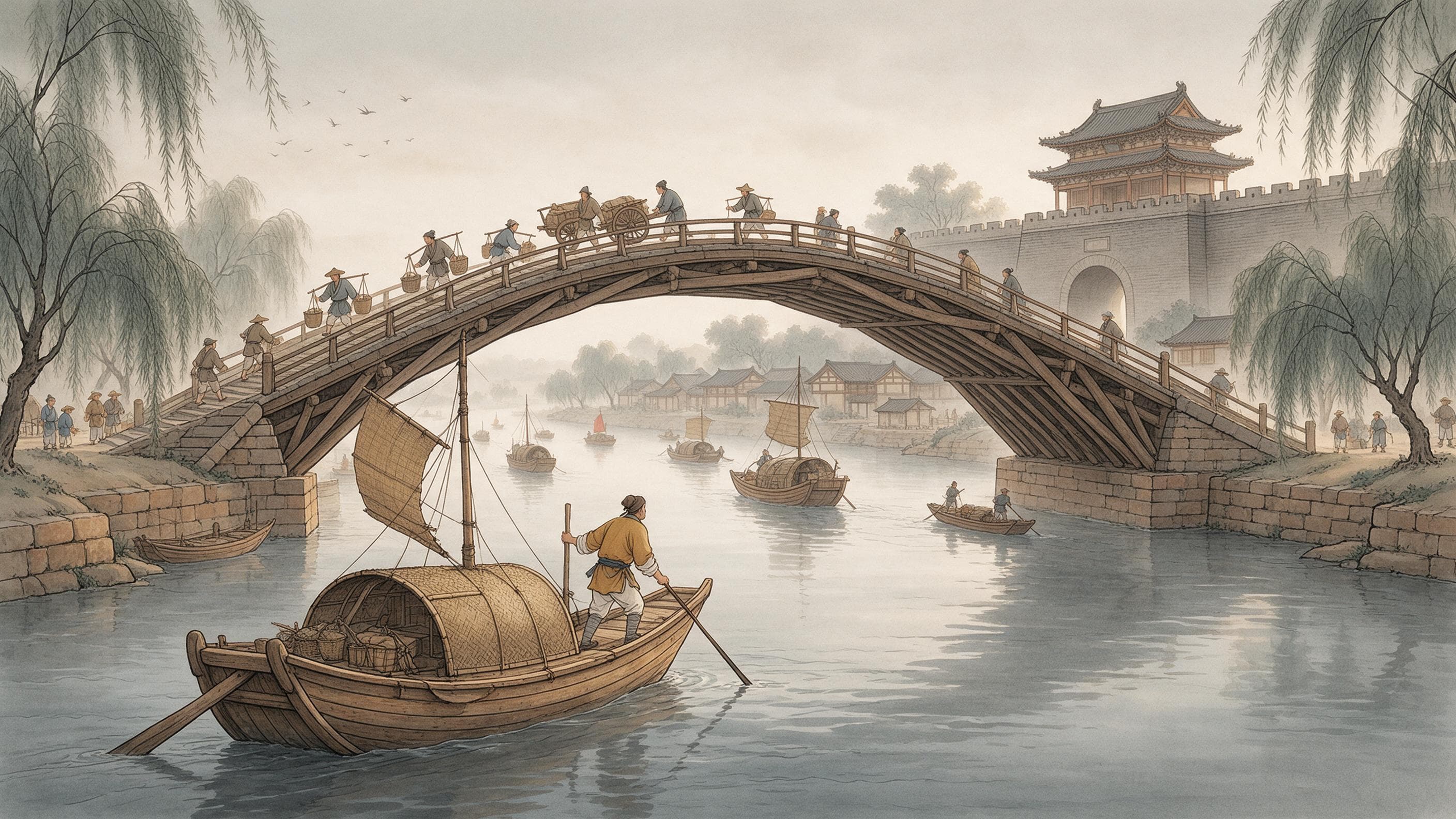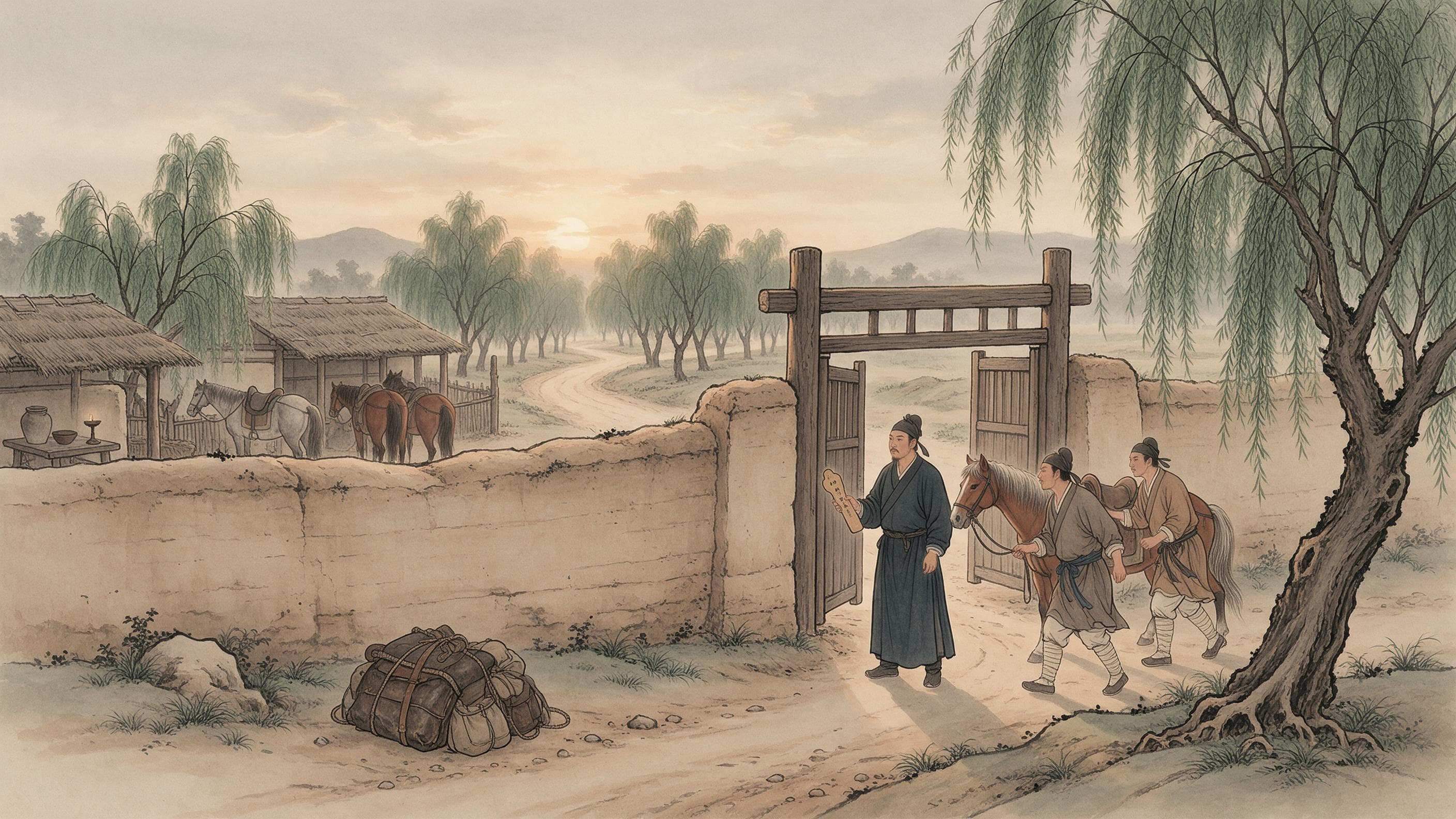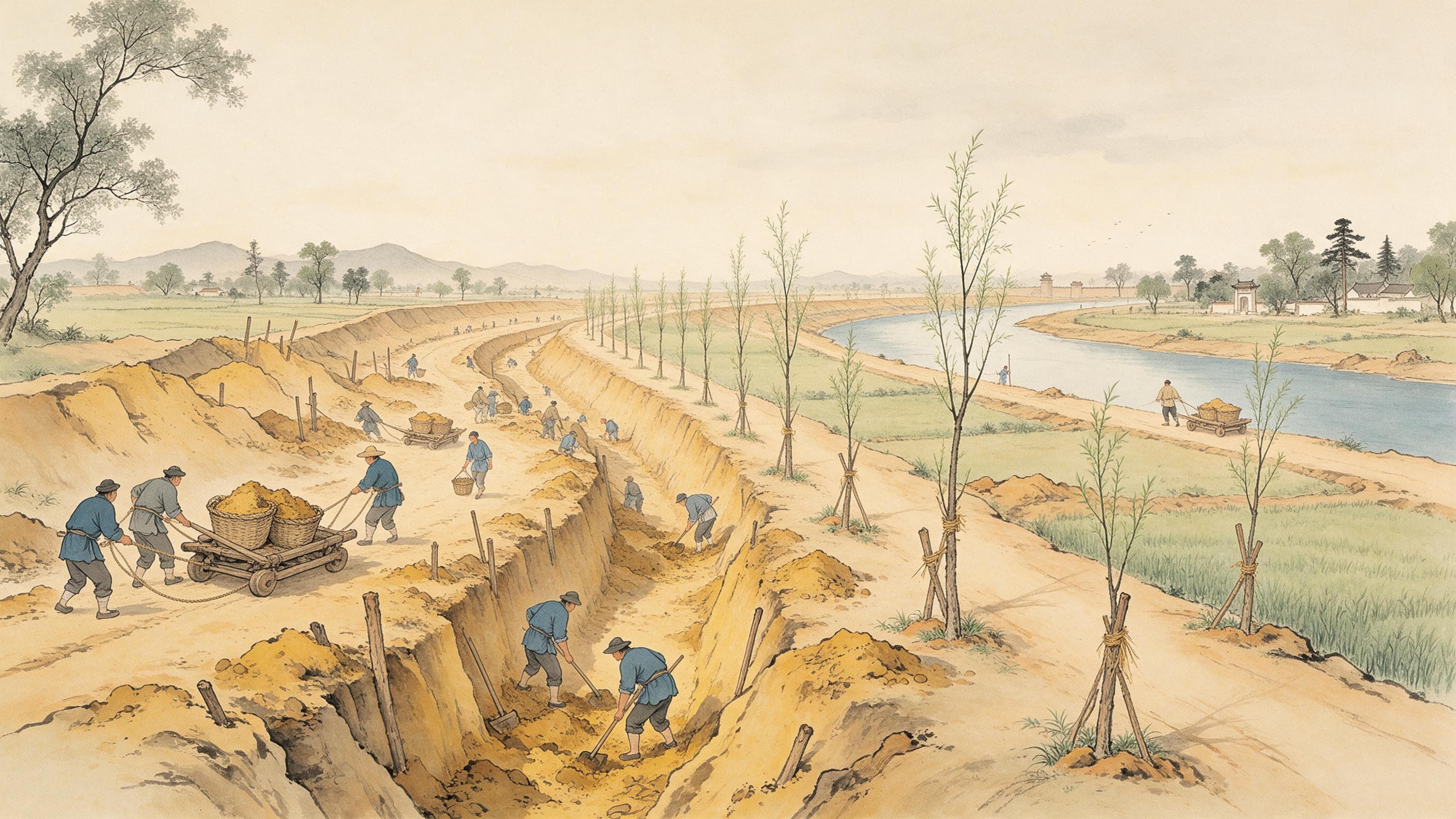
In the third month of 605, men and women of the Henan and Huaibei commanderies were levied to dig a canal: from the Western Garden at Luoyang the Gu and Luo rivers were drawn into the Yellow river, and from Banzhu the river water was led into the Huai. According to the Zizhi tongjian, the channel was forty paces wide, with an imperial road along both banks and willows planted on it; between Chang'an and Jiangdu more than forty detached palaces were built along the way. One order, and a million-odd people went to the works.
One order, a million people
The Sui shu's annals record that in the third month of 605 'more than a million men and women of the Henan commanderies were levied to open the Tongji canal, drawing the Gu and Luo from the Western Garden to the Yellow river, and the river from Banzhu to the Huai'. The Tongjian is more exact: the assistant director Huangfu Yi 'levied the commanderies of Henan and Huaibei, a hundred thousand and more over time', in four stages — from the Western Garden to the river, from Banzhu through Xingze into the Bian, from east of Daliang into the Si, and so to the Huai; 'and another hundred thousand from Huainan opened the Hangou, from Shanyang to Yangzi, entering the Yangtze'. The same entry records that an envoy was sent south to buy timber and build dragon boats and phoenix barges, several tens of thousands of them. The Sui shu gives the canal in a single sentence; the Tongjian turns it into a paragraph, with four stages of route and two subsidiary canals.
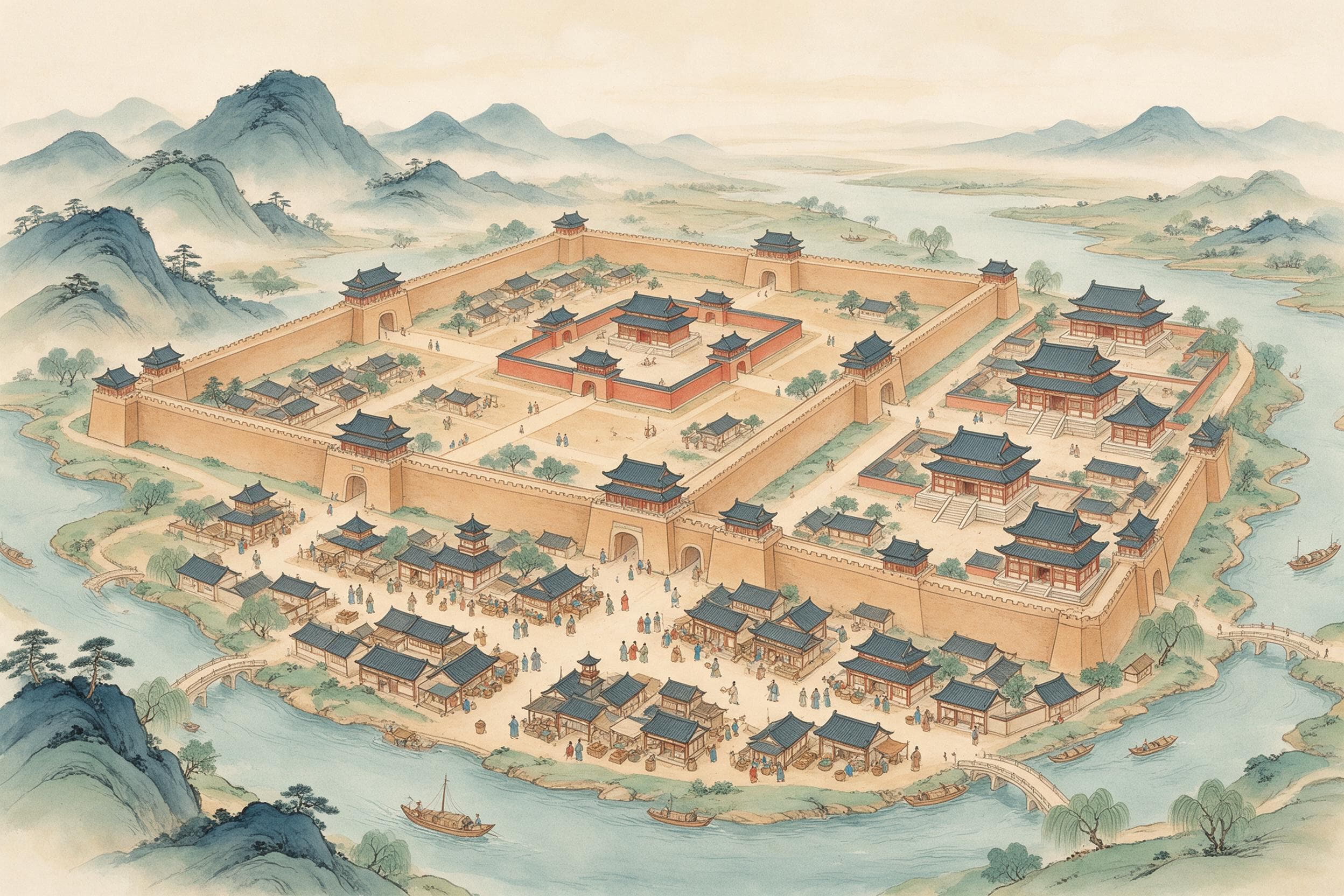
One figure is easy to misplace. Immediately after the canal the Tongjian records the building of the Eastern Capital: 'two million labourers a month ... four or five in ten of them died'. That is the death rate of a city under construction, not of the canal. The two passages stand side by side in the book but belong to two different worksites, and this piece does not move the figure across.
Three years later: two numbers for one canal
In the first month of 608 the Sui shu says an edict 'levied more than a million men and women of the Hebei commanderies to open the Yongji canal, drawing the Qin river south to the Yellow river and north to Zhuojun'. The same event in the Tongjian is 'an edict levying five million and more of the Hebei troops to cut the Yongji canal', with the addition that 'the able-bodied men were not enough, and women were levied for the first time'. A hundred-odd thousand against five million-odd: a fivefold gap. Both readings are given here, neither merged nor averaged, and no figure of 'about three million' is invented. Why they differ, this piece could not find out, and says so.
The line about women comes from the Tongjian, written five centuries later; the Sui shu's levy record does not have it, and it is quoted as the Song compiler's sentence. The route both books agree on: the Qin drawn south to the Yellow river, north to Zhuojun. Why the canal ran to Zhuojun, the sources do not say, and no purpose is supplied here.
An earlier canal, and a later one
The canals were not one man's work. The Sui shu's treatise on the economy records that in 584 Emperor Wen 'ordered Yuwen Kai to lead water engineers and cut a canal, drawing the Wei river from east of Daxing to Tongguan, three hundred-odd li, called the Guangtong canal; transport flowed and the region inside the passes depended on it'. The edict is practical: 'east from Tongguan, west drawing the Wei, using human labour to open the transport channel ... so that official and private boats, great and small, may move grain morning and evening without stopping'. This one was for the capital's own supply.
In 610 came the last: 'an edict to cut the Jiangnan canal, from Jingkou to Yuhang, eight hundred-odd li, ten-odd zhang wide, so that the dragon boats could pass', with post stations and staging camps along it. Four canals, four dates — 584, 605, 608, 610 — not one project. Only the Jiangnan canal has both a length and a width in these two books; the Guangtong canal has its three hundred li; for the Tongji and the Yongji neither book gives a total length. The Tongjian adds that the work was meant for a tour of Kuaiji, in the south-east.
What can be counted, and what cannot
What can be counted: four dates; three levy figures (a million-odd for the Tongji, a hundred thousand-odd for the Hangou, a million-odd or five million-odd for the Yongji); the Jiangnan canal's eight hundred li and ten-odd zhang; the Tongji's forty paces (about sixty metres by the usual conversion, an approximation only); willows along the imperial road; forty-odd detached palaces. Each has its source and can stand beside the others.
What cannot: earthwork volume, construction time, grain per labourer, wages, the list of commanderies levied, the annual tonnage carried. Neither book has any of it, nor total lengths for the Tongji and Yongji. This piece does not convert li into kilometres, does not estimate a schedule, and does not fill the gaps with modern engineering calculations. The ledger runs only as far as how many people, in what year, how wide, how long. The Sui shu mentions neither length nor width for the Tongji; the Tongjian gives only the width.
Beyond the ledger
Some limits. The claim that canal-building caused the dynasty's fall is not made; the sources contain no such chain. The Eastern Capital's death rate is not moved onto the canal. The two Yongji figures are printed side by side, not reconciled. No 'earliest' or 'longest canal in the world' is claimed, and no comparison with other countries' canals is drawn. The Sui shu was compiled in the early Tang, not by Sui hands, and the four-library text is unpunctuated: the quotations here are punctuated by sense and have not been checked against the modern critical edition.
Back to the channel: forty paces of water, one imperial road and two lines of new willows, forty-odd palaces along the way. A three-hundred-li canal inside the passes in 584; a million-odd people from Henan and Huaibei in 605; another million, or five, in Hebei in 608; eight hundred li in the south in 610. The ledger has dates, people, lengths and widths. The earth moved and the grain eaten are not in the record — which is the half of the account this piece can give. Four dates, three levy figures, two lengths, one width: that is the whole of it, and nothing at all about earth moved or grain eaten.
Sources & further reading
- 《隋书》卷三·炀帝纪上、卷二十四·食货志(唐魏征等修;四库全书本,维基文库;四库本无标点,引文按文义加标点,未与中华书局点校本复核) — Four-library text without punctuation. Juan 3: in 605, a hundred thousand and more men and women of the Henan commanderies opened the Tongji canal, drawing the Gu and Luo from the Western Garden to the Yellow river and the river water from Banzhu to the Huai; in 608 an edict levied a hundred thousand and more from Hebei to open the Yongji canal, drawing the Qin south to the river and north to Zhuojun; the Eastern Capital begun the same year. Juan 24 (https://zh.wikisource.org/wiki/隋書_(四庫全書本)/卷24): in 584 Yuwen Kai led water engineers to cut a canal from east of Daxing to Tongguan, three hundred li, called the Guangtong canal.
- 《资治通鉴》卷一百八十、卷一百八十一·隋纪(宋司马光修;维基文库) — Song compilation, five centuries after the events. Juan 180: Huangfu Yi levied Henan and Huaibei commanderies, a hundred thousand and more over time, to open the Tongji canal by four stages; another hundred thousand from Huainan for the Hangou; the channel forty paces wide, an imperial road and willows along it, forty-odd detached palaces between Chang'an and Jiangdu; the same passage records the Eastern Capital's two million labourers a month and the death rate, which belongs to the city, not the canal. Juan 181 (https://zh.wikisource.org/wiki/資治通鑑/卷181): in 608 five million and more from Hebei for the Yongji canal, 'men not enough, women first levied'; in 610 the Jiangnan canal, 800-odd li, ten-odd zhang wide.