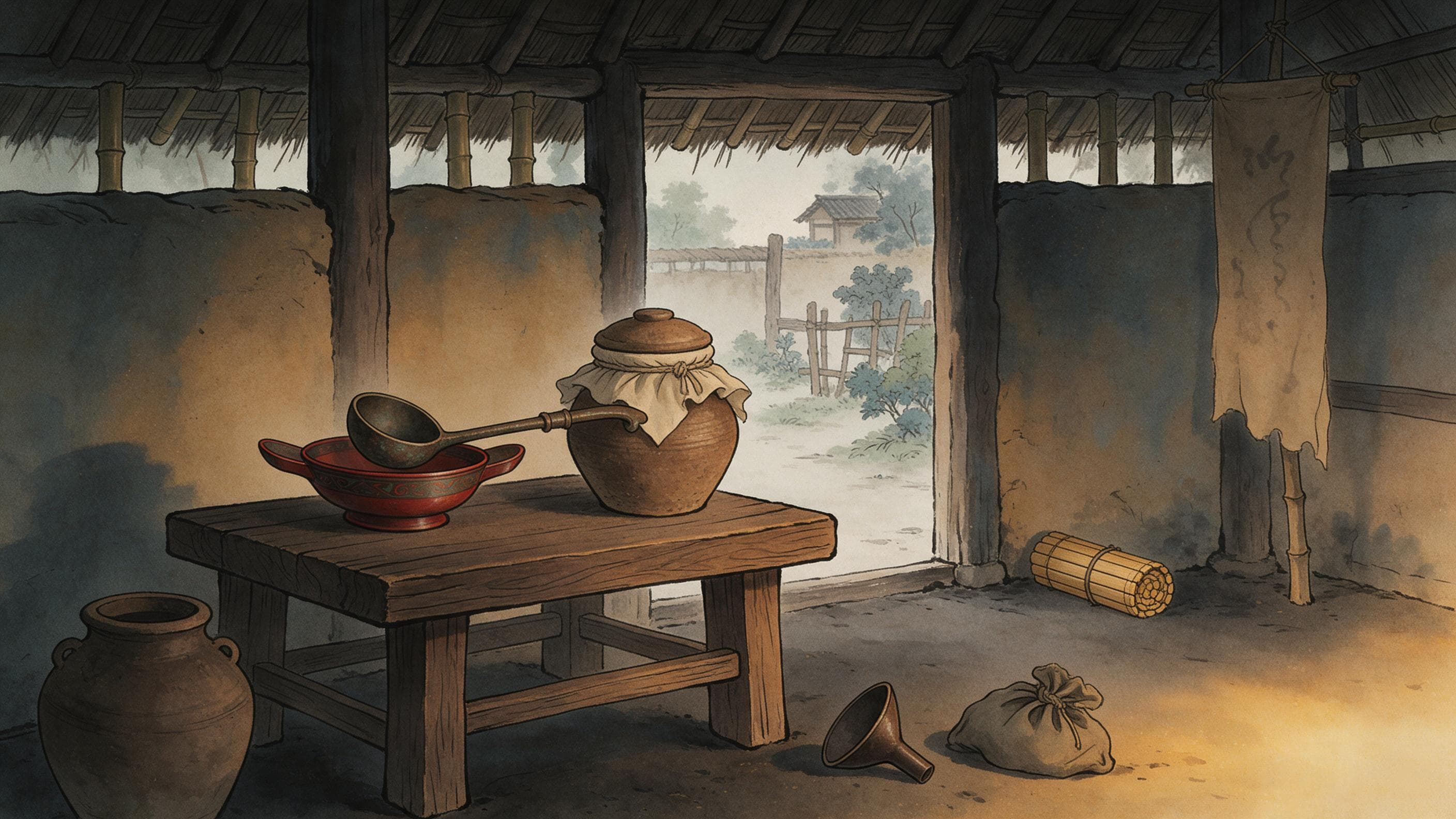
Xu Miao was a Gentleman of the Secretariat when the Wei state had just been founded, and the regulations of the time forbade wine. He drank in private until he was drunk. The watch officer Zhao Da came to ask about government business; Xu Miao answered, 'I am in the sage.' Zhao Da reported it, and Cao Cao was angry. The general Xianyu Fu explained: 'Drinkers call clear wine the sage and cloudy wine the worthy; Xu Miao is a careful man, and this was a drunkard's phrase.' In the end Xu Miao was charged and let off without punishment.
In the sage
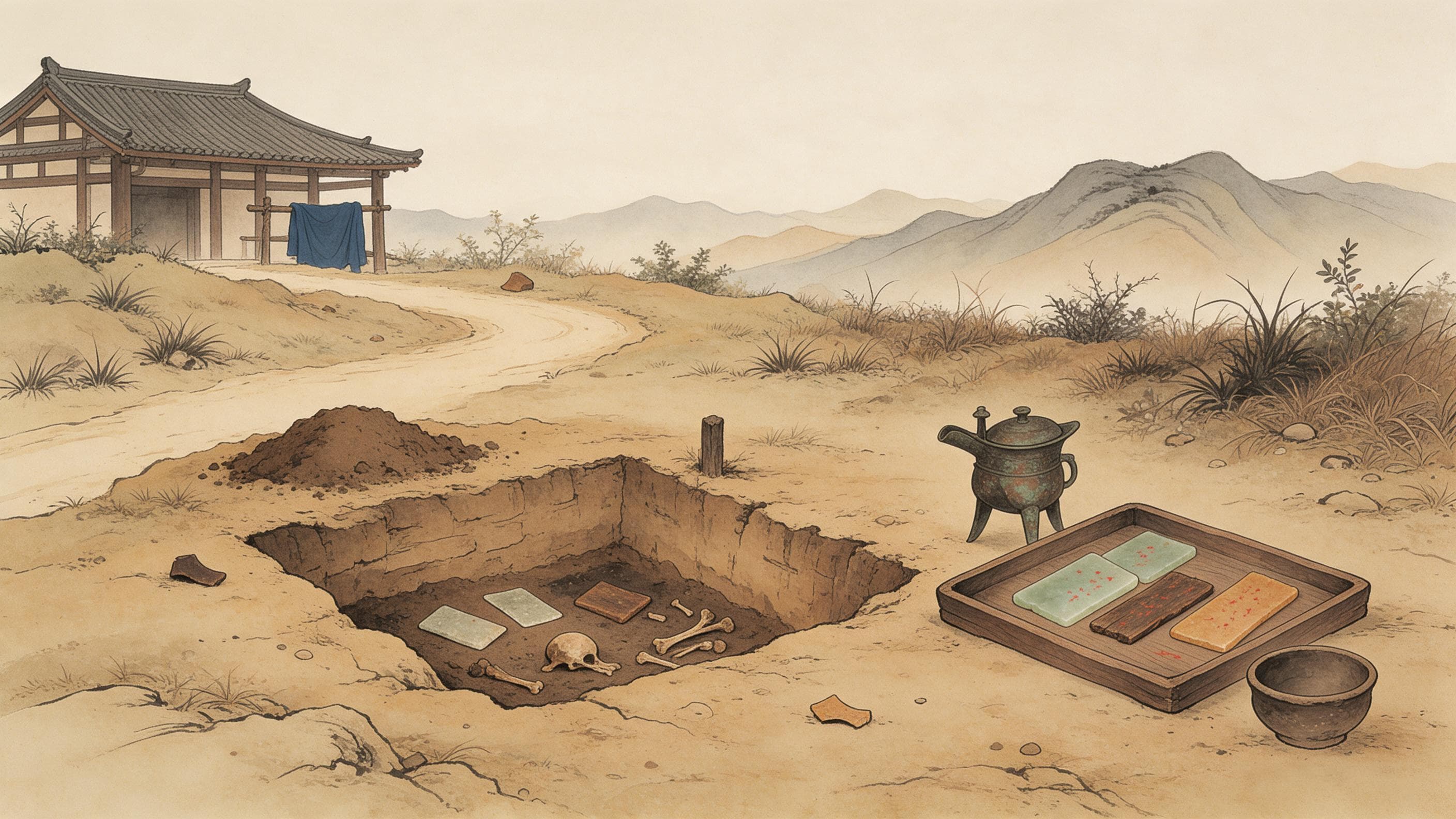
The record is a biography, not a statute. 'The regulations of the time forbade wine' — the word is ke, a regulation; the regulation itself is never quoted and does not survive. There is no date, no penalty, no procedure. What the text has is the scene: a drinking official, a question, a code word, an angry ruler, and an explanation that turned a drunkard's talk into something harmless. 'Let off without punishment' tells us there was a charge; it does not say what the punishment would have been. Nor does it say what the regulation said, how far it reached, or whether it was new.
The story has an epilogue. When Emperor Wen of Wei visited Xuchang he asked Xu Miao, 'Have you been in the sage again lately?' Xu Miao answered with two ancient drunkards and a self-mocking line about being known for his drinking, and the emperor laughed. That is an anecdote, fit to close a paragraph; it is not dated, and 'when the Wei state had just been founded' is a job description, not the year of a ban.
They have the equipment
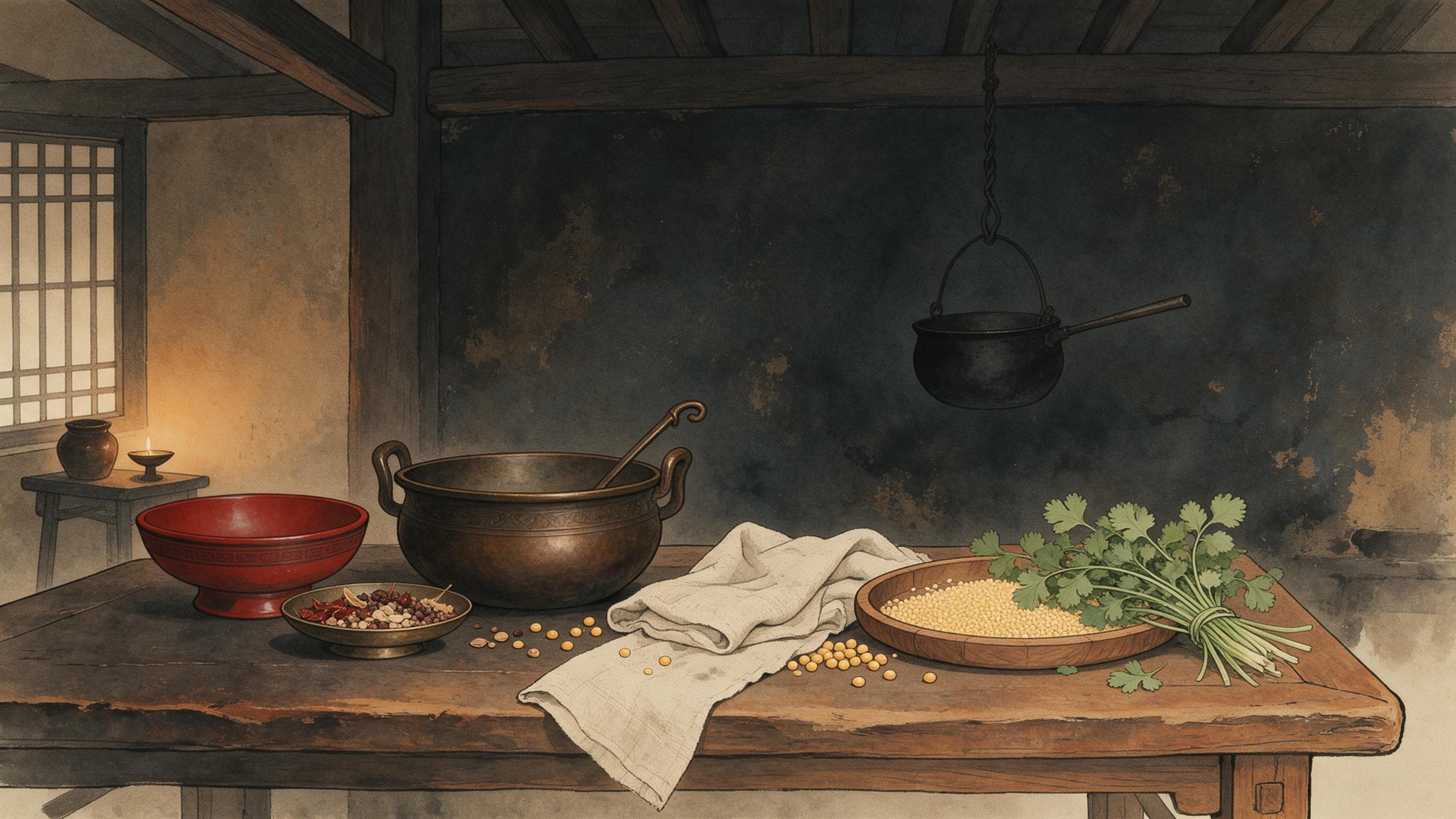
In Shu the ban came from drought: 'At the time, because of drought, wine was forbidden, and those who brewed were punished.' Officers searching a house found brewing vessels, and the men discussing the case wanted the owner punished as if he had brewed. Jian Yong was walking with Liu Bei when they passed a man and a woman on the road; he said, 'That man is going to commit fornication — why not arrest him?' Liu Bei asked how he knew. Jian Yong answered, 'They have the equipment — the same as those who meant to brew.' Liu Bei laughed and pardoned those who had meant to brew. The vessels were enough to bring the officers into the house; they were not enough to prove wine.
The sharp point is not the joke but the evidence. A vessel is not wine; intention is not the act. Yet the record is careful about what happened: the men discussing the case 'wanted' the same punishment — a proposal, talked down, not an enacted law of collective responsibility. The pardon covers those who meant to brew; it does not abolish the ban, and it says nothing about the year.
Two letters
In the Han court the ban was Cao Cao's. Fan Ye's history has one sentence: 'The year was famine-stricken and war had arisen; Cao Cao memorialised for a wine ban, and Kong Rong repeatedly wrote to dispute it, with much insolent language.' The letters themselves survive only in Li Xian's Tang commentary, quoting Kong Rong's collected works. The first argues that wine has served ritual and politics: wine has its star in heaven and its spring on earth; without a thousand cups Yao could not have made the age peaceful; without a hundred goblets Confucius could not have borne his sagehood; Fan Kuai at Hongmen needed pork and wine; Gaozu's snake, Jingdi's night, Yuan Ang's escape, Dingguo's judgments — all, he says, came through wine. 'How has wine failed government?' Fan Ye wrote in the fifth century; Li Xian and his commentary in the seventh.
The second letter is shorter and sharper. Granting that dynasties fell through wine, Kong Rong answers that Xu Yanwang's benevolence, Yan Kuai's abdication, Lu's scholars and the Xia and Shang empresses did not lead anyone to abolish benevolence, abdication, learning or marriage. 'Yet wine alone is treated as urgent — I suspect it is simply that you grudge the grain, not that you take the fall of kings as a warning.' That is Kong Rong's guess at motive, not a historian's finding. The letters are argument, not record: when they say Yao drank a thousand cups, that is rhetoric, not evidence.
One letter, two texts
The letter also has a second text. The Tang encyclopedia Yiwen leiju prints it under the title 'Kong Rong disputes Emperor Wu of Wei's wine ban', and it opens differently: 'When you first came, the people of the state danced and leapt for joy, looking for our lord. And then you arrived — and the wine ban was enforced.' Its readings differ too: 'wine star' in one text, 'wine banner' in the other; pork shoulder 'with a cup' or 'with a bell-shaped vessel'; 'failed government' or 'failed governance'. Even the title differs: one calls it a disputation, the other does not. One text may be quoted; the other is a variant, not a fuller original.
The two texts cannot be stitched into one 'original'. The encyclopedia page is marked unproofread; Kong Rong's collected works were not available here; and the relation between the two witnesses is not known. What can be said is that the letter existed, that it was copied more than once, and that the copies do not agree — which is itself a fact about how such texts reached us.
No edict
The background is recorded; the ban is not. In 196 the court reached Luoyang to find the palaces stripped and the provinces sending nothing; the state settled people as military farmers near Xu and drew 'tens of millions of hu' a year from the fields; after Hebei was taken, the land tax became four sheng of grain a mu and two bolts of silk with two catties of floss a household. The Jin shu chapter that records this never mentions a wine ban. That chapter is about grain, not about drink. That wine bans and grain shortages belonged together is a reasonable inference — 'famine-stricken and war had arisen' is Fan Ye's own frame — but no edict connects them.
So the article ends where the evidence does. Three scenes: a drunk official let off; a man with jars let go; two letters that argue and are not answered. Two letters, and one of them in two versions. What does not survive is the thing itself: no year, no text of the ban, no named penalty, no statement of how far it reached. The three episodes belong to three governments; they cannot be made into one law. A ban was enforced — the records agree on that much — and that is almost all they agree on.
Sources & further reading
- 陈寿《三国志》卷二十七·魏书·徐邈传、卷三十八·蜀书·简雍传 (Chen Shou, Sanguozhi, juan 27, Life of Xu Miao, and juan 38, Life of Jian Yong) — J uan 27: Xu Miao, a Gentleman of the Secretariat when the Wei state was newly founded, drank privately to drunkenness while wine was forbidden by regulation; asked about official business he answered 'I am in the sage', and was let off punishment after a general explained that drinkers call clear wine the sage and cloudy wine the worthy. No date, no statute text, no named penalty. Juan 38 (https://zh.wikisource.org/wiki/三國志/卷38): in a drought wine-making was banned and brewers punished; officers found brewing vessels in a house and some proposed punishing the owner like a brewer, until Jian Yong's joke about a man and woman on the road 'having the equipment' made Liu Bei laugh and pardon those who had meant to brew. A proposal, not an enacted collective punishment.
- 范晔《后汉书》卷七十·郑孔荀列传·孔融(唐李贤注引《融集》)(Fan Ye, Hou Han shu, juan 70, Life of Kong Rong, with Li Xian's Tang commentary) — Fan Ye's main text: 'the year was famine-stricken and war had arisen; Cao Cao memorialised for a wine ban, and Kong Rong repeatedly wrote to dispute it, with much insolent language.' The two letters survive only in Li Xian's commentary, quoting Kong Rong's collected works: the first lists wine's service to ritual and politics and ends 'how has wine failed government?'; the second concedes that dynasties fell through wine but argues that wine alone is treated as urgent because 'you grudge the grain, not because you take the fall of kings as a warning'. Letters in commentary, not main text, and undated.
- 欧阳询等《艺文类聚》卷七十二·食物部·酒(维基文库 50% 页,未与中华书局点校本复核)(Ouyang Xun et al., Yiwen leiju, juan 72, 'Wine') — Tang encyclopedia excerpt of the same letter under the title 'Kong Rong disputing Emperor Wu of Wei's wine ban', with a different opening ('when you first came... the ban was enforced') and variant readings (wine banner for wine star; pig shoulder with a cup for pig shoulder with a bell-shaped vessel; 'failed governance' for 'failed government'). A second witness, not a fuller text; the page is marked unproofread.
- 房玄龄等《晋书》卷二十六·食货志 (Fang Xuanling et al., Jin shu, juan 26, 'Food and Money') — Background only, and never mentions a wine ban: in 196 the court reached Luoyang to find the palaces stripped and no supplies arriving from the provinces; Cao Cao settled people as military farmers near Xu and drew tens of millions of hu a year; after Hebei was taken the land tax was set at four sheng of grain a mu with two bolts of silk and two jin of floss a household.